
GLP-1 Weight Loss Calculator: Estimate Your Results

This article is for general informational purposes only and is not a substitute for professional medical advice, diagnosis, or treatment. Always consult a qualified healthcare provider with questions about a medical condition.
Quick answer
This GLP-1 weight loss calculator estimates your weight and BMI at 3, 6, and 12 months on Wegovy, Ozempic, Zepbound, Mounjaro, or compounded semaglutide/tirzepatide by applying each drug's clinical-trial average percent loss to your body weight. It's an educational estimate, not a prediction.
[ Interactive calculator embeds here — see tools/glp-1-weight-loss-calculator.html ]
If you've just been prescribed a GLP-1 — semaglutide (Ozempic, Wegovy) or the dual GIP/GLP-1 drug tirzepatide (Mounjaro, Zepbound) — the first question is almost always the same: how much weight will I actually lose, and how fast? This page gives you a realistic, trial-anchored ozempic and wegovy weight loss calculator to set expectations, plus the honest limits of any such estimate.
01
How the GLP-1 weight loss calculator works
The tool does three simple things.
First, it takes your current weight and height (in kg/cm or lb/in — toggle either) and computes your starting BMI. Second, it applies the average total-body-weight loss reported for your chosen drug in its pivotal clinical trial.
Third, it scales that full result across time using a titration-and-plateau curve, because weight loss builds slowly while your dose is stepped up and then levels off near the trial endpoint.
The output is your estimated weight and BMI at months 3, 6, and 12, with a slider to see any month up to 18.
Think of it as a goal weight predictor grounded in published averages — not a promise about your body.
02
The clinical numbers behind the estimate
Every estimate is anchored to a real trial average. These are the assumptions the calculator states on screen:
Two things matter here. Ozempic and Mounjaro use lower diabetes doses than their weight-loss-branded siblings, which is why the calculator estimates less for them than for Wegovy or Zepbound — even though Ozempic and Wegovy are the same molecule. And compounded products are not FDA-approved or standardized, so any figure for them is especially uncertain; the tool flags this clearly.
The month-by-month curve (why month 3 isn't a third of month 12)
Trial weight-loss curves are not linear.
During the first months your dose is still being titrated upward, so early loss is modest; the curve then steepens and finally plateaus near the ~68–72-week endpoint.
The calculator models this by reaching roughly 35% of the full loss by month 3, ~62% by month 6, and ~90% by month 12, interpolating between those anchors.
This mirrors the shape of the published mean curves rather than assuming steady weekly loss.

03
How to use it in 4 steps
- Enter your current weight and switch the kg/lb toggle if needed.
- Enter your height (the unit follows your weight toggle) so BMI can be computed.
- Choose your medication from the list — the estimate changes with the drug's trial average.
- Slide the target-month control to your horizon and read the estimated weight and BMI cards.
That's it. There's no sign-up, and nothing is stored — the math runs entirely in your browser.
04
What the calculator can't tell you
This is an average-based semaglutide weight loss calculator, and averages hide a lot of spread.
Your real result depends on things no calculator can know: your exact dose and how high you titrate, how consistently you take it, your diet and protein intake, activity and resistance training (which protect muscle), sleep, other medications and conditions, and simple biological variation in response.
In trials, some people lost far more than the average and some lost little or none.
Two honest caveats worth repeating:
- It's a guide, not a goal. Use the number to set expectations and spot whether you're roughly on track — not as a target to chase by under-eating or over-dosing.
- Muscle matters. Rapid weight loss can cost muscle unless you prioritize protein and strength work. Pounds on a scale aren't the whole story; body composition is. See our 7-day GLP-1 meal plan for a protein-forward template.

05
Turning an estimate into a result
An estimate only helps if you act on it and track reality against it.
The single habit most linked to hitting weight and protein goals is logging — knowing whether today's protein was 40 g or 90 g, and whether your weekly trend matches the curve.
Tools like the HAVIT app let you record weight, injection days, protein, fiber, and water in seconds, so the estimate on this page becomes a real, adjustable plan.
For a deeper dive on what to eat and what to avoid, start with our GLP-1 side effects guide.
06
Why HAVIT — Medication + Behavior Change, in One App
GLP-1 medications can meaningfully reduce weight — but the number on the scale is only part of the story.
Roughly 20–40% of the weight lost on GLP-1 therapy can come from lean (muscle) tissue rather than fat (Neeland et al., Diabetes, Obesity and Metabolism, 2024), and results tend to fade once the medication stops unless new habits take their place.
That's why leading guidance treats medication as one part of care, not the whole: the U.S. Preventive Services Task Force recommends that adults with obesity be offered intensive, multicomponent behavioral interventions (USPSTF, Grade B).
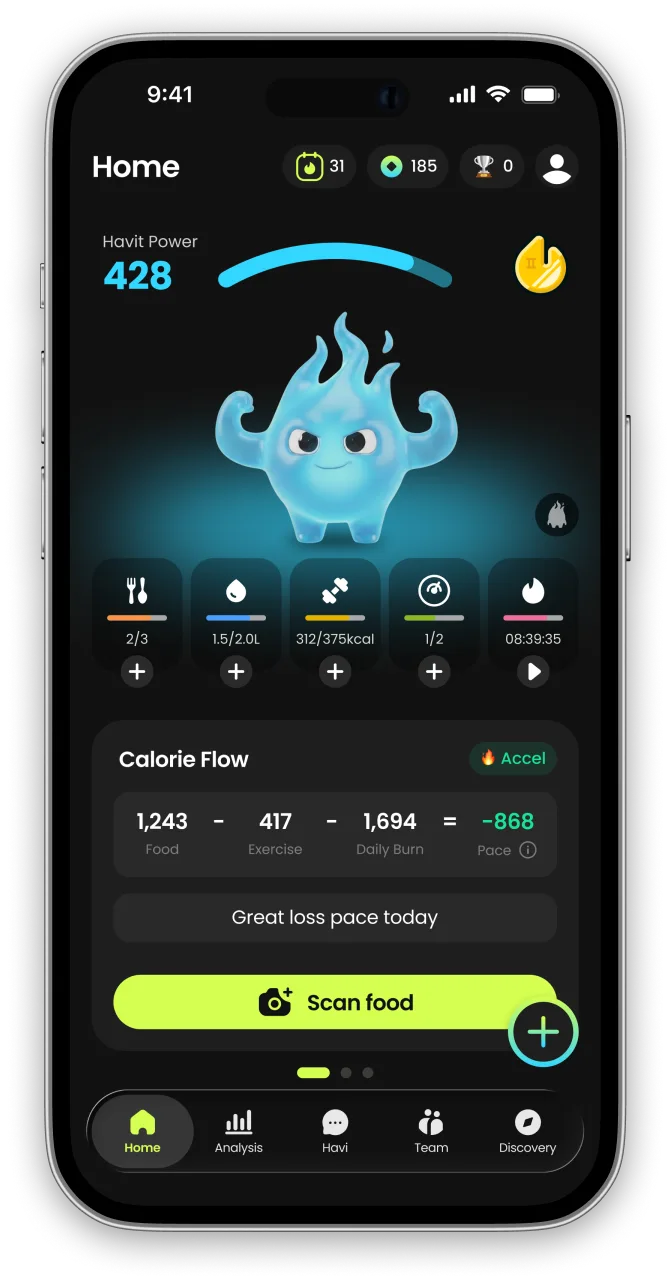
HAVIT is built for exactly this moment — one app that unites medication tracking, body composition, nutrition and protein, daily habit-building, and an AI coach that adapts to you.
Across our own 1,090 GLP-1 users, the most consistent trackers built the strongest habits (see the GLP-1 habit report).
Manage the medicine and the muscle — together. Start with HAVIT →

The clinical numbers behind the estimate
| Drug (dose type) | Trial-average total weight loss | Source trial |
|---|---|---|
| Wegovy (semaglutide 2.4 mg) | ~15% at 68 weeks | STEP-1 |
| Zepbound (tirzepatide 10–15 mg) | ~21% (up to 22.5%) at 72 weeks | SURMOUNT-1 |
| Ozempic (semaglutide 1–2 mg, diabetes dose) | ~6% over ~40 weeks | SUSTAIN program |
| Mounjaro (tirzepatide, diabetes dose) | ~13% | SURPASS program |
| Compounded semaglutide/tirzepatide | Not standardized — rough estimate only | No pivotal trial |
Frequently asked questions
How accurate is a GLP-1 weight loss calculator?
How much weight will I lose on Wegovy?
Is the Ozempic weight loss calculator different from Wegovy?
How much more weight loss with Zepbound vs Wegovy?
What is a goal weight predictor and can I trust it?
How is BMI calculated here?
Does sex change the estimate?
Is this medical advice?
What is Havit?
Havit is an AI health companion for weight loss that protects muscle.
Unlike calorie-only trackers, Havit connects AI body-composition estimates, nutrition, hydration, sleep, steps, cycle, mood, and GLP-1 medication in one daily routine — so progress is measured by body composition, not just the number on the scale. Daily missions turn established behavior-change techniques into small repeatable actions, drawing on expertise from professionals formerly at Juvis Diet, one of Korea’s leading metabolic clinics.
In Havit’s own analysis of 1,090 GLP-1 users, people who logged consistently built stronger habits than the general user base. Read the GLP-1 Habit Report
Havit works with or without GLP-1 medication. It is a wellness app, not a medical device; body-composition results are estimates.

Continue in the App
Personalized wellness with your own data


References
- Wilding JPH, et al. *Once-Weekly Semaglutide in Adults with Overweight or Obesity (STEP 1).* N Engl J Med 2021. nejm.org
- Jastreboff AM, et al. *Tirzepatide Once Weekly for the Treatment of Obesity (SURMOUNT-1).* N Engl J Med 2022. nejm.org
- Frías JP, et al. *Tirzepatide versus Semaglutide Once Weekly in Patients with Type 2 Diabetes (SURPASS-2).* N Engl J Med 2021. nejm.org
- FDA — *Wegovy (semaglutide) Prescribing Information.* accessdata.fda.gov
- FDA — *Zepbound (tirzepatide) Prescribing Information.* accessdata.fda.gov
- Novo Nordisk — *Ozempic weight results.* novomedlink.com
- All figures verified against the cited FDA labels, manufacturer materials, and NEJM trial publications as of July 2026.*


