
GLP-1 for PCOS: Semaglutide, Weight & Ovulation (2026)

This article is for general informational purposes only and is not a substitute for professional medical advice, diagnosis, or treatment. Always consult a qualified healthcare provider with questions about a medical condition.
Quick answer
GLP-1 medications for PCOS are used off-label — they are not FDA-approved for polycystic ovary syndrome itself. By driving weight loss and improving insulin resistance, drugs like semaglutide (Ozempic, Wegovy) can help restore ovulation and more regular cycles in some women, but they require medical supervision and are not for use in pregnancy.
Polycystic ovary syndrome (PCOS) is one of the most common hormonal conditions in women of reproductive age, and insulin resistance sits near the center of it.
Because GLP-1 receptor agonists — semaglutide (Ozempic, Wegovy) and the dual GIP/GLP-1 drug tirzepatide (Mounjaro, Zepbound) — powerfully improve weight and insulin sensitivity, more women with PCOS are being prescribed them.
Prescribing among women with PCOS rose from roughly 2.4% in 2021 to about 17.6% in 2025, per a large US health-record analysis.
This page explains, honestly, what a GLP-1 can and cannot do for PCOS, what the evidence actually shows, the reproductive-safety points you must not miss, and exactly what to track so your data is useful at your next appointment.
It is education, not a prescription.
01
What PCOS is — and why insulin resistance matters
PCOS is diagnosed by a combination of irregular or absent ovulation, signs of excess androgens (such as acne or unwanted hair growth), and/or polycystic-appearing ovaries on ultrasound.
Beyond fertility, it is a metabolic condition: insulin resistance affects roughly 50–70% of women with PCOS, and it occurs in both higher-weight and lean women, per a review of insulin resistance in PCOS.
Here is the loop that makes PCOS self-reinforcing: insulin resistance pushes the body to make more insulin, higher insulin nudges the ovaries to make more androgens, and excess androgens disrupt the normal signals that trigger ovulation — which is why cycles become irregular.
This is why guidelines put weight and insulin sensitivity at the foundation of PCOS management.
Even modest weight loss of 5–10% can improve ovulation, cycle regularity, and metabolic markers.
02
Does a GLP-1 help PCOS? What the evidence shows
GLP-1 receptor agonists were designed for type 2 diabetes and (at higher doses) obesity, and they target exactly the levers that drive PCOS: they slow gastric emptying, act on brain appetite centers to reduce intake, and improve insulin sensitivity. In PCOS populations specifically, trials and reviews report meaningful improvements — though the evidence base is still smaller than for diabetes or obesity.
Individual results vary widely; figures are drawn from cited PCOS studies and are not guarantees. Verify current evidence with your clinician.
The most consistent finding is that improvements in PCOS track with weight loss and better insulin sensitivity rather than a PCOS-specific drug effect — which is exactly why the same mechanism helps.

03
The honest part: GLP-1 for PCOS is off-label
This matters, so it gets its own section. No GLP-1 is FDA-approved to treat PCOS. Semaglutide and liraglutide are approved for chronic weight management (and diabetes), not for PCOS as a diagnosis.
When a clinician prescribes one for a woman with PCOS, they are prescribing it off-label — a legal and common practice, but one that shifts more responsibility to the prescriber's judgment and to you as an informed patient.
The 2023 International Evidence-Based PCOS Guideline update reflects this cautiously: it states that anti-obesity medications — including GLP-1 receptor agonists — may be considered, alongside active lifestyle intervention, for adults with PCOS and higher weight, while noting the evidence in PCOS specifically is still limited.
In other words: a reasonable option for the right person, not a routine recommendation for everyone with PCOS. Metformin remains a first-line insulin-sensitizing option, and the two are sometimes combined.
04
Insulin resistance, weight, and ovulation: the connection
If a GLP-1 helps your PCOS, the likely path is: lower insulin resistance and weight → lower androgen levels → the ovulation signal is restored → cycles regularize. For some women this can happen within months; for others it takes longer or not at all.
Do not treat a returning period as proof the drug is "curing" PCOS — PCOS is a chronic condition, and cycles can drift again if weight or insulin sensitivity change.
Two practical implications follow. First, because ovulation can return, fertility can return — sometimes unexpectedly (see the next section).
Second, because the benefit is metabolic, the behaviors that protect insulin sensitivity — protein-forward eating, resistance training, sleep, and steady activity — amplify what the medication does and matter whether or not you stay on it.

05
A reproductive-safety point you must not miss
This is the single most important safety message on this page.
GLP-1 medications are not for use during pregnancy — the FDA-approved semaglutide (Wegovy) label directs discontinuation at least 2 months before a planned pregnancy because of the drug's long half-life and lack of pregnancy safety data.
The trap: many women with PCOS assume they cannot easily get pregnant because they rarely ovulate.
A GLP-1 can quietly restore ovulation before you notice regular cycles — clinicians now talk about so-called "Ozempic babies," unplanned pregnancies during GLP-1 treatment.
Two takeaways:
- If you could become pregnant and are not trying, use reliable contraception while on a GLP-1. Note that tirzepatide (Mounjaro/Zepbound) may reduce the effectiveness of oral birth control around starting and dose increases — a barrier or non-oral method may be advised; semaglutide does not carry this specific warning. Confirm your method with your clinician.
- If you are planning pregnancy, talk to your clinician about when to stop the medication and how to manage the transition.
06
What to track on a GLP-1 for PCOS
Because PCOS improvements are individual and gradual, tracking turns a vague "is this working?" into evidence you and your clinician can act on. Focus on these:
- 1
Menstrual cycle
start date, length, and flow, to see whether cycles are regularizing.
- 2
Weight and waist
trends over weeks, not daily noise; aim to notice the 5–10% mark.
- 3
PCOS symptoms
acne, hair changes, energy and mood.
- 4
Insulin/metabolic labs
fasting glucose, HbA1c, and any insulin/androgen labs your clinician orders.
- 5
Protein intake and resistance training
the muscle-protective habits that support insulin sensitivity.
- 6
Side effects
nausea, constipation, and other GI symptoms, especially around dose changes.
- 7
Contraception or conception plan
logged deliberately, given the fertility point above.
| What to track | Why it matters for PCOS | How often |
|---|---|---|
| Cycle start / length / flow | Ovulation & cycle regularity signal | Every cycle |
| Weight & waist | 5–10% loss drives improvement | Weekly |
| Acne / hair / mood | Androgen-related symptom trend | Weekly |
| Fasting glucose / HbA1c | Insulin-resistance progress | Per clinician |
| Protein + strength sessions | Protects muscle & insulin sensitivity | Daily / weekly |
| GI side effects | Tolerability & dose timing | As they occur |
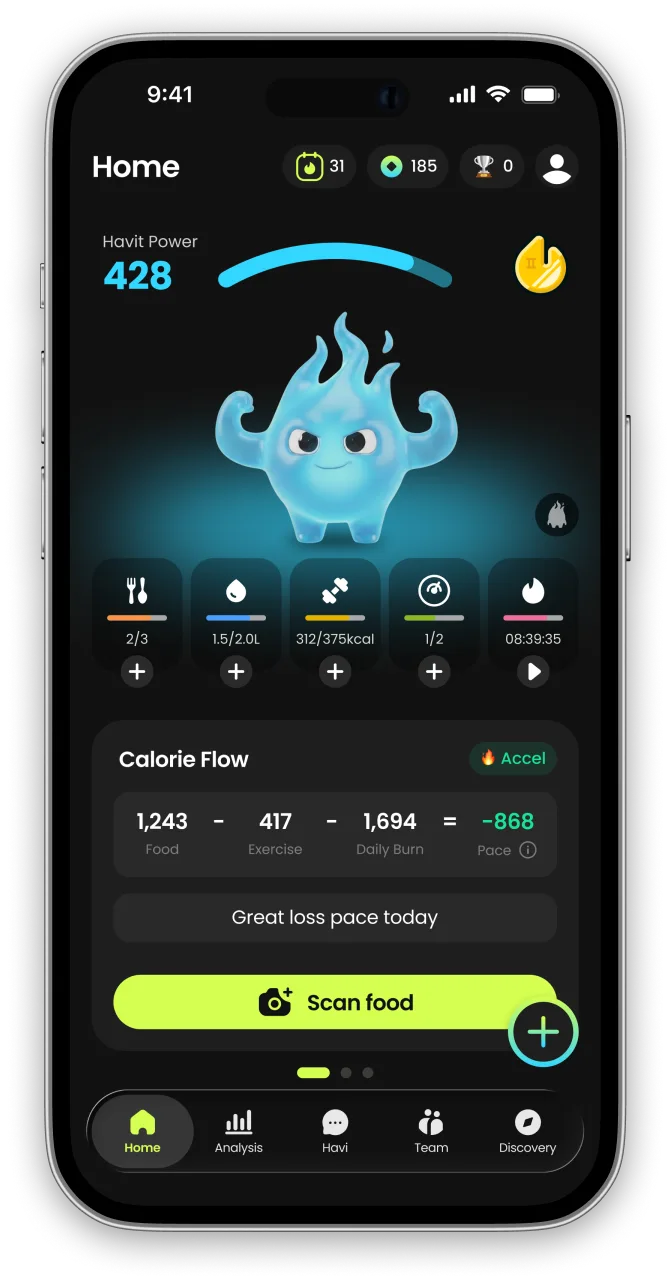
Keeping this in one place is exactly what the Havit app is built for — log your cycle, weight, meals, protein, workouts, doses, and how you feel, and bring real patterns to your OB-GYN or endocrinologist. (Havit is a tracking companion, not a medical device — always defer to your clinician.)
For the broader medication picture, see our guide to GLP-1 side effects and, if weight loss is a goal, the GLP-1 weight-loss calculator.
Women navigating midlife hormones may also want GLP-1 for menopause.
07
Why HAVIT — Medication + Behavior Change, in One App
GLP-1 medications can meaningfully reduce weight — but the number on the scale is only part of the story.
Roughly 20–40% of the weight lost on GLP-1 therapy can come from lean (muscle) tissue rather than fat (Neeland et al., Diabetes, Obesity and Metabolism, 2024), and results tend to fade once the medication stops unless new habits take their place.
That's why leading guidance treats medication as one part of care, not the whole: the U.S. Preventive Services Task Force recommends that adults with obesity be offered intensive, multicomponent behavioral interventions (USPSTF, Grade B).
HAVIT is built for exactly this moment — one app that unites medication tracking, body composition, nutrition and protein, daily habit-building, and an AI coach that adapts to you.
Across our own 1,090 GLP-1 users, the most consistent trackers built the strongest habits (see the GLP-1 habit report).
Manage the medicine and the muscle — together. Start with HAVIT →
Does a GLP-1 help PCOS? What the evidence shows
| PCOS outcome | What the evidence suggests | Source type |
|---|---|---|
| Weight / waist | Significant weight and waist-circumference reduction; combining with metformin often beats either alone | PCOS trials & meta-analyses |
| Insulin resistance | Improved insulin sensitivity and glucose control | PCOS reviews |
| Menstrual regularity / ovulation | Increased menstrual frequency and higher natural-pregnancy rates in some trials (e.g., exenatide vs metformin) | Comparative trials |
| Androgens | Improvement in free androgen index / testosterone alongside weight loss | PCOS trials |
| FDA approval for PCOS | None — use is off-label | FDA / reviews |
Frequently asked questions
Is a GLP-1 approved for PCOS?
Can Ozempic or Wegovy help me ovulate again?
Does GLP-1 fix PCOS insulin resistance?
GLP-1 vs metformin for PCOS — which is better?
Can I get pregnant on a GLP-1 with PCOS?
Will my PCOS symptoms come back if I stop?
Does a GLP-1 help PCOS acne and unwanted hair?
Are the side effects different if I have PCOS?
What is Havit?
Havit is an AI health companion for weight loss that protects muscle.
Unlike calorie-only trackers, Havit connects AI body-composition estimates, nutrition, hydration, sleep, steps, cycle, mood, and GLP-1 medication in one daily routine — so progress is measured by body composition, not just the number on the scale. Daily missions turn established behavior-change techniques into small repeatable actions, drawing on expertise from professionals formerly at Juvis Diet, one of Korea’s leading metabolic clinics.
In Havit’s own analysis of 1,090 GLP-1 users, people who logged consistently built stronger habits than the general user base. Read the GLP-1 Habit Report
Havit works with or without GLP-1 medication. It is a wellness app, not a medical device; body-composition results are estimates.
Continue in the App
Personalized wellness with your own data


References
- Abdalla MA, et al. — The Potential Role of Glucagon-Like Peptide-1 (GLP-1) Agonists for Polycystic Ovary Syndrome (review). PMC. pmc.ncbi.nlm.nih.gov
- Goldberg AS, et al. — Anti-obesity pharmacological agents for PCOS: systematic review & meta-analysis to inform the 2023 international evidence-based guideline. *Obesity Reviews* (2024). onlinelibrary.wiley.com
- Endocrine Society — Polycystic Ovary Syndrome (patient library). endocrine.org
- ACOG — Polycystic Ovary Syndrome (Practice Bulletin). acog.org
- Insulin Resistance in Polycystic Ovarian Syndrome (review). PMC. ncbi.nlm.nih.gov
- GLP-1 receptor agonists on weight management and metabolic parameters in PCOS: meta-analysis of RCTs. *Scientific Reports* (2025). nature.com
- FDA — WEGOVY (semaglutide) Prescribing Information (pregnancy: discontinue ≥2 months before planned pregnancy). accessdata.fda.gov
- Mayo Clinic — Polycystic ovary syndrome (PCOS): symptoms & causes. mayoclinic.org
- All medical claims above were verified against the cited reviews, guidelines, FDA label, and major clinics as of mid-2026. Evidence in PCOS is evolving and labels are updated periodically — confirm current details with your clinician.*


