
GLP-1 for Perimenopause: Weight Gain & Insulin (2026)

This article is for general informational purposes only and is not a substitute for professional medical advice, diagnosis, or treatment. Always consult a qualified healthcare provider with questions about a medical condition.
Quick answer
GLP-1 for perimenopause is used to treat the weight gain, rising insulin resistance, and belly fat that begin during the transition years — often while you are still having periods — not perimenopause itself. Semaglutide (Ozempic, Wegovy) and tirzepatide (Mounjaro, Zepbound) can help, but protein and strength training are essential because perimenopause is when lean-muscle loss accelerates.
Perimenopause is the transition — usually in your 40s — leading up to your final period.
What makes it different from menopause is that estrogen doesn't simply fall; it swings erratically, spiking and crashing month to month, while progesterone drifts down.
Those swings are why weight, mood, sleep, and blood sugar can feel newly unpredictable.
Crucially, the metabolic change starts here, before periods stop: SWAN research found that at the start of the menopause transition the rate of fat gain doubled and lean mass began to decline (Greendale et al., JCI Insight 2019).
That is why GLP-1 receptor agonists have become a common perimenopausal conversation.
This page explains what they can do for perimenopause weight gain, the insulin-resistance shift that makes weight suddenly stubborn, the muscle-loss risk you must actively manage, and what to track.
It is education, not a prescription — and if there is any chance of pregnancy, a GLP-1 is not appropriate.
01
Why perimenopause changes your weight — while you still have periods
Perimenopause weight gain is not "willpower." It is a measurable shift driven by fluctuating estrogen layered on aging, and it begins earlier than most women expect.
Four changes matter most:
Estrogen is normally insulin-sensitizing — it helps muscle pull glucose out of the blood (estrogen and metabolism review, PMC 2025).
As its signaling becomes erratic in perimenopause, insulin resistance and abdominal fat rise together in a self-reinforcing loop.
So the perimenopause goal is not just a smaller number on the scale — it is better insulin sensitivity and less visceral fat while preserving muscle.
02
Can a GLP-1 help perimenopause weight gain?
Yes — but understand what it treats. No GLP-1 is FDA-approved for "perimenopause." These drugs are approved for type 2 diabetes and chronic weight management, and many perimenopausal women qualify on those grounds.
Because GLP-1s slow gastric emptying, reduce appetite via the brain, and improve insulin sensitivity, they act directly on the two problems perimenopause creates — rising insulin resistance and expanding visceral fat.
The insulin angle is what makes GLP-1s a logical fit here specifically: perimenopause is often the first time a woman becomes insulin resistant, and GLP-1s were built around the incretin/insulin pathway.
If your struggles began even earlier with a hormonal condition, see GLP-1 for PCOS, which shares the insulin-resistance mechanism.
One firm caveat: perimenopausal women can still ovulate and conceive. GLP-1s are not for use in pregnancy and semaglutide should be stopped at least 2 months before a planned pregnancy (FDA Wegovy label). Discuss reliable contraception with your clinician.

03
The muscle-loss risk you must manage
This is the most important section for perimenopause, because muscle loss is already accelerating here — not later.
SWAN data show lean mass begins declining at the very start of the transition, and all meaningful weight loss adds to that: randomized-trial evidence indicates GLP-1-based therapies typically produce lean-mass reductions representing roughly 20–30% of total weight lost (body-composition review, PMC).
Why this compounds: less muscle means a lower resting metabolism (making weight harder to keep off), weaker support for bone (which begins thinning in perimenopause), and reduced strength.
Losing weight while losing disproportionate muscle can leave you lighter but metabolically worse off.
The countermeasures are non-negotiable in midlife:
- Prioritize protein at every meal to support muscle protein synthesis.
- Strength-train 2–3 times per week — the single most protective habit for muscle and bone.
- Lose weight gradually, not crash-fast, to limit lean-mass loss.
- Protect bone with adequate calcium, vitamin D, and clinician-guided monitoring.
- Track body composition, not just weight, so muscle loss is caught early.
04
Perimenopause vs. menopause: don't confuse the two
They are different stages and the treatment emphasis differs.
In perimenopause, estrogen fluctuates and the story is the onset of insulin resistance and muscle loss while you still menstruate.
In menopause and after, estrogen is steadily low and the story is entrenched visceral fat and bone loss.
If your periods have stopped for 12 months, our companion guide, GLP-1 for menopause, covers the post-transition picture.
For the general drug safety landscape at any stage, see GLP-1 side effects.

05
What to track on a GLP-1 in perimenopause
In the transition, the right metrics shift from "weight" to "insulin, body composition, and cycle." Track these:
| What to track | Why it matters in perimenopause | How often |
|---|---|---|
| Weight and waist | Visceral belly fat is the real target | Weekly |
| Body composition (muscle vs fat) | Lean loss is already accelerating — catch it early | Monthly / per scan |
| Protein intake | Protects muscle during weight loss | Daily |
| Strength sessions | Top muscle- and bone-protective habit | 2–3×/week |
| Cycle changes / symptoms | Perimenopause is defined by irregular cycles | Ongoing |
| Blood sugar / clinician labs | Insulin resistance is rising | Per clinician |
| GI side effects | Tolerability & dose timing | As they occur |
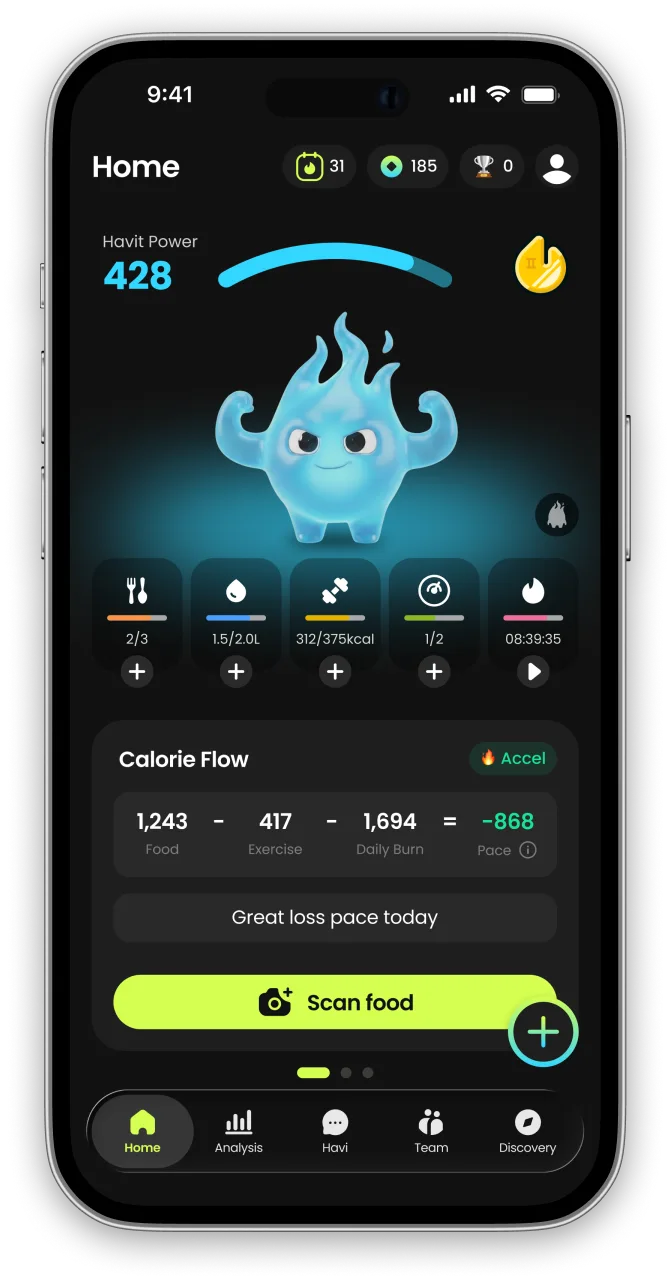
Logging weight and waist and protein and strength and your cycle together is exactly what the Havit app makes effortless — so you can confirm you are losing fat while holding onto muscle, and bring real data to your perimenopause or endocrinology appointment. (Havit is a tracking companion, not a medical device — always defer to your clinician.)
Anyone weighing options can also start with the GLP-1 weight-loss calculator.
06
Why HAVIT — Medication + Behavior Change, in One App
GLP-1 medications can meaningfully reduce weight — but the number on the scale is only part of the story.
Roughly 20–40% of the weight lost on GLP-1 therapy can come from lean (muscle) tissue rather than fat (Neeland et al., Diabetes, Obesity and Metabolism, 2024), and results tend to fade once the medication stops unless new habits take their place.
That's why leading guidance treats medication as one part of care, not the whole: the U.S. Preventive Services Task Force recommends that adults with obesity be offered intensive, multicomponent behavioral interventions (USPSTF, Grade B).
HAVIT is built for exactly this moment — one app that unites medication tracking, body composition, nutrition and protein, daily habit-building, and an AI coach that adapts to you.
Across our own 1,090 GLP-1 users, the most consistent trackers built the strongest habits (see the GLP-1 habit report).
Manage the medicine and the muscle — together. Start with HAVIT →

Why perimenopause changes your weight — while you still have periods
| Change | What happens in perimenopause | Why it matters |
|---|---|---|
| Estrogen fluctuation | Estrogen swings up and down erratically before its final decline | Drives unpredictable weight, sleep, and appetite shifts |
| Insulin resistance onset | Muscle becomes less responsive to insulin as estrogen signaling turns inconsistent | The same meal at 45 raises blood sugar and stores more fat than at 30 |
| Visceral (belly) fat rise | Fat starts redistributing from hips/thighs to the abdomen | Visceral fat is metabolically riskier and worsens insulin resistance |
| Lean-muscle loss | Fat-gain rate doubles and lean mass declines at the start of the transition | Lowers resting metabolism and weakens bone support |
Frequently asked questions
Is a GLP-1 approved for perimenopause?
Why does weight gain start in perimenopause while I still have periods?
Does a GLP-1 help perimenopause insulin resistance?
Will I lose muscle on a GLP-1 during perimenopause?
Can I take a GLP-1 in perimenopause if I could still get pregnant?
Perimenopause or menopause — which article applies to me?
Can I combine a GLP-1 with hormone therapy in perimenopause?
Will perimenopause weight come back if I stop?
What is Havit?
Havit is an AI health companion for weight loss that protects muscle.
Unlike calorie-only trackers, Havit connects AI body-composition estimates, nutrition, hydration, sleep, steps, cycle, mood, and GLP-1 medication in one daily routine — so progress is measured by body composition, not just the number on the scale. Daily missions turn established behavior-change techniques into small repeatable actions, drawing on expertise from professionals formerly at Juvis Diet, one of Korea’s leading metabolic clinics.
In Havit’s own analysis of 1,090 GLP-1 users, people who logged consistently built stronger habits than the general user base. Read the GLP-1 Habit Report
Havit works with or without GLP-1 medication. It is a wellness app, not a medical device; body-composition results are estimates.

Continue in the App
Personalized wellness with your own data


References
- Greendale GA, et al. Changes in body composition and weight during the menopause transition (fat-gain rate doubles, lean mass declines at transition start). *JCI Insight*, 2019. PMC. pmc.ncbi.nlm.nih.gov
- Estrogen and Metabolism: Navigating Hormonal Transitions from Perimenopause to Postmenopause (estrogen is insulin-sensitizing). PMC, 2025. pmc.ncbi.nlm.nih.gov
- Increased visceral fat and decreased energy expenditure during the menopausal transition. PMC. pmc.ncbi.nlm.nih.gov
- The menopause transition and women's health at midlife: SWAN progress report. PMC. pmc.ncbi.nlm.nih.gov
- The Influence of GLP-1 Receptor Agonists on Body Composition (lean mass ~20–30% of weight loss). PMC. ncbi.nlm.nih.gov
- FDA — WEGOVY (semaglutide) Prescribing Information (pregnancy: discontinue ≥2 months before planned pregnancy). accessdata.fda.gov
- Mayo Clinic — Menopause weight gain: Stop the middle-age spread. mayoclinic.org
- Endocrine Society — Menopause and Bone Loss (patient library). endocrine.org
- All medical claims above were verified against the cited peer-reviewed studies, FDA label, and major clinics as of mid-2026. Evidence is evolving and labels are updated periodically — confirm current details with your clinician.*


