
GLP-1 First Month: What to Expect on Ozempic & Wegovy (2026)

This article is for general informational purposes only and is not a substitute for professional medical advice, diagnosis, or treatment. Always consult a qualified healthcare provider with questions about a medical condition.
Quick answer
In your first month on a GLP-1, you start at the lowest dose — semaglutide 0.25 mg (Ozempic/Wegovy) or tirzepatide 2.5 mg (Mounjaro/Zepbound) — for four weeks. Expect mild early nausea, a fading appetite, and small, gradual weight loss. The starter dose is for adjustment, not results.
The first four weeks on a GLP-1 rarely look the way people imagine.
The starting dose of semaglutide — the active ingredient in Ozempic and Wegovy — is 0.25 mg once weekly, and per the FDA-approved Wegovy label this dose is below the therapeutic range: its only job is to let your body adjust to the drug with as little nausea as possible.
The same is true of tirzepatide (Mounjaro, Zepbound), which starts at 2.5 mg for four weeks per the Zepbound label.
So if the scale barely moves in month one, that is normal and expected — not a sign the medication isn't working.
Below is a realistic, week-by-week picture, followed by exactly what to track so your first clinic conversation is grounded in your own data.
01
GLP-1 first month, week by week (at a glance)
This table is a general timeline for the standard 0.25 mg semaglutide starter month. Individual experience varies widely; tirzepatide (2.5 mg start) follows a similar arc.
(Doses reflect the FDA Wegovy/Ozempic labels. Your prescriber decides whether and when to step up.)
02
Week 1: the starter dose and the first injection
Your first 0.25 mg dose introduces the drug slowly. Most people feel little on day one.
The most common early effect is mild nausea, which per the FDA labels tends to appear in the first one to three days after a dose and then eases.
Some people notice nothing at all in week one — also normal.
Two practical habits pay off immediately: choose a consistent injection day (semaglutide is once weekly, and a long ~1-week half-life means levels build gradually), and start a simple log from day one so you can see your own pattern rather than guessing.

03
Week 2: your body adjusts
By the second dose, many people report that early nausea is milder and more predictable.
This is also when some begin to notice the effect that GLP-1 users describe most vividly: the quieting of "food noise" — the constant background pull toward snacking.
Mechanistically, GLP-1 drugs slow gastric emptying and act on appetite centers, so you feel full sooner and stay full longer.
Lean into it: eat smaller, more frequent, lower-fat meals, stop at the first sign of fullness, and prioritize protein to protect muscle as weight starts to come off.
04
Week 3: appetite suppression becomes obvious
For most people, week three is when reduced appetite is clearly there — meals feel smaller, and forgetting to snack becomes normal.
Because you may also feel less thirsty, under-drinking is a real risk; sip water through the day, especially if you have any nausea or loose stools.
Keep logging side effects and their timing relative to your dose day.

05
Week 4: small early loss, and the first dose decision
By the end of the starter month, many people have lost a few pounds (roughly 1–3% of body weight) — a modest, gradual change, not a dramatic one.
That is exactly what the trials predict: the big results in STEP-1 (mean 14.9% weight loss with semaglutide 2.4 mg) accrued over 68 weeks at the full dose, not in month one.
Per the label schedule, week 4 is when semaglutide typically steps up from 0.25 mg to 0.5 mg (tirzepatide from 2.5 mg to 5 mg) — but only under your prescriber's direction.
Bring your log. If side effects were rough, your clinician may hold you at the current dose longer; that is a normal, common decision. Never adjust your own dose.
06
What to track in your first month (a HowTo)
Structured tracking turns a vague "I think it's working" into evidence you and your clinician can act on. Do these, in order:
- Log your injection day and dose every week — the anchor for everything else.
- Weigh weekly, not daily. Daily weight swings are mostly water and noise; a weekly trend is the real signal.
- Record side effects and their timing relative to your dose (e.g., "nausea, day 2, mild").
- Track meals and protein — aim to eat protein first and note portion sizes shrinking.
- Log hydration, especially on days with any nausea, vomiting, or diarrhea.
- Note energy, sleep, and "food noise" — non-scale wins that matter early.
- Flag red-flag symptoms immediately (see below) — don't "wait it out."
- Review the whole log before your next appointment so dose decisions use your real data.
Keeping this by hand is tedious, which is why a companion like the Havit app is built to make it effortless — log doses, meals, weight, and how you feel each day, and watch your own first-month pattern emerge. (It's a tracking companion, not a medical device — always defer to your clinician.)

07
Red flags in month one — when to call your clinician
Most first-month symptoms are mild and temporary, but per the FDA labels some need prompt attention: severe, persistent abdominal pain (possible pancreatitis — stop and seek care), upper-right abdominal pain with fever or jaundice (gallbladder), vomiting or diarrhea you can't keep fluids down through (dehydration risk), and any serious allergic reaction. For the full list and what each may mean, see our GLP-1 side effects guide.
08
Why HAVIT — Medication + Behavior Change, in One App
GLP-1 medications can meaningfully reduce weight — but the number on the scale is only part of the story.
Roughly 20–40% of the weight lost on GLP-1 therapy can come from lean (muscle) tissue rather than fat (Neeland et al., Diabetes, Obesity and Metabolism, 2024), and results tend to fade once the medication stops unless new habits take their place.
That's why leading guidance treats medication as one part of care, not the whole: the U.S. Preventive Services Task Force recommends that adults with obesity be offered intensive, multicomponent behavioral interventions (USPSTF, Grade B).
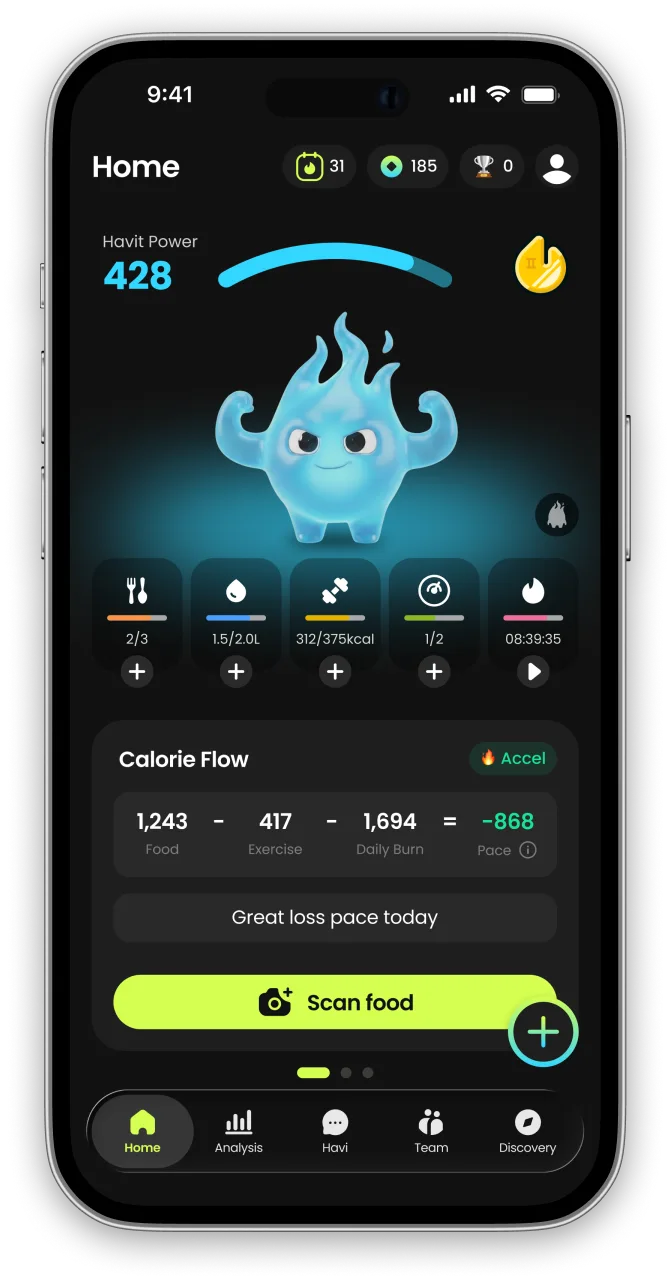
HAVIT is built for exactly this moment — one app that unites medication tracking, body composition, nutrition and protein, daily habit-building, and an AI coach that adapts to you.
Across our own 1,090 GLP-1 users, the most consistent trackers built the strongest habits (see the GLP-1 habit report).
Manage the medicine and the muscle — together. Start with HAVIT →

GLP-1 first month, week by week (at a glance)
| Week | Typical dose (semaglutide) | What many people notice | What to focus on |
|---|---|---|---|
| Week 1 | 0.25 mg (first injection) | First dose; possible mild nausea 1–3 days after; appetite may start to dip | Pick a fixed weekly injection day; start logging |
| Week 2 | 0.25 mg | Nausea often mild and settling; "food noise" may quiet | Smaller portions, hydrate, protein first |
| Week 3 | 0.25 mg | Appetite suppression more noticeable; fuller sooner | Track meals and any side-effect timing |
| Week 4 | 0.25 mg → prep for 0.5 mg | Small early loss (often a few pounds / ~1–3%); reduced appetite settled | Weigh weekly; review with your prescriber before the increase |
Frequently asked questions
How much weight will I lose in the first month on a GLP-1?
Is it normal to lose almost no weight the first month?
When do GLP-1 side effects start and how long do they last?
When does appetite suppression kick in?
What is the starting dose of Ozempic and Wegovy?
Does the first month differ on Mounjaro or Zepbound?
What should I eat in the first month?
Should I weigh myself every day?
What is Havit?
Havit is an AI health companion for weight loss that protects muscle.
Unlike calorie-only trackers, Havit connects AI body-composition estimates, nutrition, hydration, sleep, steps, cycle, mood, and GLP-1 medication in one daily routine — so progress is measured by body composition, not just the number on the scale. Daily missions turn established behavior-change techniques into small repeatable actions, drawing on expertise from professionals formerly at Juvis Diet, one of Korea’s leading metabolic clinics.
In Havit’s own analysis of 1,090 GLP-1 users, people who logged consistently built stronger habits than the general user base. Read the GLP-1 Habit Report
Havit works with or without GLP-1 medication. It is a wellness app, not a medical device; body-composition results are estimates.

Continue in the App
Personalized wellness with your own data


References
- FDA — WEGOVY (semaglutide) Prescribing Information (label). accessdata.fda.gov
- FDA — OZEMPIC (semaglutide) Prescribing Information (label). accessdata.fda.gov
- FDA — ZEPBOUND (tirzepatide) Prescribing Information (label). accessdata.fda.gov
- Novo Nordisk — Wegovy Dosing Schedule (0.25→2.4 mg). novomedlink.com
- Wilding JPH, et al. — Once-Weekly Semaglutide in Adults with Overweight or Obesity (STEP-1). NEJM 2021. nejm.org
- Mayo Clinic — Tirzepatide (subcutaneous route): description, side effects, dosing. mayoclinic.org
- All medical claims above were verified against the cited FDA labels, manufacturer dosing materials, and NEJM trial as of July 2026. Labels are updated periodically — confirm current details with your clinician and the official prescribing information.*


