
How to Keep a GLP-1 Diary: Shot, Weight & Habit Tracking

This article is for general informational purposes only and is not a substitute for professional medical advice, diagnosis, or treatment. Always consult a qualified healthcare provider with questions about a medical condition.
Quick answer
A useful GLP-1 diary needs only four things logged each time: shot day, weight, meals (protein), and side effects. With a record, the patterns behind your results and symptoms become visible, and the longer you keep it, the more it pays off. Aim for "one number plus one line," not a perfect journal.
Once you start a GLP-1 medication, small questions surface almost daily: "Is today's queasiness the drug?" "I feel lighter than last week — is it real?" "Wait, when was my last shot?" The answers live in a record, not in memory.
Building the habit of keeping a GLP-1 diary is the plainest, most reliable move you can make — it turns treatment from "going okay, I think" into a plan you can actually see.
This guide covers what to log, how to log it, and the hardest part of all: how to keep the habit going. Setting a weight-loss target is a separate job — hand that to the GLP-1 weight loss calculator — while here we focus purely on the tracking itself.
01
Why tracking works so well on a GLP-1
The reason is simple: on a GLP-1, your changes and your side effects are tightly linked to daily behavior. Appetite drops and you naturally eat less, while nausea and constipation rise and fall around your shot day and dose increases.
Without a record, that rhythm just reads as "a rough day here and there." With one, your own pattern surfaces — for example, "nausea tends to hit two days after a dose bump."
Weight-loss science says the same thing: self-monitoring is one of the most reproducible predictors of success.
Reviews pooling many studies consistently find that people who track food, weight, and activity lose more weight (Burke LE, et al. J Am Diet Assoc 2011).
On a GLP-1 the bigger risk is usually under-eating protein and nutrients, not overeating — so your diary helps confirm you're getting enough more than it polices excess.
Here's what a record buys you:
A real sense of progress
you read a weekly trend line instead of riding daily ups and downs.
Getting ahead of side effects
you can predict rough days and lighten meals in advance.
Sharper appointments
instead of "I just felt off," you can say "three days after my dose increase I couldn't keep water down."
Motivation to continue
small wins (logged today; hit my protein) stack up.
02
What to log in your GLP-1 diary
You don't need to aim for complete. At first, the four essentials in the table below are plenty. Add the "nice to have" items once tracking feels automatic.
The trick is one number plus one line. Turn it into a long journal and it won't last. A weight figure and "nausea 1 today" is all the detail you need.

03
Why shot-day tracking matters most
Of the four, the one to habit-build first is shot-day tracking. Once-weekly GLP-1s work best when you inject on the same day of the week, which keeps the rhythm steady.
A record makes three things obvious at a glance:
- 1
Your next shot day
your best insurance against a missed or doubled dose.
- 2
When you increased the dose
this is the starting point of the side-effect wave.
- 3
Injection-site rotation
a log of abdomen, thigh, and arm keeps you from hitting one spot repeatedly (always follow your prescriber and the label for sites and technique).
Injection-log mini format (copy this frame):
- Date / weekday: / (e.g., every Friday)
- Dose: __ mg (mark "↑" when you step up)
- Site: abdomen, thigh, or arm
- One line after: how you felt, anything you noticed
If you realize you missed a dose, don't decide on your own — log it and talk to your prescriber.
The more precisely you've recorded "when, how many mg, and where," the faster and more accurate that conversation is.
04
How to log weight the right way
Weight moves every day. A 1–2 lb (about 0.5–1 kg) swing from yesterday's salt, water, or bathroom timing is completely normal.
That's exactly why the rule is: fix how you weigh, and read a line, not a dot.
Standardize conditions
morning, after waking, after the bathroom, same clothing (or underwear).
Frequency is your call
daily gives a smoother trend line; weekly avoids "swing fatigue." Pick whichever you'll actually keep.
Don't ride the daily number
watch whether the 1–2 week average is falling, not any single day.
Plateaus are normal
the curve drops in steps. A few flat weeks is not failure.
Tracking body composition (muscle vs. fat) is even better, but logging your weight trend steadily comes first.
To avoid losing muscle to fast weight loss, put "was protein enough?" and "did I do strength work?" right next to the number — that protects the quality of the weight you lose (GLP-1 side effects guide).
05
Using a side-effect diary to find patterns
Log nausea, constipation, and reflux and their regularity starts to show. Intensity on a 0 (none) to 3 (tough) scale is enough.
After a few weeks, your own tendencies emerge — for example:
| Pattern you may see in your log | The move you can make |
|---|---|
| Nausea tends to hit the day or two after a dose increase | Switch those two days to bland, low-fat, small portions |
| Constipation worsens later in the week | Add soluble fiber and water a few days ahead |
| Reflux after a greasy meal out | Skip fried food; eat veggies → protein → carbs |
The point of a record is not to "grit your teeth through the rough days" — it's to have fewer of them. For strong symptoms, like nausea so bad you can't keep water down or severe abdominal pain, seek care before you reach for the diary.
06
How to make the habit actually stick
This is the heart of it.
Knowing that tracking works but not keeping it up isn't weak willpower — it's a design problem. Habit research finds it takes an average of about 66 days (18–254 days, depending on the person and behavior) for an action to become automatic, and that habit formation still progresses even when you're not perfect every day (Lally P, et al. Eur J Soc Psychol 2010).
In other words, missing a few days is not dropping out. Build a structure that lasts:
- 1
Stack it onto an existing habit (if-then)
"after I brush my teeth, I weigh in"; "after breakfast, I log." Don't carve out new time — attach it to something you already do.
- 2
Lower the bar to the floor
your first goal is "one item only." A day with just a weight number logged counts as a win.
- 3
Make the trigger visible
scale where you'll see it by the sink, app on the first page of your home screen.
- 4
Ban "later"
30 seconds, on the spot. Try to batch it and you'll forget.
- 5
Never miss twice
one skipped day is normal — just don't skip two in a row.
- 6
Small rewards
treat yourself after a one-week streak. Checking off progress where you can see it helps too.
- 7
Drop the perfectionism
blanks are fine. A 60% record kept for a year beats a 100% record you quit in a week.
07
Paper notebook vs. app — which is better?
The honest answer is "whichever one you'll keep," but each suits a different temperament.
| Paper / notebook | App | |
|---|---|---|
| Ease | Just open it, no battery | Reminders and auto-calc make entry fast |
| Totals & charts | You build them by hand | Charts weight and protein automatically |
| Reviewing | Flip back through pages | Period comparisons and trend lines in an instant |
| Staying with it | For people who enjoy writing | Reminders make it hard to forget |
Tallying numbers by hand — is today's protein 40 g or 90 g? where's the weight trend heading? — is genuinely hard to keep up. Automate that and the barrier to tracking drops sharply.
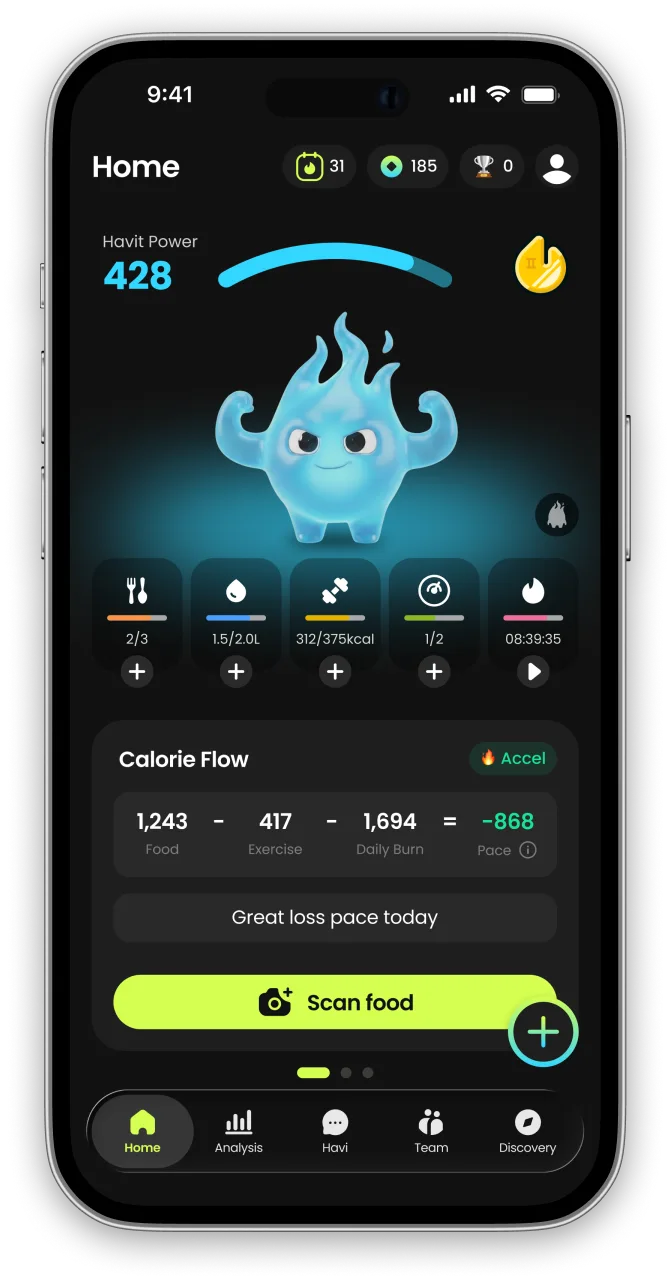
The HAVIT app lets you log meals, weight, and water in seconds, with shot-day reminders and protein and fiber totals all on one screen.
Start on paper, and if it doesn't stick, switch to an app — that's perfectly fine.
To compare options, see the best GLP-1 tracker apps; to read your week as a report, see the GLP-1 habit report.
08
Your first 4 weeks: a tracking roadmap
Not doing everything at once is the whole trick. Stack one rung per week.
Week 1 — shot day only.
Fix the weekday; record that you took it and the site. This is the foundation.
Week 2 — add weight.
Standardize how you weigh. One number is fine.
Week 3 — add side effects.
The 0–3 scale plus one line. Start spotting patterns.
Week 4 — add meals & protein.
Begin with a simple "enough / not enough" check; add amounts once it's easy.
By the end of four weeks, the four essentials should feel as automatic as brushing your teeth.
From here, the rest is just fine-tuning as you watch your own tendencies. Tracking is the shortcut that turns a plan on paper into a result in the mirror.
09
The signals your diary gives that it's time to check in
A diary isn't only a scoreboard. It's also an early-warning system that flags when to talk to your prescriber. Watch the change in trend more than any single number.
Weight dropping too fast
a pace well above about 1% of body weight per week, sustained, can signal muscle loss or under-nutrition. With a record you can say exactly when it accelerated.
Side-effect scores that won't come down
if nausea or constipation stays at 2–3 for weeks after a dose increase, or you have days you can't keep water down, your log becomes the basis for a clinical decision.
A run of "not enough" on meals/protein
if appetite drops so far that under-eating days pile up, it's time for a nutrition conversation. On a GLP-1, the risk is under-eating, not overeating.
Missed shot days adding up
if you're forgetting doses, revisit your weekday choice and daily routine with your prescriber.
A record is not "proof you tried hard" — it's material for a decision. The weeks that went badly are the ones most worth keeping, not erasing.
10
A day in the life of someone who keeps it up
"Diary" sounds heavy, but the people who actually stick with it keep records that are surprisingly short. Here's a typical day for someone doing it without strain:
Morning
step on the scale after brushing your teeth. One tap in the app. 10 seconds.
After breakfast
"eggs + Greek yogurt + berries, protein ✓" in one tap. No calorie math.
Shot day (every Friday)
after injecting, just "Fri · __ mg · abdomen." Different site than last week.
Night
the day's side effects as "nausea 0 / constipation 1." One line only if something stood out.
The point is that all of it happens "along the way." No new time carved out — each piece is attached to something already there (brushing, meals, bedtime), which is why it lasts.
The whole day totals under a minute. For the first week or two, just stacking these "10-second logs" is enough.
Once it's second nature, a 5-minute weekend review of your weight trend line and side-effect patterns makes the next week's meals and shot day far easier to prepare.
11
Why HAVIT — medication management and behavior change in one place
GLP-1 medications reliably reduce weight. But the scale number isn't the whole story.
Roughly 20–40% of the weight lost on a GLP-1 can be lean mass, such as muscle, rather than fat (Neeland et al., Diabetes, Obesity and Metabolism, 2024), and if habits haven't taken root by the time you stop the drug, the results tend to reverse.
That's why major guidelines treat medication as one part of treatment, not the whole.
The U.S. Preventive Services Task Force (USPSTF) recommends offering adults with obesity intensive, multicomponent behavioral interventions (USPSTF, Grade B).
HAVIT is built for exactly this moment — medication logging, body composition, nutrition and protein, daily habit-building, and an AI coach that adapts to you, all in one app.
Across 1,090 real HAVIT GLP-1 users, the people who kept tracking built the strongest habits (see the GLP-1 habit report).
Manage the medication and the muscle. Get started with HAVIT →
What to log in your GLP-1 diary
| Priority | Item | What to capture |
|---|---|---|
| Essential | Shot day & dose | Keep the same weekday. Always note the day you increase the dose |
| Essential | Weight | Same conditions (morning, after waking, after the bathroom). Daily or weekly — either is fine |
| Essential | Meals & protein | What you ate + whether protein was enough (aim ~20–30 g per meal) |
| Essential | Side effects | Presence and intensity of nausea/constipation/reflux (a 0–3 scale is enough) |
| Nice to have | Water | Check against a target of about 6–8 glasses a day |
| Nice to have | Appetite & fullness | A phrase like "full fast" or "zero appetite" |
| Nice to have | Mood & energy | Sluggishness, focus, mood swings |
| Nice to have | Steps & exercise | Whether you walked or did strength work (your muscle-preservation record) |
Frequently asked questions
What's the minimum I should write in a GLP-1 diary?
Should I weigh daily or weekly?
Why is shot-day tracking so important?
My tracking never lasts more than a few days.
Paper or app — which do you recommend?
How detailed should side-effect notes be?
Do I need to count calories in my meal log?
Should I show the diary to my prescriber?
What is Havit?
Havit is an AI health companion for weight loss that protects muscle.
Unlike calorie-only trackers, Havit connects AI body-composition estimates, nutrition, hydration, sleep, steps, cycle, mood, and GLP-1 medication in one daily routine — so progress is measured by body composition, not just the number on the scale. Daily missions turn established behavior-change techniques into small repeatable actions, drawing on expertise from professionals formerly at Juvis Diet, one of Korea’s leading metabolic clinics.
In Havit’s own analysis of 1,090 GLP-1 users, people who logged consistently built stronger habits than the general user base. Read the GLP-1 Habit Report
Havit works with or without GLP-1 medication. It is a wellness app, not a medical device; body-composition results are estimates.

Continue in the App
Personalized wellness with your own data


References
- Burke LE, Wang J, Sevick MA. *Self-Monitoring in Weight Loss: A Systematic Review of the Literature.* J Am Diet Assoc 2011;111(1):92-102. pubmed.ncbi.nlm.nih.gov
- Lally P, van Jaarsveld CHM, Potts HWW, Wardle J. *How are habits formed: Modelling habit formation in the real world.* Eur J Soc Psychol 2010;40:998-1009. onlinelibrary.wiley.com
- Neeland IJ, et al. *Changes in lean body mass with GLP-1-based therapies.* Diabetes, Obesity and Metabolism 2024. dom-pubs.onlinelibrary.wiley.com
- U.S. Preventive Services Task Force — *Weight Loss to Prevent Obesity-Related Morbidity and Mortality in Adults: Behavioral Interventions.* uspreventiveservicestaskforce.org
- Cleveland Clinic — *GLP-1 Agonists.* my.clevelandclinic.org
- Mayo Clinic — *GLP-1 agonists: Diabetes drugs and weight loss.* mayoclinic.org

