
GLP-1 Questions Answered: Your Top FAQs, Evidence-Based

This article is for general informational purposes only and is not a substitute for professional medical advice, diagnosis, or treatment. Always consult a qualified healthcare provider with questions about a medical condition.
Quick answer
The most common GLP-1 questions — what to eat, a missed dose, side effects, how long to take it, plateaus, and muscle loss — have short, evidence-based answers below, each linking to a deeper guide. For anything personal, ask your prescriber.
Starting a GLP-1 like Ozempic, Wegovy, Mounjaro, or Zepbound brings a wave of questions, and the internet answers them inconsistently.
This page is a curated answer hub: the questions people actually ask, each with a concise, sourced answer and a link to the full guide.
It's a map of the whole GLP-1 topic — start here, then go deep where you need to. None of it replaces your clinician; use it to ask better questions at your next visit.
01
What can I eat on a GLP-1?
Because these drugs sharply reduce appetite, the risk shifts from overeating to under-nourishing. The priority is protein at every meal (roughly 20–30 g) to protect muscle, plus fiber-rich foods — vegetables, beans, oats, berries — to ease the constipation that low intake can cause.
Small, slow meals reduce nausea.
There's no forbidden-foods list, but ultra-rich, greasy meals often trigger symptoms. → Go deeper: our data shows GLP-1 users nail protein but miss fiber (GLP-1 Habit Report), and tracking makes the gap visible (GLP-1 tracker app guide).
02
What happens if I miss a dose?
It depends on the medicine, and you should always follow your own label.
For Wegovy (semaglutide) injection, you take a missed dose only if your next scheduled dose is more than 2 days (48 hours) away; otherwise skip it and resume on your normal day (Wegovy dosing).
For Zepbound (tirzepatide), you can take a missed dose within 4 days (96 hours); after that, skip it (Zepbound dosing). Never double up.
A tracker that timestamps each shot makes this decision easy. → Go deeper: how to log doses and never guess in the GLP-1 tracker app guide.

03
Which side effects are normal, and which are red flags?
Most side effects are gastrointestinal — nausea, vomiting, diarrhea, constipation, reflux — and usually appear or worsen right after a dose increase, then settle as your body adapts (Cleveland Clinic).
Rare but serious risks include pancreatitis and gallbladder disease; severe or persistent abdominal pain warrants prompt medical care.
Logging symptom, severity, and timing turns "I feel off" into a pattern your doctor can act on. → Go deeper: managing GLP-1 side effects.
04
How long do I stay on a GLP-1?
For most people, GLP-1 therapy for weight management is treated as a long-term, often ongoing medication rather than a short course, because stopping frequently leads to weight regain as appetite returns (Cleveland Clinic — how long to take a GLP-1).
How long is a decision you make with your prescriber based on your goals, response, and tolerance.
Building durable habits alongside the drug is what makes results last if you ever taper off. → Go deeper: staying consistent with streaks and habits.

05
Why did my weight loss plateau?
Plateaus are normal and expected.
As you lose weight, your body reaches a new energy equilibrium at a lower weight and burns fewer calories — this is metabolic adaptation, not the drug "stopping working." Small increases in intake or muscle loss can also flatten the curve.
Watch the multi-week trend, keep protein and activity up, and discuss dose questions with your clinician rather than adjusting on your own. → Go deeper: set a realistic target with the GLP-1 weight-loss calculator.
06
Will I lose muscle on a GLP-1?
Some lean-mass loss is expected with rapid weight loss: roughly 20–40% of the weight lost on GLP-1 therapy can come from lean (muscle) tissue rather than fat (Neeland et al., 2024).
You can defend against it with two habits — adequate protein (about 20–30 g per meal) and resistance training two to four times a week.
Protecting muscle protects your metabolism and long-term results. → Go deeper: the GLP-1 tracker app guide covers protein and body-composition tracking.

07
How do I stay consistent when motivation fades?
Consistency is a design problem, not a willpower problem.
Attach a new habit to an existing cue (weigh in after brushing teeth), keep the bar low, and use the "never miss twice" rule so one off day doesn't spiral.
Game mechanics like streaks and small rewards measurably boost health behaviors, and behaviors take roughly 66 days on average to become automatic (Lally et al., 2010). → Go deeper: gamify weight loss with streaks and rewards.
08
How do I get reliable answers between doctor visits?
Stick to primary sources — the FDA label, the manufacturer's site, or a major clinic — and be wary of forums and AI-generated blogs for anything medical.
An AI health assistant built into your tracking app can answer routine, general questions instantly and point you to your own logged data, which is handy for the small stuff.
But it is not a clinician: anything about your dose, symptoms, or safety belongs with your prescriber or pharmacist.

09
Why HAVIT — Medication + Behavior Change, in One App
GLP-1 medications can meaningfully reduce weight — but the number on the scale is only part of the story.
Roughly 20–40% of the weight lost on GLP-1 therapy can come from lean (muscle) tissue rather than fat (Neeland et al., Diabetes, Obesity and Metabolism, 2024), and results tend to fade once the medication stops unless new habits take their place.
That's why leading guidance treats medication as one part of care, not the whole: the U.S. Preventive Services Task Force recommends that adults with obesity be offered intensive, multicomponent behavioral interventions (USPSTF, Grade B).
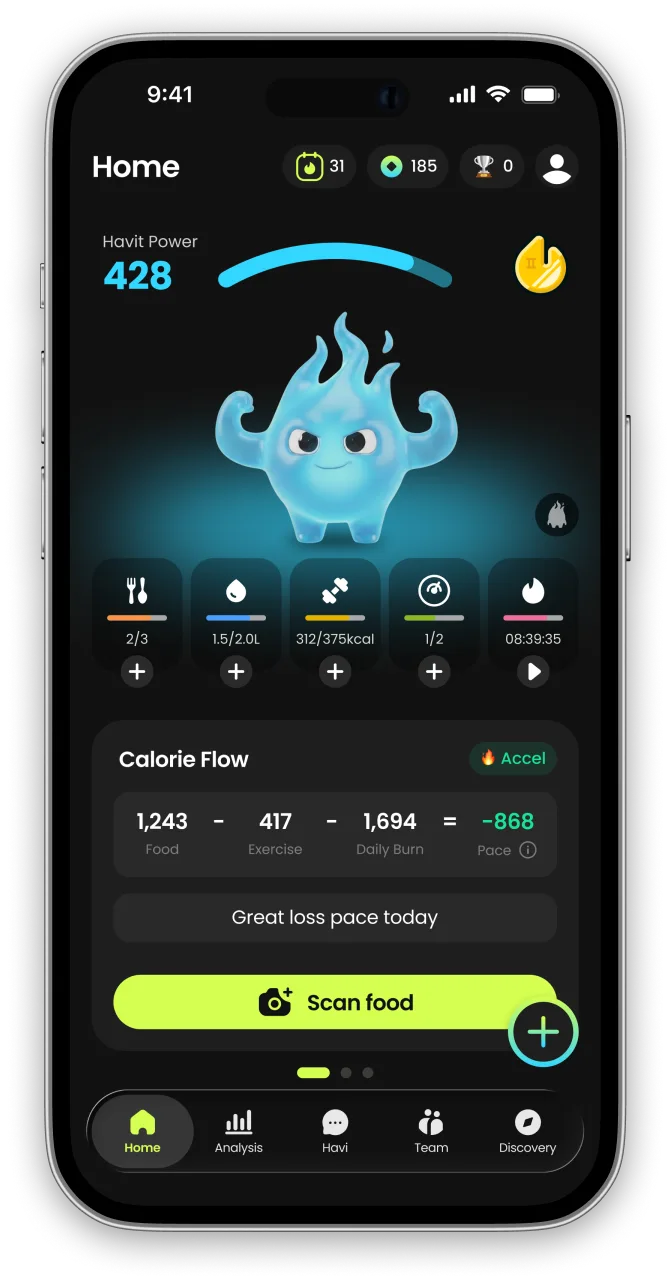
HAVIT is built for exactly this moment — one app that unites medication tracking, body composition, nutrition and protein, daily habit-building, and an AI coach that adapts to you.
Across our own 1,090 GLP-1 users, the most consistent trackers built the strongest habits (see the GLP-1 habit report).
Manage the medicine and the muscle — together. Start with HAVIT →
10
Related guides
- GLP-1 side effects: what's normal and when to worry
- GLP-1 tracker app: the complete guide
- GLP-1 diet: a 7-day meal plan
- Gamify weight loss: streaks & habits on GLP-1
- The GLP-1 Habit Report: what 1,090 users reveal
Get your questions answered and your habits tracked in one place — HAVIT.

Frequently asked questions
Are GLP-1 questions the same for Ozempic, Wegovy, Mounjaro, and Zepbound?
What should I eat first when appetite drops?
What do I do about a missed GLP-1 dose?
How long do GLP-1 side effects last?
Is a weight-loss plateau a sign the drug stopped working?
Can I prevent muscle loss on a GLP-1?
Do I have to stay on a GLP-1 forever?
Can an app answer my GLP-1 questions?
What is Havit?
Havit is an AI health companion for weight loss that protects muscle.
Unlike calorie-only trackers, Havit connects AI body-composition estimates, nutrition, hydration, sleep, steps, cycle, mood, and GLP-1 medication in one daily routine — so progress is measured by body composition, not just the number on the scale. Daily missions turn established behavior-change techniques into small repeatable actions, drawing on expertise from professionals formerly at Juvis Diet, one of Korea’s leading metabolic clinics.
In Havit’s own analysis of 1,090 GLP-1 users, people who logged consistently built stronger habits than the general user base. Read the GLP-1 Habit Report
Havit works with or without GLP-1 medication. It is a wellness app, not a medical device; body-composition results are estimates.

Continue in the App
Personalized wellness with your own data


References
- Wegovy (Novo Nordisk) — *Dosing schedule and missed-dose guidance.* wegovy.com
- Zepbound (Eli Lilly) — *Dosage options, schedules, and missed doses.* zepbound.lilly.com
- Cleveland Clinic — *GLP-1 Agonists.* my.clevelandclinic.org
- Cleveland Clinic — *How Long To Take a GLP-1 for Weight Loss.* health.clevelandclinic.org
- Neeland IJ, et al. *Changes in lean body mass with GLP-1-based therapies.* Diabetes, Obesity and Metabolism 2024. dom-pubs.onlinelibrary.wiley.com
- Lally P, et al. *How are habits formed.* Eur J Soc Psychol 2010;40:998-1009. onlinelibrary.wiley.com


