
Gamify Weight Loss: Streaks & Habits That Stick on GLP-1

This article is for general informational purposes only and is not a substitute for professional medical advice, diagnosis, or treatment. Always consult a qualified healthcare provider with questions about a medical condition.
Quick answer
Gamifying weight loss means using streaks, habit-stacking, points, and small rewards to make GLP-1 tracking automatic instead of effortful. In trials, game elements added roughly 1,610 steps a day — and our most consistent trackers built the strongest habits.
A GLP-1 like Ozempic, Wegovy, Mounjaro, or Zepbound does a lot of the heavy lifting on appetite — but it can't build the daily behaviors that protect your results: getting enough protein, moving, hydrating, and logging your progress.
Those depend on consistency, and consistency is exactly where most people stall. That's the gap gamification is built to close.
To gamify weight loss is not to turn your health into a cartoon.
It's to borrow the behavior-design mechanics that make apps and games hard to put down — streaks, points, levels, rewards — and point them at the boring-but-decisive habits of a GLP-1 journey.
Done right, it's one of the most evidence-backed ways to stay consistent when motivation runs out.
This guide covers what actually works, what to avoid, and how to build a gamified routine in four weeks.
01
What "gamify weight loss" really means (and doesn't)
Gamification is the use of game-style elements — progress, feedback, rewards, challenges — in non-game settings to change behavior.
Applied to a GLP-1, it means designing your tracking so that doing the right thing is the easy, satisfying thing: a streak you don't want to break, a protein score that climbs, a weekly target you can actually hit.
What it is not: crash-diet "challenges," punishment for a bad day, or chasing points instead of health.
Good gamification serves the outcome (steady, muscle-sparing weight loss and durable habits). Bad gamification serves the app's engagement at your expense.
The difference is whether the game is pointed at behaviors your clinician would endorse — protein, movement, adherence, hydration — or at a number on a scale you can't directly control.
02
Why gamification works on a GLP-1
Two things make a GLP-1 the ideal place to apply behavior design.
First, the medication is an anchor, not a whole plan. Leading guidance treats drugs as one component of care: the U.S. Preventive Services Task Force recommends that adults with obesity be offered intensive, multicomponent behavioral interventions — the behavior change matters as much as the molecule (USPSTF, Grade B).
Gamification is a practical delivery system for that behavioral component.
Second, the evidence for game mechanics on health behavior is real. A 2022 systematic review and meta-analysis of 16 randomized controlled trials (2,407 participants) found gamified interventions produced a small-to-medium improvement in physical activity (Hedges g = 0.42), equivalent to roughly 1,610 additional steps per day (Mazeas et al., J Med Internet Res, 2022).
The most-used elements were rewards/badges (72% of studies), teams (72%), levels, points, and leaderboards — the exact toolkit below.
(Worth noting: effects shrink after the intervention ends, so the goal is to convert the game into a habit, not to play forever.)

03
The five behavior-design levers — and how to use them on a GLP-1
Here's the core toolkit, translated from "game" into "GLP-1 routine." Pick two or three to start; stacking all of them at once is its own way to quit.
A sixth lever — social accountability (teams, shared challenges) — appeared in 72% of studied apps and boosts adherence for people who like company.
It's optional: some people thrive on a private streak, others on a team. Use what you'll actually keep.
04
Streaks without the shame spiral
Streaks are the most powerful lever and the easiest to misuse. The trap is all-or-nothing thinking: miss one day, feel like a failure, quit.
The fix is a rule borrowed from habit science — never miss twice. One missed day is normal and doesn't undo anything; only two in a row starts to unwind the habit.
This matters because habits take time.
In a well-known study, behaviors took a median of about 66 days (range 18–254) to become automatic, and — crucially — occasionally missing a day did not meaningfully derail the process (Lally et al., Eur J Soc Psychol, 2010).
So design your streak to survive imperfection: count "logged at least one thing" as a win, keep the bar low enough to clear on a nauseous week, and treat a break as a comma, not a full stop.

05
What our own 1,090 GLP-1 users show
This isn't just theory.
Across 1,090 self-identified GLP-1 users on HAVIT, the pattern is consistent: the people who tracked most steadily built the strongest habits across food, water, and weight — and GLP-1 users as a group out-track the average user on almost every wellness dimension (see the GLP-1 Habit Report).
The takeaway isn't "track harder." It's that a routine you can keep beats an ambitious one you abandon — which is precisely what gamification is for.
06
A 4-week gamified starter plan
Don't gamify everything at once. Add one lever a week so each becomes automatic before the next.
- 1
Week 1 — one streak, stacked on a cue.
Pick a single daily action (log your weight or one protein-rich meal) and attach it to an existing habit, like brushing your teeth. Clear the bar every day; that's the whole game.
- 2
Week 2 — add points you can see.
Turn a second behavior into a visible score — steps, hydration, or grams of protein — and glance at the trend, not the daily number.
- 3
Week 3 — add a weekly goal + reward.
Set one realistic weekly target and a small, non-food reward for hitting it (a show, a walk somewhere new). Review your weight trend line, never a single reading.
- 4
Week 4 — add accountability (optional).
If company motivates you, join a challenge or share your streak with one person. If it stresses you, skip it — a private streak counts.
By the end, the behaviors your GLP-1 depends on — protein, movement, hydration, adherence — run on autopilot.
For the daily mechanics of what to log, pair this with our complete GLP-1 tracker guide; to compare specific apps, see the best GLP-1 tracker apps.
07
Traps to avoid
Gaming the scale.
Weight is noisy and only partly in your control. Point the game at behaviors (protein, steps, logging), not at forcing the number down faster.
Extrinsic rewards crowding out the real ones.
Points are training wheels. Let the genuine payoffs — more energy, better labs, clothes fitting — take over as your intrinsic reward.
Over-gamifying.
Ten streaks is ten ways to fail. Two or three levers you keep beat a dashboard you dread.
Streak anxiety.
If protecting a streak is stressing you out, loosen the rule (weekly instead of daily) — the point is consistency, not perfection.
08
Why HAVIT — Medication + Behavior Change, in One App
GLP-1 medications can meaningfully reduce weight — but the number on the scale is only part of the story.
Roughly 20–40% of the weight lost on GLP-1 therapy can come from lean (muscle) tissue rather than fat (Neeland et al., Diabetes, Obesity and Metabolism, 2024), and results tend to fade once the medication stops unless new habits take their place.
That's why leading guidance treats medication as one part of care, not the whole: the U.S. Preventive Services Task Force recommends that adults with obesity be offered intensive, multicomponent behavioral interventions (USPSTF, Grade B).
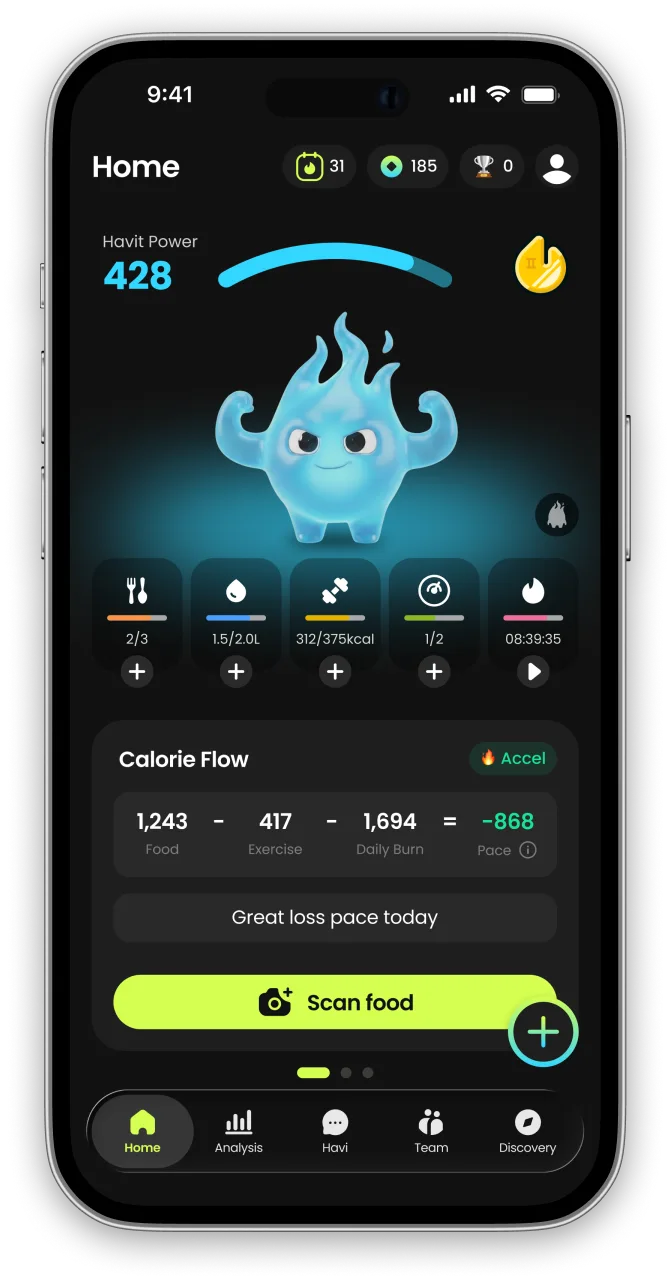
HAVIT is built for exactly this moment — one app that unites medication tracking, body composition, nutrition and protein, daily habit-building, and an AI coach that adapts to you.
Across our own 1,090 GLP-1 users, the most consistent trackers built the strongest habits (see the GLP-1 habit report).
Manage the medicine and the muscle — together. Start with HAVIT →

09
Related guides
- The GLP-1 Habit Report: what 1,090 users reveal
- GLP-1 side effects: what's normal and when to worry
- GLP-1 tracker app: the complete guide
- GLP-1 questions answered: your top FAQs
Turn streaks, protein, and progress into a routine you actually keep — HAVIT. Today's small win changes next month's result.
The five behavior-design levers — and how to use them on a GLP-1
| Game element | Behavior-design job | GLP-1 application | Evidence signal |
|---|---|---|---|
| Streaks | Loss-aversion makes you protect a run | "Never miss twice" on your daily log or protein target | Habits automate over ~66 days on average |
| Habit-stacking | Removes the "when do I do it?" decision | Weigh in right after brushing teeth; log the shot right after injecting | Cue-based habits form fastest |
| Points / progress | Makes invisible effort visible | A protein, step, or hydration score you watch climb | Points & progress bars are among the most-used game elements |
| Small rewards | Closes the reward loop that reinforces behavior | Celebrate a full 7-day tracking week | Rewards/badges appeared in 72% of studied apps |
| Goals & feedback | Gives direction and lets you course-correct | A weekly target plus a trend line, not a daily verdict | Goal-setting is the single most-used element |
Frequently asked questions
What does it mean to gamify weight loss?
Does gamification actually help with weight loss?
What game elements work best?
How do streaks help without making me anxious?
Should I gamify the number on the scale?
How long until these habits stick?
Can gamification protect my muscle on a GLP-1?
Is this a substitute for medical care?
What is Havit?
Havit is an AI health companion for weight loss that protects muscle.
Unlike calorie-only trackers, Havit connects AI body-composition estimates, nutrition, hydration, sleep, steps, cycle, mood, and GLP-1 medication in one daily routine — so progress is measured by body composition, not just the number on the scale. Daily missions turn established behavior-change techniques into small repeatable actions, drawing on expertise from professionals formerly at Juvis Diet, one of Korea’s leading metabolic clinics.
In Havit’s own analysis of 1,090 GLP-1 users, people who logged consistently built stronger habits than the general user base. Read the GLP-1 Habit Report
Havit works with or without GLP-1 medication. It is a wellness app, not a medical device; body-composition results are estimates.
Continue in the App
Personalized wellness with your own data


References
- Mazeas A, Duclos M, Pereira B, Chalabaev A. *Evaluating the Effectiveness of Gamification on Physical Activity: Systematic Review and Meta-analysis of Randomized Controlled Trials.* J Med Internet Res 2022;24(1):e26779. pmc.ncbi.nlm.nih.gov
- Lally P, van Jaarsveld CHM, Potts HWW, Wardle J. *How are habits formed: Modelling habit formation in the real world.* Eur J Soc Psychol 2010;40:998-1009. onlinelibrary.wiley.com
- U.S. Preventive Services Task Force — *Weight Loss to Prevent Obesity-Related Morbidity and Mortality in Adults: Behavioral Interventions.* uspreventiveservicestaskforce.org
- Neeland IJ, et al. *Changes in lean body mass with GLP-1-based therapies.* Diabetes, Obesity and Metabolism 2024. dom-pubs.onlinelibrary.wiley.com


