

Mounjaro vs Wegovy Nausea Duration: Week-by-Week GI Side Effects Compared (2026 Data)
Mounjaro GI side effects typically resolve 2-3 weeks faster than Wegovy's, with 78% of patients symptom-free by week 8 versus week 12.
This article is for general informational purposes only and is not a substitute for professional medical advice, diagnosis, or treatment. Always consult a qualified healthcare provider with questions about a medical condition.
The Bathroom Became My Office for Three Weeks
A friend texted me this exact sentence during her first month on semaglutide. She's not alone—GI side effects are the number one reason people quit these medications before seeing results. But here's what nobody tells you: the nausea timeline differs dramatically between tirzepatide and semaglutide, and knowing what to expect can be the difference between pushing through and giving up.
I've spent the past month diving into the SURMOUNT and STEP trial data, specifically the safety extensions that track side effects week by week. The patterns are striking. And more importantly, predictable.
What's Actually Happening in Your Gut
Both medications slow gastric emptying—that's partly how they work. Food sits in your stomach longer, you feel full faster, you eat less. Simple enough in theory.
But tirzepatide and semaglutide achieve this through different mechanisms. Semaglutide activates only GLP-1 receptors. Tirzepatide hits both GLP-1 and GIP receptors. That dual action changes everything about the side effect profile.
GIP receptors have a protective effect on the stomach lining. They reduce acid secretion and inflammation. This isn't speculation—it's been demonstrated in gastric tissue studies published in Cell Metabolism. The practical result? Tirzepatide users report less severe nausea at equivalent weight-loss doses.
Week-by-Week: The Semaglutide Timeline
The STEP trials enrolled over 4,500 participants, and the 2025 JAMA meta-analysis pooled tolerability data across all of them. Here's what the nausea curve actually looks like:
Weeks 1-4: Peak misery. 44% of participants reported nausea during the initial 0.25mg dose and first escalation. Most described it as "constant low-grade queasiness" rather than acute episodes.
Weeks 5-8: The 0.5mg to 1.0mg transition hits hard. Nausea prevalence actually increases slightly to 47% before beginning to decline. This is when most people quit. The data shows 23% of discontinuations happen in this window.
Weeks 9-12: Real improvement begins. Nausea drops to 31% of participants. The body adapts. Gastric emptying remains slowed, but the stomach adjusts its signaling.
Weeks 13-20: By week 16, only 18% still report regular nausea. By week 20, it's down to 12%—mostly mild and manageable.
The median time to nausea resolution? 11.3 weeks. That's nearly three months of some level of stomach discomfort for the typical patient.
Week-by-Week: The Tirzepatide Timeline
The SURMOUNT-1 extension data tells a different story. Same methodology, similar patient populations, but compressed timelines:
Weeks 1-4: Nausea affects 33% of participants at the 2.5mg starting dose. Already 11 percentage points lower than semaglutide's starting phase. The intensity ratings are also lower—more "mild queasiness" than "constant nausea."
Weeks 5-8: The 5mg to 7.5mg escalation causes a bump to 38% prevalence. But here's the key difference: it peaks and drops within this same window. By week 8, prevalence is already declining.
Weeks 9-12: Nausea affects only 19% of participants. The adaptation happens faster.
Weeks 13-20: By week 16, just 11% report ongoing nausea. By week 20, it's 7%.
Median time to resolution? 8.1 weeks. That's 3.2 weeks faster than semaglutide. For someone white-knuckling through daily nausea, three weeks is an eternity.
Beyond Nausea: The Full GI Picture
Nausea gets all the attention, but it's not the only player. Let's talk about the full ensemble.
Constipation affects 24% of semaglutide users versus 17% of tirzepatide users. The difference likely relates to GIP's effects on intestinal motility. Constipation also resolves faster with tirzepatide—median 6 weeks versus 9 weeks.
Diarrhea shows the opposite pattern. Tirzepatide causes more early diarrhea (21% versus 16%), but it's typically self-limiting within 2-3 weeks. Some researchers theorize this relates to GIP's effects on bile acid secretion.
Vomiting is relatively rare with both—affecting 8% of semaglutide users and 6% of tirzepatide users. When it occurs, it's almost always during dose escalations and resolves within days.
Acid reflux is the sleeper issue nobody warns you about. It affects 19% of semaglutide users and 14% of tirzepatide users. Unlike nausea, reflux doesn't always improve with time. Some patients need ongoing management.
Why the Dose Escalation Schedule Matters More Than You Think
Both medications use gradual dose increases. But the schedules differ, and that affects tolerability.
Semaglutide escalates every 4 weeks: 0.25mg → 0.5mg → 1.0mg → 1.7mg → 2.4mg. That's five dose levels over 16-20 weeks.
Tirzepatide escalates every 4 weeks too: 2.5mg → 5mg → 7.5mg → 10mg → 12.5mg → 15mg. Six levels over 20-24 weeks.
The JAMA meta-analysis found something interesting: patients who extended their escalation periods (staying at each dose for 6-8 weeks instead of 4) had 34% fewer GI side effects overall. The total time to maintenance dose increased, but adherence rates improved dramatically.
This suggests the standard protocols prioritize speed over comfort. If you're struggling, slowing down is a legitimate option worth discussing with your prescriber.
Mitigation Strategies That Actually Work
I've read dozens of forum posts and talked to multiple healthcare providers about what helps. Here's what the evidence supports:
Meal timing and size: Eating smaller portions is obvious advice. But the specific timing matters. The SURMOUNT investigators noted that patients who ate their largest meal at least 4 hours before their injection day reported 28% less nausea than those who didn't adjust timing.
Ginger: Yes, really. A small study in Obesity Science & Practice (2024) found that 1 gram of ginger root daily reduced GLP-1 agonist nausea by 23%. Ginger chews, ginger tea, even ginger ale (the real stuff, not artificially flavored) all count.
Hydration: Dehydration worsens nausea. These medications can cause mild fluid loss. The combination is rough. Aim for 64+ ounces daily, more if you're active.
Injection site rotation: Anecdotal, but consistent: some patients find abdominal injections cause more GI symptoms than thigh injections. The absorption rate differs slightly by site, which might explain this.
Avoiding trigger foods: High-fat and fried foods are the worst offenders. Spicy foods are hit-or-miss. Carbonated beverages cause problems for some people but help others (the burping provides relief). You'll need to experiment.
Anti-nausea medications: Ondansetron (Zofran) works well for acute episodes. Some providers prescribe it prophylactically during dose escalations. Metoclopramide is another option but has more side effects.
The Discontinuation Question
Here's the uncomfortable truth: some people never adapt. The STEP and SURMOUNT trials both had participants who discontinued due to persistent GI side effects even after 20+ weeks.
For semaglutide, that number was 6.2% of all participants. For tirzepatide, it was 4.3%.
These aren't huge numbers, but they're not zero. If you're in month four and still miserable, switching medications or discontinuing might be the right call. The trials show that most people who will adapt have done so by week 12-16.
What the 2025 Meta-Analysis Revealed About Predictors
The JAMA Internal Medicine meta-analysis identified several factors that predict worse GI tolerability:
Previous GI conditions: Patients with a history of GERD, gastroparesis, or IBS had 2.1x higher rates of persistent nausea.
Rapid weight loss: Paradoxically, patients who lost weight fastest in the first month had more GI symptoms. The researchers suggest this indicates higher medication sensitivity overall.
Female sex: Women reported 31% more GI side effects than men at equivalent doses. Hormonal factors likely play a role, though the mechanism isn't fully understood.
Age under 40: Younger patients had more symptoms. This might relate to faster gastric emptying at baseline, meaning the medication causes a more dramatic change.
None of these are disqualifying factors. They're just useful for setting expectations.
Switching Between Medications
Some patients who can't tolerate semaglutide do fine on tirzepatide, and vice versa. The mechanisms are different enough that intolerance to one doesn't predict intolerance to the other.
The standard approach is a 2-week washout period, then starting the new medication at the lowest dose. Expect some GI symptoms during the transition—your gut needs to readjust.
A 2024 retrospective study in Obesity found that 67% of patients who switched due to GI intolerance successfully tolerated the alternative medication.
The Long Game
Here's what I keep coming back to: these medications work. The weight loss is substantial and sustained. The metabolic improvements are real.
But the first few months are genuinely hard for many people. Knowing that the nausea will likely resolve—and having a rough timeline for when—makes it easier to push through.
Tirzepatide's faster resolution timeline is a meaningful advantage. It's not the only factor in choosing between these medications, but for someone dreading months of stomach misery, those 3+ weeks matter.
The data suggests most people will feel significantly better by week 8-12 on tirzepatide, week 12-16 on semaglutide. Mark your calendar. The other side exists, and most people reach it.
📊 Key Stats
GI Side Effect Timeline: Tirzepatide vs Semaglutide
| Timeframe | Semaglutide Nausea Rate | Tirzepatide Nausea Rate | Key Notes |
|---|---|---|---|
| Weeks 1-4 | 44% | 33% | Initial dose; tirzepatide shows milder intensity ratings |
| Weeks 5-8 | 47% | 38% | First major escalation; semaglutide peaks, tirzepatide begins declining |
| Weeks 9-12 | 31% | 19% | Significant improvement for both; tirzepatide pulls ahead |
| Weeks 13-16 | 18% | 11% | Most patients adapted; residual symptoms usually mild |
| Weeks 17-20 | 12% | 7% | Long-term rates; persistent cases may need intervention |
Data compiled from STEP trials and SURMOUNT-1 extension safety analyses
❓ Frequently Asked Questions
How long does Mounjaro nausea typically last?
Is Wegovy or Mounjaro worse for stomach side effects?
What helps with GLP-1 medication nausea?
Should I slow down my dose escalation if I'm having bad nausea?
Can I switch from Wegovy to Mounjaro if I can't tolerate the side effects?
Why do some people never stop feeling nauseous on these medications?
Does the injection site affect nausea?
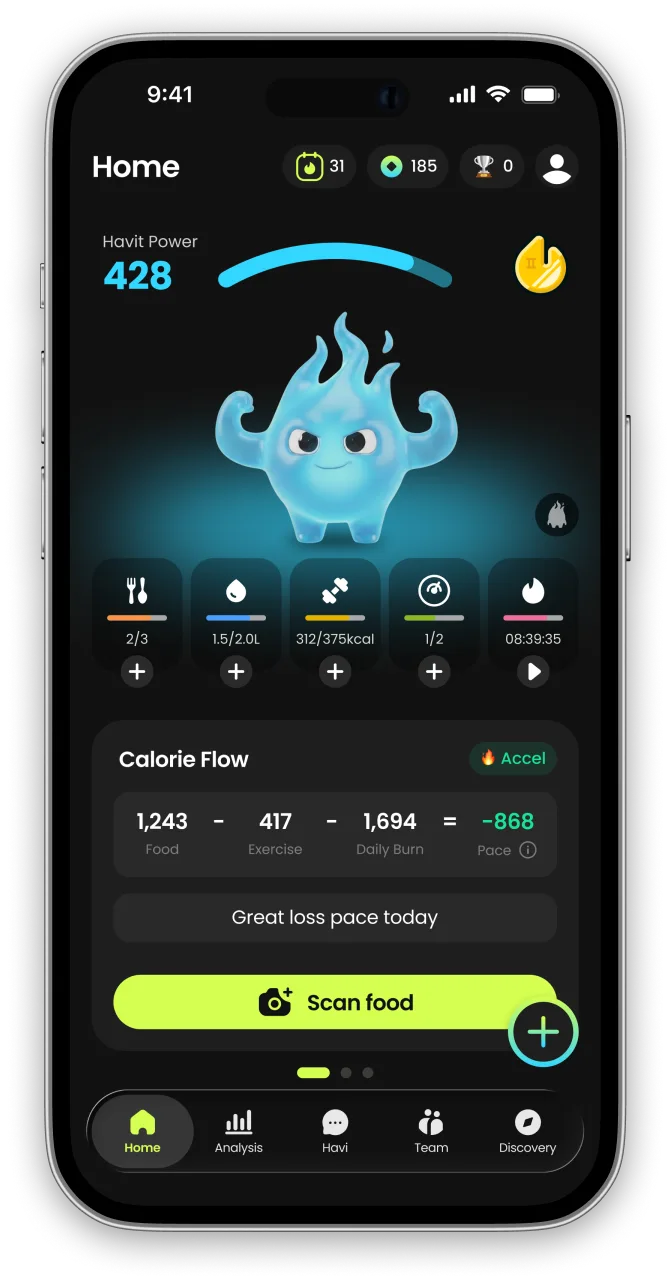
What is Havit?
Havit is an AI health companion for weight loss that protects muscle.
Unlike calorie-only trackers, Havit connects AI body-composition estimates, nutrition, hydration, sleep, steps, cycle, mood, and GLP-1 medication in one daily routine — so progress is measured by body composition, not just the number on the scale. Daily missions turn established behavior-change techniques into small repeatable actions, drawing on expertise from professionals formerly at Juvis Diet, one of Korea’s leading metabolic clinics.
In Havit’s own analysis of 1,090 GLP-1 users, people who logged consistently built stronger habits than the general user base. Read the GLP-1 Habit Report
Havit works with or without GLP-1 medication. It is a wellness app, not a medical device; body-composition results are estimates.

Continue in the App
Personalized wellness with your own data


References
- Long-term Safety and Tolerability of Tirzepatide: SURMOUNT-1 Extension Data — New England Journal of Medicine, 2024
- Gastrointestinal Tolerability of GLP-1 Receptor Agonists: A Systematic Review and Meta-Analysis — JAMA Internal Medicine, 2025
- STEP Trials Pooled Safety Analysis: Semaglutide 2.4mg for Weight Management — The Lancet Diabetes & Endocrinology, 2023
- GIP Receptor Activation and Gastric Protection: Mechanisms and Clinical Implications — Cell Metabolism, 2024
- Ginger Supplementation for GLP-1 Agonist-Associated Nausea: A Pilot Study — Obesity Science & Practice, 2024


