

GLP-1 Alone Is Not Enough — The "Drug + Behavioral Therapy" Model Recommended by WHO/ADA, and HAVIT's M0/M1/M2 Stages
GLP-1 receptor agonists (Wegovy, Mounjaro, Zepbound) produce 15–22% average weight loss (STEP 1, SURMOUNT-1). But STEP 4 reported +11.6%p regain one year after discontinuation — about 78% of weight loss returned. WHO (2022) and ADA Standards (2024) explicitly recommend behavioral therapy alongside pharmacotherapy, and STEP 3 (JAMA 2021) showed Intensive Behavioral Therapy in combination achieved nearly 3× the weight loss of standard-care combination (−16% vs −5.7%). HAVIT structures this in 3 stages — pre-medication (M0), adaptation (M1), maintenance/discontinuation (M2) — integrating drugs, muscle preservation, and behavior learning. HAVIT does not prescribe GLP-1; prescription, dosing, and discontinuation remain the physician's domain.
This article is for general informational purposes only and is not a substitute for professional medical advice, diagnosis, or treatment. Always consult a qualified healthcare provider with questions about a medical condition.
1. Why Drug Alone Is Not the Answer in the GLP-1 Era
Since the FDA approved Wegovy (semaglutide 2.4mg) as an obesity treatment in 2021, the landscape of obesity care has completely changed.
Efficacy figures (52–68 weeks):
- Wegovy (semaglutide): average 14.9% weight loss (STEP 1, Wilding et al. 2021, NEJM)
- Zepbound (tirzepatide): average 22.5% (SURMOUNT-1, Jastreboff et al. 2022, NEJM)
No prior obesity treatment achieved these numbers.
However — follow-up data from the same trials reveal the limits.
1.1 STEP 4 — Regain After Discontinuation
STEP 4 (Rubino et al. 2021, NEJM) followed groups switched from semaglutide to placebo after the STEP 1 trial ended.
One year after drug discontinuation, average +11.6%p regain — about 78% (~3/4) of the ~14.9% loss in STEP 1 returned.
This is the GLP-1 trap. The drug is powerful, but only under lifelong-use assumptions. Yet for reasons including lifelong cost, accumulating side effects, pregnancy plans, and insurance/payment ability, most users eventually discontinue.
1.2 Explicit Guideline Recommendations from WHO and ADA
"Drug + behavioral therapy" combination, not drug alone, is the guideline standard:
- WHO Clinical Management of Obesity Guidelines (2022) — Obesity pharmacotherapy must be combined with "lifestyle interventions with behavior change support."
- ADA Standards of Medical Care in Diabetes (2024, §8) — Obesity drug prescribing requires "concurrent intensive behavioral interventions."
- Endocrine Society Clinical Practice Guideline — Concurrent nutrition, physical activity, and behavioral management are essential for GLP-1 users.
1.3 STEP 3 Demonstrating the Effect of Behavioral Therapy Intensity
Wadden et al. (2021, JAMA) STEP 3 — 611 participants randomized.
- Semaglutide 2.4mg + standard care: −5.7%
- Semaglutide 2.4mg + Intensive Behavioral Therapy (IBT): −16.0%
Same drug, same dose, same period — the only difference was behavioral therapy intensity. It amplified the drug effect by more than 2×.
Solution: A systematic behavior change system that prepares both while the drug is in use and after discontinuation.
2. Why GLP-1 Alone Falls Short — 3 Clinical Reasons
2.1 Muscle Loss (Sarcopenic Obesity Risk)
The STEP 1 DXA sub-study reported about 30–40% of weight loss as lean mass (muscle and connective tissue) loss (Wilding et al. 2022, Diabetes Obes Metab sub-study). At 14.9kg loss, this means an estimated 4.5–6kg muscle loss.
Muscle is the metabolic engine. Muscle loss means lower BMR, and after discontinuation, weight rebuilds faster on the same diet. In older age, sarcopenic obesity is associated with elevated mortality (Roh et al. 2024, Endocrinology and Metabolism).
→ Resistance training + adequate protein intake essential
2.2 "Food Noise" Disappears → Eating Habits Not Learned
One major effect of GLP-1 is suppression of "food noise" (persistent food thoughts). Appetite naturally drops.
The problem is that food noise returns after discontinuation. If eating habits weren't learned (because the drug handled it), bingeing mode resumes.
→ Eating habit learning is essential during the drug's effective window
2.3 No Plateau Response
GLP-1 users experience weight loss deceleration at certain points (Wadden et al. 2021, Obesity). Dose changes or behavioral changes are needed, requiring accurate assessment and prescription at that moment.
→ Automatic plateau detection + automatic prescription adjustment tools needed
3. HAVIT's M0/M1/M2 3-Stage Integrated Prescription
HAVIT divides GLP-1 users by treatment timeline into 3 stages — implementing the "drug + behavioral therapy" model recommended by WHO/ADA/STEP 3:
M0: Pre-medication ~ first 4 weeks
M1: Drug adaptation (4 weeks ~ 8-12 weeks)
M2: Maintenance · discontinuation · post-discontinuation (8-12+ weeks)
3.1 M0 — Pre-Medication Baseline
Goal: Accurate baseline measurement + GI side-effect prevention diet
HAVIT prescription:
- AI body composition baseline: body fat %, muscle mass, visceral fat measurement. Reference point for change tracking after drug start.
- GI side-effect prep diet: First 4 weeks: soft, low-fat meals — immediate adjustment options if nausea/vomiting occur.
- Hydration · electrolyte monitoring: Reduced food intake → dehydration risk → 35ml/kg daily guidance.
- Resistance training onboarding: Pre-start muscle baseline + 2× weekly resistance training recommended.
3.2 M1 — Drug Adaptation (4 weeks ~ 8-12 weeks)
Goal: Muscle preservation + eating habit learning + plateau preparation
HAVIT prescription:
- Protein 1.6–2.0 g/kg/day (70kg body → 112–140g/day) — ISSN Position Stand 2017 cutting guideline. Prevents automatic low-protein intake from reduced appetite.
- Resistance training 3× weekly recommended — 65–80% of 1RM. Core to preventing muscle loss despite reduced appetite.
- Sleep 7–9 hours monitoring — Sleep deprivation disrupts appetite hormone balance (ghrelin↑, leptin↓), reducing behavioral prescription effectiveness.
- Weekly body composition tracking — AI body composition estimation (n=70 internal comparison vs InBody, ±5% agreement 92.9%) detects weekly changes. Users provide smartphone survey + basic body info only (photos optional).
- AI coach plateau detection — Trigger for prescription adjustment when 7-day average weight change falls below threshold.
3.3 M2 — Maintenance · Post-Discontinuation (8-12+ weeks)
Goal: Behavior habituation + post-discontinuation regain prevention (STEP 4 response)
HAVIT prescription:
- Food noise return preparation behavior guide — As drug effect weakens, strengthen pre-meal hydration, eating environment adjustment, slow eating, and similar behavior signals.
- Calorie cycling — Not identical daily calories X → weekday diet + weekend mild high-day pattern (the maintainer pattern Wing & Phelan 2005 reported).
- Increase low-intensity activity — NEAT (non-exercise activity thermogenesis) — tracking walks, stairs, and daily activity.
- Regain risk score — Simultaneous decline in weight, food logging frequency, and exercise frequency triggers risk alert and healthcare-professional consultation suggestion.
- 6-month follow-up cohort — Average regain patterns of post-discontinuation users → archetype-differentiated prescription.
4. Case Scenarios (Illustrative)
Scenario A: First-time Wegovy user, 45F, BMI 32
M0 (Week 0):
- AI body composition: 38% body fat, 22kg muscle, BMR 1,380
- Protein target: 112g/day (1.6 g/kg)
- Exercise baseline: 0×/week → 2×/week walks + 1× resistance start
- Diet: soft food focus, <30g fat per meal
M1 (Week 4-8):
- Past nausea phase, reaches 2.4mg dose
- Weight loss 5.2kg (-4.5%) — normal pace
- Muscle 23.5kg (slight gain — exercise effect)
- Plateau detection: Week 7 weight change +0.1kg
- AI prescription adjustment: protein +10g, resistance intensity 70% → 75%
M2 (Week 12+):
- Cumulative -12% reached
- Decision time: maintain vs reduce dose
- HAVIT scenarios: "maintain drug" vs "reduce + behavior settling" two options simulated
- User choice after physician consultation: maintain + behavior habituation 6 months
Scenario B: Mounjaro user in plateau, 35M
HAVIT assessment:
- 7-day weight variation ±0.2kg (plateau confirmed)
- Average protein intake 95g/day (target 140g, under)
- Sleep 5.8h (target 7-9h, under)
- Resistance training 1×/week (target 3×, under)
HAVIT prescription:
- Week 1: protein +30g/day (egg, Greek yogurt, chicken breast options presented)
- Week 2: +30 min sleep (cut evening caffeine + screen time)
- Week 3-4: resistance 2× → 3× + 70% intensity maintained
- After 4 weeks → average weight change -1.8kg
(※ The above are illustrative cases of HAVIT prescription algorithm behavior; actual user outcomes vary, and physician guidance takes precedence.)
5. After Discontinuation — 6 Regain-Prevention Signals
See the comparison table below for the M2 stage monitoring signals.
When 3+ signals concurrently appear, healthcare-professional consultation recommended.
6. The Same Framework for Non-Drug Users — Lifestyle Intervention Evidence (DPP Basis)
The same M0/M1/M2 structure applies to non-GLP-1 users (only some of HAVIT's 126 archetypes are GLP-1-related).
Basis: DPP (Diabetes Prevention Program, NEJM 2002) — 3,234 participants randomized; lifestyle intervention reduced diabetes incidence almost 2× more than metformin (58% vs 31%). Without medication, systematic lifestyle intervention produces strong effects.
Look AHEAD (NEJM 2013) — 10-year follow-up; intensive lifestyle intervention consistently improved weight, HbA1c, and cardiovascular risk factors over standard care.
That is, regardless of GLP-1 use, systematic behavior change + self-monitoring is the academic consensus on the core of effectiveness.
7. Limitations and Caveats
Stated transparently:
- HAVIT does not prescribe GLP-1. Drug prescription, dosing, discontinuation, and transition decisions are the physician's domain. HAVIT is a supportive tool for behavior change, diet, exercise, and body composition monitoring during drug use.
- STEP/SURMOUNT trials are averages. Individual responses vary considerably; HAVIT scenarios are illustrative.
- Compounded GLP-1 products lack FDA approval and carry FDA Drug Safety Communication (2025) warnings. HAVIT designs its integrated workflow against FDA-approved GLP-1 only.
- Microdosing trends (e.g., 0.25mg long-term low-dose use) lack clinical validation. HAVIT bases prescription on standard dose-titration protocols.
- Physician monitoring takes precedence — Side effects and clinical changes during GLP-1 use are the prescriber's monitoring domain. HAVIT is a daily-supportive tool.
8. Global Market Application — US First
The US has the fastest-growing GLP-1 user population. CDC NHANES 2021–2023 reports US adult obesity at 41.9% (~136M), with Wegovy and Zepbound prescriptions growing in double digits annually. Simultaneously, regain after discontinuation, healthcare cost burden, and limited behavioral therapy access are reported.
HAVIT focuses on the US as a core market — bringing the clinically validated behavior-prescription know-how of the Korean metabolic clinic model (K-Wellness) into digital form, to close the "drug + behavioral therapy integration" gap that US GLP-1 users face.
9. Conclusion
Even in the GLP-1 era, "drug + behavioral therapy" is the effectiveness standard. STEP 3, STEP 4, WHO, and ADA all point in the same direction.
The challenge is behavioral therapy access. Human-coach IBT is expensive and difficult to scale. HAVIT brings clinically validated models (the JUVIS Diet 12-week transformation program know-how) into digital and AI coaching, creating integrated behavioral therapy access for global GLP-1 users including the US.
Drug prescription and discontinuation decisions remain the physician's domain. HAVIT is a supportive tool around those decisions — daily behavior, diet, exercise, and body composition monitoring. (HAVIT is not a medical diagnostic tool.)
📊 Key Stats
6 Regain-Prevention Signals Monitored in HAVIT's M2 Stage
| # | Signal | Risk Threshold | Automatic Action |
|---|---|---|---|
| 1 | Weekly weight change | ≥ +0.5kg/week | Diet + exercise prescription adjustment |
| 2 | Food logging frequency | < 5×/week | Notification reinforcement + mission simplification |
| 3 | Protein intake | < 1.2 g/kg | Food recommendation reinforcement |
| 4 | Exercise frequency | < 2×/week | Short missions (7-min workouts) presented |
| 5 | Sleep time | < 6h for 7 consecutive days | Sleep hygiene coaching |
| 6 | Body composition change | Muscle -1kg / month | Integrated exercise + protein prescription |
When 3+ signals concurrently appear, healthcare-professional consultation is recommended. Drug-related decisions remain with the prescriber.
❓ Frequently Asked Questions
Does HAVIT prescribe GLP-1 drugs?
Is it true that 60–70% returns after discontinuation?
Does behavioral therapy really double the drug effect?
Are M0/M1/M2 prescriptions the same as physician guidelines?
What about compounded semaglutide users?
What is Havit?
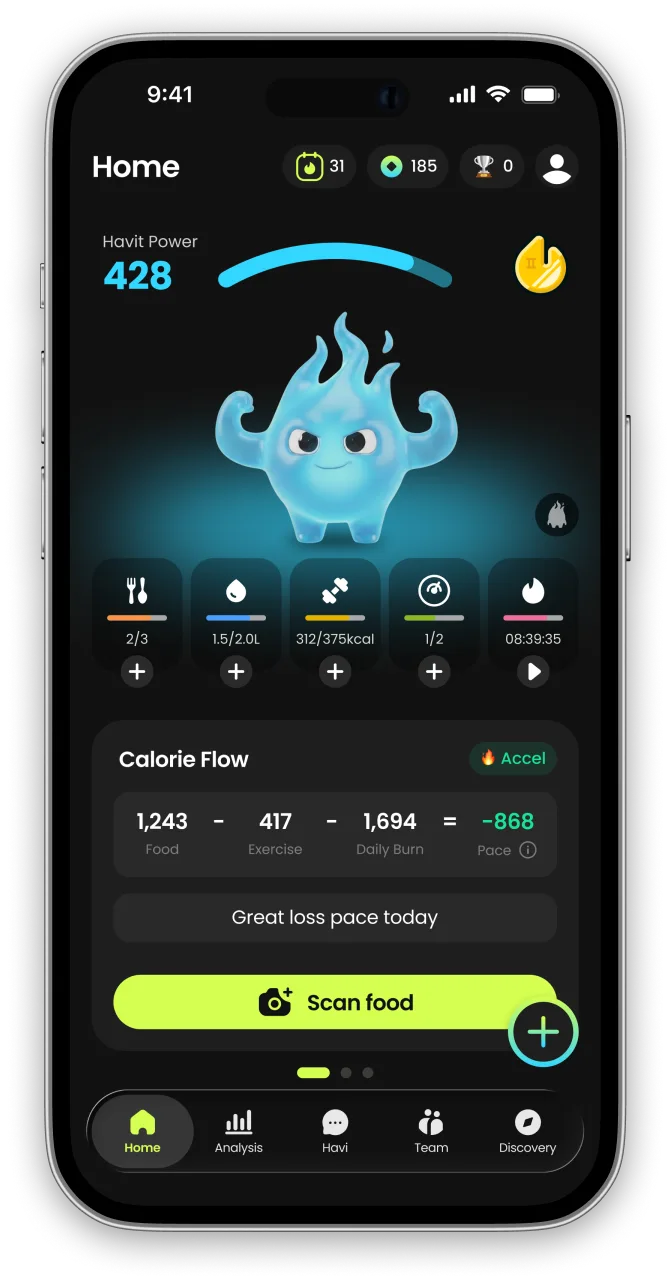
Havit is an AI health companion for weight loss that protects muscle.
Unlike calorie-only trackers, Havit connects AI body-composition estimates, nutrition, hydration, sleep, steps, cycle, mood, and GLP-1 medication in one daily routine — so progress is measured by body composition, not just the number on the scale. Daily missions turn established behavior-change techniques into small repeatable actions, drawing on expertise from professionals formerly at Juvis Diet, one of Korea’s leading metabolic clinics.
In Havit’s own analysis of 1,090 GLP-1 users, people who logged consistently built stronger habits than the general user base. Read the GLP-1 Habit Report
Havit works with or without GLP-1 medication. It is a wellness app, not a medical device; body-composition results are estimates.

Continue in the App
Personalized wellness with your own data


References
- STEP 1 — Once-Weekly Semaglutide in Adults with Overweight or Obesity (n=1,961) (Wilding et al.) — New England Journal of Medicine, 2021
- STEP 1 DXA sub-study (lean mass) (Wilding et al.) — Diabetes, Obesity and Metabolism, 2022
- STEP 3 — Semaglutide + Intensive Behavioral Therapy (n=611) (Wadden et al.) — JAMA, 2021
- STEP 4 — Continued vs Withdrawn Treatment (regain) (Rubino et al.) — New England Journal of Medicine, 2021
- SURMOUNT-1 — Tirzepatide for Obesity (n=2,539) (Jastreboff et al.) — New England Journal of Medicine, 2022
- Diabetes Prevention Program — DPP (Knowler et al.) — New England Journal of Medicine, 2002
- Cardiovascular Effects of Intensive Lifestyle Intervention (Look AHEAD Research Group) — New England Journal of Medicine, 2013
- Long-term weight loss maintenance (Wing & Phelan) — American Journal of Clinical Nutrition, 2005
- ISSN Position Stand — Protein and Exercise — Journal of the International Society of Sports Nutrition, 2017
- Plateau dynamics in pharmacologic weight loss (Wadden et al.) — Obesity, 2021
- Clinical Management of Obesity Guidelines — World Health Organization, 2022
- Standards of Medical Care in Diabetes, §8 — American Diabetes Association, 2024
- Sarcopenic obesity and mortality (Roh et al.) — Endocrinology and Metabolism, 2024
- Compounded GLP-1 RA Products — Drug Safety Communication — U.S. Food and Drug Administration, 2025
- Internal Body Composition Validation Study, n=70 — AI Connect, 2025


