
GLP-1 for Menopause: Weight Gain, Belly Fat & Muscle (2026)

This article is for general informational purposes only and is not a substitute for professional medical advice, diagnosis, or treatment. Always consult a qualified healthcare provider with questions about a medical condition.
Quick answer
GLP-1 for menopause is used to treat the weight gain and visceral belly fat that often accompany the menopause transition — not menopause itself. Drugs like semaglutide (Ozempic, Wegovy) can reduce weight and abdominal fat, but a portion of the loss is muscle, so protein and strength training are essential to protect midlife muscle and bone.
The menopause transition reshapes the body.
As estrogen declines, fat shifts from the hips and thighs toward the abdomen as visceral fat, resting energy expenditure falls, and muscle loss (sarcopenia) accelerates.
On average, women gain roughly 1–1.5 pounds per year through the transition, on top of normal aging, per the Study of Women's Health Across the Nation (SWAN).
For many women this is the first time exercise and dieting "stop working" the way they used to.
That is why GLP-1 receptor agonists — semaglutide (Ozempic, Wegovy) and the dual GIP/GLP-1 drug tirzepatide (Mounjaro, Zepbound) — have become a common midlife conversation.
This page explains what they can do for menopause weight gain, the muscle-loss risk you must actively manage, how hormone therapy fits in, and what to track.
It is education, not a prescription.
01
Why menopause changes your weight and shape
Menopause weight gain is not simply "willpower" — it is a measurable shift in biology driven by falling estrogen layered on aging. Three changes matter most:
The visceral-fat shift is the key clinical concern: research from the SWAN Heart Study links the rise in visceral adipose tissue across the menopause transition to greater cardiovascular risk.
So the goal in midlife is not just a lower number on the scale — it is less visceral fat while preserving muscle and bone.
02
Can a GLP-1 help menopause weight gain?
Yes — but understand what it treats. No GLP-1 is FDA-approved for "menopause." These drugs are approved for type 2 diabetes and chronic weight management, and many menopausal women qualify on those grounds.
Because GLP-1s slow gastric emptying, reduce appetite via the brain, and improve insulin sensitivity, they tend to preferentially reduce fat mass, including visceral and ectopic fat — exactly the depot that expands in menopause.
There is also emerging interest in pairing GLP-1s with menopausal hormone therapy (MHT/HRT): estrogen therapy is associated with reduced total and visceral adiposity, and some clinicians report better body-composition results when the two are combined than with either alone.
This is an individualized decision with its own risks and benefits — one to make with a menopause-literate clinician, not from a blog.

03
The muscle-loss risk you must manage
This is the most important section for midlife.
All meaningful weight loss — from dieting, GLP-1s, or surgery — includes some lean mass (muscle), and evidence from randomized trials indicates GLP-1-based therapies typically produce lean-mass reductions representing roughly 20–30% of total weight lost. In menopause, that lands on top of estrogen-driven sarcopenia that is already underway.
Why this compounds: less muscle means a lower resting metabolism (making weight harder to keep off), weaker support for bone (which is also thinning as estrogen falls), and reduced strength and function.
Losing weight while losing disproportionate muscle can leave you lighter but metabolically worse off.
The countermeasures are well established and non-negotiable in midlife:
- Prioritize protein at every meal to support muscle protein synthesis.
- Strength-train 2–3 times per week — the single most protective habit for muscle and bone.
- Lose weight gradually, not crash-fast, to limit lean-mass loss.
- Protect bone with adequate calcium, vitamin D, and clinician-guided monitoring.
- Track body composition, not just weight, so muscle loss is caught early.
04
Hormones, hot flashes, and the bigger picture
Weight is not the only midlife lever.
Higher lean body mass is associated with fewer vasomotor symptoms (hot flashes and night sweats) in SWAN data, another reason muscle preservation matters beyond metabolism.
If you are considering hormone therapy, weight management, and a GLP-1 together, the sequencing and combination should be individualized.
A GLP-1 addresses weight and appetite; MHT addresses estrogen-driven symptoms and may itself blunt visceral-fat gain.
They solve different problems and can be complementary — under medical guidance.
Also remember the general GLP-1 safety landscape still applies in midlife: gastrointestinal side effects around dose changes, and the rarer serious risks.
Review our full GLP-1 side effects guide, and if muscle is your priority, our note on protecting it during weight loss.

05
What to track on a GLP-1 in menopause
In midlife the right metrics shift from "weight" to "body composition and function." Track these:
| What to track | Why it matters in menopause | How often |
|---|---|---|
| Weight and waist | Visceral fat is the real target | Weekly |
| Body composition (muscle vs fat) | Catch disproportionate muscle loss early | Monthly / per scan |
| Protein intake | Protects muscle during weight loss | Daily |
| Strength sessions | The top muscle- and bone-protective habit | 2–3×/week |
| Hot flashes / sleep / mood | Menopause symptom trend | Weekly |
| Bone-health markers | Estrogen loss thins bone | Per clinician |
| GI side effects | Tolerability & dose timing | As they occur |
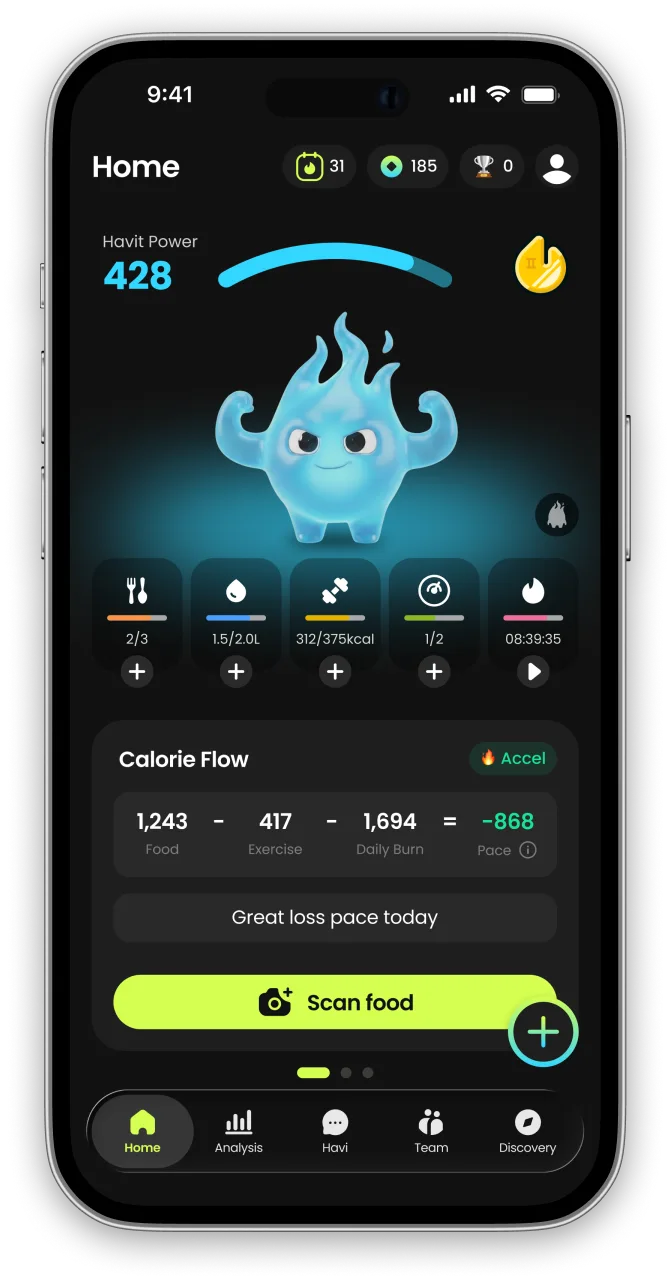
Logging weight and waist and protein and strength together is exactly what the Havit app makes effortless — so you can confirm you are losing fat while holding onto muscle, and bring real data to your menopause or endocrinology appointment. (Havit is a tracking companion, not a medical device — always defer to your clinician.)
Women whose weight struggles began earlier with a hormonal condition may also want GLP-1 for PCOS, and anyone weighing options can start with the GLP-1 weight-loss calculator.
06
Why HAVIT — Medication + Behavior Change, in One App
GLP-1 medications can meaningfully reduce weight — but the number on the scale is only part of the story.
Roughly 20–40% of the weight lost on GLP-1 therapy can come from lean (muscle) tissue rather than fat (Neeland et al., Diabetes, Obesity and Metabolism, 2024), and results tend to fade once the medication stops unless new habits take their place.
That's why leading guidance treats medication as one part of care, not the whole: the U.S. Preventive Services Task Force recommends that adults with obesity be offered intensive, multicomponent behavioral interventions (USPSTF, Grade B).
HAVIT is built for exactly this moment — one app that unites medication tracking, body composition, nutrition and protein, daily habit-building, and an AI coach that adapts to you.
Across our own 1,090 GLP-1 users, the most consistent trackers built the strongest habits (see the GLP-1 habit report).
Manage the medicine and the muscle — together. Start with HAVIT →

Why menopause changes your weight and shape
| Change | What happens in menopause | Why it matters |
|---|---|---|
| Estrogen decline | Fat redistributes from hips/thighs to the abdomen | Drives visceral fat, which is metabolically riskier |
| Visceral fat rise | Deep abdominal fat can climb from ~5–8% to ~10–15% of body weight | Linked to insulin resistance and cardiovascular risk |
| Muscle loss (sarcopenia) | Estrogen loss speeds decline in lean muscle | Lowers resting metabolism, weakens bone support |
Frequently asked questions
Is a GLP-1 approved for menopause?
Does a GLP-1 target menopause belly fat?
Will I lose muscle on a GLP-1 during menopause?
Can I take a GLP-1 with hormone therapy (HRT)?
Why is menopause weight so hard to lose?
Does a GLP-1 help hot flashes?
Is a GLP-1 safe after menopause?
Will menopause weight come back if I stop?
What is Havit?
Havit is an AI health companion for weight loss that protects muscle.
Unlike calorie-only trackers, Havit connects AI body-composition estimates, nutrition, hydration, sleep, steps, cycle, mood, and GLP-1 medication in one daily routine — so progress is measured by body composition, not just the number on the scale. Daily missions turn established behavior-change techniques into small repeatable actions, drawing on expertise from professionals formerly at Juvis Diet, one of Korea’s leading metabolic clinics.
In Havit’s own analysis of 1,090 GLP-1 users, people who logged consistently built stronger habits than the general user base. Read the GLP-1 Habit Report
Havit works with or without GLP-1 medication. It is a wellness app, not a medical device; body-composition results are estimates.

Continue in the App
Personalized wellness with your own data


References
- Study of Women's Health Across the Nation (SWAN Heart) — Abdominal Visceral Adipose Tissue Over the Menopause Transition and Carotid Atherosclerosis. PMC. pmc.ncbi.nlm.nih.gov
- Increased visceral fat and decreased energy expenditure during the menopausal transition. PMC. pmc.ncbi.nlm.nih.gov
- Adverse Changes in Body Composition During the Menopausal Transition and Relation to Cardiovascular Risk (review). PMC. pmc.ncbi.nlm.nih.gov
- The Influence of GLP-1 Receptor Agonists and Other Incretin Agonists on Body Composition (lean-mass ~20–30% of weight loss). PMC. ncbi.nlm.nih.gov
- Association of Lean Body Mass to Menopausal Symptoms: SWAN. PMC. pmc.ncbi.nlm.nih.gov
- Mayo Clinic — Menopause weight gain: Stop the middle-age spread. mayoclinic.org
- FDA — WEGOVY (semaglutide) Prescribing Information. accessdata.fda.gov
- Endocrine Society — Menopause and Bone Loss / midlife metabolic health (patient library). endocrine.org
- All medical claims above were verified against the cited peer-reviewed studies, FDA label, and major clinics as of mid-2026. Evidence is evolving and labels are updated periodically — confirm current details with your clinician.*


