
GLP-1 Period Changes, Fatigue & Hot Flashes (2026)

This article is for general informational purposes only and is not a substitute for professional medical advice, diagnosis, or treatment. Always consult a qualified healthcare provider with questions about a medical condition.
Quick answer
On a GLP-1 (semaglutide — Ozempic, Wegovy; or tirzepatide — Mounjaro, Zepbound), period changes and hot flashes are mostly indirect — driven by weight loss, hormone shifts, and midlife menopause overlap, not a direct drug action — while fatigue is a recognized side effect tied to eating less, dehydration, and low blood sugar. Track them; verify causes with your clinician.
If you started a GLP-1 for weight or blood sugar and noticed your period shifted, your energy crashed, or you're suddenly flushing and sweating, you are not imagining it — and you are not alone.
But these three symptoms have very different mechanisms, and lumping them together as "GLP-1 side effects" hides what is actually going on.
This page separates the honest signal from the noise for semaglutide (Ozempic, Wegovy, Rybelsus) and tirzepatide (Mounjaro, Zepbound): which changes are direct drug effects, which are indirect consequences of weight loss and eating less, and which are menopause running in parallel. Then it gives you a simple framework for what to track and when to call your clinician.
This is education, not a prescription.
01
Do GLP-1s change your period?
Mostly indirectly — through weight loss, not through the reproductive hormones themselves.
GLP-1 receptor agonists act on appetite, insulin, and gastric emptying; they are not known to directly target estrogen, progesterone, FSH, or LH. But the weight loss, lower calorie intake, and improved insulin sensitivity they produce can meaningfully shift your cycle in two opposite directions.
More regular cycles (often the goal). For people carrying excess weight — especially with PCOS — losing weight can restore ovulation and regularity.
The American College of Obstetricians and Gynecologists notes that symptoms of PCOS commonly improve with a 5–10% weight loss (ACOG), and Cleveland Clinic explains that even modest weight loss can help periods become more regular (Cleveland Clinic).
Irregular, lighter, or missed cycles. In the other direction, rapid weight loss or eating too little can suppress the hypothalamic-pituitary-ovarian axis — the same low-energy-availability pathway seen in athletes and dieters that leads to irregular or absent periods (functional hypothalamic amenorrhea) (Mayo Clinic Proceedings).
Mayo Clinic likewise lists a substantial recent weight change among the things that can disrupt ovulation (Mayo Clinic).
The honest bottom line: there is no large randomized trial designed to track menstrual outcomes on GLP-1s outside PCOS, so most of what's reported is the expected downstream effect of weight change.
For a deeper dive into cycle timing, tracking, and fertility, read our dedicated guide below.
02
The fertility catch: returning ovulation and contraception
Here is the part that surprises people: as weight loss restores ovulation, fertility can return unexpectedly — even before your cycle looks "regular," and even if you assumed you couldn't get pregnant.
Mayo Clinic is explicit that irregular periods don't rule out ovulation.
Two contraception facts matter on a GLP-1:
- Pregnancy is generally not recommended on these drugs. GLP-1s are not established as safe in pregnancy; most labels advise stopping before a planned pregnancy. If a period is late, rule out pregnancy first.
- Tirzepatide (Mounjaro, Zepbound) can reduce oral birth-control effectiveness. Because it delays gastric emptying, the FDA label advises switching to a non-oral contraceptive or adding a barrier method for 4 weeks after starting and after each dose increase (FDA Mounjaro label). Semaglutide's label does not carry this specific warning — a real difference between the two drugs.
This is exactly why cycle tracking on a GLP-1 is about more than symptoms — it's about not being caught off guard.

03
Why GLP-1s can make you tired
Unlike periods, fatigue is a recognized side effect on the label — reported by about 11% of adults on Wegovy versus 5% on placebo (FDA Wegovy label).
But it is rarely the drug acting on your energy directly; it's usually the downstream effect of eating and drinking far less. The main drivers:
Cleveland Clinic frames it well: much of the fatigue and "brain fog" people report on GLP-1s traces back to malnourishment, dehydration, or electrolyte problems, and often improves once nutrition and hydration get attention (Cleveland Clinic).
Fatigue is usually strongest early and around dose increases, then eases as your body adjusts.
If it's severe or persistent, that's a clinician conversation — not something to push through.
04
Hot flashes: usually menopause, not the drug
This is the one most often misattributed. Hot flashes are not an established GLP-1 effect — there is no good evidence that semaglutide or tirzepatide causes vasomotor symptoms.
The far more likely explanation is timing: many people prescribed a GLP-1 in midlife are also in perimenopause or menopause, where 60–80% of women experience hot flashes and night sweats (Mayo Clinic).
The GLP-1 didn't start the flashes; the calendar did.
There may even be a small indirect upside: losing fat and, crucially, preserving lean muscle is associated with fewer hot flashes — in the SWAN cohort, higher lean body mass tracked with fewer menopausal symptoms (SWAN, PMC).
Evidence that weight loss itself reliably reduces hot flashes is mixed, so don't expect a GLP-1 to treat them.
If hot flashes are disrupting your life, the targeted treatments are menopause-specific (hormone therapy or approved non-hormonal options) — a conversation for a menopause-literate clinician, covered in our menopause and perimenopause guides below.
One overlap worth naming: night sweats worsen sleep, and poor sleep worsens fatigue — so the "GLP-1 is exhausting me" feeling can actually be menopause-driven sleep loss.
Tracking helps you tell them apart.

05
What to track and when to call your clinician
In midlife on a GLP-1, the useful move is to log symptoms against your dose timeline so you (and your clinician) can see cause and effect instead of guessing.
| What to track | Why it matters | How often |
|---|---|---|
| Period dates, flow, and length | Separates weight-loss cycle shifts from other causes; catches missed periods | Every cycle |
| Protein and total calories | Undereating drives both fatigue and cycle disruption | Daily |
| Hydration and any GI symptoms | Dehydration is a top fatigue cause | Daily |
| Energy / fatigue (1–5) vs. dose changes | Fatigue peaks around dose increases | Daily / at each step |
| Hot flashes, night sweats, sleep | Flags menopause overlap vs. drug effect | Weekly |
| Weight, waist, and body composition | Confirms fat loss while preserving muscle | Weekly / per scan |
| Contraception method + last period | Fertility can return; rule out pregnancy | Ongoing |
Call your clinician promptly if: a period is late and pregnancy is possible; periods stop for several cycles; fatigue is severe, sudden, or comes with dizziness or fainting; you have signs of dehydration; or hot flashes are new, severe, or don't fit a menopause picture. Never adjust your dose on your own — bring the data and let your prescriber decide.
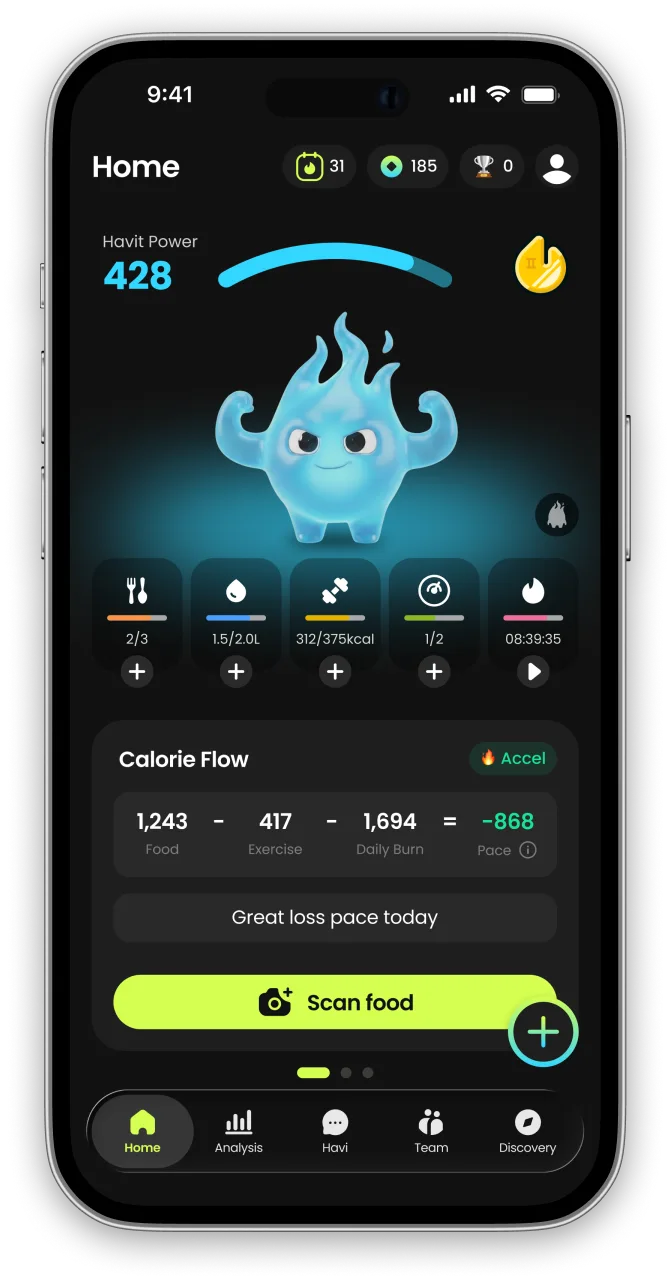
Logging periods, protein, hydration, energy, and weight in one place is exactly what the Havit app makes effortless — so you arrive at your appointment with a clear timeline instead of a vague "I've felt off." (Havit is a tracking companion, not a medical device — always defer to your clinician.)
06
Why HAVIT — Medication + Behavior Change, in One App
GLP-1 medications can meaningfully reduce weight — but the number on the scale is only part of the story.
Roughly 20–40% of the weight lost on GLP-1 therapy can come from lean (muscle) tissue rather than fat (Neeland et al., Diabetes, Obesity and Metabolism, 2024), and results tend to fade once the medication stops unless new habits take their place.
That's why leading guidance treats medication as one part of care, not the whole: the U.S. Preventive Services Task Force recommends that adults with obesity be offered intensive, multicomponent behavioral interventions (USPSTF, Grade B).
HAVIT is built for exactly this moment — one app that unites medication tracking, body composition, nutrition and protein, daily habit-building, and an AI coach that adapts to you.
Across our own 1,090 GLP-1 users, the most consistent trackers built the strongest habits (see the GLP-1 habit report).
Manage the medicine and the muscle — together. Start with HAVIT →

Why GLP-1s can make you tired
| Fatigue driver | Why it happens on a GLP-1 | What usually helps |
|---|---|---|
| Eating much less | Appetite drops sharply, so calorie intake can fall too fast | Don't undereat; hit protein and total-calorie floors |
| Dehydration | Reduced thirst plus GI losses (nausea, vomiting, diarrhea) | Drink to a target; watch electrolytes |
| Low blood sugar | More likely if combined with insulin or sulfonylureas | Discuss dosing of other diabetes meds with your prescriber |
| Nutrient gaps | Smaller meals can shortchange iron, B12, protein | Prioritize nutrient-dense food; check labs if it persists |
| Poor sleep | Night sweats or reflux around dose changes disrupt sleep | Treat the sleep disruptor; time meals earlier |
Frequently asked questions
Does a GLP-1 change your period?
Why did my period stop on Ozempic or Wegovy?
Can I get pregnant more easily on a GLP-1?
Does tirzepatide (Mounjaro) affect birth control?
Why does a GLP-1 make me so tired?
How do I fix GLP-1 fatigue?
Do GLP-1s cause hot flashes?
Are period changes, fatigue, and hot flashes dangerous on a GLP-1?
What is Havit?
Havit is an AI health companion for weight loss that protects muscle.
Unlike calorie-only trackers, Havit connects AI body-composition estimates, nutrition, hydration, sleep, steps, cycle, mood, and GLP-1 medication in one daily routine — so progress is measured by body composition, not just the number on the scale. Daily missions turn established behavior-change techniques into small repeatable actions, drawing on expertise from professionals formerly at Juvis Diet, one of Korea’s leading metabolic clinics.
In Havit’s own analysis of 1,090 GLP-1 users, people who logged consistently built stronger habits than the general user base. Read the GLP-1 Habit Report
Havit works with or without GLP-1 medication. It is a wellness app, not a medical device; body-composition results are estimates.

Continue in the App
Personalized wellness with your own data


References
- ACOG — Polycystic Ovary Syndrome (PCOS): symptoms improve with 5–10% weight loss. acog.org
- Cleveland Clinic — Yes, Weight Loss Can Impact Your Menstrual Cycle. health.clevelandclinic.org
- Mayo Clinic — Menstrual cycle: What's normal, what's not (weight change and ovulation). mayoclinic.org
- Functional Hypothalamic Amenorrhea: Recognition and Management (low energy availability). Mayo Clinic Proceedings / PMC. pmc.ncbi.nlm.nih.gov
- FDA — MOUNJARO (tirzepatide) Prescribing Information (oral contraceptive interaction; barrier method 4 weeks). accessdata.fda.gov
- FDA — WEGOVY (semaglutide) Prescribing Information (fatigue ~11% vs 5% placebo). accessdata.fda.gov
- Cleveland Clinic — Answering Your Questions About GLP-1s (fatigue, brain fog, dehydration). my.clevelandclinic.org
- Mayo Clinic — Hot flashes: Diagnosis & treatment (prevalence, vasomotor symptoms). mayoclinic.org
- Association of Lean Body Mass to Menopausal Symptoms: SWAN. PMC. pmc.ncbi.nlm.nih.gov
- All medical claims above were verified against the cited FDA labels, major clinics (Mayo, Cleveland Clinic), ACOG, and peer-reviewed studies as of mid-2026. Evidence is evolving and labels are updated periodically — confirm current details with your clinician.*


