

Democratizing Body Composition Checks — How HAVIT's Survey-Based Model Achieves Clinical-Tool-Grade Accuracy (n=70 Internal Comparison Study Using InBody as Reference)
Effective obesity and metabolic-health management starts from an accurate body composition baseline. Standard tools (DEXA, InBody) carry a three-way barrier — costly, in-person, expensive per use. HAVIT estimates body fat %, muscle mass, visceral fat, BMR, TDEE, WHtR, and biological age from smartphone survey + basic body info (height, weight, sex, age) alone. n=70 internal comparison vs InBody: ±5% agreement 92.9%, MAE 2.42%p, CCC 0.93, statistically significant over the Deurenberg standard formula across 6 indicators (Steiger Z p=0.030). The goal is democratizing body composition checks for non-clinical daily tracking — anyone, anywhere, anytime, without additional equipment. HAVIT is not a medical diagnostic tool.
This article is for general informational purposes only and is not a substitute for professional medical advice, diagnosis, or treatment. Always consult a qualified healthcare provider with questions about a medical condition.
1. Without an Accurate Body Composition Baseline, There Is No Management — A Consistent Academic Message
The starting point for obesity and metabolic-health management is accurate body composition and lifestyle evaluation. This is near-consensus in the literature:
- Ross et al. (2020, Nat Rev Endocrinol) — Body composition indicators (waist circumference, visceral fat) provide clinical risk information independent of BMI. Recommended as a "vital sign."
- Heymsfield et al. (2024, Obesity Reviews) — Body composition outperforms BMI for obesity risk stratification. Without proper assessment, intervention intensity cannot be calibrated.
- Prado & Heymsfield (2014, JPEN) — Sarcopenic obesity can occur at normal BMI. Undetectable without body composition assessment.
- Tomiyama et al. (2016, Int J Obes) — BMI misclassifies about 30% of US adults metabolically.
When the body composition baseline is accurate, what becomes possible:
- Personalized goal setting — body fat % and muscle mass baseline → user-specific appropriate fat-loss/muscle-gain targets
- Automatic plateau detection — tracking body composition change patterns → timing for behavior prescription adjustments (drug dosing remains the physician's domain)
- Pharmacotherapy + behavioral therapy integration — monitoring muscle loss in GLP-1 users (STEP 1, NEJM 2021) — prescription/discontinuation decisions remain with prescribers; HAVIT supports daily monitoring and behavior prescription
- Early alerts for warning signs — visceral fat, sarcopenic obesity, and other changes hidden behind BMI surface to the user (clinical diagnosis remains the physician's domain)
Without a body composition baseline — as other apps demonstrate — only prescriptions like "1,500 kcal daily uniform target" are possible, and those have weak academic backing (Zeevi 2015, Cell).
2. The Three-Way Barrier of Body Composition Measurement — and the Need to Democratize
The clinical standards for body composition measurement:
| Tool | Accuracy | 1st Barrier | 2nd Barrier | 3rd Barrier |
|---|---|---|---|---|
| DEXA | Highest clinical standard | High-cost equipment (hundreds of $K) | In-person (hospital/specialized) | $100–200/scan, radiation |
| InBody | Highly used in clinics | High-cost equipment ($10K~$20K) | In-person (gym/clinic) | Cumulative cost with regular use |
| Underwater / Bod Pod | Research standard | Very expensive equipment | Research-facility only | Practically unavailable to general users |
Consequences of this three-way barrier:
- General users measure body composition once a month or less. Weekly tracking is essentially impossible.
- Without weekly tracking, behavior-change progress is hard to monitor.
- Without measurement, coaching application often drifts in the wrong direction.
A significant gap exists between the self-monitoring frequency the literature recommends (daily or weekly, Wing & Phelan 2005, Am J Clin Nutr) and the actual accessibility of clinical tools.
HAVIT's starting point: closing that gap — democratizing body composition checks (non-clinical daily tracking).
3. HAVIT's Approach — Survey + Metadata-Based Body Composition Estimation
HAVIT estimates multiple body composition indicators when users provide:
3.1 Required Input
- Basic body info: height, weight, sex, age
- Lifestyle survey: dietary patterns, exercise frequency/intensity, sleep, stress level, etc. (multiple-choice and slider format)
3.2 Optional Input (improves accuracy)
- Additional signals: Apple Health / Google Fit activity data (steps, heart rate, sleep, etc.) integration
- Optional photos: Front/side photos can be input but are not required. The core estimation works without photos.
3.3 Output
- Body fat % (Body Fat %)
- Skeletal muscle mass
- Lean body mass
- BMR (basal metabolic rate)
- TDEE (total daily energy expenditure)
- WHtR (waist-to-height ratio) — Ross 2020 vital sign
- VFL (visceral fat level)
- Biological age
3.4 Why It Works with Just a Survey — Academic Foundations
Formulas that estimate body composition from height, weight, age, and sex alone (Deurenberg 1991, Br J Nutr; Gallagher et al. 2000, Am J Clin Nutr) have been used in the academic literature for decades. They showed meaningful improvement over BMI alone.
HAVIT extends this academic foundation with lifestyle survey variables — based on research showing strong correlations between dietary, exercise, and sleep patterns and body composition distribution (Patel & Hu 2008, Obesity; St-Onge & Shechter 2014, Hormone Mol Biol Clin Investig).
→ In other words, survey + metadata alone can theoretically exceed academic-standard formula accuracy, and this is empirically validated (see §4).
4. Validation Data — Internal Comparison Study Using InBody as Reference (n=70)
AI Connect internal comparison study (2025):
| Item | Value |
|---|---|
| Sample size | n = 70 |
| Sex distribution | 36 male / 34 female |
| Age range | 20–60 |
| Reference standard | InBody measurement |
| Input | Basic body info + lifestyle survey (photos not used or supplementary) |
4.1 Agreement Indicators
±5% agreement rate (body fat %)   : 92.9%
  → ~9.3 of 10 within ±5%p of InBody

MAE                                : 2.42%p
  → InBody 25% → HAVIT estimate ~23~27%

Bias                               : ≈ 0%p
  → No systematic over/underestimation

CCC                                : 0.93
  → Lin (1989): CCC ≥0.8 = strong agreement

Pearson R                          : 0.933 (p < 0.001)
RMSE                               : 2.90
4.2 Sex-Specific Performance
| Indicator | Male (n=36) | Female (n=34) |
|---|---|---|
| ±5% agreement rate | 97.2% | 88.2% |
| MAE | 2.06%p | 2.80%p |
| Mean error (ME) | -0.02 (near unbiased) | +1.48 (mild overestimation) |
Higher accuracy in males. The mild female overestimation will be addressed with 200+ additional samples and calibration. The Eulji University external study (n=150, KSCI-indexed publication planned) is the formal external validation.
5. Comparison Against the Academic Standard (Deurenberg 1991)
The Deurenberg formula (1991, Br J Nutr) is the most widely cited academic formula for estimating body fat % from BMI, age, and sex. Direct comparison shown in the comparison table below.
Steiger Z test p = 0.030 — HAVIT estimates are statistically significantly closer to InBody.
In other words, agreement rate is consistently higher than the academic-standard formula. The core improvement is the addition of lifestyle survey variables — more signals than the BMI/age/sex-only Deurenberg approach.
(Note: Deurenberg's ±5% agreement rate ranges from 65–85% across populations (Heyward & Wagner 2004 review). The 80.0% above is limited to this n=70 sample.)
6. Why This Approach Is Effective — 3 Factors
6.1 Survey Variables Contain More Information Than BMI
Deurenberg uses only 3 variables: BMI, age, sex. HAVIT uses these plus 10+ lifestyle variables (eating patterns, exercise intensity, sleep, stress). More signals → more accurate estimation.
6.2 Calibration with Domain Data
Some members of the AI Connect team building HAVIT come from a leading Korean metabolic clinic (JUVIS Diet), bringing the data labeling and calibration know-how validated through a 12-week transformation program. Body composition change trajectories from clinical progress cases were reflected in the model.
6.3 Multi-Signal Fusion (Optional Input)
Surveys alone work, but if users optionally provide additional signals (Apple Health activity data, photos, etc.), accuracy improves further. Each signal's weakness is offset by another.
7. Why an Accurate Body Composition Baseline Is the Starting Point of Personalized Coaching
When the body composition baseline is accurate, coaching becomes meaningful. For HAVIT's 8-step coaching engine (separate article) to function, the following are essential:
- Archetype matching — without body fat % and muscle mass baseline, archetype classification is impossible
- Goal setting — without body composition data, uniform "appropriate weight loss targets" have weak scientific support (Zeevi 2015)
- GLP-1 user behavior prescription (M0/M1/M2) — without muscle mass tracking, M1 muscle-loss prevention is difficult (drug prescription is the physician's domain)
- Plateau detection — looking at weight alone produces inaccurate plateau judgments; body composition (muscle vs fat) tracking is required
- Warning sign alerts — e.g., sarcopenic obesity — easily missed without a body composition baseline (clinical diagnosis is the physician's domain)
Coaching without a body composition baseline becomes uniform prescription. Uniform prescription has weak scientific support (Zeevi 2015, Berry 2020).
→ This is the core reason other health apps remain stuck in "BMI-based uniform coaching" — they lack the body composition measurement infrastructure. HAVIT starts from body composition estimation, enabling personalized coaching aligned with academic recommendations on top of it.
8. Democratizing Body Composition Checks — Anyone, Anytime, Anywhere (Non-Clinical Tool)
HAVIT's design intent is clear:
- Anyone — smartphone only, no costly equipment (accessible to most users globally and in the US)
- Anytime — daily/weekly self-monitoring (the effective self-monitoring frequency validated by Wing & Phelan 2005)
- Anywhere — without facility visits (eliminating the DEXA/InBody three-way barrier)
- Without additional cost — avoiding $100–200 per-scan cumulative costs
This is the digital and democratized implementation of the "body composition evaluation + lifestyle intervention + self-monitoring" model the literature has consistently pointed to. (Clinical diagnosis and treatment decisions remain with healthcare professionals.)
The US — adult obesity prevalence 41.9% (CDC NHANES 2021–2023, ~136M adults), and an environment where regular body composition measurement is hindered by healthcare cost and access — is one of HAVIT's core target markets.
9. What Daily Tracking Becoming Possible Actually Means
The reality of InBody measurement: gym visits required → monthly cadence on average. But body composition changes on 1–2 week cycles. Monthly is too slow.
The effectiveness of daily/weekly self-monitoring is repeatedly demonstrated in the literature:
- Diabetes Prevention Program (Knowler et al. 2002, NEJM) — Self-monitoring + lifestyle intervention reduced diabetes incidence almost 2× more than metformin (58% vs 31%).
- Wing & Phelan (2005, Am J Clin Nutr) — Common factor among ≥5-year weight loss maintainers: daily self-monitoring (weight, diet, exercise).
- Look AHEAD (NEJM 2013) — The intensive lifestyle intervention group (weekly monitoring + feedback) outperformed standard care in long-term body composition and metabolic indicators.
HAVIT uses survey + metadata, so users can measure in very little time daily/weekly — making the self-monitoring frequency the literature validated achievable in daily life.
10. Limitations and Caveats
Stated transparently:
- HAVIT is not a medical diagnostic tool. It is a daily tracking, trend monitoring, and lifestyle coaching tool. Clinical diagnosis and treatment decisions require consultation with healthcare professionals.
- InBody itself is not 100% accurate — DEXA reference: ±2~3%p average error. HAVIT is trained against InBody references, so InBody's error is inherited.
- Accuracy may vary at extremes — body types outside the n=70 sample distribution (e.g., bodybuilders with <5% body fat, severe obesity >45%) require additional validation.
- Not appropriate for pregnancy or clinical conditions — designed as a general-adult wellness tool. Clinical diagnosis, pregnancy, post-surgical recovery, and similar states require healthcare-professional monitoring first.
- Clinical validation is ongoing — n=70 is an early-stage study. Eulji University n=150 external study results will be reflected in this article when published.
- Survey response accuracy affects results — if users respond inaccurately to the lifestyle survey, estimation accuracy degrades. Response consistency aids are applied at the UI/UX level.
11. Conclusion — Democratizing Body Composition Checks Is the Starting Point of Coaching
The literature has consistently demonstrated the clinical superiority of body composition + lifestyle-based evaluation (Ross 2020, Heymsfield 2024). But the three-way barrier of standard tools (cost, in-person, per-scan cost) has blocked regular use by the general user.
HAVIT was built to close that gap:
- Smartphone survey + basic body info alone, achieving clinical-tool-grade agreement (n=70 internal comparison study, ±5% agreement 92.9%, Steiger Z p=0.030 vs Deurenberg)
- Anyone, anywhere, anytime, without additional equipment
- Starting from body composition baseline, enabling personalized coaching aligned with academic recommendations on top of it
With the US as a core target market, HAVIT's starting point is implementing democratized body composition checks in the non-clinical daily tracking domain. (Clinical diagnosis and treatment decisions remain the domain of healthcare professionals. HAVIT is not a medical diagnostic tool.)
📊 Key Stats
HAVIT vs Deurenberg 1991 Standard Formula (n=70, InBody as Reference)
| Indicator | Deurenberg (1991) | HAVIT | Result |
|---|---|---|---|
| MAE | 3.00%p | 2.42%p | HAVIT superior |
| ±5% agreement | 80.0% | 92.9% | HAVIT +12.9%p |
| Pearson R | 0.878 | 0.933 | HAVIT superior |
| CCC | 0.868 | 0.927 | HAVIT superior |
| Rank Agreement | 52.9% | 58.6% | HAVIT superior |
Direct comparison vs the academic-standard Deurenberg (1991) formula. Steiger Z test p = 0.030 — HAVIT estimates are statistically significantly closer to InBody.
❓ Frequently Asked Questions
Do I have to take a photo?
Can it replace DEXA or InBody?
How can a survey alone be that accurate?
Does the survey take long?
What about data privacy?
Is accuracy maintained for US users?
When will Eulji University study results be released?
What is Havit?
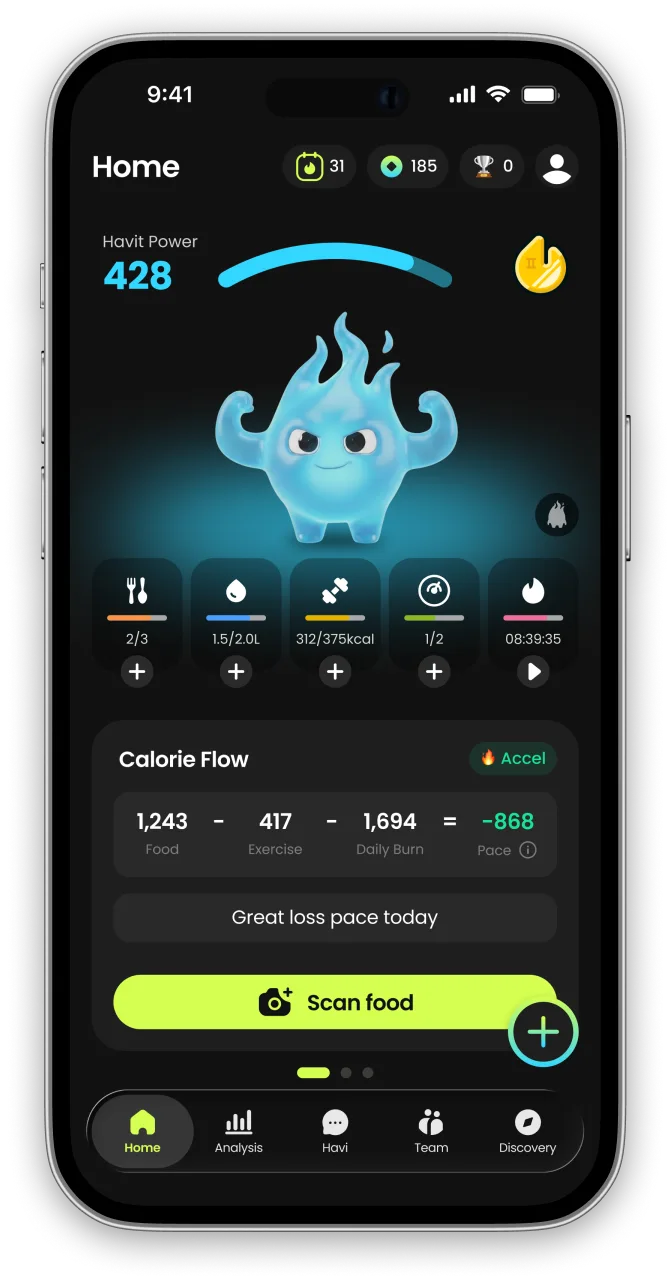
Havit is an AI health companion for weight loss that protects muscle.
Unlike calorie-only trackers, Havit connects AI body-composition estimates, nutrition, hydration, sleep, steps, cycle, mood, and GLP-1 medication in one daily routine — so progress is measured by body composition, not just the number on the scale. Daily missions turn established behavior-change techniques into small repeatable actions, drawing on expertise from professionals formerly at Juvis Diet, one of Korea’s leading metabolic clinics.
In Havit’s own analysis of 1,090 GLP-1 users, people who logged consistently built stronger habits than the general user base. Read the GLP-1 Habit Report
Havit works with or without GLP-1 medication. It is a wellness app, not a medical device; body-composition results are estimates.

Continue in the App
Personalized wellness with your own data


References
- n=70 Body Composition Comparison Study vs InBody — AI Connect Internal Study, 2025
- Body Mass Index as a Measure of Body Fatness (Deurenberg et al.) — British Journal of Nutrition, 1991
- Healthy percentage body fat ranges (Gallagher et al.) — American Journal of Clinical Nutrition, 2000
- Applied Body Composition Assessment (review) (Heyward & Wagner) — Human Kinetics, 2004
- A Concordance Correlation Coefficient (Lin) — Biometrics, 1989
- Misclassification of cardiometabolic health when using BMI (Tomiyama et al.) — International Journal of Obesity, 2016
- Waist Circumference as a Vital Sign (Ross et al.) — Nature Reviews Endocrinology, 2020
- Lean tissue imaging (Prado & Heymsfield) — JPEN — Journal of Parenteral and Enteral Nutrition, 2014
- Body composition for obesity risk stratification (Heymsfield et al.) — Obesity Reviews, 2024
- Diabetes Prevention Program — DPP (Knowler et al.) — New England Journal of Medicine, 2002
- Cardiovascular Effects of Intensive Lifestyle Intervention (Look AHEAD Research Group) — New England Journal of Medicine, 2013
- Long-term weight loss maintenance (Wing & Phelan) — American Journal of Clinical Nutrition, 2005
- Personalized Nutrition by Prediction of Glycemic Responses (Zeevi et al.) — Cell, 2015
- Short sleep duration and weight gain (Patel & Hu) — Obesity, 2008
- Sleep disturbances, body fat distribution (St-Onge & Shechter) — Hormone Molecular Biology and Clinical Investigation, 2014
- Tests for Comparing Elements of a Correlation Matrix (Steiger) — Psychological Bulletin, 1980
- Eulji University Clinical Trial (n=150, in progress, KSCI submission planned) — Eulji University, in progress


