
Retatrutide Tracker: What It Is & What to Track (2026)

This article is for general informational purposes only and is not a substitute for professional medical advice, diagnosis, or treatment. Always consult a qualified healthcare provider with questions about a medical condition.
Quick answer
A retatrutide tracker guide: what the investigational triple agonist is, trial results so far (~24% weight loss in Phase 2), its status, and what you'd track.
Retatrutide is the most-watched name in the next wave of metabolic medicine — and, unlike Wegovy or Zepbound, it is not something you can be prescribed today. It is still in clinical trials.
So a page called a "retatrutide tracker" cannot be a dosing companion the way an Ozempic tracker or Wegovy tracker is.
Instead, this guide covers three honest things: what retatrutide actually is, what the trials have shown so far, and what tracking would look like for anyone in a trial or simply following its development.
If you want the general framework first, start with our complete GLP-1 tracker app guide.
01
What is retatrutide?
Retatrutide (research code LY3437943) is an experimental, once-weekly injectable from Eli Lilly. What sets it apart is that it is a triple hormone-receptor agonist — it activates three receptors at once: GIP, GLP-1, and glucagon (Jastreboff et al., NEJM 2023).
For comparison, semaglutide (Ozempic, Wegovy) is a single GLP-1 agonist, and tirzepatide (Mounjaro, Zepbound) is a dual GIP/GLP-1 agonist.
The added glucagon action is the "third G," and it is thought to raise energy expenditure and act on liver fat — while also being the reason some trial-specific effects (like a modest rise in heart rate) matter for tracking.
To be clear about entities: retatrutide is not tirzepatide and not semaglutide. It is a distinct, later-stage molecule.
If you are comparing the approved options instead, see our semaglutide vs. tirzepatide guide.
02
Is retatrutide FDA-approved? Current status (2026)
No. As of 2026, retatrutide is investigational and not approved by the FDA — or any major regulator — for any use. It is available only to people enrolled in clinical trials.
Eli Lilly has said it anticipates regulatory submission around 2026 following its pivotal Phase 3 readouts, which means the earliest realistic public availability would be roughly 2027–2028, and only if trials and review succeed (Eli Lilly).
Because there is no approved label, there is no official dosing schedule for the public, no pharmacy supply, and no companion app — anyone selling "retatrutide" outside a trial is not offering an approved product.

03
Retatrutide trial results so far
Here is where the excitement comes from.
The headline data below is a snapshot of published and topline trial results — treat it as evidence, not a promise, since averages hide big individual variation and Phase 3 details are still being published.
Sources: NEJM Phase 2; TRIUMPH-1 (ClinicalTrials.gov NCT05929066); AJMC — TRIUMPH-1 topline; Eli Lilly investor — Phase 3 T2D.
In the Phase 2 obesity trial, the 12-mg dose produced a mean 24.2% weight reduction at 48 weeks, with a clear dose-response (roughly 8.7% at 1 mg up to 24.2% at 12 mg) (NEJM 2023).
Trial participants started at a low dose (2 mg) and escalated every four weeks — the same titrate-slowly logic used by approved GLP-1s.
A separate Phase 2a trial reported large reductions in liver fat in people with metabolic dysfunction-associated steatotic liver disease (Nature Medicine 2024).
These numbers are why retatrutide is discussed as potentially best-in-class — but they come from controlled trials, not real-world use.
04
What tracking retatrutide would look like
Even though you can't be prescribed retatrutide, the tracking framework is worth understanding — it's the same discipline that helps on any GLP-1, and it's exactly what trial participants are asked to monitor.
A triple agonist adds one wrinkle: because the glucagon component nudged heart rate up in trials, resting heart rate becomes a data point worth watching alongside the usual set (NEJM 2023).
| What to track | Why it matters | How often |
|---|---|---|
| Dose date & amount (mg) | Trials titrate slowly and escalate on a schedule; a dated log keeps the timeline clean | Every injection (weekly) |
| Injection site & rotation | Rotating subcutaneous sites avoids lumpy tissue that alters absorption | Every injection |
| Body weight trend | The primary outcome; a trend line — not one reading — shows real progress and plateaus | 1–3× per week, same time |
| Waist / measurements | Catches body-composition change the scale misses | Every 1–2 weeks |
| Protein intake (grams) | With this much appetite suppression, protecting lean muscle is critical | Daily |
| Resting heart rate | Glucagon agonism raised heart rate in trials — a retatrutide-specific signal to watch | A few times per week |
| Side effects & severity | GI effects (nausea, diarrhea, constipation) were common and dose-related in trials | As they occur |
| Hydration & bloods (if in a trial) | Trials monitor labs; hydration eases early GI symptoms | Daily / per trial schedule |
Side effects seen in trials — what the data shows
In the Phase 3 obesity trial, the most common adverse events at the top dose were gastrointestinal: nausea (~42%), diarrhea (~32%), and constipation (~26%), mostly mild-to-moderate and dose-related, and eased by a low starting dose (NEJM 2023; ClinicalTrials.gov).
Trials also tracked the modest heart-rate increase noted above.
For how GI side effects compare across the approved GLP-1 class, see our guide to GLP-1 side effects.
05
How to build a metabolic-tracking routine now
You don't need retatrutide to build the habit that makes any GLP-1 work — and starting now means you arrive prepared if a triple agonist ever reaches the market.
This takes under two minutes a week.
- 1
Weigh in on fixed days.
Pick 1–3 mornings, same conditions, and read the trend, not the daily noise.
- 2
Track protein daily.
Muscle protection is the single most under-rated habit in any rapid-weight-loss journey.
- 3
Log resistance-training sessions.
Strength work is the strongest defense against losing lean mass.
- 4
Note how you feel.
Appetite, energy, GI comfort, and — if relevant — resting heart rate.
- 5
Photo every 2–4 weeks.
Same lighting and angle; body-composition change is often invisible on the scale.
- 6
If you enter a trial, log the dose and site right after each injection and bring the record to every study visit.
06
Do you need an app for this?
Right now, "tracking retatrutide" mostly means staying informed and building the underlying habits — no approved product means no dedicated companion app. A notebook is fine.
What a general wellness app adds is the automation people forget: a weight trend that smooths daily noise, daily protein and movement logging, and a place to note symptoms or resting heart rate over time.
If you want those habits living in one place — ready for whatever GLP-1 you and a doctor eventually choose — a wellness app like HAVIT is a natural home.
Compare options in our best GLP-1 tracker apps guide and pick what you'll actually keep using; consistency beats hype.

07
Related guides
08
Why HAVIT — Medication + Behavior Change, in One App
GLP-1 medications can meaningfully reduce weight — but the number on the scale is only part of the story.
Roughly 20–40% of the weight lost on GLP-1 therapy can come from lean (muscle) tissue rather than fat (Neeland et al., Diabetes, Obesity and Metabolism, 2024), and results tend to fade once the medication stops unless new habits take their place.
That's why leading guidance treats medication as one part of care, not the whole: the U.S. Preventive Services Task Force recommends that adults with obesity be offered intensive, multicomponent behavioral interventions (USPSTF, Grade B).
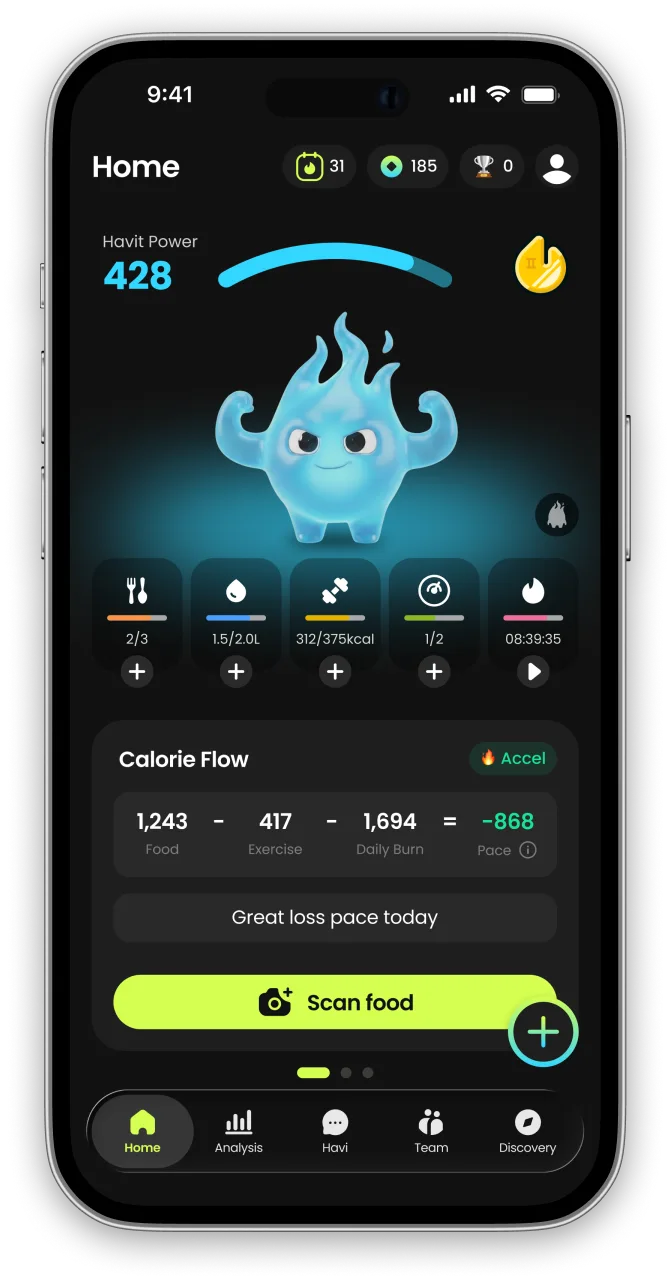
HAVIT is built for exactly this moment — one app that unites medication tracking, body composition, nutrition and protein, daily habit-building, and an AI coach that adapts to you.
Across our own 1,090 GLP-1 users, the most consistent trackers built the strongest habits (see the GLP-1 habit report).
Manage the medicine and the muscle — together. Start with HAVIT →

Retatrutide trial results so far
| Trial | Phase | Duration | Highest dose | Reported weight loss | Status |
|---|---|---|---|---|---|
| Jastreboff et al. (obesity) | Phase 2 | 48 weeks | 12 mg | ~24.2% mean reduction | Published, *NEJM* 2023 |
| TRIUMPH-1 (obesity, no diabetes) | Phase 3 | 80 weeks | 12 mg | ~28% (treatment-regimen) to ~30% (on-treatment) | Topline announced 2026; full results forthcoming |
| TRANSCEND-T2D-1 (type 2 diabetes) | Phase 3 | 40 weeks | 12 mg | Superior A1C + weight vs. placebo (~16.8%) | Topline announced 2026 |
Frequently asked questions
What is a retatrutide tracker?
Is retatrutide FDA-approved?
How much weight did people lose with retatrutide?
How is retatrutide different from Ozempic or Mounjaro?
Can I buy retatrutide now?
What are retatrutide's side effects?
When will retatrutide be available?
Should I track anything now if I'm interested in retatrutide?
What is Havit?
Havit is an AI health companion for weight loss that protects muscle.
Unlike calorie-only trackers, Havit connects AI body-composition estimates, nutrition, hydration, sleep, steps, cycle, mood, and GLP-1 medication in one daily routine — so progress is measured by body composition, not just the number on the scale. Daily missions turn established behavior-change techniques into small repeatable actions, drawing on expertise from professionals formerly at Juvis Diet, one of Korea’s leading metabolic clinics.
In Havit’s own analysis of 1,090 GLP-1 users, people who logged consistently built stronger habits than the general user base. Read the GLP-1 Habit Report
Havit works with or without GLP-1 medication. It is a wellness app, not a medical device; body-composition results are estimates.
Continue in the App
Personalized wellness with your own data


References
- Jastreboff AM, et al. *Triple–Hormone-Receptor Agonist Retatrutide for Obesity — A Phase 2 Trial.* New England Journal of Medicine, 2023. nejm.org nejm.org
- ClinicalTrials.gov (NIH) — *TRIUMPH-1: A Study of Retatrutide in Participants With Obesity or Overweight* (NCT05929066), Phase 3. clinicaltrials.gov clinicaltrials.gov
- Eli Lilly and Company — *What to know about retatrutide* (investigational status). lilly.com lilly.com
- Eli Lilly and Company (investor) — *Retatrutide demonstrated significant reductions in A1C and weight in first Phase 3 trial for type 2 diabetes.* investor.lilly.com investor.lilly.com
- AJMC — *Retatrutide Achieves Up to 30.3% Average Weight Loss in Phase 3 TRIUMPH-1 Trial* (2026 topline). ajmc.com ajmc.com
- Sanyal AJ, et al. *Triple hormone receptor agonist retatrutide for metabolic dysfunction-associated steatotic liver disease: a randomized phase 2a trial.* Nature Medicine, 2024. nature.com nature.com
- All statements verified against the cited NEJM/Nature Medicine publications, ClinicalTrials.gov, and Eli Lilly materials as of July 2026. Retatrutide's regulatory status is changing — re-verify before relying on any timeline, and re-review at least every 6 months or when Phase 3 results publish or an approval is announced.*


