
GLP-1 Dose Tracker: Log Your mg & Titration Schedule

This article is for general informational purposes only and is not a substitute for professional medical advice, diagnosis, or treatment. Always consult a qualified healthcare provider with questions about a medical condition.
Quick answer
A GLP-1 dose tracker logs which milligram you took on which date and follows your titration — Wegovy 0.25→2.4, Zepbound 2.5→15. See how to track and share it.
GLP-1 medicines are not a single fixed dose.
They start low and climb through a planned titration schedule to reduce side effects, then settle at a maintenance dose. That means the answer to "how much am I on?" changes every few weeks — and the milligram you inject is different from the act of injecting it.
A dose tracker owns the milligram side of the story: which strength, on which date, and where you are on the escalation ladder.
(For logging the injection event and site rotation, see the companion GLP-1 shot tracker; for the whole picture, the GLP-1 tracker app hub ties dose, weight, protein and side effects together.)
01
Why the titration schedule is worth tracking
Three things make your dose history genuinely useful rather than just tidy:
It keeps you synced to the plan.
Step-ups happen on a calendar (typically no sooner than every four weeks). A tracker shows when your next increase is due so you and your prescriber are aligned.
It ties side effects to a change.
Nausea and GI symptoms most often appear or worsen right after a dose increase. Logging the mg and the date lets you see "the queasiness started three days after I moved to 1.0 mg" — a pattern your clinician can act on.
It gives your prescriber exact history.
At dose-adjustment visits, "I think I've been on the middle one for a while" is far weaker than a dated ladder they can read in seconds.
02
Titration schedules by drug (log which mg, which date)
Here is the escalation shape for the common GLP-1s. Use it as the backbone of your dose log — but treat the exact timing as your prescriber's call, not a self-adjustment guide.
Wegovy reaches its 2.4 mg maintenance dose over roughly 16–17 weeks; tirzepatide climbs in 2.5 mg increments through 2.5, 5, 7.5, 10, 12.5 and 15 mg, with your prescriber choosing where you settle based on response and tolerability.
The clinical reasoning behind the pace is covered in the dose-escalation timing guide.

03
What a good dose log actually records
For each entry, capture:
- The date the dose applied from (usually your injection date).
- The strength in mg you took.
- Whether it was a step-up, a hold, or a step-down — and, briefly, why (e.g., "held at 5 mg — nausea").
- Tolerability at that dose — a quick note or 1–5 rating so patterns show.
Logged this way, your history reads as a ladder: 0.25 mg (Mar 3) → 0.5 mg (Mar 31) → held (Apr 28, GI) → 1.0 mg (May 12). That single line tells your prescriber more than a whole appointment of recollection.
04
Reaching and staying on your maintenance dose
Titration is the climb; maintenance is where most of the journey happens.
Once you settle at a maintenance strength (for example Wegovy 2.4 mg, or a tirzepatide dose from 5–15 mg), the log's job shifts from "track the climb" to "confirm I'm taking the right strength consistently and note how it's holding up." If side effects, cost, or results prompt a change, a dated history makes the conversation about adjusting the dose — up, down, or holding — grounded in evidence rather than memory.

05
Sharing your dose history with your prescriber
A dose tracker's biggest payoff is the appointment. Before a visit:
- Open your dose ladder — the dated sequence of strengths.
- Mark where side effects clustered relative to each step-up.
- Note any holds or missed step-ups and the reason.
- Bring your weight trend alongside it so response and dose are visible together.
- Ask your specific question — "Should I move up, or hold here?" — backed by the data instead of a guess.
06
How to build a dose-tracking routine in 5 steps
- Record your current strength and the date it started as your baseline.
- Log every step-up the day it happens, exactly as your prescriber directed — never self-escalate.
- Add a one-line tolerability note at each new dose (nausea, none, better).
- Set a reminder for your next review, roughly four weeks out, so a step-up isn't forgotten.
- Export or screenshot the ladder before each clinic visit to share cleanly.

07
How a GLP-1 dose tracker app automates this
- A visual dose ladder that plots each mg against its date automatically.
- Step-up reminders timed to your ~4-week escalation cadence.
- Side-effect overlay so symptoms line up against the exact dose change that preceded them.
- A shareable export — a clean dated history for your prescriber.
- Maintenance confirmation so you always know the strength you should be injecting this week.
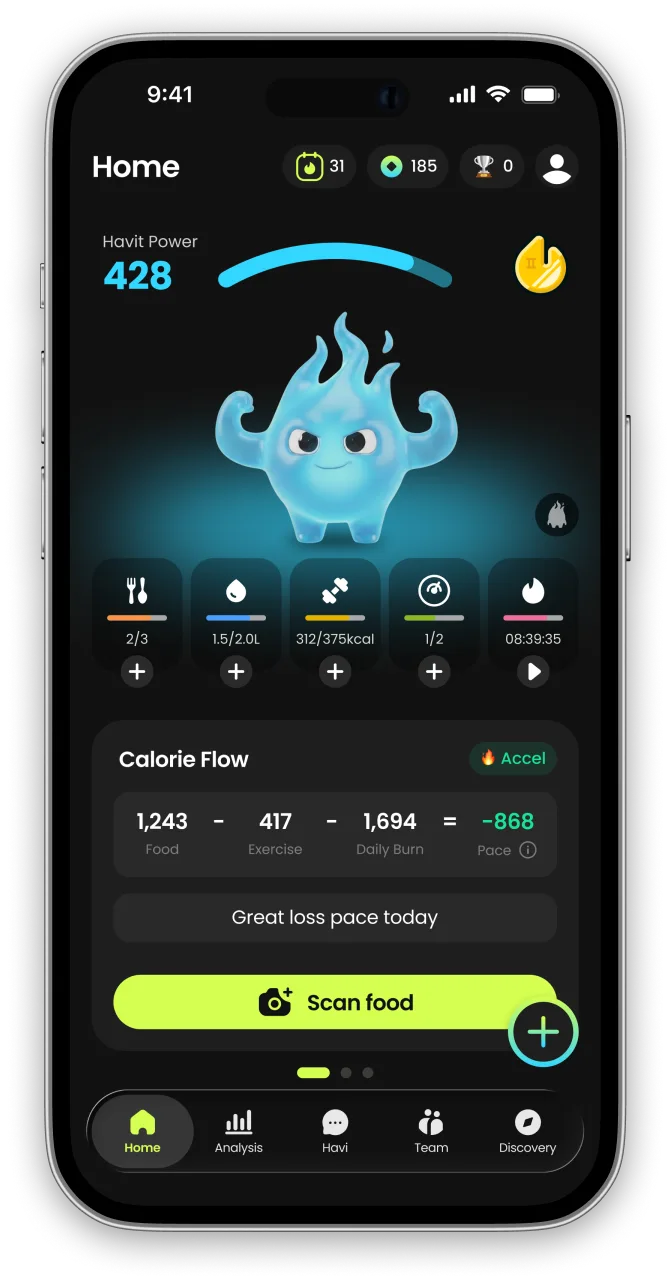
HAVIT keeps your dose ladder next to weight, body-composition, food and protein tracking in one wellness app — so a step-up and the side effects, appetite and results around it all live together.
If you want your titration history and your daily habits in the same place, it is a natural home for your GLP-1 journey. Comparing drugs while you decide?
08
Why HAVIT — Medication + Behavior Change, in One App
GLP-1 medications can meaningfully reduce weight — but the number on the scale is only part of the story.
Roughly 20–40% of the weight lost on GLP-1 therapy can come from lean (muscle) tissue rather than fat (Neeland et al., Diabetes, Obesity and Metabolism, 2024), and results tend to fade once the medication stops unless new habits take their place.
That's why leading guidance treats medication as one part of care, not the whole: the U.S. Preventive Services Task Force recommends that adults with obesity be offered intensive, multicomponent behavioral interventions (USPSTF, Grade B).
HAVIT is built for exactly this moment — one app that unites medication tracking, body composition, nutrition and protein, daily habit-building, and an AI coach that adapts to you.
Across our own 1,090 GLP-1 users, the most consistent trackers built the strongest habits (see the GLP-1 habit report).
Manage the medicine and the muscle — together. Start with HAVIT →

Titration schedules by drug (log which mg, which date)
| Medicine (generic) | Starting dose | Escalation | Maintenance |
|---|---|---|---|
| Wegovy (semaglutide) | 0.25 mg once weekly | step up ~every 4 weeks: 0.5 → 1.0 → 1.7 mg | 1.7 or 2.4 mg weekly |
| Ozempic (semaglutide) | 0.25 mg weekly for 4 weeks | → 0.5 mg, then 1.0 after ≥4 weeks | 0.5, 1.0 or 2.0 mg weekly |
| Zepbound / Mounjaro (tirzepatide) | 2.5 mg weekly for 4 weeks | → 5 mg, then +2.5 mg every ≥4 weeks | 5–15 mg weekly |
Frequently asked questions
What is a GLP-1 dose tracker?
How is a dose tracker different from a shot tracker?
What is titration and why does it matter?
How fast does the dose go up?
What is a maintenance dose?
Can a dose tracker tell me when to increase my dose?
Why should I log side effects with the dose?
How do I share my dose history at an appointment?
What is Havit?
Havit is an AI health companion for weight loss that protects muscle.
Unlike calorie-only trackers, Havit connects AI body-composition estimates, nutrition, hydration, sleep, steps, cycle, mood, and GLP-1 medication in one daily routine — so progress is measured by body composition, not just the number on the scale. Daily missions turn established behavior-change techniques into small repeatable actions, drawing on expertise from professionals formerly at Juvis Diet, one of Korea’s leading metabolic clinics.
In Havit’s own analysis of 1,090 GLP-1 users, people who logged consistently built stronger habits than the general user base. Read the GLP-1 Habit Report
Havit works with or without GLP-1 medication. It is a wellness app, not a medical device; body-composition results are estimates.

Continue in the App
Personalized wellness with your own data


References
- U.S. Food & Drug Administration — WEGOVY (semaglutide) prescribing information, dosage and titration (0.25→2.4 mg). accessdata.fda.gov
- Novo Nordisk — Wegovy dosing schedule and dose-escalation guidance. wegovy.com
- Novo Nordisk — Ozempic dosing (0.25→0.5→1→2 mg) and titration. ozempic.com
- Eli Lilly — ZEPBOUND (tirzepatide) prescribing information, dosage and titration (2.5→15 mg). pi.lilly.com
- Eli Lilly — Zepbound dosage options and schedules. zepbound.lilly.com
- Cleveland Clinic — GLP-1 Agonists: dosing overview. my.clevelandclinic.org
- All medical claims verified against the cited FDA labels and manufacturer materials as of July 2026. Labels are updated periodically — confirm current details with your prescriber and the official prescribing information.*


