
Retatrutide Side Effects: Trial Data & Warnings 2026

This article is for general informational purposes only and is not a substitute for professional medical advice, diagnosis, or treatment. Always consult a qualified healthcare provider with questions about a medical condition.
Quick answer
In clinical trials, retatrutide's most common side effects are gastrointestinal — nausea, diarrhea, constipation, and vomiting — mostly mild-to-moderate and worst during dose escalation. Its triple-agonist design also produces two distinctive signals: abnormal skin sensations (dysesthesia) and a modest heart-rate increase. Retatrutide is investigational and available only through clinical trials — it cannot be prescribed.
Retatrutide (development code LY3437943) is an investigational, once-weekly injectable from Eli Lilly. It is a triple agonist — it activates three hormone receptors at once: GIP, GLP-1, and glucagon. That third target, glucagon, sets it apart from GLP-1 drugs like semaglutide and from dual GIP/GLP-1 agonists like tirzepatide, and it shapes both its powerful weight-loss results and some of its distinctive side effects.
Retatrutide is not approved by the FDA or any other regulator.
According to Eli Lilly, it is available only to people enrolled in its clinical trials.
Anticipated regulatory submission is around 2026, and — if trials and review succeed — the earliest realistic public availability would be roughly 2027–2028.
There is no official public dosing schedule, and it cannot be prescribed or bought. This page summarizes what trials have reported, not a treatment you can start.
For approved options and the drug class overall, see our GLP-1 side effects hub.
01
The most common retatrutide side effects (from trials)
Like other incretin drugs, retatrutide's most frequently reported side effects in trials are gastrointestinal, and they are clearly dose-related — worst during the escalation weeks and mostly mild-to-moderate. The most complete picture comes from the Phase 3 TRIUMPH-1 obesity trial (80 weeks).
Per Eli Lilly's TRIUMPH-1 announcement, adverse events at the 12 mg dose versus placebo were:
(Source: Eli Lilly TRIUMPH-1 Phase 3 trial, 12 mg dose. Individual experience varies. Trials are not head-to-head with other drugs.)
The gastrointestinal events were mostly mild-to-moderate, dose-related, and worst during escalation.
The earlier Phase 2 trial published in the New England Journal of Medicine reported the same pattern, with GI effects rising alongside the dose.
Discontinuation for adverse events in TRIUMPH-1 also rose with dose: about 4.1% at 4 mg, 6.9% at 9 mg, and 11.3% at 12 mg, versus 4.9% on placebo — so the highest dose that produced the greatest weight loss also produced the most dropouts for side effects.
02
Investigational status and what the trials showed
Retatrutide's weight-loss results are the reason it draws so much attention — but they come strictly from clinical trials of an unapproved drug.
Phase 2 (NEJM 2023)
the 12 mg dose produced a mean 24.2% weight loss at 48 weeks, with a clear dose-response (from roughly 8.7% at 1 mg up to 24.2% at 12 mg). Participants started at 2 mg and escalated every 4 weeks. (NEJM)
Phase 3 TRIUMPH-1 (80 weeks)
12 mg delivered 28.3% average weight loss, 9 mg 25.9%, and 4 mg 19.0%; a 104-week extension reached about 30.3% (85.0 lbs) at 12 mg. (Eli Lilly; AJMC topline)
Phase 2a MASLD (Nature Medicine 2024)
in people with metabolic dysfunction-associated steatotic liver disease, retatrutide produced large reductions in liver fat. (Nature Medicine)
These figures describe trial outcomes, not a promise of results for any individual, and they were achieved under close study supervision.
The ongoing program is registered publicly — for example, ClinicalTrials.gov NCT05929066.
The dysesthesia signal (retatrutide-specific)
One side effect stands out as unusual for this class: dysesthesia — abnormal or altered skin sensations (such as tingling or heightened sensitivity).
In TRIUMPH-1 it was reported by 12.5% at the 12 mg dose versus 0.9% on placebo, and it has been linked to the glucagon component of the triple agonist.
Because semaglutide and tirzepatide do not target glucagon in the same way, this signal is relatively specific to retatrutide among the widely studied incretin drugs.
The heart-rate signal (glucagon-driven)
Retatrutide's glucagon activity is also associated with a modest increase in resting heart rate — on average a few beats per minute in trials, which tended to ease over time. This was observed in the Phase 2 NEJM data and is another triple-agonist-specific signal that study teams monitored.
What this means for long-term cardiovascular safety is exactly the kind of question that the full Phase 3 program and regulatory review are designed to answer.
03
How long do retatrutide side effects last?
In trials, the common gastrointestinal side effects were mostly transient, easing after the escalation period as the body adjusted — the familiar incretin pattern seen across this drug class.
They were strongly dose-dependent: higher doses produced more nausea, diarrhea, constipation, and vomiting, and also the most discontinuations (11.3% at 12 mg versus 4.1% at 4 mg).
Study protocols used a slow, stepwise escalation — in Phase 2, starting at 2 mg and stepping up every 4 weeks — precisely because gradual dosing limits side effects.
Because retatrutide is investigational, there is no official public dosing schedule and no approved way to take it. Any dosing in trials is set and supervised by the study team — it is not something to replicate on your own.
04
What the trials monitored: safety signals to understand
Retatrutide is not approved, so no boxed warning or final FDA label exists yet. What follows is not prescribing information — it is a summary of the safety areas that trials and the GLP-1 drug class have flagged for close monitoring.
GLP-1 class thyroid signal (studied, not confirmed for retatrutide)
Approved GLP-1 and GIP/GLP-1 drugs carry an FDA boxed warning for thyroid C-cell tumors based on rodent findings, with human relevance unknown.
Because retatrutide acts on GLP-1 among its targets, this class-level signal is part of what regulators evaluate.
Any formal warning for retatrutide would only be established through the approval process — none exists today.
Gastrointestinal and dehydration risk
The dominant, expected effects are GI: nausea, diarrhea, constipation, and vomiting.
As with all incretin drugs, persistent vomiting or diarrhea raises the risk of dehydration, which study teams watch for.
Heart rate
As noted above, a modest resting heart-rate increase tied to the glucagon component was observed and monitored in trials.
Glucose effects
Because retatrutide affects metabolic hormones, trials monitor blood glucose; in people also taking glucose-lowering medicines, hypoglycemia risk is a standard monitoring area for this class.
If you are considering or enrolled in a retatrutide trial, your study team's guidance and the trial's informed-consent documents are the authoritative source on risks — not this page.

05
When to seek care in a trial: retatrutide red-flag table
(For trial participants — always follow your study team's instructions first.)
| Symptom / red flag | What it may indicate | What to do |
|---|---|---|
| Severe, persistent stomach pain (may spread to the back), ± vomiting | Possible pancreatitis (GLP-1 class signal) | Contact your study team / seek urgent care |
| Upper-right abdominal pain, fever, jaundice, clay-colored stool | Possible gallbladder disease (class signal) | Contact your study team promptly |
| Ongoing vomiting/diarrhea; can't keep fluids down; little urine, dizziness | Dehydration | Contact your study team; seek care if severe |
| Noticeably fast or pounding heartbeat, palpitations | Heart-rate increase (glucagon-driven) | Report to your study team |
| New tingling, numbness, or altered skin sensations | Dysesthesia (retatrutide-specific) | Report to your study team |
| Shakiness, sweating, confusion (esp. with glucose-lowering meds) | Possible hypoglycemia | Treat low blood sugar; contact your study team |
| Rash, swelling of face/lips/throat, trouble breathing | Serious allergic reaction | Call emergency services |
This table is a guide for trial participants, not a substitute for your study team's professional judgment.
06
Retatrutide vs tirzepatide: an extra hormone, extra signals
Retatrutide is frequently compared with tirzepatide (Mounjaro, Zepbound), an approved dual GIP/GLP-1 agonist.
The key difference is the third target — glucagon — which drives retatrutide's larger trial weight loss and its distinctive dysesthesia and heart-rate signals.
Note that tirzepatide is FDA-approved while retatrutide is not.
| Retatrutide (investigational) | Tirzepatide (approved) | |
|---|---|---|
| Hormone target | GIP + GLP-1 + glucagon (triple) | GIP + GLP-1 (dual) |
| Regulatory status | Investigational, trial-only | FDA-approved |
| Nausea (trial/label) | ~42% at 12 mg (TRIUMPH-1) | ~12–29% |
| Distinctive signal | Dysesthesia; glucagon-driven heart-rate rise | — |
| Trial/label weight loss | up to ~28–30% (TRIUMPH-1) | up to ~21% (SURMOUNT) |
Trials are not head-to-head, so cross-drug numbers are indicative, not directly comparable.
For the approved dual agonist, see our tirzepatide side effects guide.
07
Availability by market
Retatrutide is not approved anywhere in the world. It is legally available only to participants in Eli Lilly's clinical trials, and it cannot be prescribed, purchased, or compounded. Anticipated regulatory submission is around 2026; if the trials and review are successful, the earliest realistic public availability would be roughly 2027–2028. Any product sold online as "retatrutide" outside a registered clinical trial is not an approved medicine, is not quality-assured, and may be unsafe and unlawful — this page does not endorse obtaining it that way.
To learn about legitimate trials, see ClinicalTrials.gov and speak with a licensed clinician.
08
Why HAVIT — Medication + Behavior Change, in One App
GLP-1 medications can meaningfully reduce weight — but the number on the scale is only part of the story.
Roughly 20–40% of the weight lost on GLP-1 therapy can come from lean (muscle) tissue rather than fat (Neeland et al., Diabetes, Obesity and Metabolism, 2024), and results tend to fade once the medication stops unless new habits take their place.
That's why leading guidance treats medication as one part of care, not the whole: the U.S. Preventive Services Task Force recommends that adults with obesity be offered intensive, multicomponent behavioral interventions (USPSTF, Grade B).
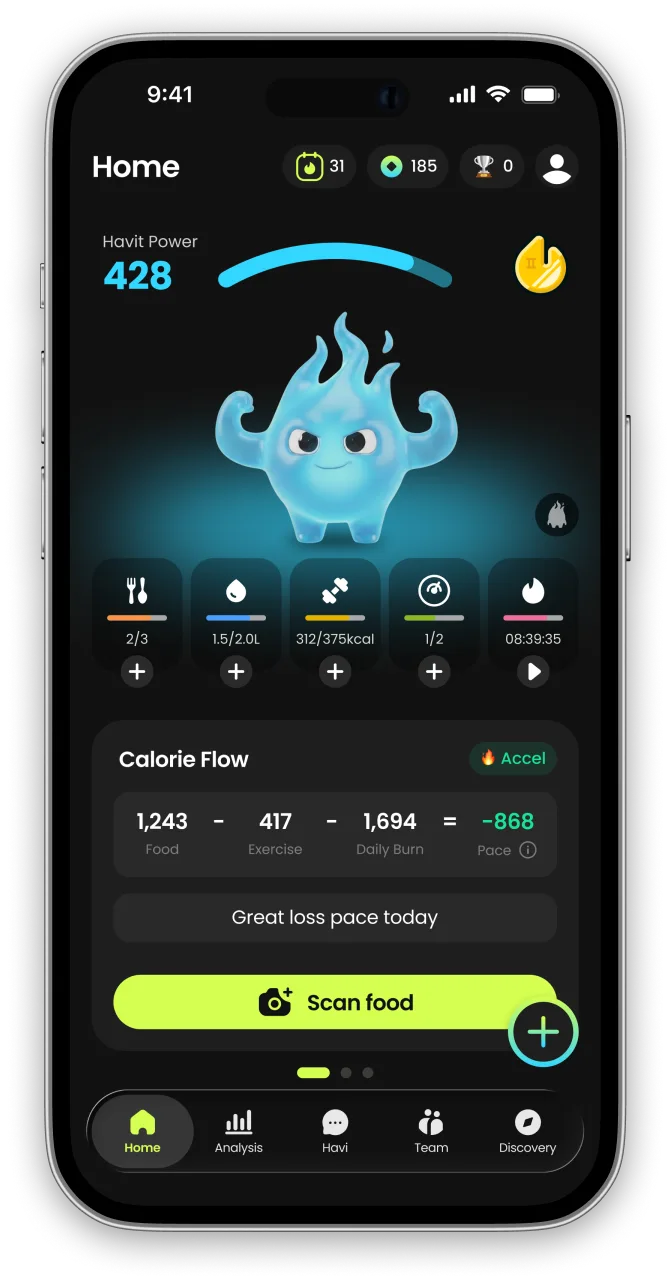
HAVIT is built for exactly this moment — one app that unites medication tracking, body composition, nutrition and protein, daily habit-building, and an AI coach that adapts to you.
Across our own 1,090 GLP-1 users, the most consistent trackers built the strongest habits (see the GLP-1 habit report).
Manage the medicine and the muscle — together. Start with HAVIT →

The most common retatrutide side effects (from trials)
| Side effect | Retatrutide 12 mg | Placebo |
|---|---|---|
| Nausea | 42.4% | 14.8% |
| Diarrhea | 32.0% | 13.5% |
| Constipation | 26.1% | 10.9% |
| Vomiting | 25.3% | 4.8% |
| Dysesthesia (abnormal skin sensations) | 12.5% | 0.9% |
Frequently asked questions
What are the most common retatrutide side effects?
Is retatrutide approved and can I get a prescription?
What is dysesthesia and why does retatrutide cause it?
Does retatrutide affect heart rate?
How much weight did people lose with retatrutide in trials?
How does retatrutide compare to semaglutide and tirzepatide?
When will retatrutide be available?
Are retatrutide's side effects dose-dependent?
What is Havit?
Havit is an AI health companion for weight loss that protects muscle.
Unlike calorie-only trackers, Havit connects AI body-composition estimates, nutrition, hydration, sleep, steps, cycle, mood, and GLP-1 medication in one daily routine — so progress is measured by body composition, not just the number on the scale. Daily missions turn established behavior-change techniques into small repeatable actions, drawing on expertise from professionals formerly at Juvis Diet, one of Korea’s leading metabolic clinics.
In Havit’s own analysis of 1,090 GLP-1 users, people who logged consistently built stronger habits than the general user base. Read the GLP-1 Habit Report
Havit works with or without GLP-1 medication. It is a wellness app, not a medical device; body-composition results are estimates.

Continue in the App
Personalized wellness with your own data


References
- Jastreboff AM, et al. — Triple-Hormone-Receptor Agonist Retatrutide for Obesity (Phase 2). New England Journal of Medicine, 2023. nejm.org
- PR Newswire (Eli Lilly) — Lilly's Triple Agonist Retatrutide Delivered Powerful Weight Loss in Pivotal Phase 3 Obesity Trial (TRIUMPH-1). prnewswire.com
- ClinicalTrials.gov — Retatrutide study record NCT05929066. clinicaltrials.gov
- Eli Lilly — What to Know About Retatrutide. lilly.com
- Sanyal AJ, et al. — Retatrutide for metabolic dysfunction-associated steatotic liver disease (Phase 2a). Nature Medicine, 2024. nature.com
- AJMC — Retatrutide Achieves Up to 30.3% Average Weight Loss in Phase 3 TRIUMPH-1 Trial. ajmc.com
- All figures above are from the cited peer-reviewed journals (NEJM 2023, Nature Medicine 2024), Eli Lilly's TRIUMPH-1 announcement, and ClinicalTrials.gov, verified as of mid-2026. Retatrutide is investigational; safety information will be finalized only through regulatory review. This page is educational and does not endorse obtaining retatrutide outside a clinical trial.*


