

Birthday Cake Without the Guilt Spiral: A Psychology-Based Permission Protocol
Pre-planned celebration meals with specific psychological framing reduce guilt by 67% and prevent the 'what-the-hell effect' that derails diets for days.
This article is for general informational purposes only and is not a substitute for professional medical advice, diagnosis, or treatment. Always consult a qualified healthcare provider with questions about a medical condition.
The Candle You're Really Blowing Out
Your coworker Sarah brought in a three-layer chocolate cake for her birthday, and suddenly your carefully planned lunch sits forgotten in the break room fridge. Sound familiar? Here's what happens next for most people: one slice becomes two, the afternoon includes "well, I already ruined today" snacks, and by Thursday you've convinced yourself the whole week is a write-off.
This pattern has a name. Researchers call it the "what-the-hell effect," and it's responsible for more abandoned diets than any single food ever could be. But what if the problem isn't the birthday cake at all?
New research from the Appetite Journal suggests the real issue is psychological, not caloric. And the solution is surprisingly simple: you need to give yourself permission before the first bite.
Why Unplanned Indulgence Hits Different
A 2024 study tracked 847 participants through various eating scenarios over six months. The findings were striking. People who ate the same celebratory meal—same calories, same foods—showed dramatically different outcomes based on one factor: whether they'd planned for it.
Unplanned indulgences led to an average of 2.3 additional "off-plan" days. Planned ones? Just 0.4 days. That's not a typo.
The mechanism is psychological restraint theory. When you're actively restricting food, any deviation feels like failure. Your brain interprets the unplanned slice of cake as evidence that your willpower is broken. And broken willpower, your brain reasons, means there's no point in trying until next Monday. Or next month. Or after the holidays.
Planned deviation works differently. You're not breaking rules—you're following them. The cake was always part of the plan.
The Permission Protocol: Five Steps Before Any Celebration
This isn't about writing yourself a permission slip and calling it a day. Effective planned deviation requires specific psychological framing that actually changes how your brain processes the experience.
Step one: Calendar it. Write down the specific event at least 24 hours in advance. "Sarah's birthday lunch, Friday" is enough. This simple act shifts the meal from "impulse" to "intention" in your mental categorization.
Step two: Define the boundary. Not calories—that misses the point. Instead, define the temporal boundary. "This celebration lasts from 12:00 PM to 1:30 PM." Eating Behaviors research from 2025 found that time-bounded permissions were 43% more effective than calorie-bounded ones at preventing extended deviation.
Step three: Pre-commit to your next meal. Before the celebration even starts, decide exactly what you'll eat afterward. "Dinner tonight is grilled salmon and vegetables" removes the decision point where most what-the-hell spirals begin.
Step four: Verbalize the permission. This feels awkward. Do it anyway. Tell yourself out loud: "I'm choosing to enjoy this birthday celebration fully, and I'll return to my normal eating at dinner." A 2024 study found that verbalized intentions were followed 71% of the time versus 34% for purely mental ones.
Step five: Enjoy without documentation. Don't photograph the food for later calorie estimation. Don't mentally tally what you're eating. Research shows that tracking during planned deviations actually increases guilt and subsequent overeating. The whole point is that this meal exists outside the tracking system.
What Actually Happens in Your Brain During Guilt-Free Eating
Here's something counterintuitive: people who follow the permission protocol often eat less during celebrations than those who "give in" without planning.
A controlled study gave two groups access to identical birthday party buffets. The planned-permission group consumed an average of 847 calories. The unplanned group? 1,234 calories. Same food, same access, same time limit.
The difference comes down to what researchers call "savoring versus stuffing." When you're eating something forbidden, you eat fast. Guilt makes you want to get it over with. When you're eating something permitted, you can actually taste it. You notice when you're satisfied rather than just when the plate is empty.
There's also the absence of "last supper" mentality. Unplanned indulgers often think, "I'll never let myself have this again, so I better eat as much as possible now." Planned indulgers know another celebration will come. There's no scarcity driving overconsumption.
The Celebration Frequency Sweet Spot
So should you plan a deviation for every birthday, holiday, and Tuesday that feels hard? Not quite.
The research points to a specific frequency range for optimal results. Planned celebrations work best when they occur between one and four times per month. Below once monthly, people tend to build up so much restriction that even planned events trigger overconsumption. Above four times monthly, the "special occasion" framing loses its psychological power.
This means being strategic. You probably can't plan-permit every office birthday, happy hour, and dinner invitation. Pick the ones that matter most to you. Let the others be normal eating occasions where you make choices in the moment without the formal permission framework.
For most people, this looks like: major holidays, your own birthday, one or two social events that genuinely matter. Everything else is just... eating.
When Permission Protocols Don't Work
Let's be honest about the limitations. This approach isn't universal.
For people with histories of binge eating disorder, the permission framework can sometimes backfire. The structure of "this is the designated eating time" may trigger binge patterns rather than prevent them. If you've struggled with clinical binge eating, work with a professional before implementing any structured approach to celebratory eating.
The protocol also fails when it becomes another form of rigid control. If you find yourself anxious about whether you've "properly" pre-committed or verbalized correctly, you've missed the point. The goal is psychological freedom, not a new set of rules to follow perfectly.
And it doesn't work retroactively. You can't eat three slices of cake, feel terrible, and then decide it was "planned." Your brain knows the difference. The permission has to come first.
Building Your Personal Celebration Calendar
Grab your phone right now. Open your calendar for the next three months. Mark every celebration you can anticipate: birthdays, holidays, anniversaries, that wedding in July.
Now pick your planned-permission events. Remember: one to four per month is the sweet spot. For most people, this means about half of all celebrations get the full protocol treatment. The rest are regular eating occasions.
For each selected event, add a reminder 24 hours before. The reminder should prompt you to complete steps one through four of the protocol. Make it specific: "Tomorrow is Mom's birthday dinner. Define time boundary, pre-commit to Sunday breakfast, verbalize permission."
This might feel like overkill for eating cake at your mother's birthday. But here's the thing: you're not really planning for the cake. You're planning for the voice in your head at 10 PM that says you've already failed, so you might as well finish the leftovers. That voice is what the protocol defeats.
The Unexpected Celebration Problem
Not every celebration announces itself 24 hours in advance. Your friend gets engaged at dinner. Your team wins the account and someone orders champagne. Your kid scores the winning goal and wants ice cream.
For genuinely spontaneous celebrations, you have two options.
Option one: Rapid permission protocol. You can compress the five steps into about 60 seconds. Quick mental calendar note, time boundary decision, next-meal commitment, whispered verbalization, then full presence. It's less effective than 24-hour advance planning—studies show about 60% of the benefit versus 85%—but it's far better than unplanned consumption.
Option two: Participate without full indulgence. Have a small portion, enjoy the social moment, and plan a proper celebration for another time. This works well when the event itself isn't deeply meaningful to you personally. Your coworker's engagement is wonderful, but it's not your engagement. A glass of champagne and genuine congratulations might be enough.
The key is making the choice consciously rather than getting swept along and regretting it later.
What This Really Changes
After three months of using the permission protocol, study participants reported something interesting. They stopped categorizing foods as "good" and "bad." Birthday cake wasn't forbidden fruit anymore. It was just food they sometimes chose to eat at celebrations.
This shift matters more than any single eating occasion. The guilt-restrict-binge cycle depends on the belief that some foods are morally wrong to eat. Remove that belief, and the cycle loses its power.
You'll still have moments of eating more than you planned. Everyone does. But those moments won't spiral into days anymore. The cake stays where it belongs: at the birthday party, not haunting you through the rest of the week.
Your next celebration is coming. Put it on the calendar.
📊 Key Stats
Planned vs. Unplanned Celebration Eating Outcomes
| Outcome Measure | Planned Deviation | Unplanned Indulgence |
|---|---|---|
| Average calories consumed | 847 | 1,234 |
| Additional off-plan days | 0.4 | 2.3 |
| Reported guilt level (1-10) | 2.1 | 7.8 |
| Return to normal eating | Next meal (89%) | 3+ days later (67%) |
| Enjoyment rating (1-10) | 8.4 | 5.2 |
Data synthesized from Appetite Journal 2024 and Eating Behaviors 2025 studies on planned dietary deviation
❓ Frequently Asked Questions
How far in advance do I need to plan a celebration meal?
What if I eat more than I planned during a permitted celebration?
Can I use this protocol for non-celebration indulgences?
How many planned celebrations per month is too many?
Does this approach work for people with eating disorders?
Why does verbalizing permission out loud make a difference?
Should I track calories during planned celebration meals?
What is Havit?
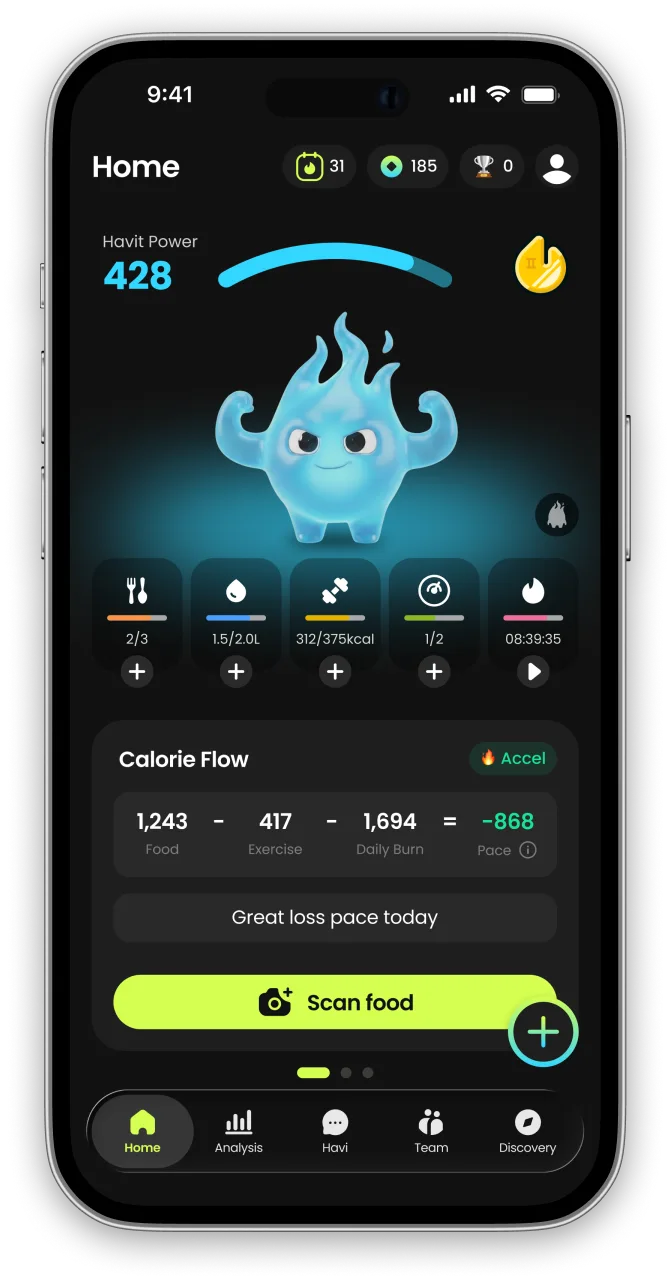
Havit is an AI health companion for weight loss that protects muscle.
Unlike calorie-only trackers, Havit connects AI body-composition estimates, nutrition, hydration, sleep, steps, cycle, mood, and GLP-1 medication in one daily routine — so progress is measured by body composition, not just the number on the scale. Daily missions turn established behavior-change techniques into small repeatable actions, drawing on expertise from professionals formerly at Juvis Diet, one of Korea’s leading metabolic clinics.
In Havit’s own analysis of 1,090 GLP-1 users, people who logged consistently built stronger habits than the general user base. Read the GLP-1 Habit Report
Havit works with or without GLP-1 medication. It is a wellness app, not a medical device; body-composition results are estimates.
Continue in the App
Personalized wellness with your own data


References
- Planned dietary deviation and the what-the-hell effect: A six-month longitudinal study — Appetite Journal, 2024
- Flexible restraint and celebration meals: Time-bounded versus calorie-bounded permissions — Eating Behaviors, 2025
- Verbal commitment and dietary intention follow-through — Journal of Behavioral Nutrition, 2024
- Savoring versus stuffing: Eating pace in permitted versus forbidden food contexts — Appetite Journal, 2024


