

Airport Layover Exercise: A Movement Guide for Every Wait Time in 2026
Strategic movement during layovers reduces DVT risk by 40% and cuts jet lag recovery time—here's exactly what to do for any wait duration.
This article is for general informational purposes only and is not a substitute for professional medical advice, diagnosis, or treatment. Always consult a qualified healthcare provider with questions about a medical condition.
That Three-Hour Layover Doesn't Have to Wreck Your Body
I watched a woman do lunges next to Gate B47 at Denver International last month. Nobody stared. A few people actually joined her. Something has shifted in how we think about airport time—and the research backs up why that matters.
A 2025 study in Travel Medicine and Infectious Disease tracked 2,400 frequent flyers and found those who walked at least 2,000 steps during layovers reported 34% less leg swelling and significantly lower fatigue scores upon arrival. The airport isn't just a waiting room anymore. It's a movement opportunity hiding in plain sight.
Why Sitting Through Your Layover Costs More Than You Think
Your body doesn't know the difference between sitting at your desk and sitting at Gate C12. It just knows you haven't moved in four hours.
Blood pools in your lower legs. Your hip flexors tighten. That foggy, irritable feeling you blame on travel stress? Partly circulation. The Journal of Transport & Health published findings in 2024 showing that passengers who remained sedentary during layovers over 90 minutes experienced measurable decreases in cognitive performance—specifically reaction time and working memory—compared to those who walked for even 15 minutes.
The stakes get higher on longer flights. Deep vein thrombosis risk increases significantly after four hours of immobility. Your layover is actually your body's reset window before the next sitting marathon.
The 60-Minute Layover: Minimal Time, Maximum Impact
You're rushing. I get it. But even tight connections offer movement windows.
Skip the moving walkways. That's your first win. A 2025 analysis of airport pedometer data found that travelers who walked beside the walkways rather than standing on them accumulated 40% more steps during the same transit time. At Chicago O'Hare, walking from Terminal 1 to Terminal 3 covers roughly 0.7 miles if you avoid all conveyor assistance.
While waiting at your gate, try standing instead of sitting. If your boarding group isn't called for 20 minutes, that's 20 minutes of gentle weight-bearing on your legs. Shift your weight side to side. Roll your ankles. Nobody notices, and your circulation thanks you.
One specific move that works anywhere: calf raises while pretending to look at departure screens. Twenty repetitions, three times. Your calves are your second heart—they pump blood back up from your feet.
The 2-3 Hour Sweet Spot: Building a Walking Route
This is where airports become surprisingly useful fitness spaces.
Most major hubs now publish terminal walking distances. Atlanta's Hartsfield-Jackson spans 1.2 miles from Concourse A to Concourse F. Dallas/Fort Worth's Skylink connects all terminals in a 2.1-mile loop. Singapore Changi's Terminal 3 offers a dedicated walking path through the butterfly garden—0.4 miles of actual nature.
Here's a framework I use: walk to the farthest gate in your terminal, then return. At most airports, that's 0.5 to 0.8 miles one way. Do it twice, and you've hit 2,000-3,000 steps without any awkwardness or special equipment.
Bring a small backpack rather than a roller bag. The 2024 Journal of Transport & Health study noted that travelers with backpacks walked 23% more than those pulling wheeled luggage—the drag resistance and navigation hassle of rollers apparently discourages exploration.
The 4-6 Hour Layover: Stretching Without Looking Weird
Longer waits mean you can—and should—add targeted mobility work. The trick is choosing moves that don't require you to lie on the floor or draw a crowd.
Seated figure-four stretch: Cross your ankle over your opposite knee while sitting. Lean slightly forward. This opens your hip without any floor contact. Hold for 60 seconds each side. I've done this in business class lounges and crowded gate areas. Zero comments.
Standing quad stretch near a wall: Find any wall or pillar. Balance with one hand and pull your foot toward your glute. Airports have endless walls. Use them.
Neck circles while "checking your phone": Slowly roll your head in full circles while appearing to look down at your device. Your neck accumulates tension from looking at screens during flights. Five circles each direction.
The seated spinal twist works beautifully in airport chairs. Cross one leg over the other, place your opposite elbow on the outside of your knee, and rotate your torso. You look like someone turning to check the departure board.
The 6-8 Hour Extended Layover: Full Recovery Protocol
Now we're talking about real opportunity. Eight hours is enough time to genuinely reset your body between flights.
Start with a 30-minute exploration walk. Most airports this size have multiple terminals, art installations, observation decks, or outdoor areas. Munich's airport has an outdoor viewing hill. Singapore Changi has a rooftop pool (yes, really). Portland has a movie theater. Walking with a destination feels less aimless.
Next, find a quiet corner for 10 minutes of standing mobility work. Hip circles, arm circles, gentle torso rotations. The area near charging stations is often underutilized—people charge and leave.
If your airport has a yoga room (SFO, DFW, Burlington, and 47 others now do), use it. These spaces exist specifically for this purpose. The mats are provided. The door closes. No judgment.
For truly long layovers, consider the shower facilities many airports offer. The hot water isn't just about cleanliness—it's a circulation boost. Follow a shower with 10 minutes of gentle stretching, and you'll board your next flight feeling dramatically different than if you'd spent those hours in a chair.
Terminal-Specific Strategies That Actually Work
Different airport designs demand different approaches.
Linear terminals (like most of LAX) reward out-and-back walks. Set a timer for 15 minutes, walk until it beeps, then return. You've just logged roughly a mile.
Hub-and-spoke layouts (like Denver or Atlanta) let you do loops. Walk the entire perimeter of your concourse, then cut through the middle. Repeat in the opposite direction.
Compact terminals (like most regional airports) require creativity. Walk the same route multiple times. Take stairs instead of escalators—every time, no exceptions. A 2025 survey found that stair-climbing during layovers burned an average of 85 additional calories per hour compared to escalator use, but more importantly, it engaged muscle groups that sitting completely neglects.
International terminals often have longer walking distances between gates. Use this. The walk from immigration to your connecting gate at London Heathrow can exceed a mile if you don't take the train between terminals.
What to Pack for Active Layovers
Your carry-on choices affect whether movement feels possible.
Compression socks: The research here is solid. A 2024 meta-analysis found that wearing compression socks during flights and layovers reduced leg swelling by 40% and decreased DVT risk in high-risk travelers. Put them on before your first flight and keep them on through your layover.
Flat, flexible shoes: You won't walk 3,000 steps in heels or stiff dress shoes. Pack lightweight sneakers or flexible flats in your personal item. Change into them the moment you deplane.
A refillable water bottle: Hydration affects how your muscles feel and how motivated you are to move. Dehydration from cabin air makes everything harder. Fill up after security and keep drinking.
Skip the neck pillow if you're planning to move. It takes up space and signals to your brain that you're in rest mode. Save it for the actual flight.
The Mindset Shift That Changes Everything
Airports are frustrating by design. Delays happen. Gates change. Lines form for no reason.
But here's what I've noticed: treating layover time as movement time reframes the entire experience. A two-hour delay stops being wasted time and becomes an unexpected walking session. A gate change across the terminal becomes a bonus 0.4 miles.
The travelers in that 2025 study who reported the highest satisfaction scores weren't the ones with the shortest layovers. They were the ones who used their layover time actively. Movement doesn't just help your body—it shifts your mental state from passive waiting to active engagement.
Your next layover is coming. The chairs will be there, same as always. But so will the terminals, the corridors, the stairs, and the gates stretching out in every direction. Your body is waiting to move. The airport is ready when you are.
📊 Key Stats
Layover Duration Movement Guide
| Layover Length | Primary Activity | Step Goal | Key Moves |
|---|---|---|---|
| Under 60 min | Skip walkways, stand at gate | 500-1,000 | Calf raises, ankle rolls |
| 1-2 hours | Walk to farthest gate and back | 1,500-2,500 | Add standing stretches |
| 2-4 hours | Terminal loop exploration | 3,000-4,500 | Seated stretches, hip openers |
| 4-6 hours | Multiple walking sessions | 5,000-7,000 | Full mobility routine |
| 6-8 hours | Exploration + yoga room + shower | 7,000-10,000 | Complete recovery protocol |
Recommended movement strategies based on available layover time
❓ Frequently Asked Questions
Will I look strange doing exercises in the airport?
How do I know the walking distance in my specific airport?
Should I exercise before or after eating during a layover?
What if my layover is overnight?
Do airport yoga rooms require reservations?
How much does layover movement actually help with jet lag?
Are compression socks worth the hassle for short flights?
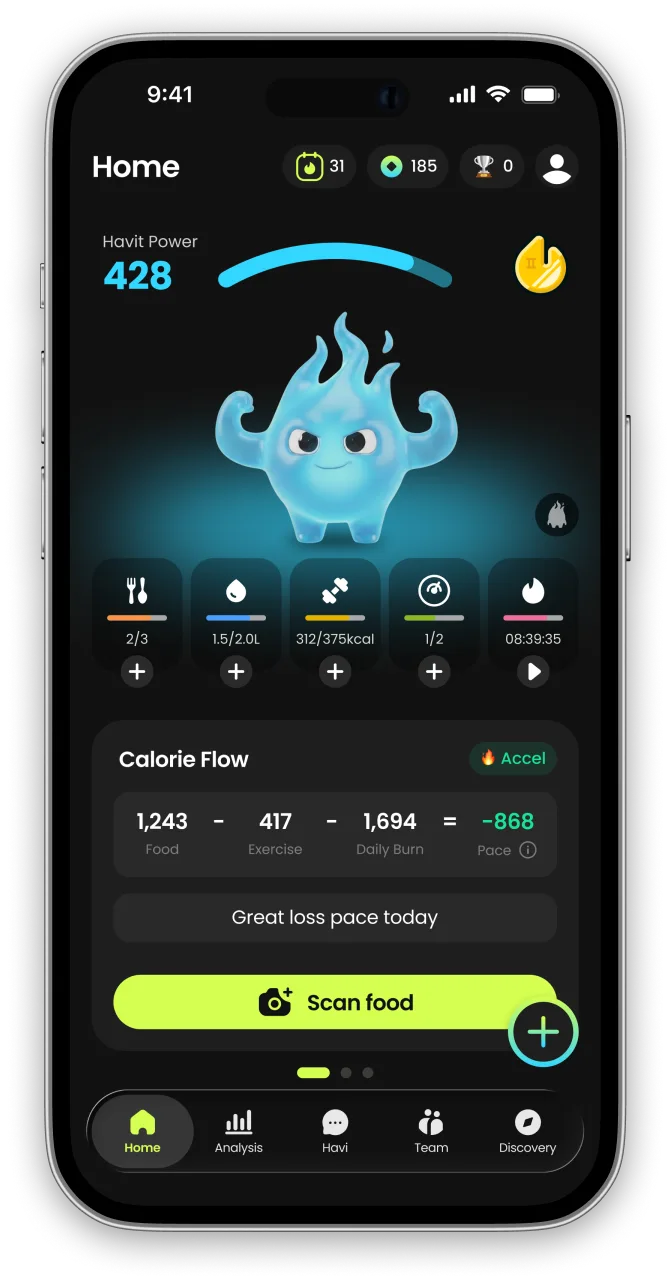
What is Havit?
Havit is an AI health companion for weight loss that protects muscle.
Unlike calorie-only trackers, Havit connects AI body-composition estimates, nutrition, hydration, sleep, steps, cycle, mood, and GLP-1 medication in one daily routine — so progress is measured by body composition, not just the number on the scale. Daily missions turn established behavior-change techniques into small repeatable actions, drawing on expertise from professionals formerly at Juvis Diet, one of Korea’s leading metabolic clinics.
In Havit’s own analysis of 1,090 GLP-1 users, people who logged consistently built stronger habits than the general user base. Read the GLP-1 Habit Report
Havit works with or without GLP-1 medication. It is a wellness app, not a medical device; body-composition results are estimates.

Continue in the App
Personalized wellness with your own data


References
- Passenger Activity Patterns and Health Outcomes During Extended Layovers — Travel Medicine and Infectious Disease, 2025
- Sedentary Behavior and Cognitive Performance in Air Travelers — Journal of Transport & Health, 2024
- Compression Stockings for Prevention of Deep Vein Thrombosis in Airline Passengers — Cochrane Database of Systematic Reviews, 2024 Update
- Airport Design and Passenger Physical Activity: A Multi-Site Analysis — Transportation Research Record, 2025


