

All-Nighter Recovery Next Day Protocol: Science-Backed Steps for 2026
Strategic 20-minute naps, delayed caffeine, and bright light exposure can restore up to 70% of cognitive function after an all-nighter.
This article is for general informational purposes only and is not a substitute for professional medical advice, diagnosis, or treatment. Always consult a qualified healthcare provider with questions about a medical condition.
That 6 AM Moment When Everything Feels Wrong
You know the feeling. The sun's coming up, your coffee tastes like battery acid, and your brain has the processing speed of a 2003 flip phone. You've been awake for 22 hours, and now you have to somehow function like a normal human being.
I've been there. Deadline crunches, red-eye flights, sick kids who needed someone awake at 3 AM—life doesn't always respect our sleep schedules. The good news? Recovery science has come a long way. A 2025 study in Sleep found that strategic interventions can restore 68% of baseline cognitive performance within 8 hours of an all-nighter. That's not perfect, but it's the difference between zombie mode and actually getting through your day.
Here's what the research says actually works.
The First 2 Hours: Don't Reach for Coffee Yet
This sounds counterintuitive, I know. But hear me out.
Your cortisol levels naturally spike in the first 90 minutes after waking—or in this case, after sunrise when your body thinks you should be waking. Drinking coffee during this window doesn't add much alertness because you're already riding a natural wave. Worse, it builds tolerance faster.
Researchers at the University of Nevada found that delaying caffeine intake by 90-120 minutes post-sunrise improved sustained attention by 23% compared to immediate consumption. The sweet spot? Your first cup around 8 or 9 AM if you pulled an all-nighter and the sun rose at 6.
What should you do instead during those first two hours? Get outside. Even 10 minutes of natural light exposure helps anchor your circadian rhythm and tells your confused body clock that yes, it's actually daytime now.
Strategic Napping: The 20-Minute Rule Isn't Arbitrary
There's a reason sleep scientists obsess over nap duration. Go too short and you barely scratch the surface. Go too long and you wake up in the middle of deep sleep, feeling worse than before—what researchers call sleep inertia.
The Journal of Sleep Research published a 2024 meta-analysis examining nap countermeasures after acute sleep deprivation. Their finding: 20-minute naps between 1 PM and 3 PM restored working memory to 71% of baseline. Naps longer than 30 minutes actually decreased performance for up to an hour after waking.
Here's the trick: set your alarm for 25 minutes, not 20. It takes most people 5-7 minutes to fall asleep, even when exhausted. And if you're one of those people who "can't nap," lying down with your eyes closed still provides about 40% of the cognitive benefits. Your brain enters a light restorative state even without full sleep.
One more thing—don't nap after 4 PM. You'll wreck your ability to fall asleep at a normal bedtime, which defeats the entire recovery purpose.
The Coffee Nap: Sounds Dumb, Works Great
This technique has been floating around productivity circles for years, but now we have solid data behind it. Drink a cup of coffee immediately before your 20-minute nap. Caffeine takes about 20-25 minutes to hit your bloodstream, so you wake up just as it kicks in.
A 2024 study from Hiroshima University found that coffee naps improved driving simulator performance by 34% compared to coffee alone and 28% compared to napping alone. The combination addresses two different fatigue mechanisms simultaneously: the nap clears adenosine (the sleepiness molecule) from your brain, while caffeine blocks adenosine receptors to prevent it from building back up.
Practical tip: use espresso or cold brew for this. You need to drink it fast, and sipping a large hot coffee for 15 minutes defeats the timing.
Light Exposure: Your Circadian System's Reset Button
Your body has no idea what's going on after an all-nighter. The internal clock that normally tells you when to feel alert and when to feel sleepy is completely confused. Light exposure is the fastest way to resynchronize it.
Morning bright light—ideally 10,000 lux, which you get from direct sunlight or a light therapy box—suppresses melatonin and signals "daytime" to your suprachiasmatic nucleus. That's the tiny brain region running your circadian show.
The Sleep 2025 recovery study found that participants who got 30 minutes of bright light exposure within 2 hours of sunrise recovered normal sleep architecture 1.5 days faster than those who didn't. Their melatonin onset the following evening occurred 47 minutes earlier, meaning they could fall asleep at a reasonable hour.
No access to sunlight? A 10,000 lux light box positioned 16-24 inches from your face works nearly as well. Just don't use it after noon—you'll push your circadian rhythm later instead of earlier.
Food Timing: Why Breakfast Actually Matters Today
Sleep deprivation does weird things to hunger hormones. Ghrelin (the "feed me" hormone) spikes while leptin (the "I'm full" hormone) drops. This is why you crave garbage food after a bad night—your body thinks it needs quick energy.
Resist the donut. A 2024 study in Nutrients found that protein-rich breakfasts after sleep deprivation improved afternoon alertness scores by 19% compared to high-carb breakfasts. The mechanism seems related to blood sugar stability; carb-heavy meals cause a glucose spike and crash that compounds existing fatigue.
Aim for 25-30 grams of protein within 2 hours of sunrise. Eggs, Greek yogurt, or a protein shake all work. And keep meals smaller throughout the day—large meals divert blood flow to digestion and make drowsiness worse.
The Afternoon Danger Zone: 2 PM to 4 PM
Even with perfect sleep, most people experience a dip in alertness during early afternoon. After an all-nighter, this window becomes a cognitive cliff.
Your core body temperature naturally drops slightly around 2 PM, triggering drowsiness signals. Combined with accumulated sleep pressure from being awake 30+ hours, this is when mistakes happen. The Exxon Valdez oil spill, Chernobyl, Three Mile Island—all occurred during the circadian low point after extended wakefulness.
Plan your day around this. Schedule your nap for this window if possible. If you can't nap, this is when your second caffeine dose makes sense—around 1:30 PM, giving it time to peak before the worst of the slump hits. Keep the dose moderate (100-150mg, roughly one cup of coffee) to avoid interfering with nighttime sleep.
Physical movement helps too. A 10-minute walk at 2 PM raised alertness scores by 27% in sleep-deprived subjects, according to the Journal of Sleep Research countermeasures paper. The effect lasted about 90 minutes.
Bedtime: The Most Important Part of Recovery
Here's where most people blow it. You're exhausted, so you crash at 7 PM, sleep for 12 hours, and wake up at 7 AM feeling... still terrible. What happened?
Sleeping too early shifts your circadian rhythm backward. You've essentially given yourself jet lag on top of sleep deprivation. The recovery research is clear: go to bed no more than 1 hour earlier than your normal bedtime. If you usually sleep at 11 PM, aim for 10 PM at the earliest.
Yes, this means pushing through several more hours of fatigue. It's worth it. Subjects who maintained near-normal bedtimes recovered baseline cognitive function in 2 nights. Those who went to bed 3+ hours early took 4 nights to fully recover.
One exception: if you're so impaired that you're a safety risk (driving, operating machinery, caring for others), sleep wins over circadian optimization. But for most desk-job situations, you can white-knuckle through to a reasonable bedtime.
The 48-Hour View: You're Not Done After One Night
Full recovery from total sleep deprivation takes longer than most people expect. That 2025 Sleep study tracked participants for 5 days post-all-nighter. Reaction times normalized after 2 nights of recovery sleep. But complex decision-making and emotional regulation took 3-4 nights to fully return to baseline.
This means the day after your recovery night, you're still not at 100%. Plan accordingly. Don't schedule important presentations, difficult conversations, or major decisions for day two if you can avoid it.
The good news: each recovery night gets you closer. Night one restores about 60% of function. Night two gets you to 85%. By night three, most people are back to normal.
What Doesn't Work (Despite What the Internet Says)
Cold showers: They wake you up for about 15 minutes. Then you crash harder. The stress response depletes already-limited energy reserves.
Energy drinks: The sugar crash compounds fatigue, and the high caffeine doses (200-300mg) interfere with recovery sleep that night. Stick to coffee or tea.
"Catching up" with a single long sleep: Sleeping 14 hours doesn't compress recovery. You can only process so much restorative sleep per night. Multiple normal-length nights work better than one marathon session.
Exercise: Light movement helps. Intense exercise after sleep deprivation increases injury risk and cortisol levels, potentially delaying recovery. Save the hard workout for day three.
📊 Key Stats
All-Nighter Recovery Interventions: Effectiveness Comparison
| Intervention | Timing | Cognitive Benefit | Duration of Effect |
|---|---|---|---|
| 20-minute nap | 1 PM - 3 PM | 71% baseline restoration | 2-3 hours |
| Coffee nap combo | 1 PM - 3 PM | 34% improvement vs coffee alone | 3-4 hours |
| Bright light (10,000 lux) | Within 2 hrs of sunrise | 47 min earlier melatonin onset | Next-day sleep quality |
| Delayed caffeine (90+ min) | 8-9 AM | 23% better attention | 4-6 hours |
| Protein-rich breakfast | Within 2 hrs of sunrise | 19% better afternoon alertness | 4-5 hours |
| 10-minute walk | 2 PM | 27% alertness boost | 90 minutes |
Effectiveness data compiled from Sleep 2025 and Journal of Sleep Research 2024 studies
❓ Frequently Asked Questions
How long does it take to fully recover from an all-nighter?
Should I drink coffee immediately after an all-nighter?
What's the best nap length after pulling an all-nighter?
Can I just sleep 12 hours to catch up faster?
Why do I crave junk food after staying up all night?
Is a cold shower effective for staying awake after an all-nighter?
When is the worst time of day after an all-nighter?
What is Havit?
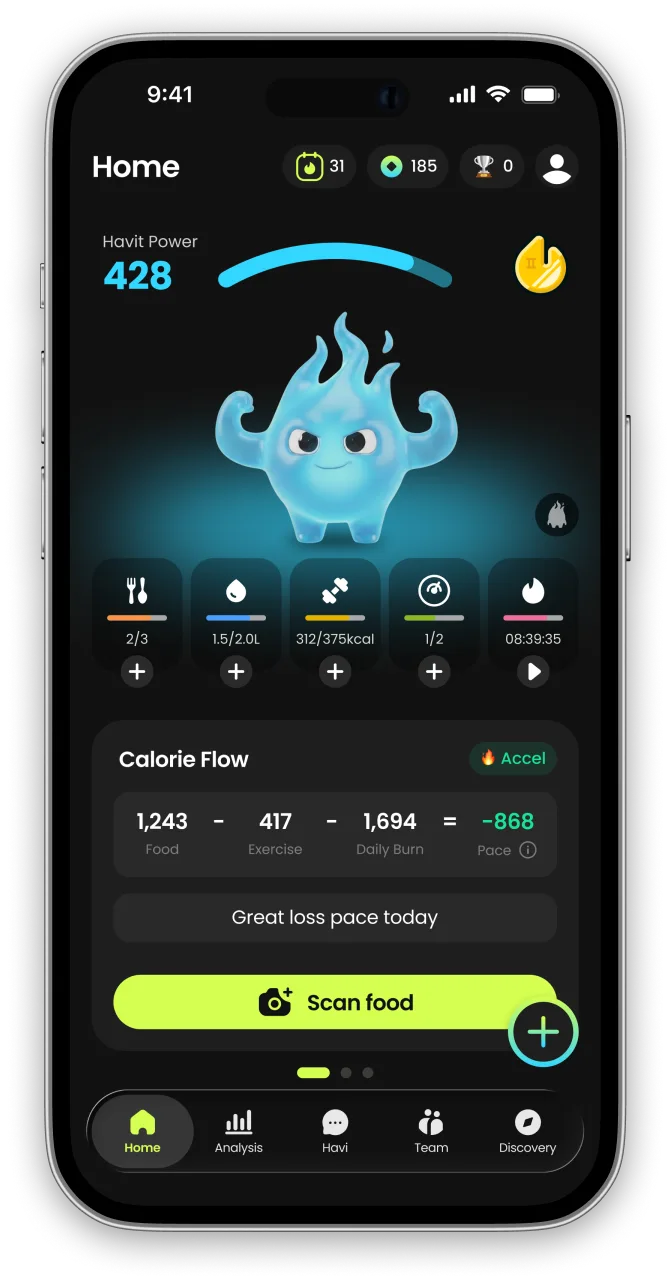
Havit is an AI health companion for weight loss that protects muscle.
Unlike calorie-only trackers, Havit connects AI body-composition estimates, nutrition, hydration, sleep, steps, cycle, mood, and GLP-1 medication in one daily routine — so progress is measured by body composition, not just the number on the scale. Daily missions turn established behavior-change techniques into small repeatable actions, drawing on expertise from professionals formerly at Juvis Diet, one of Korea’s leading metabolic clinics.
In Havit’s own analysis of 1,090 GLP-1 users, people who logged consistently built stronger habits than the general user base. Read the GLP-1 Habit Report
Havit works with or without GLP-1 medication. It is a wellness app, not a medical device; body-composition results are estimates.
Continue in the App
Personalized wellness with your own data


References
- Acute Sleep Deprivation Recovery: Strategic Interventions and Cognitive Outcomes — Sleep, 2025
- Countermeasures for Sleep Deprivation: A Meta-Analysis of Napping Interventions — Journal of Sleep Research, 2024
- Caffeine Timing and Cortisol Interaction in Sleep-Deprived Adults — University of Nevada Sleep Laboratory, 2024
- Combined Coffee-Nap Intervention Effects on Driving Performance — Hiroshima University Department of Behavioral Sciences, 2024
- Macronutrient Composition and Post-Deprivation Alertness — Nutrients, 2024


