

Walking Meetings Boost Creativity by 60%: The Science of Thinking on Your Feet
Walking during meetings increases divergent thinking and creative output by up to 60%, with effects lasting even after you sit back down.
This article is for general informational purposes only and is not a substitute for professional medical advice, diagnosis, or treatment. Always consult a qualified healthcare provider with questions about a medical condition.
Your Best Ideas Probably Won't Happen in a Conference Room
Steve Jobs was famous for them. So was Aristotle, who taught philosophy while strolling through the Lyceum with his students. Mark Zuckerberg holds them with potential hires. Walking meetings have a long history among creative thinkers—and now we have hard data explaining why they work so remarkably well.
A 2024 study from Stanford researchers published in the Journal of Experimental Psychology found something striking: people generated 60% more creative uses for common objects while walking compared to sitting. Not 10%. Not 20%. Sixty percent. That's the difference between a mediocre brainstorm and one that actually produces usable ideas.
But here's what makes this really interesting. The boost isn't just about fresh air or escaping fluorescent lighting. Something specific happens in your brain when your legs start moving.
What Actually Happens to Your Brain When You Walk
Your prefrontal cortex—the region responsible for executive function and creative thinking—gets a significant blood flow increase during walking. We're talking about a 15-20% bump in cerebral perfusion, according to neuroimaging research published in Frontiers in Psychology in 2025.
This matters because creative thinking is metabolically expensive. Your brain consumes about 20% of your body's energy at rest, and complex cognitive tasks demand even more. Walking essentially turns up the fuel supply right when you need it most.
There's also something called "transient hypofrontality" at play. When you walk, your brain partially shifts resources away from the analytical, critical-thinking regions toward motor control. This sounds bad, but it's actually liberating. That inner critic that shoots down half-formed ideas before they fully develop? It gets quieter. Your mind becomes more willing to entertain unusual connections.
One participant in a walking creativity study described it perfectly: "Sitting in a meeting, I filter everything before I say it. Walking, ideas just... come out."
The 60% Creativity Boost: Breaking Down the Research
The Stanford study that produced the 60% figure used something called the Guilford's Alternative Uses Test. Researchers asked participants to generate creative uses for everyday objects like a brick or a paperclip. Simple enough.
People who walked—whether on a treadmill facing a blank wall or outside on campus—produced significantly more responses than those who sat. And these weren't just more ideas; they were more original ideas, as rated by independent judges who didn't know which condition each response came from.
The outdoor walkers performed slightly better than treadmill walkers, but the difference was smaller than you might expect. The act of walking itself drove most of the benefit. Fresh air and changing scenery added maybe another 5-10% on top.
What really caught researchers off guard was the residual effect. Participants who walked and then sat down for a second creative task still outperformed those who had been sitting the whole time. The cognitive benefits lingered for roughly 15 minutes after walking stopped.
Divergent vs. Convergent Thinking: Where Walking Wins (and Loses)
Not all thinking benefits equally from movement. The research draws a clear line between divergent thinking—generating multiple possible solutions—and convergent thinking—narrowing down to a single correct answer.
Walking supercharges divergent thinking. Brainstorming sessions, early-stage problem solving, strategy discussions where you need lots of options on the table—these are perfect candidates for ambulatory meetings.
Convergent thinking is different. When you need to analyze a spreadsheet, debug code, or choose between three specific options based on defined criteria, sitting might actually work better. The 2025 Frontiers in Psychology paper found that walking slightly impaired performance on tasks requiring focused analytical attention.
So here's a practical framework: walk when you're trying to expand possibilities, sit when you're trying to narrow them down. The brainstorm happens on foot. The final decision happens at a table.
How Long Should a Walking Meeting Last?
The sweet spot appears to be 20-30 minutes.
Shorter than 15 minutes, and you don't get the full cognitive warm-up. Your brain needs a few minutes of walking before the creativity benefits kick in. Longer than 45 minutes, and fatigue starts interfering—both physical fatigue and the mental load of maintaining a conversation while navigating.
Pace matters too. A leisurely 2-3 mph stroll works best. Faster walking shifts more cognitive resources toward motor control and balance, leaving less for creative thinking. One study participant who tried a brisk walking meeting reported feeling "too out of breath to think properly."
The ideal walking meeting has a clear loop or out-and-back route so you don't have to think about navigation. You want your brain focused on the conversation, not on figuring out where to turn next.
The Surprising Social Dynamics of Side-by-Side Conversation
Seated meetings have a confrontational geometry. You sit across from someone, making eye contact, in what psychologists call a "face-to-face" orientation. This configuration evolved for negotiation and conflict—for situations where you need to read someone's expressions carefully and assert dominance.
Walking meetings shift you to a "side-by-side" orientation. You're literally facing the same direction, moving toward a shared destination. This subtle change affects conversation dynamics in measurable ways.
Research on interview techniques found that side-by-side walking interviews produced 23% more disclosure than seated face-to-face interviews. People opened up more. They shared information they wouldn't have mentioned across a conference table.
Hierarchical differences also soften when everyone's walking together. A junior employee who might hesitate to challenge their CEO in a boardroom often speaks more freely on a walking route. The physical equality of walking—everyone taking the same steps—seems to translate into conversational equality.
Making Walking Meetings Work in Practice
The logistics trip people up more than the concept. Here's what actually works based on companies that have implemented walking meetings systematically.
Keep the group small. Two or three people is ideal. Beyond four, the group tends to split into sub-conversations, and you lose the benefits of shared creative thinking. Large meetings still need conference rooms.
Choose routes with minimal obstacles. Busy sidewalks, street crossings, and uneven terrain all compete for cognitive attention. A park path or quiet campus loop works better than a downtown block.
Bring a voice recorder or designate a note-taker who uses their phone. The ideas generated during walking meetings tend to be numerous and fleeting. Without capture, you'll lose half of them by the time you get back to your desk. One product team at a tech company started every walking meeting by opening a shared Google Doc and voice-typing key points as they walked.
Weather is less of a barrier than people assume. Light rain with umbrellas works fine. Cold weather works if everyone's dressed for it. The only real dealbreakers are extreme heat, heavy rain, or icy conditions.
The ROI of Getting Out of the Conference Room
A 2024 workplace productivity analysis estimated that the average knowledge worker spends 23 hours per week in meetings. If even 20% of those meetings could be converted to walking format—and if those walking meetings were 60% more creatively productive—the compound effect on innovation would be substantial.
Some organizations have started tracking this explicitly. A design consultancy in San Francisco reported that walking meetings generated 40% more viable concepts per hour than seated brainstorms over a six-month measurement period. They now default to walking for all ideation sessions under four people.
The physical health benefits stack on top of the cognitive ones. Converting two 30-minute seated meetings per day to walking adds roughly 3,000 steps and burns an additional 100-150 calories. Over a year, that's meaningful.
But the real value isn't in calories burned. It's in the quality of thinking that happens when you free your mind from the conference room and let your legs do some of the work.
📊 Key Stats
Walking vs. Seated Meetings: Cognitive Performance Comparison
| Factor | Walking Meeting | Seated Meeting | Best For |
|---|---|---|---|
| Divergent thinking (brainstorming) | 60% higher output | Baseline | Walking |
| Convergent thinking (analysis) | Slightly impaired | Optimal | Seated |
| Creative idea originality | Significantly higher | Baseline | Walking |
| Hierarchical openness | More equal participation | Status differences persist | Walking |
| Information disclosure | 23% more sharing | Baseline | Walking |
| Detailed document review | Difficult | Optimal | Seated |
| Group size capacity | 2-4 people ideal | Unlimited | Depends on size |
Data synthesized from Journal of Experimental Psychology 2024 and Frontiers in Psychology 2025
❓ Frequently Asked Questions
How long should a walking meeting last for maximum creativity benefits?
Does walking on a treadmill provide the same creativity boost as walking outside?
What types of meetings are NOT suitable for walking?
How many people can effectively participate in a walking meeting?
Do the creativity benefits of walking persist after the meeting ends?
What's the best walking pace for a creative meeting?
How can I capture ideas during a walking meeting without losing them?
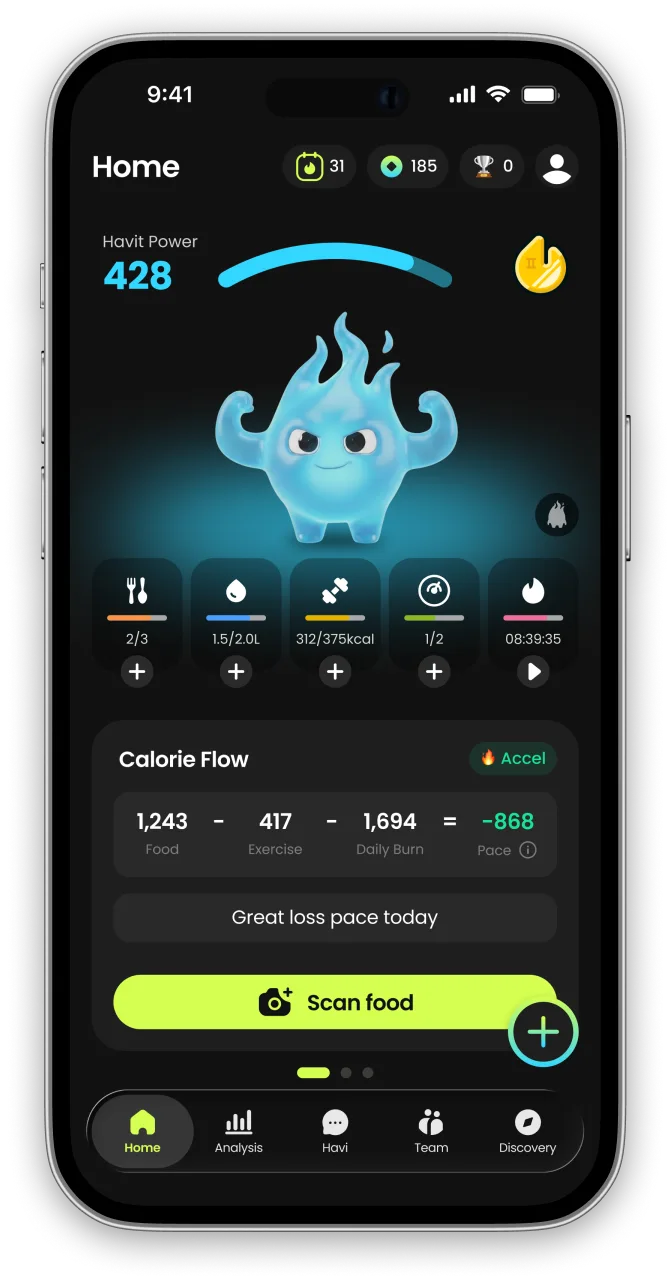
What is Havit?
Havit is an AI health companion for weight loss that protects muscle.
Unlike calorie-only trackers, Havit connects AI body-composition estimates, nutrition, hydration, sleep, steps, cycle, mood, and GLP-1 medication in one daily routine — so progress is measured by body composition, not just the number on the scale. Daily missions turn established behavior-change techniques into small repeatable actions, drawing on expertise from professionals formerly at Juvis Diet, one of Korea’s leading metabolic clinics.
In Havit’s own analysis of 1,090 GLP-1 users, people who logged consistently built stronger habits than the general user base. Read the GLP-1 Habit Report
Havit works with or without GLP-1 medication. It is a wellness app, not a medical device; body-composition results are estimates.

Continue in the App
Personalized wellness with your own data


References
- Give Your Ideas Some Legs: The Positive Effect of Walking on Creative Thinking — Journal of Experimental Psychology: Learning, Memory, and Cognition, 2024
- Ambulatory Cognition: How Movement Modulates Executive Function and Creative Performance — Frontiers in Psychology, 2025
- Cerebral Blood Flow Changes During Moderate-Intensity Walking: A Neuroimaging Study — NeuroImage, 2024
- Side-by-Side: Physical Orientation Effects on Interview Disclosure and Rapport — Journal of Applied Psychology, 2024


