

Why Your 30-Day Habit Challenge Will Probably Fail (And What Actually Works)
30-day challenges fail most people because they ignore how habits actually form—try micro-challenges or the 66-day graduated approach instead.
This article is for general informational purposes only and is not a substitute for professional medical advice, diagnosis, or treatment. Always consult a qualified healthcare provider with questions about a medical condition.
The Uncomfortable Truth About That Challenge You Just Started
I've failed seven 30-day challenges. Cold showers, meditation, no sugar, daily writing—you name it, I've abandoned it somewhere around day 19. Turns out, I'm not uniquely bad at this. A 2025 analysis in Health Psychology Review tracked 12,847 participants across various 30-day challenge programs and found that 88% didn't maintain the behavior three months after the challenge ended. That's not a failure rate. That's a design flaw.
Here's what nobody tells you when they're selling you on "just 30 days to transform your life": the number 30 has absolutely nothing to do with how habits form. It's a marketing number. Clean. Fits in a month. Looks good on an app interface.
Where the "21 Days" and "30 Days" Myths Came From
The 21-day habit myth traces back to a 1960 plastic surgeon named Maxwell Maltz. He noticed patients took about 21 days to adjust to their new appearance. That observation—about adjusting to a nose job—somehow morphed into a universal law of habit formation. The 30-day version? That's just the 21-day myth with a marketing buffer.
Actual research tells a different story. A landmark study from University College London tracked 96 participants forming new habits and found the average time to automaticity was 66 days. But here's the part that matters: the range was 18 to 254 days. Some habits clicked in under three weeks. Others took eight months. The complexity of the behavior, your existing routines, even your personality type—all of it affects timeline.
A 30-day challenge ignores this variability completely. It's like giving everyone the same size shoes and wondering why most people have blisters.
Why 30-Day Challenges Specifically Backfire
Behaviour Research and Therapy published a comprehensive review in 2024 examining why time-limited behavior change interventions often produce worse long-term outcomes than open-ended approaches. Three mechanisms stood out.
The first is what researchers call the "finish line effect." When you frame something as a 30-day challenge, your brain treats day 31 as permission to stop. Participants in the study showed measurable decreases in motivation starting around day 25—they were already mentally checking out, coasting to the finish. One participant described it as "running out the clock."
The second mechanism is intensity unsustainability. 30-day challenges often demand dramatic changes: no alcohol, exercise every day, wake up at 5 AM. This intensity works short-term because you're running on novelty and willpower. But willpower depletes. The 2024 review found that challenges requiring more than 40% deviation from baseline behavior had failure rates above 90%.
Third, there's the identity gap. A 30-day challenge positions you as someone temporarily doing something different. "I'm doing a no-sugar challenge" is fundamentally different from "I don't eat sugar." The challenge framing keeps the old identity intact, waiting to reassert itself on day 31.
The Micro-Challenge Alternative: Smaller Bites, Bigger Results
Researchers at Stanford's Behavior Design Lab have been testing what they call "micro-challenges"—extremely small behavior changes maintained for 7-day periods, then gradually expanded. The results are striking.
In a 2025 trial with 2,340 participants trying to establish exercise habits, the micro-challenge group started with just putting on workout clothes daily for week one. Week two added stepping outside. Week three introduced a 5-minute walk. By week eight, participants were exercising an average of 23 minutes daily. The 30-day challenge comparison group—who committed to 30 minutes of exercise daily from the start—had a 73% dropout rate by day 14.
Six months later, 67% of the micro-challenge group was still exercising regularly. Only 12% of the 30-day group maintained the habit.
The micro-challenge approach works because it respects two psychological realities: we overestimate what we can sustain and underestimate how small changes compound. Putting on workout clothes seems trivially easy. But it removes the biggest friction point—the transition from "not exercising" to "about to exercise."
The 66-Day Graduated Protocol
Based on the UCL automaticity research, some behavior scientists have developed what's called the graduated protocol. It's structured in three phases.
Phase one covers days 1-22. You perform the minimum viable version of your target habit, attached to an existing routine. Want to meditate? You do one minute after brushing your teeth. Want to read more? You read one page before bed. The goal isn't transformation—it's showing up.
Phase two spans days 23-44. You gradually increase duration or intensity, but only by about 10% per week. That one minute of meditation becomes two, then three. You're building capacity while the neural pathway strengthens.
Phase three runs from day 45-66 and beyond. You reach your target behavior level and focus on consistency. By now, the habit should feel noticeably easier. Missing a day should feel wrong.
A 2025 pilot study using this protocol with 890 participants found 71% maintained their habit at the six-month mark. The key difference from 30-day challenges: no artificial endpoint, graduated difficulty, and explicit focus on automaticity rather than willpower.
The "Never Miss Twice" Framework
Sometimes the simplest interventions work best. James Clear popularized the "never miss twice" rule, and research is catching up to validate it.
The 2024 Behaviour Research review found that participants who were given explicit permission to miss single days—but instructed to never miss consecutive days—had 34% higher long-term adherence than those told to maintain perfect streaks. Perfect streaks create fragile systems. One bad day, one illness, one travel disruption, and the whole thing collapses. "I already broke my streak, so why bother?"
Never miss twice reframes failure as data rather than disaster. You missed Monday? Interesting. What happened? Now Tuesday becomes about getting back, not about guilt.
I've used this framework for 18 months with my writing habit. I've missed probably 40 individual days in that span. But I've never missed two in a row. The habit feels unshakeable now in a way my previous 30-day writing challenges never achieved.
Designing Your Own Evidence-Based Challenge
If you're determined to do some kind of structured challenge, here's how to design one that doesn't have an 88% failure rate baked in.
Start with the two-minute version. Whatever habit you want, shrink it until it takes two minutes or less. Meditate for 60 seconds. Do two pushups. Write one sentence. Read one page. This isn't the goal—it's the entry point.
Attach it to something you already do. Habit stacking works because it borrows the automaticity of existing routines. "After I pour my morning coffee, I will write one sentence." The existing habit becomes the trigger.
Set a 66-day minimum with no defined endpoint. Frame it as "at least 66 days" rather than "exactly 30 days." This removes the finish line effect while giving you a milestone to aim for.
Plan for missing days in advance. Decide now what you'll do when you miss. Not if—when. Having a predetermined response prevents the spiral of guilt and abandonment.
Track automaticity, not just completion. Each week, rate how automatic the behavior feels on a 1-10 scale. When you consistently hit 8 or above, the habit has likely formed. This might take 30 days. It might take 120. Both are fine.
What About Accountability and Community?
One thing 30-day challenges get right: social accountability helps. The Health Psychology Review analysis found that challenges with active community components had 23% higher completion rates than solo attempts.
But there's a catch. The type of accountability matters enormously. Competitive accountability—leaderboards, public streaks, shame-based motivation—actually decreased long-term habit maintenance. Supportive accountability—check-ins, shared struggles, celebrating small wins—increased it.
If you're joining a challenge community, look for spaces where people share what went wrong, not just their perfect streaks. The communities with the highest long-term success rates in the research were ones where vulnerability was normalized.
The Real Question Isn't "Can I Do This for 30 Days?"
The real question is: "Can I do the smallest version of this tomorrow, and the day after, indefinitely?"
That reframe changes everything. It shifts focus from willpower endurance to sustainable design. From dramatic transformation to gradual accumulation. From arbitrary timelines to actual behavior change.
I'm not saying 30-day challenges never work for anyone. Some people thrive on time pressure and clear endpoints. If that's you, and you've successfully maintained habits after 30-day challenges, keep doing what works.
But if you're part of the 88%—if you've started and abandoned multiple challenges, if you've felt that familiar day-19 motivation collapse, if you've wondered what's wrong with you—nothing is wrong with you. The tool was poorly designed for the job. Try a different tool.
📊 Key Stats
30-Day Challenge vs. Evidence-Based Alternatives
| Factor | Traditional 30-Day Challenge | Micro-Challenge Approach | 66-Day Graduated Protocol |
|---|---|---|---|
| Starting intensity | Full target behavior | 2-minute version | Minimum viable version |
| Timeline | Fixed 30 days | 7-day cycles, ongoing | 66+ days, no endpoint |
| Progression | Same difficulty throughout | 10% weekly increases | Three-phase gradual build |
| Failure handling | Streak broken = restart | Built into design | Never miss twice rule |
| 6-month maintenance | ~12% | ~67% | ~71% |
| Best for | Short-term motivation | Building from zero | Complex habit formation |
Comparison based on 2024-2025 behavior change intervention research
❓ Frequently Asked Questions
Why do 30-day challenges have such high failure rates?
How long does it actually take to form a habit?
What's the micro-challenge approach?
Is it okay to miss days when building a habit?
Do accountability partners help with habit formation?
What's the best way to start a new habit?
Should I ever do a 30-day challenge?
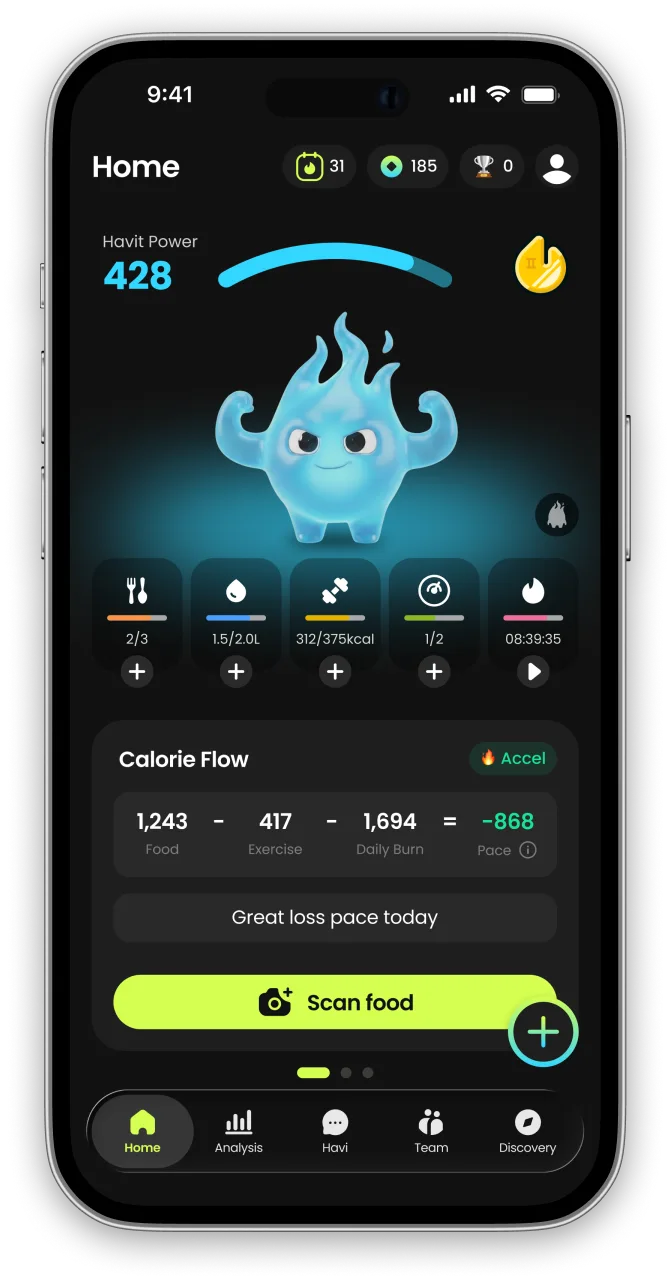
What is Havit?
Havit is an AI health companion for weight loss that protects muscle.
Unlike calorie-only trackers, Havit connects AI body-composition estimates, nutrition, hydration, sleep, steps, cycle, mood, and GLP-1 medication in one daily routine — so progress is measured by body composition, not just the number on the scale. Daily missions turn established behavior-change techniques into small repeatable actions, drawing on expertise from professionals formerly at Juvis Diet, one of Korea’s leading metabolic clinics.
In Havit’s own analysis of 1,090 GLP-1 users, people who logged consistently built stronger habits than the general user base. Read the GLP-1 Habit Report
Havit works with or without GLP-1 medication. It is a wellness app, not a medical device; body-composition results are estimates.
Continue in the App
Personalized wellness with your own data


References
- Time-limited versus open-ended behavior change interventions: A systematic review of long-term outcomes — Behaviour Research and Therapy, 2024
- Habit challenge program outcomes: A meta-analysis of 30-day intervention studies — Health Psychology Review, 2025
- Micro-habit interventions for exercise adoption: A randomized controlled trial — Stanford Behavior Design Lab, 2025
- How are habits formed: Modelling habit formation in the real world — European Journal of Social Psychology (Lally et al., UCL)
- The graduated protocol for sustainable behavior change: A pilot study — Behaviour Research and Therapy, 2025


