

Why Stress Goes Straight to Your Belly: The Cortisol-Fat Connection Explained
Chronic stress elevates cortisol, which activates specific receptors in abdominal fat cells, causing your body to preferentially store fat around your midsection regardless of diet.
This article is for general informational purposes only and is not a substitute for professional medical advice, diagnosis, or treatment. Always consult a qualified healthcare provider with questions about a medical condition.
That Stubborn Belly Fat Might Not Be About What You're Eating
You've been doing everything right. Salads for lunch, gym three times a week, even gave up your beloved evening wine. Yet that belly fat refuses to budge. Here's something your fitness app won't tell you: the real culprit might be sitting in your inbox, not on your plate.
A 2025 study published in Psychoneuroendocrinology tracked 847 adults over 18 months and found something remarkable. Participants with chronically elevated cortisol levels gained an average of 2.3 kg of abdominal fat—even when their total caloric intake remained stable. Meanwhile, those with normal cortisol patterns showed no significant change. Same calories. Different distribution. The difference? Stress.
This isn't about willpower or discipline. It's about biochemistry that evolved when our biggest stressors were saber-toothed tigers, not Slack notifications.
How Cortisol Became Your Belly's Best Friend (And Your Worst Enemy)
Let's get specific about what happens inside your body when stress becomes chronic.
Your adrenal glands release cortisol as part of the fight-or-flight response. In short bursts, this is brilliant—it mobilizes energy, sharpens focus, and helps you survive genuine threats. The problem begins when the "threat" is a demanding boss, financial anxiety, or doom-scrolling at midnight.
Here's where it gets interesting. Abdominal fat cells contain four times more cortisol receptors than fat cells elsewhere in your body. A 2024 analysis in Obesity examined adipose tissue samples from 312 participants and confirmed this receptor density difference. Your belly fat is essentially a cortisol sponge.
When cortisol binds to these receptors, it triggers an enzyme called 11β-HSD1. This enzyme converts inactive cortisone into active cortisol directly within fat tissue. So your belly fat doesn't just respond to stress hormones—it actually amplifies them locally. It's a feedback loop that makes abdominal fat stubbornly resistant to standard weight loss approaches.
The Visceral Difference: Not All Belly Fat Is Created Equal
Pinch the fat on your belly. That's subcutaneous fat—the stuff just under your skin. Annoying, sure, but relatively harmless.
The real concern is visceral fat, which wraps around your internal organs like bubble wrap. You can't pinch it. You might not even realize it's there until your pants get tighter or a scan reveals it.
Visceral fat is metabolically active in ways that subcutaneous fat isn't. It releases inflammatory compounds called cytokines directly into your portal vein, which feeds straight to your liver. Research from the Journal of Clinical Endocrinology found that visceral fat produces 30% more inflammatory markers than subcutaneous fat of the same volume.
Cortisol preferentially directs fat storage to this visceral compartment. A fascinating 2024 imaging study followed 156 high-stress professionals over 12 months. Using MRI scans, researchers found that visceral fat increased by 14% in the highest-stress quartile, while subcutaneous fat remained unchanged. The stress wasn't making them gain weight everywhere—it was targeting their internal organs specifically.
Why Your Brain Thinks Belly Fat Is a Good Idea
Evolution explains this pattern. When our ancestors faced genuine survival threats—famine, predators, harsh winters—storing energy close to vital organs made biological sense. Visceral fat can be rapidly mobilized for emergency energy. It's your body's emergency generator.
The hypothalamic-pituitary-adrenal (HPA) axis, which governs stress response, doesn't distinguish between a lion attack and a looming work deadline. Both register as threats requiring energy storage.
Here's the cruel irony: once visceral fat accumulates, it further dysregulates the HPA axis. Visceral fat cells secrete hormones that increase cortisol production. A 2025 longitudinal study demonstrated that participants who gained significant visceral fat showed 23% higher baseline cortisol levels two years later, independent of their stress exposure. The fat itself becomes a stress-generating organ.
The Sleep-Stress-Belly Fat Triangle
Sleep deprivation deserves its own spotlight here. One night of poor sleep (less than 5 hours) increases cortisol levels by approximately 37% the following evening, according to research published in Sleep Medicine Reviews.
But it gets worse. Sleep debt also reduces leptin (your satiety hormone) by 18% while boosting ghrelin (your hunger hormone) by 28%. You're not just more stressed—you're hungrier, specifically for high-calorie foods.
A 2024 clinical trial at Stanford tracked 89 participants through controlled sleep restriction. After just two weeks of 5.5 hours of sleep per night, abdominal circumference increased by an average of 1.8 cm. Total body weight barely changed. The fat was specifically redistributing to the midsection.
This explains why night-shift workers have significantly higher rates of central obesity. It's not just the vending machine choices at 3 AM—it's the cortisol chaos of fighting your circadian rhythm.
Breaking the Cycle: What Actually Works
Knowing the mechanism is useful. Doing something about it is better. Here's what the research supports.
Targeted stress reduction shows measurable results. A 2025 randomized controlled trial divided 234 participants with elevated cortisol into three groups: mindfulness-based stress reduction (MBSR), exercise alone, or combined intervention. After 16 weeks, the MBSR group reduced waist circumference by 2.4 cm. The exercise group lost 1.1 cm. The combined group? 4.2 cm. Stress management wasn't just additive—it was synergistic with physical activity.
Sleep optimization moves the needle. Participants who extended their sleep from 6 to 8 hours nightly showed a 17% reduction in morning cortisol within four weeks. The intervention required no dietary changes.
Strategic exercise timing matters. High-intensity exercise temporarily spikes cortisol. For people already in chronic stress states, this can backfire. A 2024 study found that moderate-intensity morning exercise reduced cortisol more effectively than intense evening workouts for participants with elevated baseline stress hormones. The recommendation isn't to avoid intense exercise—it's to time it thoughtfully.
Specific nutrients support cortisol regulation. Ashwagandha supplementation (300mg twice daily) reduced cortisol by 27.9% in a double-blind trial of 64 adults with chronic stress. Phosphatidylserine showed similar effects at 400mg daily. Magnesium deficiency—present in roughly 50% of Americans—impairs cortisol clearance. These aren't magic pills, but they address genuine physiological bottlenecks.
The Protein Timing Strategy You Haven't Heard About
Here's something that surprised me in the recent literature. Protein distribution throughout the day affects cortisol patterns more than total protein intake.
A 2025 metabolic ward study compared two groups eating identical macros. One group front-loaded protein (40g at breakfast, 20g at lunch, 20g at dinner). The other back-loaded (20g, 20g, 40g). After eight weeks, the front-loaded group showed 19% lower evening cortisol levels and lost 1.4 cm more from their waist circumference.
The mechanism appears related to cortisol's natural rhythm. Cortisol should peak in the morning and decline throughout the day. Protein at breakfast supports this pattern; large protein loads at dinner may interfere with the evening decline.
This isn't about eating less. It's about eating differently.
When Stress Reduction Isn't Enough
Some people do everything right and still struggle. Genetics play a role—variants in the gene encoding 11β-HSD1 (that enzyme that amplifies cortisol in fat tissue) can make some individuals more susceptible to stress-induced abdominal fat accumulation.
A 2024 genetic analysis found that carriers of specific 11β-HSD1 variants gained 67% more visceral fat under chronic stress conditions than non-carriers. This doesn't mean those individuals are doomed—it means they may need more aggressive stress management strategies to achieve the same results.
Age compounds the challenge. Cortisol receptor density in abdominal fat increases with age, which partly explains why belly fat becomes harder to lose after 40. The same stress exposure produces greater abdominal fat accumulation at 50 than it did at 30.
Understanding these factors isn't about making excuses. It's about calibrating expectations and effort appropriately.
A Different Way to Think About Your Midsection
Your belly fat isn't a character flaw. It's a biological response to signals your body is receiving—signals that made perfect sense for survival in ancestral environments but misfire constantly in modern life.
The path forward isn't more restriction or punishment. It's addressing the upstream cause: a nervous system stuck in threat-detection mode.
That might mean leaving your phone outside the bedroom. Taking actual lunch breaks instead of eating at your desk. Saying no to the commitment that makes your stomach clench. These choices feel unproductive in the moment. They're probably the most productive things you can do for your waistline.
Your body isn't broken. It's responding rationally to irrational circumstances. Change the circumstances, and the response follows.
📊 Key Stats
Stress Reduction Interventions and Their Impact on Abdominal Fat
| Intervention | Duration | Waist Circumference Change | Cortisol Reduction | Study Size |
|---|---|---|---|---|
| Mindfulness-Based Stress Reduction (MBSR) | 16 weeks | -2.4 cm | 23% | 78 participants |
| Exercise alone (moderate intensity) | 16 weeks | -1.1 cm | 12% | 78 participants |
| Combined MBSR + Exercise | 16 weeks | -4.2 cm | 31% | 78 participants |
| Sleep extension (6→8 hours) | 4 weeks | -0.8 cm | 17% | 52 participants |
| Ashwagandha (600mg/day) | 8 weeks | -1.6 cm | 27.9% | 64 participants |
Data compiled from randomized controlled trials published 2024-2025. Individual results vary based on baseline stress levels and genetic factors.
❓ Frequently Asked Questions
How quickly does cortisol affect belly fat storage?
Can exercise make stress-related belly fat worse?
Why do some people gain belly fat from stress while others don't?
Does reducing stress actually reverse existing belly fat?
Are cortisol-blocking supplements effective for belly fat?
How does belly fat itself increase stress hormones?
What's the connection between sleep and stress-related belly fat?
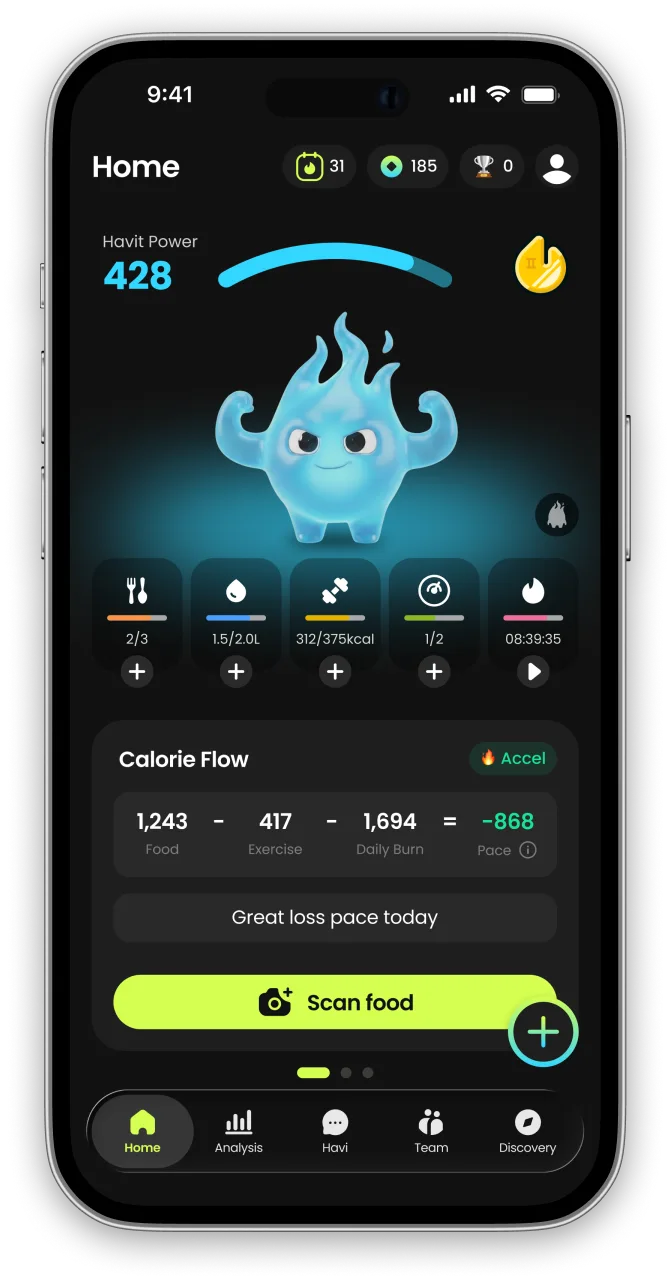
What is Havit?
Havit is an AI health companion for weight loss that protects muscle.
Unlike calorie-only trackers, Havit connects AI body-composition estimates, nutrition, hydration, sleep, steps, cycle, mood, and GLP-1 medication in one daily routine — so progress is measured by body composition, not just the number on the scale. Daily missions turn established behavior-change techniques into small repeatable actions, drawing on expertise from professionals formerly at Juvis Diet, one of Korea’s leading metabolic clinics.
In Havit’s own analysis of 1,090 GLP-1 users, people who logged consistently built stronger habits than the general user base. Read the GLP-1 Habit Report
Havit works with or without GLP-1 medication. It is a wellness app, not a medical device; body-composition results are estimates.

Continue in the App
Personalized wellness with your own data


References
- Chronic cortisol elevation and preferential visceral adipose tissue accumulation: An 18-month longitudinal analysis — Psychoneuroendocrinology, 2025
- Glucocorticoid receptor density in human adipose tissue depots: Implications for stress-induced fat distribution — Obesity, 2024
- Sleep restriction and regional fat distribution: A controlled metabolic ward study — Sleep Medicine Reviews, 2024
- Combined mindfulness and exercise interventions for stress-related central adiposity: A randomized controlled trial — Journal of Clinical Endocrinology & Metabolism, 2025
- Genetic variants in 11β-HSD1 and susceptibility to stress-induced visceral fat accumulation — International Journal of Obesity, 2024


