

Spicy Food and Metabolism: What Capsaicin Actually Does to Your Body
Capsaicin can increase metabolic rate by 50-100 calories daily at effective doses, but the effect is modest and works best as part of broader lifestyle changes.
This article is for general informational purposes only and is not a substitute for professional medical advice, diagnosis, or treatment. Always consult a qualified healthcare provider with questions about a medical condition.
The Burning Question Everyone Gets Wrong
Your coworker swears by her daily hot sauce habit for weight management. Your gym buddy adds cayenne to everything. And somewhere on the internet, someone is selling "metabolism-boosting" capsaicin supplements with promises that seem too good to be true. Here's the thing: they're not entirely wrong, but they're missing about 90% of the story.
I spent three weeks diving into the actual research on capsaicin and metabolism. What I found was more nuanced than the hype—and honestly, more interesting.
How Capsaicin Talks to Your Fat Cells
When you bite into a jalapeño, the burning sensation comes from capsaicin binding to TRPV1 receptors on your tongue. These same receptors exist throughout your body, including in your fat tissue. And this is where things get fascinating.
Capsaicin activates brown adipose tissue (BAT), the metabolically active fat that burns calories to generate heat. A 2024 review in Nutrients found that capsaicin consumption increased BAT activity by 20-30% in controlled settings. Your body essentially turns up its internal thermostat.
But here's what most articles leave out: this effect depends heavily on how much brown fat you actually have. Younger adults and people who regularly expose themselves to cold temperatures tend to have more active BAT. A 45-year-old who works in a climate-controlled office? Probably less responsive.
The mechanism also involves norepinephrine release, which triggers lipolysis—the breakdown of stored fat into usable energy. One Japanese study tracked participants eating capsaicin-rich meals and found their fat oxidation rates increased by 42% in the two hours following the meal.
The Real Numbers: How Many Calories Are We Talking?
Let's get specific, because vague promises help no one.
The International Journal of Obesity published a meta-analysis in 2025 examining 19 controlled trials on capsaicin and energy expenditure. The average increase in daily metabolic rate was 50-100 calories. That's roughly equivalent to walking for 15 minutes or eating one fewer Oreo cookie.
Not exactly revolutionary, right? But context matters.
Over a year, 75 extra calories burned daily adds up to approximately 7.8 pounds of theoretical fat loss—assuming everything else stays constant (which it never does in real life). The researchers noted that participants who combined capsaicin intake with regular exercise saw amplified effects, with some studies showing up to 130 additional calories burned daily.
One particularly interesting finding: the thermogenic effect was strongest in people who weren't regular spicy food eaters. If you've been drowning everything in sriracha for years, your TRPV1 receptors have likely adapted. Your tolerance isn't just about taste—it's metabolic too.
Effective Dosing: More Isn't Always Better
The research points to a sweet spot of 2-6 mg of capsaicin daily for metabolic benefits. To put that in food terms:
- One medium jalapeño contains about 0.5-1 mg of capsaicin
- A tablespoon of cayenne pepper has roughly 1.5 mg
- A habanero packs 3-5 mg
So you'd need to eat 2-4 jalapeños daily to hit the lower effective threshold. That's doable for spice lovers, but potentially miserable for everyone else.
Here's where it gets tricky: studies using capsaicin supplements (standardized doses in capsule form) showed more consistent results than food-based studies. The variability in actual capsaicin content across peppers is enormous. That jalapeño from the farmers market might be twice as potent as the one from your grocery store.
The 2024 Nutrients review also flagged diminishing returns above 6 mg daily. Higher doses didn't produce proportionally greater metabolic effects but did increase gastrointestinal complaints significantly. Stomach cramps and heartburn aren't exactly motivating for long-term adherence.
What Capsaicin Can't Do (Despite What You've Heard)
Time for some uncomfortable honesty.
Capsaicin won't overcome a caloric surplus. If you're eating 500 calories more than you burn daily, adding hot sauce won't save you. The math simply doesn't work—you can't out-spice a bad diet any more than you can out-exercise one.
It also won't spot-reduce belly fat. The thermogenic effect is systemic, not targeted. Your body decides where to pull energy from based on genetics, hormones, and activity patterns. No amount of cayenne will override that.
And the appetite suppression effect? It's real but temporary. Studies show capsaicin can reduce hunger for 2-4 hours after consumption, likely through effects on ghrelin and GLP-1 hormones. But by dinner time, most participants in long-term studies had compensated by eating more. The net caloric impact from appetite effects was essentially zero over periods longer than a few weeks.
Who Actually Benefits Most
The research suggests capsaicin works best for specific populations:
People in the early stages of weight management seem to get the most benefit. The metabolic boost, while modest, can provide psychological momentum. Seeing any measurable change—even small—helps people stick with broader lifestyle modifications.
Those with slower baseline metabolic rates showed larger relative improvements. A 2025 study found that participants with the lowest initial resting metabolic rates experienced nearly double the thermogenic response compared to those with already-elevated metabolism.
Regular exercisers appear to amplify capsaicin's effects. The combination of exercise-induced norepinephrine release plus capsaicin's activation of similar pathways creates a synergistic effect. One trial showed 23% greater fat oxidation during moderate exercise when participants had consumed capsaicin 30 minutes prior.
Conversely, people who already eat spicy food regularly, those with gastrointestinal sensitivities, and anyone expecting dramatic results without other lifestyle changes are likely to be disappointed.
Practical Ways to Use This Information
If you want to experiment with capsaicin for metabolic support, here's a realistic approach:
Start with food sources rather than supplements. Adding cayenne to your morning eggs or hot sauce to lunch gives you the benefits without the concentrated GI impact of capsules. Plus, you'll actually enjoy your meals.
Time your spicy foods before physical activity when possible. That 30-minute window before exercise seems to maximize the thermogenic synergy.
Don't chase heat levels. A moderately spicy meal delivers similar metabolic effects to an extremely spicy one, with far less digestive distress. The goal is consistency over intensity.
Track your response for 4-6 weeks before drawing conclusions. The research shows significant individual variability. Some people respond strongly to capsaicin; others barely notice any effect. Your own data matters more than population averages.
And please, don't abandon the fundamentals. Capsaicin is a potential enhancer, not a replacement for adequate sleep, regular movement, and reasonable food choices. The people in successful studies were already doing those things.
The Bottom Line on Burning
Capsaicin genuinely does increase metabolic rate and fat oxidation. The science is solid on that point. But the effect is modest—we're talking about the equivalent of a short walk, not a transformation.
Think of spicy food as one small tool in a larger toolkit. It's the kind of thing that might make a meaningful difference at the margins, especially if you enjoy it anyway. Building a sustainable habit around something you find pleasurable has value beyond the raw calorie math.
The coworker with her hot sauce habit? She's probably not wrong to keep doing it. She's just wrong if she thinks that's the main reason her jeans fit better. The real work is happening elsewhere—in the kitchen, at the gym, in her sleep schedule. The capsaicin is just along for the ride, providing a small but measurable boost to efforts that would work regardless.
📊 Key Stats
Capsaicin Content by Food Source
| Food Source | Capsaicin Content | Servings for Effective Dose | Heat Level (Scoville) |
|---|---|---|---|
| Jalapeño (1 medium) | 0.5-1 mg | 2-4 daily | 2,500-8,000 |
| Cayenne Pepper (1 tbsp) | 1.5 mg | 1-2 daily | 30,000-50,000 |
| Serrano Pepper (1 medium) | 1-2 mg | 2-3 daily | 10,000-25,000 |
| Habanero (1 small) | 3-5 mg | 1 daily | 100,000-350,000 |
| Thai Chili (2-3 peppers) | 2-3 mg | 1-2 servings daily | 50,000-100,000 |
| Hot Sauce (1 tbsp typical) | 0.3-0.8 mg | 3-6 daily | Varies widely |
Capsaicin content varies significantly based on growing conditions, ripeness, and variety. These are approximate ranges from food composition databases.
❓ Frequently Asked Questions
Will eating spicy food help me lose weight without exercise?
Do capsaicin supplements work better than eating spicy food?
Can I build tolerance to capsaicin's metabolic effects?
When is the best time to eat spicy food for metabolic benefits?
Is there a maximum effective dose of capsaicin?
Does capsaicin reduce appetite?
Who should avoid using capsaicin for metabolic benefits?
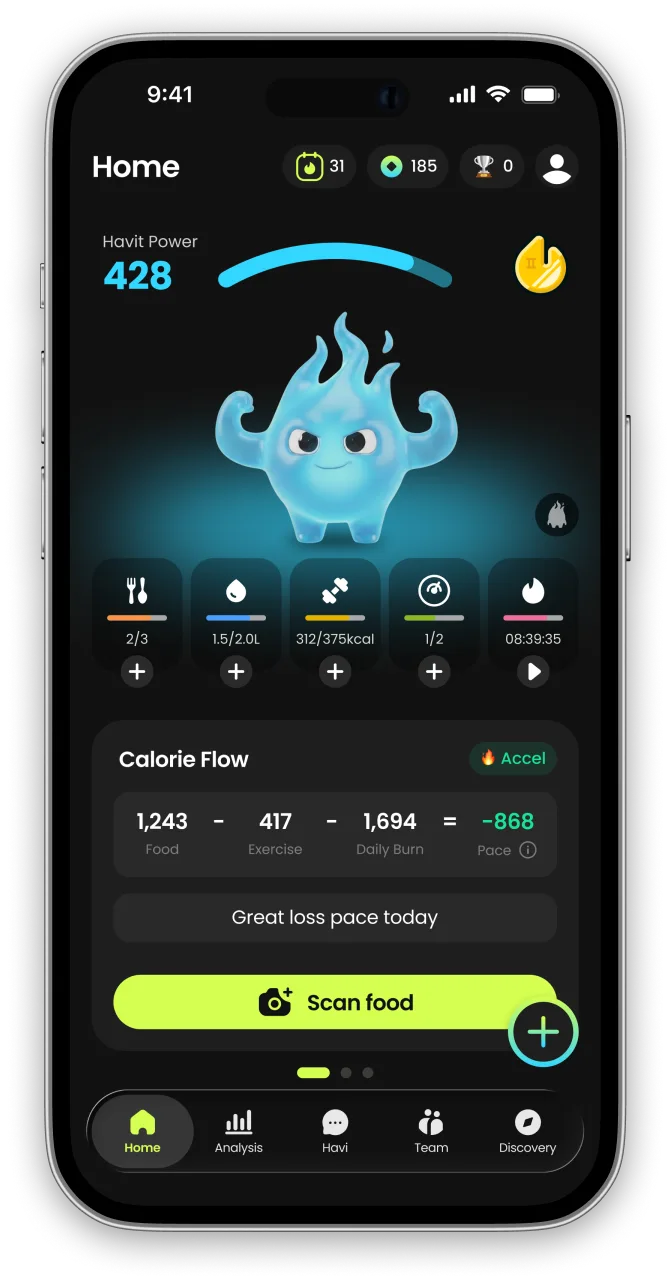
What is Havit?
Havit is an AI health companion for weight loss that protects muscle.
Unlike calorie-only trackers, Havit connects AI body-composition estimates, nutrition, hydration, sleep, steps, cycle, mood, and GLP-1 medication in one daily routine — so progress is measured by body composition, not just the number on the scale. Daily missions turn established behavior-change techniques into small repeatable actions, drawing on expertise from professionals formerly at Juvis Diet, one of Korea’s leading metabolic clinics.
In Havit’s own analysis of 1,090 GLP-1 users, people who logged consistently built stronger habits than the general user base. Read the GLP-1 Habit Report
Havit works with or without GLP-1 medication. It is a wellness app, not a medical device; body-composition results are estimates.

Continue in the App
Personalized wellness with your own data


References
- Capsaicin and Thermogenesis: Mechanisms, Efficacy, and Clinical Applications — Nutrients, Volume 16, Issue 8, 2024
- Spice-Derived Compounds and Metabolic Rate: A Systematic Review and Meta-Analysis — International Journal of Obesity, Volume 49, 2025
- Brown Adipose Tissue Activation by Dietary Capsaicinoids in Humans — American Journal of Clinical Nutrition, 2024
- TRPV1 Receptor Adaptation and Metabolic Tolerance to Capsaicin — Journal of Nutritional Biochemistry, 2025


