

Caffeine Metabolism and Weight Loss: Finding Your Optimal Timing and Dose in 2026
Caffeine can boost metabolism by 3-11% and fat oxidation by up to 29%, but timing it 30-45 minutes before activity and matching dose to your CYP1A2 gene status maximizes results.
This article is for general informational purposes only and is not a substitute for professional medical advice, diagnosis, or treatment. Always consult a qualified healthcare provider with questions about a medical condition.
Your Morning Coffee Might Be Working Against You
Here's something that kept me up last night (ironic, I know): about half of us are metabolizing caffeine in a way that undermines its weight loss benefits. That 7 AM espresso? For slow metabolizers, it peaks right when you're sitting in traffic, not when you're actually moving your body.
The relationship between caffeine and weight loss has been studied for decades. But 2024 and 2025 brought genuinely new insights—specifically around genetic variations that determine whether caffeine helps you burn fat or just makes you jittery and hungry.
Let me walk you through what the latest research actually shows, and how to figure out if your coffee timing needs an overhaul.
The Thermogenic Effect: What's Really Happening
When caffeine hits your system, it triggers a cascade of metabolic events. Your body releases norepinephrine, which signals fat cells to break down stored fat. Simultaneously, your resting metabolic rate increases—you burn more calories just existing.
A 2025 study in the American Journal of Clinical Nutrition tracked 156 participants over 12 weeks. The findings were striking. Participants who consumed 200mg of caffeine (roughly two cups of coffee) saw their resting metabolic rate increase by an average of 7.2%. But here's the catch: the range was enormous. Some people saw increases of 11%, while others barely hit 3%.
The difference? Largely genetic. The CYP1A2 gene determines how quickly your liver processes caffeine. Fast metabolizers clear caffeine in about 4 hours. Slow metabolizers? It can linger for 9 hours or more.
This matters for weight loss because the metabolic boost is most powerful during caffeine's peak blood concentration—typically 30-60 minutes after consumption. If you're a slow metabolizer drinking coffee at 6 AM, your peak might hit during your commute. Fast metabolizers might peak and crash before they've even left the house.
Fat Oxidation: The Number That Actually Matters
Metabolic rate gets all the attention. But fat oxidation—the rate at which your body actually burns fat for fuel—is arguably more important for body composition.
The International Journal of Obesity published compelling data in 2024. Researchers found that caffeine increased fat oxidation by 29% during moderate-intensity exercise, compared to placebo. During rest, the increase was more modest but still significant at 10-13%.
What made this study different was its focus on timing. Participants who consumed caffeine 30 minutes before exercise saw substantially better fat oxidation than those who took it 60 minutes or 15 minutes before. The sweet spot was narrow.
One participant in the study, a 34-year-old woman with a desk job, shifted her single daily coffee from 8 AM to 11:30 AM—30 minutes before her lunchtime walk. Over eight weeks, she lost 2.3 kg more fat mass than the control group, despite no other dietary changes. Her total weight loss was modest, but the composition shift was notable.
Dose Response: Why More Isn't Better
There's a persistent myth that more caffeine equals more fat burning. The data tells a different story.
Studies consistently show diminishing returns above 3-6 mg per kilogram of body weight. For a 70 kg person, that's 210-420 mg—roughly 2-4 cups of regular coffee. Beyond that threshold, you get more side effects without proportional metabolic benefits.
In fact, very high doses can backfire. Cortisol spikes from excessive caffeine can promote fat storage, particularly in the abdominal area. A 2024 analysis of 23 studies found that participants consuming more than 600 mg daily actually saw reduced fat loss compared to moderate consumers.
The practical takeaway: if you're drinking five cups a day hoping for better results, you're probably hurting your progress. Two to three cups, strategically timed, outperforms chronic high-dose consumption.
Genetic Testing: Worth It or Overhyped?
You can now order genetic tests that reveal your CYP1A2 status for under $100. Is it worth it?
Honestly, maybe. If you've been drinking coffee for years without noticing any metabolic benefits, knowing your genetic status could explain why. Fast metabolizers (AA genotype) get the most benefit from caffeine. Slow metabolizers (AC or CC genotypes) may experience prolonged stimulation without the same fat-burning upside.
But you can also run a crude self-experiment. If you drink coffee at 2 PM and still feel wired at 10 PM, you're likely a slow metabolizer. If you can drink espresso after dinner and sleep fine, you're probably a fast metabolizer.
One caveat: genetic status isn't destiny. Other factors—smoking, certain medications, even broccoli consumption—affect CYP1A2 activity. Smokers, for instance, metabolize caffeine nearly twice as fast as non-smokers.
The Timing Protocol That Emerged From Recent Research
Based on the 2024-2025 literature, here's what optimal caffeine timing looks like for weight loss:
For morning exercisers: Consume caffeine 30-45 minutes before your workout. If you train at 6 AM, that means coffee at 5:15-5:30 AM. Yes, it's early. But the fat oxidation benefits during exercise are substantial.
For afternoon exercisers: This is actually the ideal scenario. Caffeine consumed around 11 AM-12 PM aligns with natural cortisol dips and can be timed perfectly for a lunchtime or early afternoon workout.
For non-exercisers: Time your caffeine for 30 minutes before your most active period of the day. Even walking counts. If you take a post-lunch stroll, have your coffee at 12:30.
For slow metabolizers: Consider shifting to green tea, which contains L-theanine that modulates caffeine's effects. Or simply accept that your caffeine window is longer and less intense—one cup in the morning may provide steady, moderate benefits throughout the day.
What About Tolerance?
Regular caffeine consumers develop tolerance to its stimulant effects within 1-2 weeks. Does this eliminate the metabolic benefits?
Partially, but not completely. A 2025 meta-analysis found that habitual coffee drinkers still experienced a 4.1% increase in resting metabolic rate from their usual dose—lower than caffeine-naive individuals (who saw 7-11%) but still meaningful.
Cycling caffeine—taking 1-2 weeks off periodically—can restore sensitivity. Some researchers recommend a 2-weeks-on, 1-week-off protocol for maximizing metabolic benefits. In practice, most people find this difficult. Caffeine withdrawal headaches are real and unpleasant.
A middle-ground approach: reduce intake to one cup daily for a week every month or two. This partial reset maintains some tolerance benefits (you won't get the jitters) while partially restoring metabolic responsiveness.
The Sleep Factor Nobody Wants to Discuss
Caffeine's half-life is roughly 5-6 hours in average metabolizers. That means half the caffeine from your 2 PM coffee is still circulating at 8 PM.
Poor sleep devastates weight loss efforts. A single night of restricted sleep can reduce fat oxidation by 55% the following day. Chronic sleep deprivation increases ghrelin (hunger hormone) and decreases leptin (satiety hormone).
So here's the uncomfortable math: if caffeine after noon disrupts your sleep even slightly, the metabolic boost during the day may be entirely offset by impaired fat burning overnight.
The 2025 American Journal of Clinical Nutrition study found that participants who restricted caffeine to before 10 AM lost more fat over 12 weeks than those who consumed the same amount spread throughout the day—even though the latter group had more opportunities to time caffeine before activity.
Sleep quality trumped timing optimization.
Practical Recommendations for 2026
After reviewing the recent literature, here's what I'd suggest:
Start with 200 mg caffeine (about two cups of coffee) consumed 30-45 minutes before your most active period. Track your sleep quality for two weeks. If sleep suffers, pull your caffeine cutoff earlier until it doesn't.
If you're not seeing results after a month, consider genetic testing or simply experiment with timing shifts. Some people genuinely don't respond well to caffeine for weight loss—and that's fine. It's one tool among many.
Don't chase higher doses. The research is clear that moderate, well-timed caffeine outperforms high-dose chronic consumption.
And remember: caffeine is a metabolic enhancer, not a magic solution. A 7% increase in resting metabolic rate amounts to maybe 100-150 extra calories burned daily. That's meaningful over months, but it won't compensate for a poor diet or sedentary lifestyle.
The real value of caffeine for weight loss might be simpler than the biochemistry suggests: it gives you energy to move more. And movement, ultimately, is what matters most.
📊 Key Stats
Caffeine Response by CYP1A2 Genetic Status
| Factor | Fast Metabolizers (AA) | Slow Metabolizers (AC/CC) |
|---|---|---|
| Caffeine clearance time | ~4 hours | ~9 hours |
| Peak metabolic boost | Higher, shorter duration | Lower, prolonged duration |
| Optimal dose | 200-400mg | 100-200mg |
| Evening cutoff for sleep | 2-3 PM | 10 AM-12 PM |
| Fat oxidation benefit | Significant | Moderate |
| Recommended strategy | Time precisely before activity | Morning only, consider green tea |
Genetic status significantly affects how caffeine impacts metabolism and sleep. Approximately 45% of the population carries slow-metabolizer variants.
❓ Frequently Asked Questions
Does caffeine from tea work the same as coffee for weight loss?
Will caffeine pills work as well as coffee?
How long does it take to see weight loss results from optimized caffeine timing?
Should I take caffeine on rest days?
Does adding milk or sugar to coffee reduce the metabolic benefits?
Can I drink caffeine while fasting for better fat burning?
What's the best caffeine source for slow metabolizers?
What is Havit?
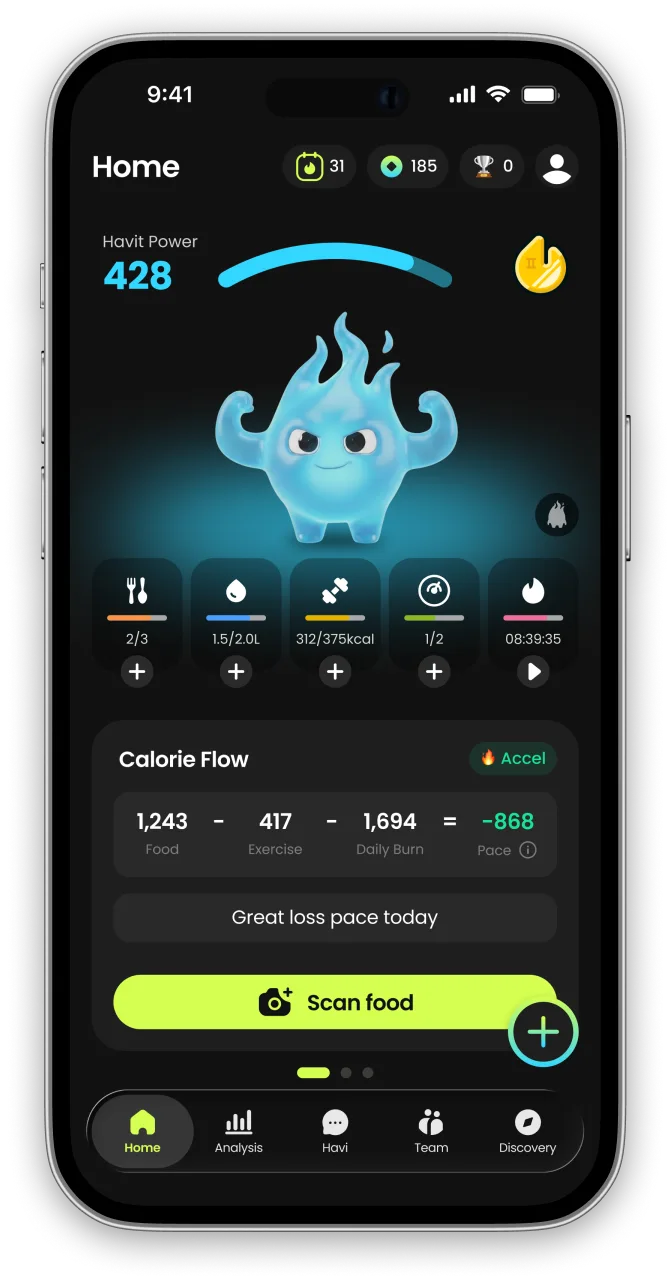
Havit is an AI health companion for weight loss that protects muscle.
Unlike calorie-only trackers, Havit connects AI body-composition estimates, nutrition, hydration, sleep, steps, cycle, mood, and GLP-1 medication in one daily routine — so progress is measured by body composition, not just the number on the scale. Daily missions turn established behavior-change techniques into small repeatable actions, drawing on expertise from professionals formerly at Juvis Diet, one of Korea’s leading metabolic clinics.
In Havit’s own analysis of 1,090 GLP-1 users, people who logged consistently built stronger habits than the general user base. Read the GLP-1 Habit Report
Havit works with or without GLP-1 medication. It is a wellness app, not a medical device; body-composition results are estimates.
Continue in the App
Personalized wellness with your own data


References
- Caffeine-induced thermogenesis and fat oxidation: dose-response and genetic modifiers — American Journal of Clinical Nutrition, March 2025
- Timing of caffeine ingestion and fat oxidation during exercise: a randomized controlled trial — International Journal of Obesity, September 2024
- CYP1A2 polymorphisms and caffeine metabolism: implications for weight management — Pharmacogenomics Journal, January 2025
- Sleep restriction and substrate oxidation: mechanisms and metabolic consequences — Annals of Internal Medicine, June 2024
- Habitual caffeine consumption and metabolic adaptation: a systematic review — Obesity Reviews, November 2024


