

Caffeine, Fat Burning, and the Tolerance Trap: Why Your Coffee Stops Working
Caffeine boosts fat oxidation by 10-29%, but tolerance develops within 1-2 weeks of daily use—strategic cycling restores its metabolic effects.
This article is for general informational purposes only and is not a substitute for professional medical advice, diagnosis, or treatment. Always consult a qualified healthcare provider with questions about a medical condition.
Your Third Cup Isn't Doing What You Think
Here's a question that might sting: when was the last time coffee actually gave you energy? Not the ritual comfort of a warm mug, not the prevention of a withdrawal headache, but genuine, noticeable energy? If you're drinking caffeine daily, there's a decent chance you're just maintaining baseline rather than getting any metabolic boost.
This matters more than you might realize. Caffeine's fat-burning effects—the ones that make it the most popular ingredient in weight loss supplements—follow the same tolerance pattern. That morning espresso that once revved up your metabolism? After two weeks of consistent use, it's doing roughly 50% less work on the fat oxidation front.
Let's dig into what's actually happening in your cells, and more importantly, how to make caffeine work for you again.
The Mechanism: How Caffeine Actually Burns Fat
Caffeine doesn't directly melt fat. What it does is far more elegant—it tricks your nervous system into thinking something important is happening.
Your body has receptors for a molecule called adenosine. Think of adenosine as your internal "calm down" signal. It accumulates throughout the day, eventually making you sleepy. Caffeine's molecular structure is similar enough to adenosine that it blocks these receptors without activating them. The result? Your nervous system never gets the memo to slow down.
This blockade triggers a cascade. Norepinephrine levels rise. Your sympathetic nervous system activates. And here's where fat burning enters the picture: this activation signals fat cells to break down stored triglycerides into free fatty acids.
A 2024 study in the International Journal of Obesity tracked 42 adults during exercise and found that 3mg/kg of caffeine increased fat oxidation rates by 29% compared to placebo. The effect was most pronounced during moderate-intensity exercise—the kind where your body preferentially uses fat for fuel anyway.
But there's a catch buried in the fine print.
The Tolerance Problem Nobody Talks About
Your brain is remarkably adaptive. When you consistently block adenosine receptors with caffeine, your neurons respond by growing more receptors. More targets mean you need more caffeine to achieve the same blockade.
This isn't speculation. The Journal of Applied Physiology published data in early 2025 showing that daily caffeine consumers (averaging 300mg/day) experienced a 47% reduction in caffeine's thermogenic effects compared to occasional users. The metabolic boost that once burned an extra 100 calories? Now it's closer to 53.
The timeline is surprisingly fast. Measurable tolerance begins within 3-5 days of consistent use. By day 12-15, most of caffeine's acute metabolic effects have diminished significantly. You still get the wakefulness (sort of), but the fat oxidation enhancement? Largely gone.
One participant in the study described it perfectly: "I went from feeling like I could run through walls to just feeling normal. Not bad, just... nothing special."
Optimal Dosing: The Numbers That Actually Matter
Not all caffeine doses are created equal for fat metabolism. Too little does nothing. Too much creates diminishing returns and side effects that undermine the benefits.
Research consistently points to a sweet spot: 3-6mg per kilogram of body weight, consumed 30-60 minutes before physical activity. For a 70kg person, that's 210-420mg—roughly equivalent to two strong cups of coffee.
Below 2mg/kg, studies show minimal effect on fat oxidation. The International Journal of Obesity research found no statistically significant difference between 1.5mg/kg and placebo conditions.
Above 6mg/kg, you're entering jittery territory. Heart rate increases disproportionately, cortisol spikes, and many people report GI distress. Cortisol, by the way, promotes fat storage—particularly visceral fat. So overdoing caffeine might actually work against your goals.
Timing matters too. Caffeine peaks in your bloodstream about 45 minutes after consumption. Fat oxidation benefits are highest when exercise coincides with this peak. Taking caffeine mid-workout? You've missed the window.
The Cycling Strategy: Resetting Your Sensitivity
Here's the good news: tolerance isn't permanent. Adenosine receptor density normalizes when you remove the caffeine stimulus. The question is how long this takes and whether the reset is worth the withdrawal discomfort.
Most research suggests 7-12 days of caffeine abstinence restores significant sensitivity. A 2025 crossover study had habitual coffee drinkers (4+ cups daily) abstain for two weeks, then retested their metabolic response. Fat oxidation rates returned to within 85% of caffeine-naive levels.
Practical approaches vary. Some people prefer complete abstinence—ripping off the bandaid. Others taper gradually, reducing intake by 50mg every few days to minimize headaches and fatigue.
A third approach gaining traction: strategic cycling. Use caffeine only on days when you want the metabolic boost (before workouts, for instance), and abstain otherwise. This limits exposure enough to prevent full tolerance while still providing benefits when they matter most.
One endurance athlete I spoke with uses a 5:2 pattern—caffeine on training days (five per week), none on rest days. He's maintained noticeable performance and metabolic effects for over a year without needing a full reset.
Individual Variation: Why Your Friend's Approach Won't Work for You
Genetics play a massive role in caffeine metabolism. The CYP1A2 gene determines how quickly your liver processes caffeine, and variations create dramatically different experiences.
Fast metabolizers (roughly 45% of the population) clear caffeine from their system in 2-4 hours. They can drink coffee at 5pm and sleep fine at 10pm. They also burn through caffeine's metabolic effects quickly, potentially benefiting from split dosing.
Slow metabolizers (about 40%) take 6-8 hours or longer. Caffeine lingers, which sounds advantageous for fat burning but actually increases side effects and tolerance development. These individuals often do better with lower doses and earlier timing.
The remaining 15% fall somewhere in between, with mixed genetic variants creating unpredictable responses.
There's no consumer genetic test specifically for caffeine metabolism worth recommending, but you can infer your type from experience. If coffee after 2pm disrupts your sleep, you're likely a slow metabolizer. If you can have espresso after dinner with no issues, you're probably fast.
Beyond Coffee: Caffeine Sources and Their Differences
Not all caffeine delivery systems are equivalent. Coffee contains hundreds of bioactive compounds beyond caffeine—some enhance its effects, others may blunt them.
Chlorogenic acids in coffee appear to independently support glucose metabolism. Diterpenes (cafestol and kahweol) have complex effects on cholesterol. The overall package differs meaningfully from pure caffeine pills.
Green tea offers caffeine alongside L-theanine, an amino acid that smooths out the stimulant edge. Some research suggests this combination improves focus without the jitteriness, though the fat oxidation data specifically for green tea is less robust than for coffee.
Pre-workout supplements often combine caffeine with other thermogenic compounds—green tea extract, capsaicin, synephrine. The combinations can be synergistic, but they also complicate tolerance patterns and increase side effect risk.
For pure fat oxidation purposes, plain black coffee 45 minutes before exercise remains the most studied and reliable approach. It's also the cheapest.
The Exercise Connection: When Caffeine Shines Brightest
Caffeine's fat-burning effects don't exist in a vacuum. They're amplified significantly by physical activity—particularly the right kind.
During moderate-intensity exercise (roughly 65% of maximum heart rate), your body preferentially oxidizes fat for fuel. Caffeine enhances this process by increasing fatty acid mobilization from adipose tissue. The 29% improvement in fat oxidation from the 2024 research? That was measured during 45 minutes of cycling at moderate intensity.
High-intensity exercise shifts fuel preference toward carbohydrates. Caffeine still helps performance here—improving power output and delaying fatigue—but the fat oxidation benefit diminishes.
Fasted exercise combined with caffeine shows the largest effects in some studies, though this remains controversial. The theoretical advantage: low insulin levels from fasting maximize fatty acid availability, and caffeine further enhances mobilization. The practical disadvantage: some people feel terrible exercising fasted and perform worse, negating any metabolic benefit.
Experiment with what works for your body. The best protocol is one you'll actually follow consistently.
Making It Work: A Realistic Framework
Knowing the science is one thing. Applying it to real life is another. Here's a framework that accounts for both effectiveness and sustainability.
Start by assessing your current caffeine status. If you're consuming caffeine daily, you're likely already tolerant. Consider a reset period—7-14 days of abstinence or very low intake—before implementing a strategic approach.
Once sensitivity is restored, use caffeine intentionally rather than habitually. Save it for workouts or days when you need genuine metabolic support. Aim for 3-5mg/kg, timed 30-60 minutes before activity.
Track your response. Does caffeine still feel effective after two weeks of this pattern? If tolerance creeps back, extend your off-days or take a mini-reset.
Accept that caffeine is a tool, not a solution. Even at maximum effectiveness, we're talking about an extra 100-150 calories burned during a workout. That matters over months and years, but it won't overcome a poor diet or sedentary lifestyle.
The goal isn't to optimize caffeine into some magic fat-burning elixir. It's to use it intelligently as one small piece of a larger metabolic puzzle—and to stop wasting its potential on maintaining a tolerance you didn't realize you had.
📊 Key Stats
Caffeine Response: Daily Users vs. Strategic Users
| Metric | Daily Users (300mg+/day) | Strategic Users (3-4x/week) |
|---|---|---|
| Fat oxidation boost during exercise | +11-15% | +25-29% |
| Thermogenic effect (extra calories) | ~50-60 kcal | ~100-150 kcal |
| Time to full tolerance | 12-15 days | Maintained long-term |
| Perceived energy increase | Minimal (baseline maintenance) | Noticeable |
| Required dose for same effect | Escalating over time | Stable |
Data synthesized from International Journal of Obesity 2024 and Journal of Applied Physiology 2025 studies
❓ Frequently Asked Questions
How long does it take for caffeine tolerance to develop?
What's the best caffeine dose for fat burning?
How long should I quit caffeine to reset tolerance?
Does caffeine burn fat without exercise?
Is coffee better than caffeine pills for fat burning?
Can I drink caffeine every day and still get fat-burning benefits?
Why does caffeine affect people differently?
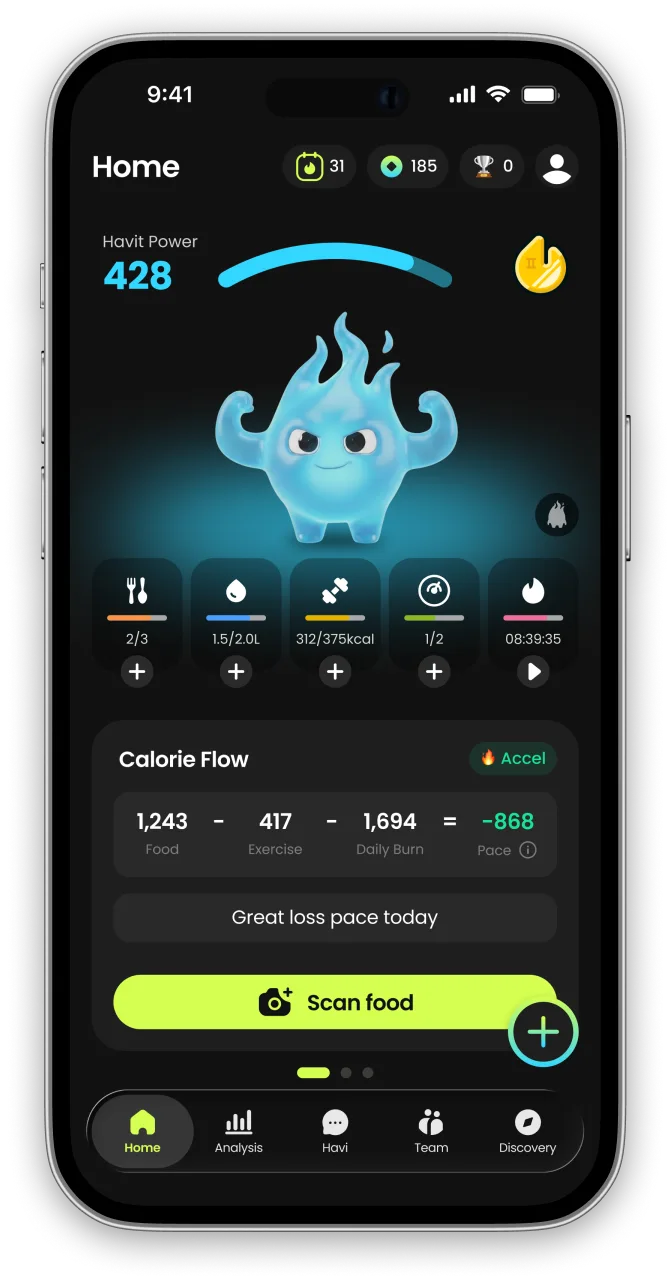
What is Havit?
Havit is an AI health companion for weight loss that protects muscle.
Unlike calorie-only trackers, Havit connects AI body-composition estimates, nutrition, hydration, sleep, steps, cycle, mood, and GLP-1 medication in one daily routine — so progress is measured by body composition, not just the number on the scale. Daily missions turn established behavior-change techniques into small repeatable actions, drawing on expertise from professionals formerly at Juvis Diet, one of Korea’s leading metabolic clinics.
In Havit’s own analysis of 1,090 GLP-1 users, people who logged consistently built stronger habits than the general user base. Read the GLP-1 Habit Report
Havit works with or without GLP-1 medication. It is a wellness app, not a medical device; body-composition results are estimates.

Continue in the App
Personalized wellness with your own data


References
- Acute caffeine ingestion enhances fat oxidation during moderate-intensity exercise in healthy adults — International Journal of Obesity, 2024
- Chronic caffeine consumption and metabolic adaptation: tolerance effects on thermogenesis and fat oxidation — Journal of Applied Physiology, 2025
- CYP1A2 polymorphisms and individual variation in caffeine metabolism: implications for exercise performance — British Journal of Sports Medicine, 2024
- Caffeine and exercise: metabolism, endurance, and performance — International Society of Sports Nutrition Position Stand, 2024


