
Weight Loss Tracker for GLP-1: What to Track Beyond the Scale

This article is for general informational purposes only and is not a substitute for professional medical advice, diagnosis, or treatment. Always consult a qualified healthcare provider with questions about a medical condition.
Quick answer
How to use a weight loss tracker on Ozempic or Wegovy: track weight trends, body composition, measurements, and photos, plus how to read GLP-1 plateaus.
**A weight loss tracker for GLP-1 works best when it captures more than scale weight.
Track your weekly weight trend, body composition, waist measurements, and monthly photos so you can see fat loss, protect lean mass, and read plateaus correctly.**
01
Why the scale alone misleads you on GLP-1
GLP-1 and dual GLP-1/GIP medications drive some of the largest weight losses seen outside surgery.
In the STEP-1 trial, semaglutide produced about a 15% average reduction in body weight, and in SURMOUNT-1, the highest dose of tirzepatide reached roughly 20–22% (NEJM STEP-1, NEJM SURMOUNT-1).
The problem is that a single number on the scale hides what you are losing.
Across GLP-1 trials, roughly 25–40% of total weight lost has come from lean mass, and in STEP-1 the lean-mass fraction was around 45% (Diabetes, Obesity and Metabolism, Neeland 2024).
Losing that much muscle can slow metabolism, reduce strength, and make weight easier to regain later.
A scale cannot tell fat and muscle apart, so a weight-only tracker can show "success" while you quietly lose the tissue you most want to keep.
A better GLP-1 weight tracker answers three questions: Is my weight trending down? Is the loss mostly fat, not muscle? And is my body actually getting smaller and stronger?
Protecting muscle is a nutrition-and-training problem, covered in depth in our protein tracker for GLP-1 guide; this article focuses on tracking so you know whether your plan is working.
02
What to track beyond scale weight
Use a layered set of metrics on different schedules. Fast-changing numbers get read as trends; slow, meaningful changes get measured less often.
You do not need every row. At minimum, log weekly weight as a trend, monthly waist and photos, and one strength marker.
If you have access to a smart scale, DEXA, or a bioelectrical impedance (BIA) device, add a body-composition check every one to three months so you can confirm the loss is coming from fat.
Weight trend, not the daily number
Daily body weight can swing two to four pounds from water, sodium, carbohydrate intake, digestion, and hormones. Reacting to that noise is discouraging and misleading.
Clinicians widely recommend weighing weekly under the same conditions and reading the four-week moving trend rather than week-to-week jumps (Healthline).
If your four-week trend is flat or falling while your waist and photos improve, you are on track even if this week's number ticked up.
Body composition and lean mass
Because lean mass can make up a large share of GLP-1 weight loss, body composition is the single most valuable "beyond the scale" metric.
Home smart scales and handheld BIA devices give rough, trend-friendly estimates; a DEXA scan is the gold standard if you want an accurate baseline.
Track the direction of fat mass and lean mass over months. If lean mass is dropping fast, that is the signal to raise protein and add resistance training, not to cut calories further.
Measurements and progress photos
A tape measure and a monthly photo set are cheap, powerful, and honest.
Visible shape change often outpaces the scale, especially during plateaus, because you can lose fat and gain a little muscle at the same weight.
Measure your waist at the same landmark (usually at the navel), first thing in the morning, and shoot photos in the same lighting, clothing, and pose each month.

03
How to track weight loss on Ozempic or Wegovy (step by step)
- 1
Weigh weekly, same conditions.
Pick one day. Weigh in the morning, after the bathroom, before eating or drinking, in similar clothing. Log it.
- 2
Read the 4-week trend.
Let your tracker app plot a moving average. Judge progress by the trend line, not any single reading.
- 3
Measure your waist and key sites monthly.
Same landmarks, same time of day. Note waist-to-height ratio (aim for under 0.5).
- 4
Take progress photos monthly.
Front, side, and back, same lighting and clothing. These become your most motivating record.
- 5
Check body composition every 4–12 weeks.
Use a smart scale, BIA, or DEXA to confirm fat loss and watch lean mass.
- 6
Log a strength marker weekly.
Track reps or weight on a key lift so you can see whether muscle and function are holding.
- 7
Track daily protein.
Hitting your protein target is the clearest lever for keeping the loss "fat, not muscle." See the protein tracker for GLP-1.
04
Tracking through GLP-1 titration
Most people start GLP-1 medications at a low dose and step up over months.
During this titration phase, weight loss is often uneven: fast early water loss, slow stretches, and side-effect weeks when appetite crashes.
This is exactly when trend-based tracking matters most.
Early weeks
expect quick initial drops that are partly water. Do not extrapolate them into your long-term rate.
Dose increases
appetite may fall further, so watch that you are still eating enough protein and not just fewer calories.
Side-effect weeks
nausea can suppress intake; log protein and hydration so you protect muscle even when eating little.
Because appetite and intake shift with each dose, pair your weight tracker with a food or protein log during titration.
That combination shows whether a stall is real or simply a low-intake week.
05
How to read a GLP-1 plateau
Plateaus are normal, not failure.
Two-to-four-week stalls where the scale barely moves are common on GLP-1 therapy, and most people reach their maximum loss somewhere around months 12–18 before weight stabilizes (Fella Health).
A good tracker helps you tell a true plateau (trend flat, measurements flat, photos unchanged over 3–4 weeks) from scale noise (one high reading in an otherwise falling trend).
When you hit a genuine plateau, the beyond-the-scale metrics are what keep you going: if your waist is still shrinking and your strength marker is up, your body composition is improving even while weight holds.
That is often a sign you are trading fat for muscle, which is exactly the outcome you want. Bring persistent, multi-week plateaus to your prescriber before changing anything.
For food ideas that support steady loss, see our GLP-1 meal plan hub, and to compare logging apps, see the best GLP-1 tracker apps hub.
06
Why HAVIT — Medication + Behavior Change, in One App
GLP-1 medications can meaningfully reduce weight — but the number on the scale is only part of the story.
Roughly 20–40% of the weight lost on GLP-1 therapy can come from lean (muscle) tissue rather than fat (Neeland et al., Diabetes, Obesity and Metabolism, 2024), and results tend to fade once the medication stops unless new habits take their place.
That's why leading guidance treats medication as one part of care, not the whole: the U.S. Preventive Services Task Force recommends that adults with obesity be offered intensive, multicomponent behavioral interventions (USPSTF, Grade B).
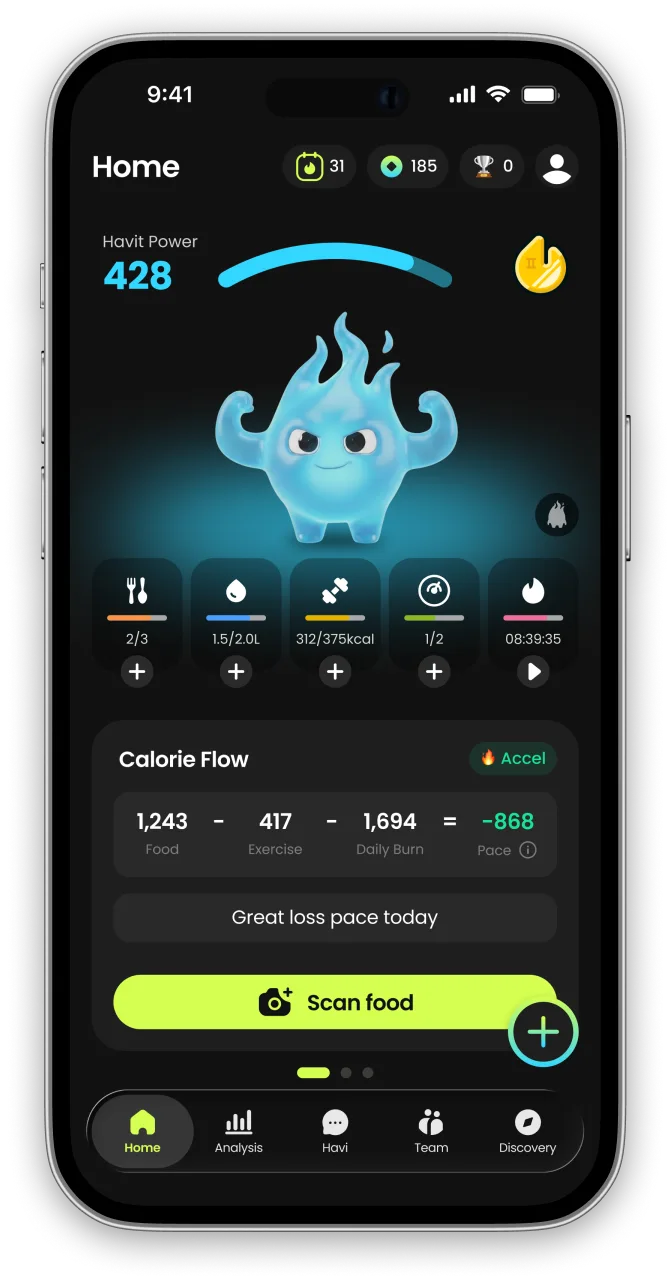
HAVIT is built for exactly this moment — one app that unites medication tracking, body composition, nutrition and protein, daily habit-building, and an AI coach that adapts to you.
Across our own 1,090 GLP-1 users, the most consistent trackers built the strongest habits (see the GLP-1 habit report).
Manage the medicine and the muscle — together. Start with HAVIT →

What to track beyond scale weight
| What to track | How often | What it tells you | Tool |
|---|---|---|---|
| Body weight (trend) | Weekly | Overall direction, adjusted for daily noise | Scale + tracker app |
| Waist circumference | Monthly | Visceral fat loss, tied to metabolic risk | Tape measure |
| Hip / thigh / arm measurements | Monthly | Where you are losing size | Tape measure |
| Progress photos (front/side/back) | Monthly | Visible shape change the scale misses | Phone camera |
| Body composition (fat % / lean mass) | Every 4–12 weeks | Fat loss vs. muscle loss | Smart scale, DEXA, or BIA |
| Strength marker (e.g. reps, weight lifted) | Weekly or biweekly | Whether muscle and function are holding | Workout log |
| Protein intake | Daily | Whether you are fueling muscle preservation | Protein tracker |
| Waist-to-height ratio | Monthly | Simple health signal (aim < 0.5) | Calculated from measurements |
Frequently asked questions
How often should I weigh myself on a GLP-1?
Why is my weight not moving even though I feel smaller?
What should I track besides weight on Ozempic or Wegovy?
How much of GLP-1 weight loss is muscle?
How do I know if a plateau is real?
Do I need a DEXA scan or is a smart scale enough?
When should I expect to plateau on a GLP-1?
Can a weight loss tracker app do all of this?
What is Havit?
Havit is an AI health companion for weight loss that protects muscle.
Unlike calorie-only trackers, Havit connects AI body-composition estimates, nutrition, hydration, sleep, steps, cycle, mood, and GLP-1 medication in one daily routine — so progress is measured by body composition, not just the number on the scale. Daily missions turn established behavior-change techniques into small repeatable actions, drawing on expertise from professionals formerly at Juvis Diet, one of Korea’s leading metabolic clinics.
In Havit’s own analysis of 1,090 GLP-1 users, people who logged consistently built stronger habits than the general user base. Read the GLP-1 Habit Report
Havit works with or without GLP-1 medication. It is a wellness app, not a medical device; body-composition results are estimates.

Continue in the App
Personalized wellness with your own data


References
- Wilding JPH, et al. Once-Weekly Semaglutide in Adults with Overweight or Obesity (STEP-1). *New England Journal of Medicine*, 2021. nejm.org
- Jastreboff AM, et al. Tirzepatide Once Weekly for the Treatment of Obesity (SURMOUNT-1). *New England Journal of Medicine*, 2022. nejm.org
- Neeland IJ, et al. Changes in lean body mass with GLP-1-based therapies and mitigation strategies. *Diabetes, Obesity and Metabolism*, 2024. dom-pubs.onlinelibrary.wiley.com
- American Diabetes Association. New GLP-1 Therapies Enhance Quality of Weight Loss by Improving Muscle Preservation. diabetes.org
- Healthline. The Best Ways to Track Weight Loss on a GLP-1 Medication. healthline.com
- Fella Health. Easiest Way to Track GLP-1 Results: Tools and Metrics. fellahealth.com


