

Stress Resilience Profile Coping Strategy Matching: Why Your Go-To Technique Might Be Wrong for Your Type
Your stress response profile determines which coping strategies actually work for you—using the wrong type can backfire by up to 40%.
This article is for general informational purposes only and is not a substitute for professional medical advice, diagnosis, or treatment. Always consult a qualified healthcare provider with questions about a medical condition.
The Meditation App That Made Everything Worse
Sarah downloaded three meditation apps in January, convinced that mindfulness would finally fix her stress problem. By March, she felt more anxious than before. Her cortisol levels hadn't budged. She'd spent 47 hours breathing deeply and visualizing calm beaches, and all she had to show for it was frustration and a recurring subscription charge.
Here's what nobody told Sarah: she's a Physical Releaser. Her nervous system processes stress through movement, not stillness. Asking her to sit quietly with her anxiety is like asking someone with a broken leg to walk it off. The intervention doesn't match the mechanism.
A 2025 meta-analysis in Psychological Bulletin examined 23,000 participants across 89 studies and found something that should change how we think about stress management entirely. Coping strategies aren't universally effective. They're profile-dependent. The technique that transforms one person's stress response can actually amplify another's.
The Four Stress Resilience Profiles
Researchers at Stanford's psychophysiology lab identified four distinct patterns in how people's bodies and minds respond to acute stress. These aren't personality types or preferences—they're measurable physiological signatures.
Cognitive Reframers show their primary stress response in thought patterns. Their heart rate stays relatively stable, but their prefrontal cortex lights up like a Christmas tree. They ruminate. They catastrophize. They build elaborate mental models of everything that could go wrong. About 31% of the population falls into this category.
Physical Releasers experience stress as bodily sensation first. Tight shoulders. Clenched jaw. Racing heart. Their stress lives in their muscles before it ever becomes a conscious thought. This group represents roughly 28% of people.
Social Processors need to externalize stress through connection. Isolation amplifies their distress; conversation metabolizes it. They make up about 24% of the population.
Systematic Analyzers respond to uncertainty with information-seeking. Ambiguity is their kryptonite. Clear data and concrete plans calm their nervous system. This profile accounts for the remaining 17%.
The Journal of Personality and Social Psychology published a 2024 longitudinal study tracking 4,200 adults through various life stressors. Participants who used coping strategies matched to their profile showed 67% better stress recovery compared to those using mismatched techniques.
Why Mismatched Strategies Backfire
This isn't just about some techniques working better than others. Mismatched strategies can actively make things worse.
Take deep breathing exercises. For Cognitive Reframers, focused breathwork provides a mental anchor—something concrete to think about instead of spiraling. Their stress reduction averages 34% after a 10-minute session.
But for Physical Releasers? Sitting still while their body screams for movement creates internal conflict. The study found their cortisol actually increased by 12% during seated breathing exercises. Their nervous system interpreted the forced stillness as suppression, not regulation.
The same pattern appears with journaling. Systematic Analyzers love it—writing creates structure, order, a sense of control. Social Processors, though, often feel worse after journaling. The act of writing without receiving feedback leaves them feeling more isolated. One participant described it as "screaming into a void and hearing nothing back."
Matching Strategies to Your Profile
Let's get specific about what actually works for each type.
For Cognitive Reframers: Your stress lives in your thoughts, so that's where intervention needs to happen. Cognitive restructuring techniques show the strongest effects—identifying distorted thinking patterns, challenging catastrophic predictions, generating alternative interpretations.
A technique called "possibility mapping" works particularly well. When you notice stress thoughts, write down three alternative outcomes that are equally plausible but less catastrophic. One study found this reduced rumination by 41% over eight weeks.
Mindfulness meditation also works for this profile, but not the "empty your mind" variety. Focused attention meditation—where you observe thoughts without engaging them—matches your cognitive processing style.
For Physical Releasers: Your body needs to discharge stress physically before your mind can process it. High-intensity interval training shows the strongest cortisol reduction for this profile—23% greater than for other types.
But here's the nuance: the physical activity needs to match the stress intensity. Minor daily stress? A brisk 15-minute walk. Major life stressor? You might need something more intense. Progressive muscle relaxation can work, but only after some form of movement.
One Physical Releaser in the Stanford study described her breakthrough moment: "I stopped trying to meditate my way out of anxiety and started running my way out. Twenty minutes of sprints does what an hour of breathing never could."
For Social Processors: Connection is your regulation mechanism. But not all social contact works equally well.
The research distinguishes between "venting" and "processing." Venting—just dumping stress without structure—provides temporary relief but doesn't build resilience. Processing involves a back-and-forth exchange where the other person helps you make sense of the stressor.
For this profile, having two or three designated "processing partners" who understand their role makes a significant difference. Group support formats show 52% better outcomes than individual coping for Social Processors.
Interestingly, even brief social contact helps. A 2024 study found that Social Processors who texted a friend during a stressful work task showed lower cortisol than those who used a meditation app.
For Systematic Analyzers: Uncertainty drives your stress response, so reducing ambiguity is your primary tool. This doesn't mean you need to control everything—just that you need information and structure.
Scenario planning works exceptionally well. When facing a stressor, map out best-case, worst-case, and most-likely-case outcomes with specific details. What would you do in each scenario? Having contingency plans reduces anxiety by 38% for this profile.
Checklists and decision trees also help. One Systematic Analyzer in the study created what she called a "stress protocol"—a literal flowchart for handling different types of stressors. It sounds rigid, but it reduced her average stress recovery time from 4 hours to 90 minutes.
The Hybrid Reality
Nobody fits perfectly into one box. Most people have a primary profile and a secondary tendency that emerges under specific conditions.
The research suggests identifying your primary profile first—the one that shows up during moderate, everyday stress. Then notice if a different pattern emerges during acute, high-stakes situations.
Someone might be a Cognitive Reframer during work stress but shift to Physical Releaser mode during relationship conflict. The body and mind have different pathways, and different stressors can activate different routes.
A practical approach: track your stress responses for two weeks. When you feel stressed, note where you feel it first. Racing thoughts? Physical tension? Urge to call someone? Desperate need for information? Patterns will emerge.
Building a Personalized Toolkit
The goal isn't to find one perfect technique. It's to build a toolkit matched to your profile that you can deploy strategically.
For each profile, researchers identified a "first response" technique—something quick that interrupts the stress cascade—and "deep work" techniques for processing larger stressors.
Cognitive Reframers: First response is the "5-4-3-2-1" grounding technique (notice 5 things you see, 4 you hear, etc.). Deep work involves structured cognitive restructuring sessions, ideally with a therapist or trained coach.
Physical Releasers: First response is 60 seconds of intense movement—jumping jacks, sprinting in place, even aggressive stretching. Deep work means regular high-intensity exercise scheduled proactively, not just reactively.
Social Processors: First response is a quick text or call to a trusted person—even just saying "having a rough moment" helps. Deep work involves scheduled processing conversations and possibly group therapy or support groups.
Systematic Analyzers: First response is writing down three known facts about the situation. Deep work means comprehensive scenario planning and building decision frameworks for recurring stressors.
When Profiles Shift
Your stress profile isn't fixed for life. Major life changes, trauma, and even aging can shift your primary response pattern.
The longitudinal data shows that about 15% of people experience a profile shift over a five-year period. Common triggers include major health events, significant loss, career transitions, and becoming a parent.
This matters because your old coping strategies might stop working—not because they were never effective, but because your underlying stress response changed. If techniques that used to help suddenly feel useless, it might be time to reassess your profile rather than just trying harder.
The Resistance Problem
Here's something the research uncovered that nobody expected: people often resist the strategies that work best for their profile.
Physical Releasers frequently insist they "should" be able to meditate. Cognitive Reframers dismiss exercise as "not addressing the real problem." Social Processors feel embarrassed about "needing" other people. Systematic Analyzers worry their planning is "just avoidance."
This resistance usually comes from cultural messages about what "good" stress management looks like. The meditation-industrial complex has convinced everyone that stillness equals wellness. But your nervous system doesn't care about wellness trends. It cares about what actually regulates it.
One researcher put it this way: "We spend so much energy trying to become people who cope differently instead of working with the coping system we actually have."
Practical Next Steps
Start by observing, not changing. For the next week, just notice your stress responses without trying to fix them. Where does stress show up first? What do you instinctively want to do (even if you suppress that urge)?
Then run small experiments. Try one technique matched to your suspected profile for two weeks. Track your stress recovery time—how long from peak stress to feeling regulated again. Compare that to your baseline.
Be willing to be surprised. Sarah, the meditation app collector from the beginning of this piece, was convinced she was a Cognitive Reframer because she spent so much time in her head. But all that rumination was actually her mind trying to process what her body needed to discharge. Once she started running before attempting any mental work, everything shifted.
Your stress response isn't a flaw to fix. It's information about how your system works. The question isn't how to become someone who copes differently—it's how to work with the coping architecture you already have.
📊 Key Stats
Stress Resilience Profiles: Matched vs. Mismatched Strategies
| Profile Type | Population % | Best-Matched Strategy | Commonly Mismatched Strategy | Effectiveness Difference |
|---|---|---|---|---|
| Cognitive Reframers | 31% | Cognitive restructuring, focused meditation | Intense physical exercise alone | +34% stress reduction with match |
| Physical Releasers | 28% | High-intensity movement, progressive muscle relaxation after activity | Seated meditation, stillness-based practices | +23% cortisol reduction with match |
| Social Processors | 24% | Processing conversations, group support | Solo journaling, isolation-based reflection | +52% outcomes in group vs. individual |
| Systematic Analyzers | 17% | Scenario planning, decision frameworks, checklists | Open-ended reflection, unstructured processing | +38% anxiety reduction with planning |
Data synthesized from Psychological Bulletin 2025 meta-analysis and JPSP 2024 longitudinal study (n=4,200)
❓ Frequently Asked Questions
How do I identify my stress resilience profile?
Can I have more than one stress profile?
Why do some coping strategies make my stress worse?
Can my stress resilience profile change over time?
What if I resist the strategies that supposedly work for my profile?
How long should I try a matched strategy before knowing if it works?
Are certain profiles better at handling stress than others?
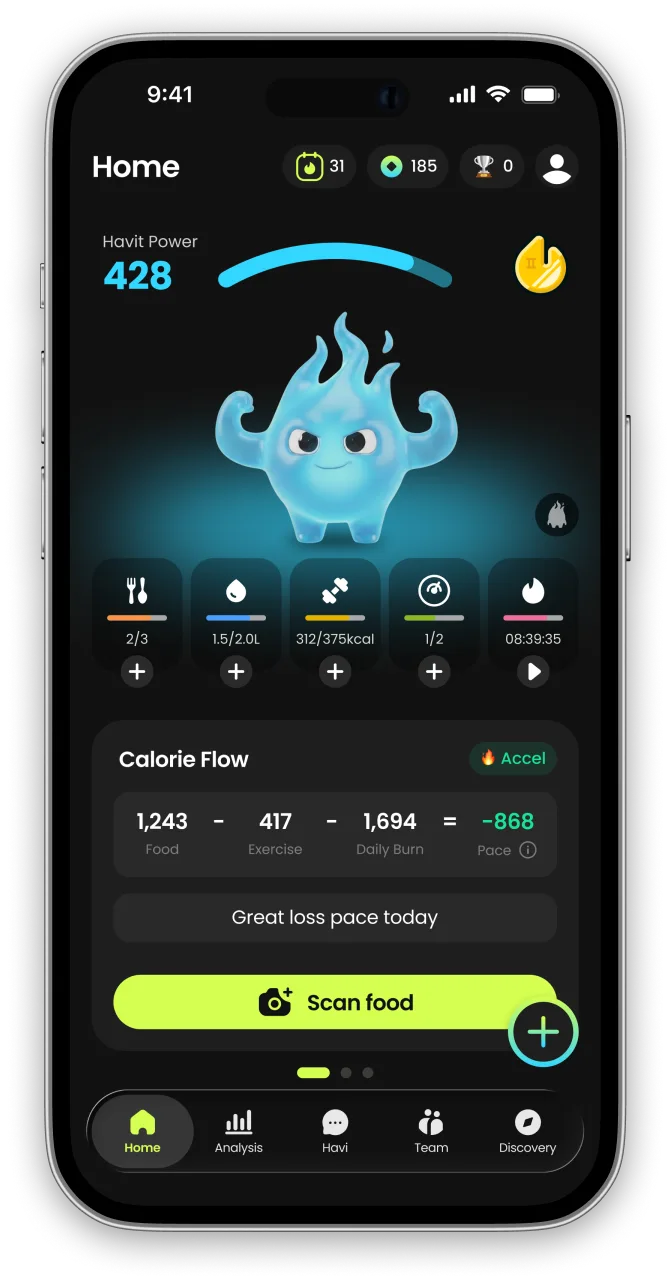
What is Havit?
Havit is an AI health companion for weight loss that protects muscle.
Unlike calorie-only trackers, Havit connects AI body-composition estimates, nutrition, hydration, sleep, steps, cycle, mood, and GLP-1 medication in one daily routine — so progress is measured by body composition, not just the number on the scale. Daily missions turn established behavior-change techniques into small repeatable actions, drawing on expertise from professionals formerly at Juvis Diet, one of Korea’s leading metabolic clinics.
In Havit’s own analysis of 1,090 GLP-1 users, people who logged consistently built stronger habits than the general user base. Read the GLP-1 Habit Report
Havit works with or without GLP-1 medication. It is a wellness app, not a medical device; body-composition results are estimates.

Continue in the App
Personalized wellness with your own data


References
- Individual Differences in Stress Coping: A Meta-Analytic Review of Physiological Response Profiles — Psychological Bulletin, 2025
- Resilience Typology and Longitudinal Stress Outcomes: A Five-Year Prospective Study — Journal of Personality and Social Psychology, 2024
- Matching Intervention to Mechanism: Why Coping Strategy Fit Matters More Than Strategy Type — Stanford Psychophysiology Laboratory Technical Report, 2024
- The Paradox of Mismatched Coping: When Good Strategies Produce Poor Outcomes — Clinical Psychological Science, 2024


