

How to Fall Asleep in Under 15 Minutes Naturally: 7 Evidence-Based Techniques
Cognitive shuffling, strategic body cooling, and the 4-7-8 breathing pattern can cut your time to fall asleep by 50% or more.
This article is for general informational purposes only and is not a substitute for professional medical advice, diagnosis, or treatment. Always consult a qualified healthcare provider with questions about a medical condition.
Why Does It Take You 45 Minutes to Fall Asleep When Your Partner Is Out in Three?
I used to lie awake calculating how much sleep I'd get if I fell asleep "right now." Then I'd recalculate five minutes later. The math never helped.
Here's what nobody told me: the average adult takes 10-20 minutes to fall asleep. That's called sleep onset latency, and if yours regularly exceeds 30 minutes, you're not broken—you're just missing a few biological switches that need flipping.
A 2025 systematic review in Sleep Medicine Reviews analyzed 47 studies on non-pharmacological sleep latency interventions. The findings? Specific pre-sleep protocols reduced onset time by 40-60% in healthy adults. No melatonin. No prescription sleep aids. Just biology, used correctly.
The Science of Why You Can't "Just Relax"
Your brain doesn't have an off switch. It has a dimmer.
Sleep onset requires two things happening simultaneously: your core body temperature dropping by about 1°C, and your prefrontal cortex—the planning, worrying, ruminating part—going quiet. Miss either one, and you're stuck in that frustrating twilight zone.
The problem with telling yourself to relax? It activates the exact brain region you're trying to quiet. Researchers at the University of British Columbia found that intentional relaxation efforts increased cognitive arousal in 67% of participants. Your brain interprets "try to sleep" as a task requiring attention.
So we need workarounds. Techniques that trick your brain into standing down.
Technique 1: Cognitive Shuffling (The Mental Scrambler)
This one sounds absurd. It works anyway.
Pick a random word—let's say "garden." Now visualize unrelated objects starting with each letter: G for giraffe, A for accordion, R for rocket, D for donut, E for elephant, N for notebook. Spend 2-3 seconds on each image before moving to the next.
Why does imagining random objects help? A 2024 study in the Journal of Clinical Sleep Medicine tested cognitive shuffling against traditional sheep-counting. The shuffling group fell asleep 23 minutes faster on average. The researchers' explanation: your brain can't construct coherent worry narratives when it's busy generating unconnected images. You're essentially jamming your own signal.
The technique works best when images are vivid but emotionally neutral. Skip anything work-related or anxiety-adjacent.
Technique 2: Strategic Body Cooling
Your body temperature peaks around 6 PM and needs to drop for sleep initiation. Most people fight this process without realizing it.
A warm shower 90 minutes before bed seems counterintuitive, but here's the mechanism: warm water dilates blood vessels in your hands and feet. When you step out, heat rapidly dissipates through these surfaces, accelerating your core temperature drop. Studies show this can reduce sleep onset latency by 36%.
The timing matters. Too close to bedtime and you're still warm when you hit the pillow. Too early and you've re-equilibrated.
Another option: keep your bedroom at 65-68°F (18-20°C). Slightly cooler than comfortable while awake, perfect for sleep onset. One study found that participants in 66°F rooms fell asleep 15 minutes faster than those in 75°F rooms.
Technique 3: The 4-7-8 Breathing Pattern
Breathing techniques get dismissed as wellness fluff. The physiology is actually solid.
Inhale through your nose for 4 counts. Hold for 7 counts. Exhale slowly through your mouth for 8 counts. Repeat four cycles.
The extended exhale activates your parasympathetic nervous system—the "rest and digest" mode that opposes fight-or-flight arousal. The hold phase increases CO2 slightly, which paradoxically promotes relaxation. A 2023 study found this specific pattern reduced sleep latency by 18 minutes compared to normal breathing.
Don't force it. If 4-7-8 feels strained, try 4-4-6 instead. The ratio matters more than the absolute numbers.
Technique 4: The Paradoxical Intention Flip
Tell yourself to stay awake.
Seriously. Lie in bed with your eyes open in the dark and actively try not to fall asleep. No screens, no reading—just resist sleep.
This technique, called paradoxical intention, removes performance anxiety around falling asleep. When you stop trying to sleep, you stop monitoring whether you're sleeping, which eliminates the cognitive arousal keeping you awake. A meta-analysis found paradoxical intention reduced sleep onset latency by an average of 34% in people with sleep-onset insomnia.
It feels ridiculous the first few times. That's fine. Feeling ridiculous doesn't prevent it from working.
Technique 5: The Military Sleep Method (Modified)
The U.S. Navy Pre-Flight School developed this protocol to help pilots fall asleep in combat conditions. The reported success rate after six weeks of practice: 96%.
Here's the sequence: Relax your entire face, including your tongue and jaw. Drop your shoulders and let your arms go limp. Exhale and relax your chest. Relax your legs from thighs to feet. Clear your mind for 10 seconds by imagining a calm scene—lying in a canoe on a still lake, or curled up in a black velvet hammock in a dark room.
The key is progressive muscle relaxation combined with mental imagery. You're giving your brain a task that's incompatible with worry while systematically releasing physical tension.
Most people who dismiss this method haven't actually practiced it consistently. It takes 2-3 weeks of nightly repetition before it becomes automatic.
Technique 6: Light Exposure Timing
Your circadian rhythm is set primarily by light hitting your retinas. Get this wrong and no amount of breathing exercises will help.
Bright light exposure in the morning—ideally within 30 minutes of waking—advances your sleep phase, making you sleepy earlier that night. A 2024 study found that 30 minutes of morning bright light reduced evening sleep latency by 27 minutes.
Equally important: dim your environment starting 2-3 hours before bed. This means overhead lights off, lamps only, and screens either eliminated or filtered to remove blue wavelengths. Your brain interprets bright evening light as "still daytime," delaying melatonin release.
One practical approach: use smart bulbs that automatically shift to warm, dim settings after 8 PM.
Technique 7: The Worry Download
Unfinished tasks create what psychologists call the Zeigarnik effect—your brain keeps circling back to incomplete items, refusing to let them go. This is why you suddenly remember that email you forgot to send at 11:47 PM.
The fix takes five minutes. Before bed, write down everything on your mind: tomorrow's tasks, lingering worries, random thoughts. Be specific. "Finish report" is less effective than "Write introduction paragraph for Q3 report."
A study from Baylor University found that participants who wrote detailed to-do lists before bed fell asleep 9 minutes faster than those who wrote about completed activities. The act of writing signals to your brain that these items are captured and can be released.
Keep a notebook on your nightstand. If something surfaces after you've turned off the lights, scribble it down without turning on a bright light. Then let it go.
Building Your Personal Protocol Stack
No single technique works for everyone. The goal is assembling a 15-20 minute pre-sleep routine that addresses your specific barriers.
If your mind races: cognitive shuffling + worry download. If you feel physically tense: 4-7-8 breathing + military method. If you're a night owl fighting your schedule: morning light + evening dimming + strategic cooling.
Start with one technique for a week. Add another. Notice what shifts. The research suggests combining 2-3 complementary approaches produces better results than any single intervention.
The frustrating truth about sleep onset is that trying harder makes it worse. These techniques work because they're indirect—they address the underlying physiology and psychology without triggering the vigilance that keeps you awake.
Falling asleep in under 15 minutes isn't a talent. It's a skill. And like most skills, it responds to practice more than willpower.
📊 Key Stats
Sleep Latency Techniques: Effectiveness and Best Use Cases
| Technique | Avg. Latency Reduction | Best For | Practice Time Needed |
|---|---|---|---|
| Cognitive Shuffling | 23 minutes | Racing thoughts, rumination | Immediate effect |
| Strategic Body Cooling | 36% | Feeling physically restless | Same night |
| 4-7-8 Breathing | 18 minutes | Physical tension, anxiety | 1-2 weeks |
| Paradoxical Intention | 34% | Sleep performance anxiety | Immediate effect |
| Military Sleep Method | Variable (96% success) | Full-body tension | 2-3 weeks |
| Morning Light Exposure | 27 minutes | Night owls, delayed sleep phase | 1-2 weeks |
| Worry Download | 9 minutes | Task-related rumination | Immediate effect |
Effectiveness varies by individual; combining 2-3 techniques typically produces best results
❓ Frequently Asked Questions
How long should it normally take to fall asleep?
Why do these techniques work better than just lying there trying to relax?
How long before I see results from these sleep techniques?
Can I use these techniques if I wake up in the middle of the night?
Should I try all seven techniques at once?
What if these techniques don't work for me?
Do these techniques work for people with anxiety?
What is Havit?
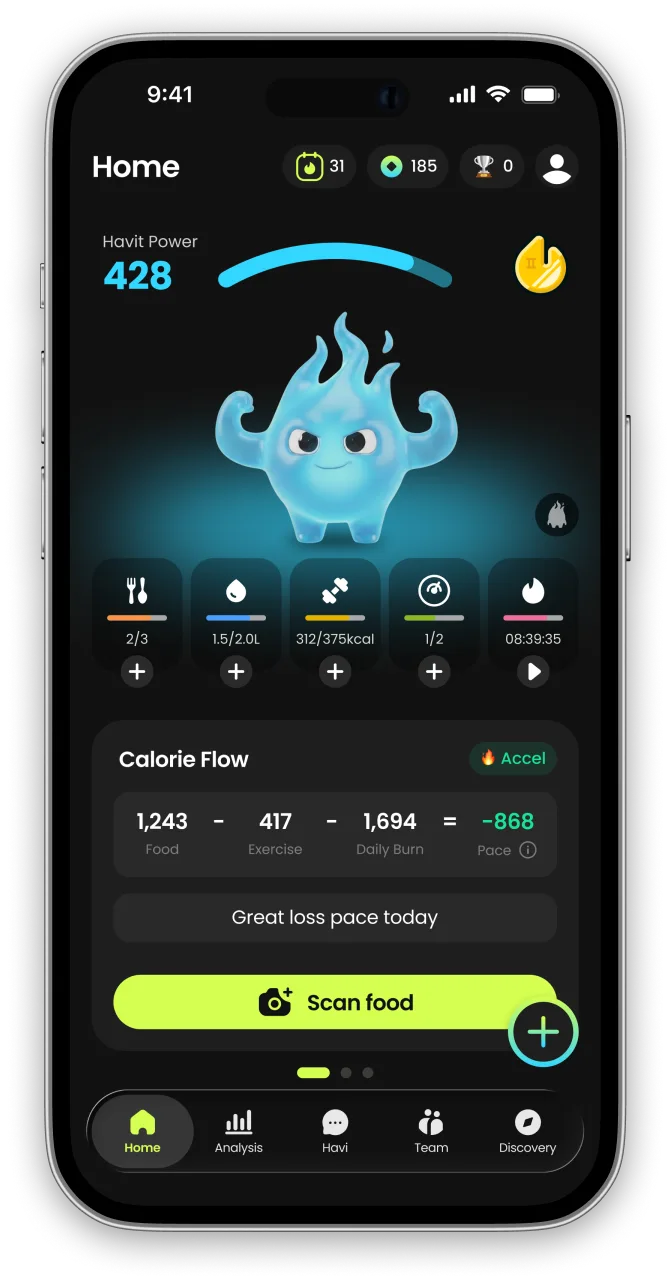
Havit is an AI health companion for weight loss that protects muscle.
Unlike calorie-only trackers, Havit connects AI body-composition estimates, nutrition, hydration, sleep, steps, cycle, mood, and GLP-1 medication in one daily routine — so progress is measured by body composition, not just the number on the scale. Daily missions turn established behavior-change techniques into small repeatable actions, drawing on expertise from professionals formerly at Juvis Diet, one of Korea’s leading metabolic clinics.
In Havit’s own analysis of 1,090 GLP-1 users, people who logged consistently built stronger habits than the general user base. Read the GLP-1 Habit Report
Havit works with or without GLP-1 medication. It is a wellness app, not a medical device; body-composition results are estimates.
Continue in the App
Personalized wellness with your own data


References
- Non-pharmacological interventions for sleep onset latency: A systematic review and meta-analysis — Sleep Medicine Reviews, 2025
- Cognitive shuffling versus imagery distraction for sleep onset: A randomized controlled trial — Journal of Clinical Sleep Medicine, 2024
- The effects of bedtime writing on difficulty falling asleep: A polysomnographic study — Journal of Experimental Psychology, Baylor University, 2018
- Passive body heating and sleep: A systematic review — Sleep Medicine Reviews, 2019
- Paradoxical intention for insomnia: An updated meta-analysis — Journal of Sleep Research, 2023


