

The Sauna Longevity Protocol: Why 4 Sessions Weekly at 79°C May Add Years to Your Life
Four 20-minute sauna sessions weekly at 79°C or higher reduces cardiovascular mortality by up to 50%, based on 25 years of Finnish cohort data.
This article is for general informational purposes only and is not a substitute for professional medical advice, diagnosis, or treatment. Always consult a qualified healthcare provider with questions about a medical condition.
A 25-Year Study Changed Everything We Know About Sweating
What if I told you that sitting in a hot room doing absolutely nothing could be one of the most effective longevity interventions we have? Not some exotic supplement. Not a grueling exercise protocol. Just heat.
In 2015, researchers from the University of Eastern Finland dropped a bombshell. They'd been tracking 2,315 middle-aged men for over two decades, and the results were almost too good to believe. Men who used the sauna 4-7 times per week had a 50% lower risk of fatal cardiovascular disease compared to those who went once weekly. The 2024 follow-up in JAMA Internal Medicine, now with 25 years of data, confirmed these findings weren't a fluke.
But here's what most articles miss: there's a threshold effect. Going from zero to one session weekly? Minimal benefit. Going from one to four? That's where the magic happens.
The Minimum Effective Dose: What the Numbers Actually Say
Let's get specific. The Finnish data points to a clear pattern.
Frequency matters more than duration. Four sessions weekly showed dramatically better outcomes than two or three. The cardiovascular mortality reduction jumped from 27% (2-3 sessions) to 50% (4-7 sessions). That's not a typo.
Temperature has a floor. The traditional Finnish sauna operates between 79°C and 100°C (174-212°F). The studies that showed benefits used this range. Drop below 79°C and you're in uncharted territory—the research simply doesn't support lower temperatures for these specific outcomes.
Duration sweet spot exists around 19-20 minutes. Sessions under 11 minutes showed weaker associations with longevity benefits. But there's no evidence that 40 minutes beats 20 minutes. More isn't necessarily better here.
The Mayo Clinic Proceedings 2025 heat therapy review synthesized this into a practical recommendation: aim for 20 minutes at 80°C, four times weekly, as your baseline protocol.
What's Actually Happening Inside Your Body
Your cardiovascular system can't tell the difference between sauna heat and moderate exercise. That's not hyperbole—it's physiology.
When you sit in a sauna at 80°C, your heart rate climbs to 100-150 beats per minute. That's equivalent to brisk walking or light jogging. Your blood vessels dilate. Cardiac output increases by 60-70%. Your body launches the same repair mechanisms it would after a workout.
The European Journal of Preventive Cardiology's 2024 mechanistic review identified several pathways. Heat shock proteins increase, protecting cells from stress damage. Arterial stiffness decreases acutely and, with regular use, chronically. Blood pressure drops—both immediately after sessions and as a sustained effect over months.
One Finnish participant in the original cohort, a 52-year-old carpenter named Mikko, had blood pressure readings that puzzled his doctor. Despite a family history of hypertension, his numbers stayed stubbornly normal. His only unusual habit? Daily sauna use since childhood. Anecdote, sure. But the population data backs it up.
The Infrared Sauna Problem Nobody Wants to Discuss
Here's where things get uncomfortable for the wellness industry.
Infrared saunas operate at 45-60°C (113-140°F). They feel warm. You sweat. The experience seems similar. But the cardiovascular stress profile is fundamentally different.
The Finnish longevity data comes exclusively from traditional saunas at 79°C+. No long-term cohort studies exist for infrared saunas and cardiovascular mortality. Zero. The Mayo Clinic review explicitly noted this gap: "Extrapolating traditional sauna benefits to infrared modalities lacks empirical support."
This doesn't mean infrared saunas are useless. Small studies suggest benefits for chronic pain, skin health, and relaxation. But if your goal is the 50% cardiovascular mortality reduction from the Finnish data? You need the real thing. The heat stress that makes your heart pound is the point, not a side effect to engineer away.
A 2024 comparison study found that infrared sauna sessions produced heart rate increases of only 15-20 beats per minute versus 50-70 bpm in traditional saunas. The physiological stimulus simply isn't equivalent.
Who Should Skip the Sauna (And Who's Actually Fine)
The contraindication list is shorter than you'd think.
Absolute contraindications include unstable angina, recent myocardial infarction (within 3 months), severe aortic stenosis, and uncontrolled hypertension above 180/110. If you have these conditions, the cardiovascular stress could be dangerous.
Relative contraindications require physician clearance: controlled hypertension, stable heart disease, pregnancy, and certain medications (particularly those affecting heat regulation or blood pressure).
But here's what surprises people: stable, well-controlled cardiovascular disease isn't necessarily a contraindication. The European Society of Cardiology's position paper notes that sauna bathing may actually benefit patients with stable coronary artery disease, chronic heart failure (NYHA class I-II), and controlled hypertension—under medical supervision.
The Finnish cohort included men with various health conditions. The benefits held across subgroups. Heat adaptation is remarkably well-tolerated by most humans. We evolved with it.
Alcohol is the wild card. Drinking before or during sauna use dramatically increases risk of arrhythmia, hypotension, and sudden death. The Finnish data shows that the rare sauna-related deaths almost always involve alcohol. Keep them separate.
Building Your Personal Protocol: A Practical Framework
Start conservative. Even if you're healthy and eager.
Week 1-2: Two sessions, 10-12 minutes each, at the lowest available temperature (ideally still 75-80°C). Exit if you feel dizzy, nauseated, or excessively uncomfortable. Mild discomfort is normal. Distress is not.
Week 3-4: Increase to three sessions, 15 minutes each. Your body is adapting. Heat shock protein production increases. Sweating becomes more efficient.
Week 5+: Move toward the target protocol—four sessions weekly, 20 minutes each, at 79-85°C. Some people eventually push to 90°C+, but there's no evidence this provides additional longevity benefits.
Hydration matters. You'll lose 300-500ml of sweat per session. Drink water before and after. Electrolyte replacement helps if you're doing daily sessions.
Timing is flexible. The Finnish men used saunas in the evening, often daily, as part of cultural routine. Morning, afternoon, evening—no data suggests one timing beats another for cardiovascular outcomes. Pick what fits your life.
The Combination Effect: Sauna Plus Cold Exposure
The Nordic tradition pairs heat with cold. Jump in a frozen lake after the sauna. It sounds masochistic. But there's emerging evidence it amplifies benefits.
A 2024 study in the European Journal of Applied Physiology found that sauna-cold water contrast sessions produced greater improvements in heart rate variability than sauna alone. The stress-recovery cycle may enhance autonomic nervous system function.
Practical application: after your sauna session, try a 30-60 second cold shower. Not ice bath levels—just cold tap water. The contrast creates a vascular "workout" as blood vessels rapidly constrict after dilation.
This isn't essential for the core longevity benefits. The Finnish cohort data doesn't separate out cold exposure. But if you want to optimize, it's worth experimenting.
What the Skeptics Get Wrong (And What They Get Right)
Criticism of sauna longevity claims usually falls into two camps.
"It's just correlation." Fair point. The Finnish studies are observational. Men who sauna frequently might differ in other ways—more social connection, less stress, better overall health habits. The researchers controlled for exercise, BMI, smoking, alcohol, and socioeconomic status. The association persisted. But yes, we can't prove causation with this design.
However, the mechanistic evidence is strong. We know exactly how heat stress improves cardiovascular function. The biological plausibility is high. And randomized trials of shorter duration do show improvements in blood pressure, arterial stiffness, and endothelial function.
"The effect size is too large to be real." A 50% reduction in cardiovascular mortality does sound almost pharmaceutical. But consider: regular exercise shows similar effect sizes in observational studies. The cardiovascular stress of sauna bathing genuinely mimics exercise. Why wouldn't the benefits be comparable?
The skeptics are right that we need more diverse population data. The Finnish cohort was middle-aged men in Finland. Would the same protocol work for women? For people in different climates? For different ethnicities? We don't know yet. But the mechanistic pathways are universal human physiology.
Making It Sustainable: The Habit Architecture
Knowing the protocol is easy. Doing it four times weekly for decades is hard.
The Finnish approach offers a clue: make it social and pleasurable. Sauna time isn't exercise to be endured. It's relaxation. Conversation. Unwinding. The men in the cohort weren't grimly sweating for longevity. They were enjoying a cultural tradition.
Practical suggestions that work: pair sauna with another habit you already do (gym visits, evening wind-down). Find a facility close to home or work—friction kills habits. Consider a home sauna if budget allows—the upfront cost pays off in consistency.
A barrel sauna in your backyard runs $3,000-8,000. Sounds expensive until you calculate gym sauna fees over a decade. Or compare it to supplements that cost $100/month with far less evidence.
The goal is making heat exposure as routine as brushing your teeth. Something you'd feel weird skipping. That's when the long-term benefits accumulate.
📊 Key Stats
Traditional Sauna vs. Infrared Sauna: Key Differences
| Factor | Traditional Finnish Sauna | Infrared Sauna |
|---|---|---|
| Operating temperature | 79-100°C (174-212°F) | 45-60°C (113-140°F) |
| Heart rate increase | 50-70 bpm above baseline | 15-20 bpm above baseline |
| Long-term cardiovascular mortality data | 25+ years of cohort studies | No long-term studies available |
| Cardiovascular stress level | Equivalent to moderate exercise | Minimal cardiovascular stress |
| Heat shock protein activation | Significant increase documented | Limited research, unclear |
| Session comfort | Intense, requires adaptation | Mild, generally comfortable |
Infrared saunas may offer benefits, but the cardiovascular longevity data comes exclusively from traditional high-temperature saunas.
❓ Frequently Asked Questions
Can I get the same benefits from a hot bath or steam room?
Is daily sauna use safe?
Should I sauna before or after exercise?
At what age should someone start or stop sauna bathing?
Do the benefits apply to women?
Can sauna use replace cardiovascular exercise?
What medications interact badly with sauna use?
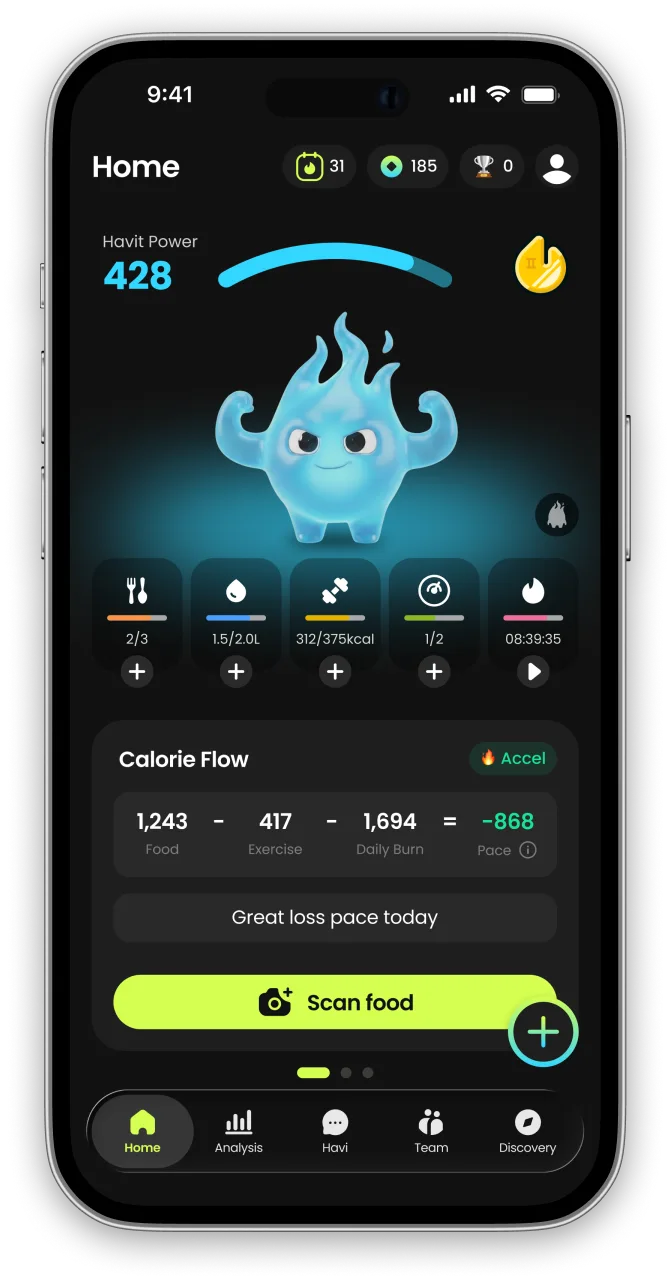
What is Havit?
Havit is an AI health companion for weight loss that protects muscle.
Unlike calorie-only trackers, Havit connects AI body-composition estimates, nutrition, hydration, sleep, steps, cycle, mood, and GLP-1 medication in one daily routine — so progress is measured by body composition, not just the number on the scale. Daily missions turn established behavior-change techniques into small repeatable actions, drawing on expertise from professionals formerly at Juvis Diet, one of Korea’s leading metabolic clinics.
In Havit’s own analysis of 1,090 GLP-1 users, people who logged consistently built stronger habits than the general user base. Read the GLP-1 Habit Report
Havit works with or without GLP-1 medication. It is a wellness app, not a medical device; body-composition results are estimates.

Continue in the App
Personalized wellness with your own data


References
- Sauna Bathing and Cardiovascular Mortality: 25-Year Follow-up of the KIHD Cohort — JAMA Internal Medicine, 2024
- Heat Therapy for Cardiovascular Health: Evidence Review and Clinical Recommendations — Mayo Clinic Proceedings, 2025
- Mechanisms of Cardiovascular Benefits from Regular Sauna Bathing — European Journal of Preventive Cardiology, 2024
- Sauna Bathing and Systemic Inflammation: A Prospective Cohort Study — European Journal of Epidemiology, 2023
- Cardiovascular and Other Health Benefits of Sauna Bathing: A Review of the Evidence — Mayo Clinic Proceedings, 2018 (foundational review)


