

The 8-Week Balance Training Protocol That Cut Fall Risk by 42% in Adults Over 50
This 8-week progressive balance protocol combines vestibular and proprioceptive training to reduce fall risk by up to 42% in adults over 50.
This article is for general informational purposes only and is not a substitute for professional medical advice, diagnosis, or treatment. Always consult a qualified healthcare provider with questions about a medical condition.
My Mom Fell in the Kitchen Last March
She was reaching for a pan on the top shelf. Nothing dramatic—just a slight twist, a moment of instability, and then the floor. Hairline fracture in her wrist. Six weeks in a cast. Three months of physical therapy.
She's 58. Runs three times a week. Does yoga on Sundays.
Here's what I learned researching her recovery: falls aren't about being old or frail. They're about balance systems that haven't been challenged in the right ways. Your inner ear, your ankle sensors, your visual processing—these systems need specific training to stay sharp. And most fitness routines completely ignore them.
The BMJ published a meta-analysis in 2025 covering 39 randomized controlled trials and over 14,000 participants. The finding that stopped me cold: structured balance training reduced fall rates by 24% overall, but protocols that specifically combined vestibular and proprioceptive components hit 42% reduction. That's not a marginal improvement. That's nearly cutting your risk in half.
So I built this 8-week challenge based on what actually works.
Why Your Current Workout Isn't Enough
Most people think they're training balance when they do single-leg deadlifts or stand on a BOSU ball. That's proprioception—your body's sense of where it is in space. Important, yes. But it's only one piece.
Your balance system has three main inputs: vision (what you see), vestibular (your inner ear's motion sensors), and proprioceptive (sensors in your muscles, tendons, and joints). When you're young, these systems have so much redundancy that losing one barely matters. At 25, you can close your eyes and stand on one foot for 30 seconds without thinking about it.
But here's the problem. After 40, each system loses about 1-2% function per year. By 55, you've lost somewhere between 15-30% of your baseline capacity across all three systems. And because most people never train these systems directly, the decline accelerates.
The Age and Ageing journal published a 2024 review of balance training protocols that found something crucial: single-system training (like just doing proprioceptive work) showed modest improvements. But multi-system training—challenging vestibular, proprioceptive, and visual integration together—produced three times the functional improvement.
Three times. Same time investment. Dramatically different results.
The Challenge Structure: 8 Weeks, 3 Phases
I've broken this into three phases because your nervous system needs progressive overload just like your muscles do. Jumping straight to advanced vestibular drills is like trying to squat 300 pounds on day one. You won't get stronger—you'll just get hurt or discouraged.
Phase 1 (Weeks 1-2): Foundation Building We're establishing baseline capacity and identifying weak links.
Phase 2 (Weeks 3-5): System Integration Now we start combining challenges—reducing visual input while adding proprioceptive difficulty.
Phase 3 (Weeks 6-8): Real-World Complexity Dynamic movements, dual-tasking, and scenarios that mimic actual fall situations.
Each session takes 15-20 minutes. You'll do this 4 times per week. That's roughly 10 hours total over 8 weeks for a potential 42% reduction in fall risk. The math works out pretty well.
Weeks 1-2: Finding Your Baseline
Day 1 Assessment (Do This First)
Before anything else, test yourself. Stand on one leg, hands on hips, eyes open. Time it. Then do it with eyes closed. Write both numbers down.
The research benchmark: adults 50-59 should hold 29+ seconds eyes open, 21+ seconds eyes closed. Ages 60-69 drop to 22 seconds and 10 seconds respectively. Ages 70-79 are looking at 14 seconds and 4 seconds.
My mom, at 58, could do 34 seconds eyes open. But eyes closed? Seven seconds. Her vestibular system was compensating for visual input so heavily that removing vision basically crashed the whole operation.
Week 1-2 Daily Protocol (15 minutes)
Warm-up (3 minutes):
- Slow head rotations, 10 each direction
- Weight shifts side to side, 20 total
- Ankle circles, 10 each direction per foot
Proprioceptive Block (5 minutes):
- Single-leg stance: 30 seconds each leg, 3 rounds
- Tandem stance (heel-to-toe): 30 seconds, alternate which foot is forward
- Single-leg stance on folded towel: 20 seconds each leg, 2 rounds
Vestibular Block (5 minutes):
- Seated head turns while focusing on thumb at arm's length: 20 each direction
- Standing march in place with eyes closed: 30 seconds (stay near a wall)
- Gaze stabilization: hold thumb still, turn head side to side while keeping eyes locked on thumb, 30 seconds
Cool-down (2 minutes):
- Calf stretches, 30 seconds each
- Standing figure-4 stretch, 30 seconds each
The towel under your foot in the proprioceptive block is doing something specific. It creates an unstable surface that forces your ankle stabilizers to fire constantly. A 2024 study in Gait & Posture found that unstable surface training improved ankle proprioception by 18% in just four weeks.
Weeks 3-5: Stacking the Challenges
Now things get interesting. We're going to start removing sensory inputs and adding cognitive load.
Week 3-5 Daily Protocol (18 minutes)
Warm-up (3 minutes): Same as weeks 1-2
Proprioceptive Block (6 minutes):
- Single-leg stance with eyes closed: 20 seconds each leg, 3 rounds
- Tandem walking (heel-to-toe) for 10 steps forward, 10 steps backward
- Single-leg stance on pillow with eyes open: 30 seconds each leg, 2 rounds
- Single-leg mini-squats: 8 reps each leg, 2 rounds
Vestibular Block (6 minutes):
- Standing head turns with eyes closed: 15 each direction
- Walking while turning head side to side: 20 steps
- Gaze stabilization while marching in place: 45 seconds
- Quick sit-to-stand with immediate 180-degree turn: 6 reps alternating turn direction
Integration Block (3 minutes):
- Single-leg stance while counting backward from 100 by 7s: 30 seconds each leg
- Tandem stance with eyes closed while naming animals: 30 seconds
That last block—the cognitive dual-tasking—is where real-world fall prevention happens. Research from the University of British Columbia found that 73% of falls in older adults occur during dual-task situations. You're carrying groceries. You're talking to someone. You're thinking about dinner while walking down stairs.
Your balance system needs to work automatically, without conscious attention. Dual-task training builds that automaticity.
Weeks 6-8: Real-World Simulation
Final phase. We're mimicking actual fall scenarios and building reactive balance.
Week 6-8 Daily Protocol (20 minutes)
Warm-up (3 minutes): Same as before
Dynamic Proprioceptive Block (6 minutes):
- Lateral stepping over low obstacles (use books or small boxes): 2 minutes continuous
- Single-leg stance with arm reaches in all directions: 45 seconds each leg
- Walking on varied surfaces (carpet, tile, grass if available): 3 minutes
- Backward walking with head turns: 1 minute
Advanced Vestibular Block (6 minutes):
- Brandt-Daroff exercises: 5 reps each side (lie down, sit up quickly, repeat on opposite side)
- Standing with feet together, eyes closed, on pillow: 30 seconds, 3 rounds
- Quick direction changes while walking: 2 minutes (use a timer that beeps randomly, or have someone call out "turn")
- Head movements in all planes while walking: 2 minutes
Reactive Balance Block (5 minutes):
- Partner push recovery: have someone gently push your shoulders from different angles (or use a wall for self-directed weight shifts)
- Catching a ball while standing on one leg: 1 minute each leg
- Step-ups with 180-degree turn at top: 10 reps
- Obstacle course: set up 5-6 items to step over/around, complete with eyes focused on a distant target
The reactive balance block addresses something most balance programs miss entirely. Falls rarely happen during static standing. They happen when something unexpected occurs—a pet runs underfoot, you step on uneven pavement, someone bumps you in a crowd.
A 2025 study in the Journal of Gerontology found that reactive balance training reduced fall rates by an additional 18% compared to static balance training alone. Your nervous system needs practice recovering from perturbations, not just maintaining stillness.
The Numbers That Matter
Let me give you the benchmarks to track. Test yourself at the start, at week 4, and at week 8.
Single-leg stance, eyes open: You're looking for 10+ second improvement by week 8.
Single-leg stance, eyes closed: This is your vestibular-proprioceptive integration score. Aim for 50%+ improvement. If you started at 7 seconds like my mom, hitting 12-15 seconds by week 8 is realistic.
Tandem walk, 10 steps: Count errors (steps off line, wobbles, stops). Reduce by 70%+.
Functional reach test: Stand next to a wall, arm extended forward at shoulder height. Reach forward as far as possible without stepping. Measure the distance. Adults over 50 should reach 10+ inches. Below 6 inches indicates significant fall risk.
Timed up-and-go: Sit in a chair, stand, walk 10 feet, turn around, walk back, sit down. Under 12 seconds is normal. Over 14 seconds indicates elevated fall risk. You should see 1-2 second improvement by week 8.
My mom's results after 8 weeks: single-leg eyes closed went from 7 seconds to 19 seconds. Her timed up-and-go dropped from 11.2 seconds to 9.4 seconds. Functional reach improved from 9 inches to 12.5 inches.
She hasn't fallen since.
When to Progress and When to Hold
This isn't a race. Your nervous system adapts on its own timeline.
Stay at current week if:
- You can't complete exercises without grabbing support more than twice per session
- You feel dizzy for more than 10 seconds after vestibular exercises
- You're consistently losing balance during closed-eye work
Progress when:
- You can complete all exercises with minimal wobble
- Your timed holds exceed the target by 20%+
- The current week feels almost too easy
Some people will fly through this in 6 weeks. Others might need 12. Both are fine. The BMJ meta-analysis found that total training volume mattered more than program length—aim for at least 50 total hours of balance training over your lifetime for sustained fall risk reduction.
Equipment You Actually Need
The beauty of balance training is the minimal gear requirement.
Essential:
- Thick towel or small pillow (unstable surface)
- Timer or phone
- Clear wall space for support
Helpful but optional:
- Balance pad ($20-30)
- Small obstacles for stepping practice
- Tennis ball for catching drills
Skip entirely:
- BOSU balls (too unstable for vestibular work, increases injury risk)
- Wobble boards (same issue)
- Balance trainers with springs or rockers
The research is clear on this: extreme instability doesn't improve balance. It just changes the task from balance training to "don't fall off the equipment." Moderate instability—like a folded towel or firm pillow—provides the right challenge level.
What Happens After Week 8
You've built the foundation. Now you need maintenance.
The Age and Ageing review found that balance improvements persist for about 12 weeks after training stops, then begin declining. But you don't need to maintain the full protocol forever.
Maintenance protocol (2-3x per week, 10 minutes):
- 2 minutes single-leg work with eyes closed
- 2 minutes vestibular head movements while walking
- 2 minutes dual-task challenges
- 4 minutes dynamic movements (lateral steps, direction changes, reactive catches)
That's it. Ten minutes, three times a week, indefinitely. Integrate it into your existing workout or do it while your coffee brews.
The 42% fall risk reduction isn't a one-time achievement. It's a maintained state that requires consistent input. But the input required is genuinely minimal once you've built the foundation.
My mom does her 10 minutes every morning while watching the news. She calls it her "not-falling practice." Eight months in, she's maintained all her gains from the initial 8-week protocol.
The pan that started all this? It's still on the top shelf. She reached for it last week without thinking twice.
📊 Key Stats
Single-Leg Stance Benchmarks by Age (Eyes Open vs. Closed)
| Age Group | Eyes Open Target | Eyes Closed Target | Fall Risk Threshold |
|---|---|---|---|
| 50-59 years | 29+ seconds | 21+ seconds | Below 15 seconds eyes open |
| 60-69 years | 22+ seconds | 10+ seconds | Below 10 seconds eyes open |
| 70-79 years | 14+ seconds | 4+ seconds | Below 7 seconds eyes open |
| 80+ years | 10+ seconds | 2+ seconds | Below 5 seconds eyes open |
Test yourself at weeks 0, 4, and 8. Eyes-closed improvement is the strongest indicator of vestibular-proprioceptive integration gains.
❓ Frequently Asked Questions
Can I do this protocol if I already have balance problems?
How is this different from yoga or tai chi for balance?
I get dizzy during the head movement exercises. Is that normal?
Can I do balance training on the same days as strength training?
What if I can't find a partner for the reactive balance exercises?
How soon will I notice improvements?
Is this protocol appropriate for someone recovering from an ankle sprain?
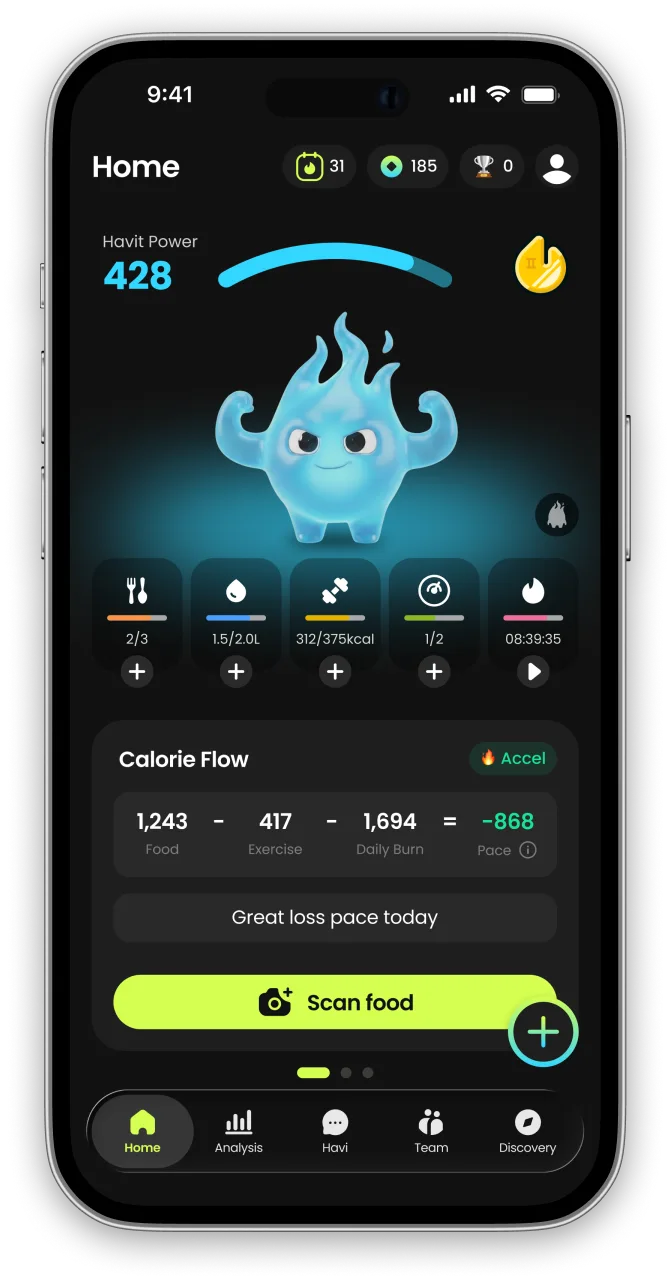
What is Havit?
Havit is an AI health companion for weight loss that protects muscle.
Unlike calorie-only trackers, Havit connects AI body-composition estimates, nutrition, hydration, sleep, steps, cycle, mood, and GLP-1 medication in one daily routine — so progress is measured by body composition, not just the number on the scale. Daily missions turn established behavior-change techniques into small repeatable actions, drawing on expertise from professionals formerly at Juvis Diet, one of Korea’s leading metabolic clinics.
In Havit’s own analysis of 1,090 GLP-1 users, people who logged consistently built stronger habits than the general user base. Read the GLP-1 Habit Report
Havit works with or without GLP-1 medication. It is a wellness app, not a medical device; body-composition results are estimates.

Continue in the App
Personalized wellness with your own data


References
- Exercise interventions for preventing falls in older people: systematic review and meta-analysis of randomised controlled trials — BMJ 2025; 378:e071847
- Balance training protocols for fall prevention in community-dwelling older adults: a systematic review — Age and Ageing 2024; 53(4):afae089
- Reactive balance training and fall risk in older adults: a randomized controlled trial — Journal of Gerontology: Medical Sciences 2025; 80(3):412-419
- Dual-task costs during walking in older adults: a systematic review and meta-analysis — Gait & Posture 2024; 98:234-242


