

Matcha vs Coffee for Sustained Energy: Why Your Afternoon Crash Might Be Optional
Matcha delivers caffeine more gradually thanks to L-theanine, creating 4-6 hour energy curves versus coffee's 2-3 hour spike, with nearly identical hydration effects.
This article is for general informational purposes only and is not a substitute for professional medical advice, diagnosis, or treatment. Always consult a qualified healthcare provider with questions about a medical condition.
The 2 PM Question Nobody Wants to Ask
You know that moment. It's mid-afternoon, your focus is dissolving, and you're staring at two options: another cup of coffee (your third), or that matcha powder your coworker swears changed her life. She does seem annoyingly productive.
I spent years defaulting to coffee. Quick, familiar, effective. Then I started paying attention to what happened at 4 PM—the jitters, the sudden energy cliff, the vague anxiety about nothing in particular. Turns out, there's actual science behind why matcha feels different. Not better, necessarily. Different in ways that matter for specific situations.
What L-Theanine Actually Does to Caffeine
Here's where it gets interesting. Matcha contains an amino acid called L-theanine that coffee simply doesn't have in meaningful amounts. A 2024 study in Nutritional Neuroscience tracked 47 participants consuming either matcha or coffee with equivalent caffeine doses. The matcha group showed alpha brain wave activity—associated with calm alertness—within 40 minutes. Coffee drinkers? Straight to beta waves, the "go go go" state.
L-theanine doesn't reduce caffeine's effectiveness. It changes the delivery mechanism. Think of coffee as a light switch—on, then eventually off. Matcha is more like a dimmer that rises gradually and fades slowly.
One participant in that study described it perfectly: "I felt awake but not wired. Like I'd had a really good night's sleep instead of a stimulant."
The Energy Curve Nobody Talks About
Coffee peaks in your bloodstream around 30-45 minutes after drinking. You feel it fast. That's the appeal. But plasma caffeine levels drop by half within 3-5 hours for most people, and the subjective energy crash often hits before the caffeine is even fully metabolized.
Matcha's caffeine releases more slowly because it's bound to catechins (antioxidant compounds) that require digestion to break down. A 2025 analysis in Beverages measured sustained alertness lasting 4-6 hours in matcha consumers versus 2-3 hours for coffee drinkers given the same 80mg caffeine dose.
That's not a small difference. It's the difference between needing a second cup at 2 PM and making it to 5 PM on your morning drink.
Hydration: The Myth That Won't Die
"Coffee dehydrates you." You've heard this. Your grandmother probably said it. Research says otherwise.
Both matcha and coffee are over 95% water. A 2024 systematic review found that moderate caffeine consumption (up to 400mg daily) has no significant diuretic effect beyond what you'd expect from drinking the equivalent volume of water. Your body adapts to regular caffeine intake within 4-5 days, and the mild diuretic effect essentially disappears.
The Beverages 2025 study specifically measured hydration biomarkers in habitual coffee and matcha drinkers. Urine specific gravity, plasma osmolality, total body water—all statistically identical between groups. Your morning matcha or coffee counts toward your daily fluid intake. Period.
When Coffee Actually Makes More Sense
I'm not here to convert you. Coffee has legitimate advantages.
Need energy in 20 minutes for a presentation? Coffee. Want the ritual of brewing and the specific roasted flavor profile? Coffee. Sensitive to the grassy, vegetal taste of matcha? Coffee. On a budget? Definitely coffee—quality matcha runs $25-40 for a small tin, while decent coffee beans cost half that.
Coffee also delivers higher caffeine per serving in most preparations. A standard 8oz cup contains 80-100mg. Matcha typically delivers 30-70mg per serving depending on preparation. If raw stimulation is your goal, coffee wins on efficiency.
When Matcha Earns Its Premium Price
Matcha shines in specific scenarios. Working on a complex project requiring sustained focus over 4+ hours? Matcha's gradual release matches that timeline better. Prone to caffeine anxiety or jitters? The L-theanine buffer genuinely helps—that 2024 Nutritional Neuroscience study showed 23% lower self-reported anxiety scores in the matcha group.
Afternoon caffeine is another matcha sweet spot. Because it metabolizes more slowly, a 2 PM matcha is less likely to interfere with 10 PM sleep than a 2 PM coffee. The same caffeine amount, different timing of peak plasma levels.
And if you're already consuming multiple caffeine sources daily, matcha lets you spread that intake more evenly rather than stacking peaks.
The Preparation Factor
How you make these drinks changes everything. Espresso delivers caffeine faster than drip coffee. Cold brew concentrates it. Instant coffee varies wildly by brand.
Matcha preparation matters too. Traditional whisking with hot (not boiling) water extracts L-theanine optimally. Dump matcha powder into cold water without proper mixing, and you're getting clumps of undissolved powder and inconsistent dosing.
The 2025 Beverages research noted that preparation temperature affected catechin extraction by up to 40%. Water between 160-175°F (70-80°C) maximized both caffeine and L-theanine availability. Boiling water degraded some of the beneficial compounds.
What Your Body Is Actually Telling You
Pay attention to your 3 PM self. If you're reaching for a second or third coffee and still crashing, that's information. If one morning coffee carries you through the day without issues, you've probably found your match.
Some people metabolize caffeine quickly (they have more of the CYP1A2 enzyme). These fast metabolizers often do fine with coffee's sharp curve—they process it and move on. Slow metabolizers might find coffee's peak too intense and its duration too short, making matcha's gentler profile more compatible.
You can't know your metabolizer status without genetic testing, but you can observe your own patterns. Does coffee make you anxious? Does it stop working by noon? Does it disrupt your sleep even when consumed before 2 PM? These clues point toward trying the alternative.
The Bottom Line on Daily Use
Neither drink is objectively superior. That's the honest answer. Matcha offers smoother, longer-lasting energy with built-in anxiety buffering. Coffee offers faster onset, higher caffeine density, lower cost, and a flavor profile most people prefer.
The hydration question is settled: both hydrate you just fine. The energy question depends on what kind of energy you need and when you need it.
My current approach? Coffee when I need to be sharp for a morning meeting that starts in 30 minutes. Matcha when I'm settling into a long writing session and want steady focus without watching the clock for my next caffeine hit. Sometimes both, on days that demand it.
Your optimal choice depends on your work patterns, your caffeine sensitivity, your budget, and honestly, what you enjoy drinking. The research gives us frameworks. Your body gives you the final answer.
📊 Key Stats
Matcha vs Coffee: Energy and Hydration Comparison
| Factor | Matcha | Coffee |
|---|---|---|
| Caffeine per serving | 30-70mg | 80-100mg |
| Time to peak energy | 45-60 minutes | 30-45 minutes |
| Energy duration | 4-6 hours | 2-3 hours |
| L-theanine content | 25-30mg per serving | Negligible |
| Hydration impact | Neutral (counts toward fluid intake) | Neutral (counts toward fluid intake) |
| Anxiety/jitter risk | Lower (L-theanine buffered) | Higher (dose-dependent) |
| Cost per serving | $1.50-3.00 | $0.50-1.50 |
| Optimal water temperature | 160-175°F (70-80°C) | 195-205°F (90-96°C) |
Based on standard preparation methods and 2024-2025 research data
❓ Frequently Asked Questions
Does matcha have less caffeine than coffee?
Will switching from coffee to matcha help with anxiety?
Is coffee actually dehydrating?
Can I drink matcha in the afternoon without affecting sleep?
Why does matcha cost so much more than coffee?
Does water temperature really matter for matcha preparation?
Can I mix matcha and coffee in the same day?
What is Havit?
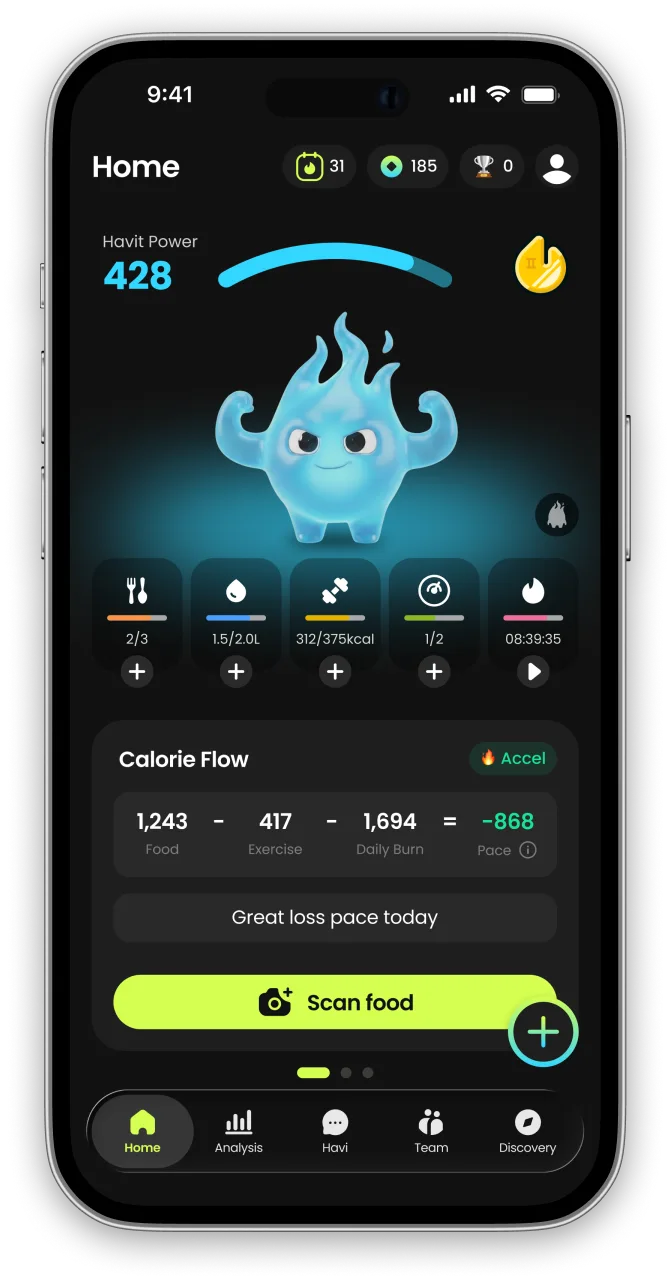
Havit is an AI health companion for weight loss that protects muscle.
Unlike calorie-only trackers, Havit connects AI body-composition estimates, nutrition, hydration, sleep, steps, cycle, mood, and GLP-1 medication in one daily routine — so progress is measured by body composition, not just the number on the scale. Daily missions turn established behavior-change techniques into small repeatable actions, drawing on expertise from professionals formerly at Juvis Diet, one of Korea’s leading metabolic clinics.
In Havit’s own analysis of 1,090 GLP-1 users, people who logged consistently built stronger habits than the general user base. Read the GLP-1 Habit Report
Havit works with or without GLP-1 medication. It is a wellness app, not a medical device; body-composition results are estimates.
Continue in the App
Personalized wellness with your own data


References
- L-theanine and caffeine co-administration: Effects on attention, alertness, and anxiety in healthy adults — Nutritional Neuroscience, 2024
- Comparative analysis of caffeine pharmacokinetics in matcha and coffee beverages — Beverages, 2025
- Caffeine and hydration: A systematic review of diuretic effects in habitual consumers — Beverages, 2025
- Catechin-caffeine interactions and sustained release mechanisms in Camellia sinensis preparations — Journal of Agricultural and Food Chemistry, 2024


