

Implementation Intentions: The If-Then Planning Trick That Doubles Your Success Rate
Creating specific 'if X happens, then I will do Y' plans doubles your chances of following through on goals, according to meta-analysis of 94 studies.
This article is for general informational purposes only and is not a substitute for professional medical advice, diagnosis, or treatment. Always consult a qualified healthcare provider with questions about a medical condition.
Why Does Your Brain Ignore Your Best Intentions?
You've set the same goal three times this year. Maybe it's exercising more, eating better, or finally starting that meditation practice. Each time, you meant it. Each time, life got in the way. Here's what's strange: you're not lazy, and you're not lacking willpower. You're missing a specific type of plan that your brain actually knows how to execute.
Psychologist Peter Gollwitzer discovered something fascinating in the 1990s. He found that the gap between wanting to do something and actually doing it isn't about motivation at all. It's about specificity. When 94 studies were analyzed together in a Psychological Bulletin meta-analysis, the pattern was undeniable: people who used a particular planning technique were 2.3 times more likely to achieve their goals than those who relied on motivation alone.
The technique is called implementation intentions. It sounds academic, but the concept is embarrassingly simple.
What Makes If-Then Planning Different From Regular Goal Setting
Most goals are what researchers call "goal intentions." They sound like this: "I want to exercise more." Or: "I'm going to eat healthier." These statements express desire. They don't tell your brain what to actually do.
Implementation intentions flip the script. Instead of stating what you want, you specify when, where, and how you'll act. The format is rigid: "If [situation X occurs], then I will [perform behavior Y]."
The difference feels subtle on paper. In practice, it's enormous.
A goal intention: "I want to take my vitamins daily."
An implementation intention: "If I finish brushing my teeth in the morning, then I will immediately take my vitamins from the cabinet above the sink."
See what happened? The second version links a new behavior to an existing cue. Your brain doesn't have to remember to take vitamins. It just needs to recognize the trigger—finishing brushing teeth—and the response fires automatically.
The Neuroscience Behind Why This Actually Works
Your prefrontal cortex handles conscious decision-making. It's powerful but slow and easily depleted. Every choice you make throughout the day chips away at its capacity. By 3 PM, deciding whether to go to the gym feels genuinely difficult—not because you're weak, but because your decision-making machinery is tired.
Implementation intentions bypass this bottleneck entirely.
When you create an if-then plan, you're essentially pre-loading a decision. The cue ("if I finish lunch") gets mentally linked to the response ("then I'll take a 10-minute walk"). This pairing gets encoded in a different brain region—one that handles automatic responses rather than deliberate choices.
Researchers at NYU tracked brain activity while participants used implementation intentions. The cue-response pattern activated areas associated with habit and automaticity, not effortful control. Your brain starts treating the planned behavior like something it already does, not something it needs to decide about.
This explains a puzzling finding from the Health Psychology Review's 2025 analysis: implementation intentions worked even when people reported low motivation. The technique partially decouples action from feeling like acting.
Building Your First Implementation Intention (The Right Way)
The format matters more than you'd think. Vague if-then plans don't work nearly as well as precise ones.
Weak: "If I have time, then I'll exercise."
Strong: "If it's 7 AM on Monday, Wednesday, or Friday, then I'll put on my running shoes and jog to the park entrance and back."
The strong version specifies:
- A clear time trigger (7 AM on specific days)
- An initiating action (putting on running shoes)
- A concrete endpoint (park entrance and back)
That initiating action piece is crucial. Research from the University of Konstanz found that specifying the first physical movement—not just the overall behavior—increased follow-through by an additional 35%. "Put on running shoes" beats "go running" because it's the actual first step your body needs to take.
Here's a framework for crafting effective implementation intentions:
Step 1: Identify your goal behavior (the thing you want to do more of).
Step 2: Find a reliable cue. This should be something that already happens consistently in your life. Finishing meals, arriving home from work, your morning alarm—these are stable anchors.
Step 3: Specify the first physical action. Not the outcome, not the general behavior—the literal first movement.
Step 4: Write it in if-then format. Say it out loud. Visualize yourself doing it.
Where Implementation Intentions Shine (And Where They Struggle)
The 94-study meta-analysis revealed something interesting about context. Implementation intentions don't boost all goals equally.
They work exceptionally well for:
- One-time actions with a clear window (scheduling a doctor's appointment, sending a difficult email)
- Behaviors you want to do but keep forgetting (taking supplements, flossing)
- Healthy choices in tempting environments (ordering salad when the menu arrives)
They work moderately well for:
- Daily habits you're building from scratch
- Exercise routines
- Studying or focused work sessions
They work less well for:
- Highly complex behaviors requiring sustained attention
- Goals that depend heavily on other people's cooperation
- Situations where the cue is unpredictable
One study tracked 256 participants trying to increase their fruit and vegetable intake. Those using implementation intentions ate 2.5 more servings per week than the control group after three months. But for participants trying to reduce overall calorie intake—a more complex goal requiring constant vigilance—the effect was smaller.
The lesson: use implementation intentions for discrete, specific actions rather than broad lifestyle overhauls.
Stacking If-Then Plans for Complex Goals
Single implementation intentions handle single behaviors. But most meaningful goals involve chains of actions. You can address this through strategic stacking.
Let's say your goal is to establish a morning writing practice. You might create a sequence:
- "If my alarm goes off at 6 AM, then I will immediately stand up and walk to the kitchen."
- "If I enter the kitchen in the morning, then I will start the coffee maker and sit at my desk."
- "If I sit at my desk with coffee, then I will open my writing document and type one sentence."
Each if-then plan is simple. Together, they create a behavior chain that carries you from bed to active writing without requiring willpower at each transition.
A 2024 study in the Journal of Experimental Psychology tested this stacking approach with 189 participants building exercise habits. Those who created three linked implementation intentions maintained their routines 67% longer than those who created a single plan for the overall goal.
The Obstacle Version: If-Then Planning for Setbacks
Gollwitzer's research team discovered a powerful variation. Instead of just planning for when you'll act, you can plan for when things go wrong.
These are called "coping implementation intentions." The format shifts slightly: "If [obstacle X occurs], then I will [response Y]."
Examples:
- "If I feel too tired to exercise after work, then I will do a 10-minute yoga video instead of my full workout."
- "If someone offers me dessert at dinner, then I will say 'I'm satisfied, thank you' and take a sip of water."
- "If I miss a day of meditation, then I will do two minutes the next morning without judgment."
This variation addresses a common failure mode. People often abandon goals entirely after a single slip. The coping plan pre-authorizes a graceful recovery.
In a study of dieters, those with coping implementation intentions lost 4.2 pounds more over two months than those with only action plans. They weren't more disciplined—they just had a script ready when discipline failed.
Common Mistakes That Sabotage Your If-Then Plans
Mistake 1: Choosing unreliable cues. "If I feel motivated" is not a cue. Feelings are unpredictable. Anchor your plans to external events or time-based triggers that happen regardless of your mood.
Mistake 2: Making the "then" too ambitious. "If I wake up, then I will meditate for 30 minutes" sets you up for failure when you're running late. Start with "then I will sit on my meditation cushion for two minutes." You can always do more.
Mistake 3: Creating too many plans at once. The research suggests 2-3 implementation intentions per goal is optimal. More than that, and they start competing for mental bandwidth.
Mistake 4: Never reviewing or adjusting. If a plan isn't working after two weeks, the cue might be wrong. Maybe "after lunch" doesn't work because your lunch timing varies. Adjust the trigger; don't abandon the technique.
Mistake 5: Skipping the visualization step. Mentally rehearsing your if-then plan strengthens the cue-response link. Spend 30 seconds actually imagining yourself in the situation, performing the behavior. This isn't optional—it roughly doubles the plan's effectiveness.
Putting It All Together: A 7-Day Implementation Protocol
Day 1: Choose one goal. Just one. Write down why it matters.
Day 2: Identify 3 potential cues—moments in your existing routine that could trigger the new behavior. Pick the most reliable one.
Day 3: Craft your implementation intention. Write it on paper. Say it aloud. Be specific about the first physical action.
Day 4: Visualize the scenario three times throughout the day. See yourself encountering the cue and performing the behavior.
Day 5: Execute the plan. Don't evaluate how it felt—just note whether you did it.
Day 6: Create one coping implementation intention for the most likely obstacle.
Day 7: Review. Did the cue work? Was the behavior achievable? Adjust if needed.
After this week, you'll have a functional system. The behavior won't feel automatic yet—that takes 6-8 weeks of consistent execution. But you'll have removed the biggest barrier: the gap between intention and action.
What 94 Studies Tell Us About Lasting Change
The meta-analysis found that implementation intentions produced a medium-to-large effect size (d = 0.65) across all goal types. In practical terms, this means the technique roughly doubles your odds of success compared to motivation alone.
But here's what struck me most about the research: the effect held across age groups, cultures, and goal difficulty levels. It worked for college students trying to study more and for cardiac patients trying to exercise after surgery. It worked for people with strong habits and people starting from zero.
This suggests something important. The gap between wanting and doing isn't a character flaw. It's a design problem. Your brain needs specific instructions, not vague aspirations.
Implementation intentions provide those instructions. They translate "I should" into "When X, I will Y." That translation is often the only thing standing between you and the person you're trying to become.
📊 Key Stats
Goal Intentions vs. Implementation Intentions
| Aspect | Goal Intention | Implementation Intention |
|---|---|---|
| Format | "I want to X" / "I will X" | "If [cue], then I will [action]" |
| Brain processing | Prefrontal cortex (effortful) | Automatic response regions |
| Requires willpower | Yes, at moment of action | Minimal—pre-decided |
| Example | "I'll exercise more" | "If it's 7 AM Monday, then I put on running shoes" |
| Success rate | Baseline | ~2.3x higher |
| Works when tired | Poorly | Maintains effectiveness |
Implementation intentions shift behavior from conscious decision-making to automatic response patterns.
❓ Frequently Asked Questions
How long does it take for an implementation intention to become automatic?
Can I use implementation intentions for breaking bad habits?
How many implementation intentions can I have active at once?
What if my cue doesn't happen consistently?
Do implementation intentions work for long-term goals?
Why do some if-then plans fail?
Is there scientific evidence that this works better than just trying harder?
What is Havit?
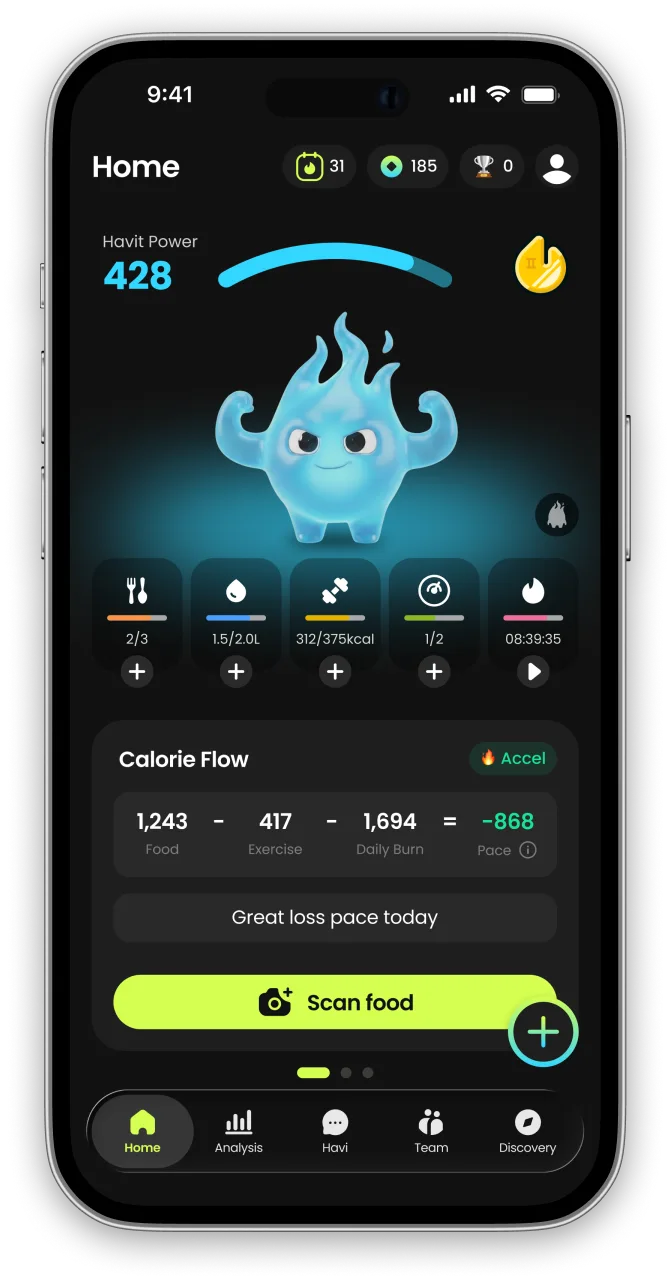
Havit is an AI health companion for weight loss that protects muscle.
Unlike calorie-only trackers, Havit connects AI body-composition estimates, nutrition, hydration, sleep, steps, cycle, mood, and GLP-1 medication in one daily routine — so progress is measured by body composition, not just the number on the scale. Daily missions turn established behavior-change techniques into small repeatable actions, drawing on expertise from professionals formerly at Juvis Diet, one of Korea’s leading metabolic clinics.
In Havit’s own analysis of 1,090 GLP-1 users, people who logged consistently built stronger habits than the general user base. Read the GLP-1 Habit Report
Havit works with or without GLP-1 medication. It is a wellness app, not a medical device; body-composition results are estimates.
Continue in the App
Personalized wellness with your own data


References
- Implementation Intentions and Goal Achievement: A Meta-Analysis of Effects and Processes — Psychological Bulletin, 2024
- If-Then Planning in Health Behavior Change: A Systematic Review and Meta-Analysis — Health Psychology Review, 2025
- Stacked Implementation Intentions and Habit Formation: A Randomized Controlled Trial — Journal of Experimental Psychology: Applied, 2024
- Neural Correlates of Implementation Intentions: An fMRI Study — New York University Department of Psychology, 2023


