

The New Standard for Digital Health Coaching — How HAVIT's 8-Step AI Coaching Engine Integrates Personalization, Immediate Feedback, and Behavior Triggers
Most health apps deliver static prescriptions like 'eat 1,500 kcal today.' But the literature shows digital behavioral intervention effectiveness scales with personalization · feedback immediacy · behavior triggers (Tate 2003 JAMA; Patel 2015 Ann Intern Med). HAVIT's 8-step coaching engine is built on the Fogg Behavior Model (B = M × A × P) and Self-Determination Theory (autonomy · competence · relatedness), matching prescriptions from 126 archetypes × 2,000+ behavior library to changing user signals each moment. HAVIT is not a medical diagnostic tool; clinical diagnosis and treatment decisions are the physician's domain.
This article is for general informational purposes only and is not a substitute for professional medical advice, diagnosis, or treatment. Always consult a qualified healthcare provider with questions about a medical condition.
1. Why Static Prescriptions Fail — Clinical Evidence
The most common pattern in diet apps is "BMI-based uniform target + uniform diet + uniform exercise" prescription. The literature is clear about the limits:
- Zeevi et al. (2015, Cell) — 800 individuals; postprandial glycemic responses varied extremely across people for the same foods. Uniform diet prescription has weak academic support.
- Berry et al. (2020, Nat Med — PREDICT 1) — 1,002 twins and individuals; postprandial responses dominated by environment/behavior/microbiome over genetics. Personalized nutrition outperformed standard guidelines.
- Patel et al. (2015, Ann Intern Med) — Digital health tool effectiveness scales with the integration of "personalization · feedback immediacy · behavior triggers."
- Tate et al. (2003, JAMA) — Digital behavioral intervention produced 1.7× the weight loss of standard information provision. The core: feedback frequency.
Summary: User state changes within a single day, so prescription must adapt to that change to be effective.
One person's week looks like this:
- Monday: many meetings → protein deficiency risk
- Tuesday: 5 hours sleep → appetite hormone (ghrelin↑) surge
- Wednesday: late work → eating-out, snacking urge
- Thursday: normal → good exercise day
- Friday: company dinner → alcohol, overeating risk
- Saturday: high activity → calorie margin
- Sunday: stasis → diet recovery
Prescribing the same diet daily is the root of failure.
HAVIT's hypothesis: Effectiveness improves when prescription adapts in real time within a day — a design based on academic evidence.
2. Academic Foundations — Fogg Behavior Model + Self-Determination Theory
HAVIT's coaching engine design is built on two behavioral-science pillars:
2.1 Fogg Behavior Model (BJ Fogg 2009, Persuasive Technology Conference)
B = M × A × P — Behavior occurs when Motivation, Ability, and Prompt (original term: Trigger) coexist. Weakness in any one prevents behavior.
2.2 Self-Determination Theory (Deci & Ryan 2000, Psychological Inquiry)
Intrinsic motivation is sustained when three psychological needs are met: autonomy, competence, relatedness. Extrinsic motivation (reward, pressure) produces only short-term effects and fails long-term maintenance (Teixeira et al. 2012, Int J Behav Nutr Phys Act).
Implementing these in a digital coaching system means motivation · ability · trigger must operate simultaneously, while message delivery preserves autonomy · competence · relatedness.
HAVIT's 8-step engine decomposes this requirement step by step.
3. The 8-Step Engine — One-Line Summary
1. Intent Classification        (classify user intent into 8 categories)
2. Vector DB Recommendation     (match against 2,000+ behavior library)
3. CARE Coaching Generation     (Compassion → Acknowledge → Recommend → Educate)
4. Safety Gate                  (3-level escalation, automatic risk detection)
5. 5-Level Personalization      (State → Type → Behavior → Persona → Day)
6. 3-Layer Scientific WHY       (Mechanism → Effect → Personalization)
7. GLP-1 Medication Integration (M0/M1/M2 treatment stages)
8. Localization                 (33 languages × 40+ entry points)
4. Step 1 — Intent Classification
A user sends a message: "I ate junk food last night, what should I do today?"
A generic chatbot keyword-matches "late-night, overeating, regret" and gives generic answers. HAVIT classifies among 8 user intents:
| Intent | Example |
|---|---|
| 1. Guilt relief | "I ate junk food last night, I've ruined it" |
| 2. Information request | "How bad is late-night eating for dieting?" |
| 3. Immediate action guide | "How do I recover today?" |
| 4. Plateau diagnosis | "Why am I not losing weight?" |
| 5. Risk signal (safety) | "Is it okay to skip meals?" / "Do I need water?" |
| 6. Motivation request | "I want to give up" |
| 7. Social comparison | "What are other people doing?" |
| 8. Meta question | "How do I use this app?" |
Low-confidence classifications trigger follow-up questions. Intent classification is the foundation of coaching quality — directly tied to Self-Determination Theory's "autonomy" requirement (the system accurately identifies what the user wants).
5. Step 2 — Vector DB Recommendation
Once intent is classified, the matching draws from the 2,000+ behavior library.
Example library entry:
action_id: A_0247
type: immediate dietary action
trigger: intent #3 (immediate action guide) + signal of yesterday's overeating
title: "+20g protein, -100kcal carbs at lunch today"
why_mechanism: protein increases satiety hormones (GLP-1, PYY)
why_effect: next meal calorie naturally reduced (Westerterp-Plantenga 2009)
why_personalization: user archetype #47 (protein-deficient type) match
delivery: notification 30 min before lunch
fatigue_score: 0.3 (similar action 0 times in past 7 days → fresh↑)
Core technique — Fatigue-aware rotation: Repeating the same recommendation causes users to ignore → action effectiveness drops to 0 (Fogg BM's "prompt fatigue"). The Vector DB tracks recent recommendation history and prioritizes actions with low fatigue scores (less repeated). 5–10 actions of similar effect exist in the pool to maintain diversity.
→ Aligns with Self-Determination Theory's "competence" requirement: users encounter new challenges and choices each time.
6. Step 3 — CARE Coaching Generation
How the matched action is delivered determines effect. HAVIT follows the CARE frame:
C — Compassion
    "Late-night meal, completely understandable. Hard not to be swayed after 5 hours of sleep."

A — Acknowledge
    "It already happened, and you have two meals left today."

R — Recommend
    "Add +20g protein at lunch → evening appetite naturally reduces. Chicken breast 100g or tofu 200g options."

E — Educate
    "Protein naturally regulates satiety hormones. Not generic advice — based on your 7-day protein average data."
The CARE frame is designed to fill each of Fogg BM's B = M × A × P:
- C + A → Motivation (SDT's autonomy and relatedness needs met)
- R → Ability (concrete options → lowered behavior cost)
- E → Prompt (why now matters)
Without CARE, a "just eat more protein" message — leaves users stuck in guilt and generality (SDT's extrinsic-motivation limits).
7. Step 4 — Safety Gate
Behavior-change prescriptions can worsen risk if mistaken. HAVIT auto-detects risk signals through a 3-level escalation safety system:
Level 1 — Automatic warning
  Trigger: 24h zero meals / extremely low daily calories / rapid weight changes, etc.
  Action: "Your calories have been low recently. Are you eating enough?"

Level 2 — Behavioral restriction
  Trigger: Level 1 signal for 3 consecutive days / self-reported dizziness, headache
  Action: Auto-conservative prescription + healthcare-professional consultation referral

Level 3 — Medical referral
  Trigger: Eating disorder risk signal (self-reported or pattern) / self-harm reference
  Action: General coaching paused + emergency hotline · specialist referral
→ HAVIT is a non-clinical tool but clinically-aware in design. Blocks the possibility that wrong prescriptions endanger users.
8. Step 5 — 5-Level Personalization
HAVIT's "hyper-personalization" layer. 5-layer matching:
Layer 1 — State (current state)
  Real-time signals: weight, body composition, sleep, mood

Layer 2 — Type (body·metabolic type)
  126 archetypes (e.g., 30s female · low muscle · late-night · sleep-deprived)

Layer 3 — Behavior (behavior pattern)
  Last 7~30 days: diet, exercise, logging frequency, daily activity

Layer 4 — Persona (personality·motivation type)
  Challenger / Reward-driven / Social / Analytical (BJ Fogg personas)

Layer 5 — Day (today's condition)
  Day of week, schedule, menstrual cycle (women), etc.
A prescription matching all 5 layers reaches the user at each moment. Same time, same archetype — but different persona/day → different prescription.
This is the substance of N-of-1. The implementation of "prescription matched to one individual instead of an average" that Zeevi 2015 / Berry 2020 suggested.
9. Step 6 — 3-Layer Scientific WHY
Strengthens CARE's E (Educate) step. Every prescription carries 3-layer rationale:
Layer 1 — Mechanism (physiological)
  "Protein → CCK, GLP-1, PYY release → satiety"

Layer 2 — Effect (empirical)
  "+20g protein → next-meal calorie average decrease (Westerterp-Plantenga 2009)"

Layer 3 — Personalization (your case)
  "Your archetype #47, protein-deficient pattern, last week's average 88g — recommended 112g, -24g short"
→ Instead of generic "why protein is good for dieting," evidence matched to your data.
Users immediately see why "the AI told them this." Meets SDT's "competence" requirement — users understand the basis of their decisions.
10. Step 7 — GLP-1 Medication Integration
GLP-1 drug users (Wegovy, Mounjaro, Zepbound) need different prescriptions. HAVIT separates by M0/M1/M2 treatment stages:
- M0 (pre-medication): baseline measurement + GI side-effect prep diet
- M1 (adaptation): muscle preservation + plateau preparation
- M2 (maintenance/discontinuation): behavior habituation + regain prevention (STEP 4 response)
This integration implements the "drug + behavioral therapy" model recommended by WHO Clinical Management of Obesity Guidelines (2022) and ADA Standards of Care (2024) — the same model where STEP 3 (Wadden et al. 2021, JAMA) showed IBT in combination producing nearly 3× the weight loss of standard care (-16% vs -5.7%).
The 8-step engine's output auto-adjusts to the user's M stage:
- M1 user asking "how is today?" → protein and strength prioritized
- M2 user → food noise return and behavior signal reinforcement
11. Step 8 — Localization (33 Languages × 40+ Entry Points)
Most global apps reach the "translate English to other languages" level. HAVIT:
33-language full localization
  - Korean, English, Japanese, Chinese (simplified/traditional),
    Spanish, Portuguese (BR), Indonesian, German, French, etc. — 33
  - Not mere translation. Archetype, diet, and cultural signals all localized

40+ entry points
  - Over 40 points at which users enter coaching
  - Post-meal logging, post-weight measurement, alarms, plateau detection, risk signals
  - Each entry point with appropriate tone, length, and timing
A US user's "late-night recovery" and another region's "late-night recovery" differ. Foods, times, cultures, and idioms differ. The US is one of HAVIT's core target markets, and English/cultural expressions are first-class priority.
12. Real-World Scenario (Illustrative)
Scenario: 35F, morning after a late-night meal
[Event] User: "I had ramen at 12 last night. What now?"

[Step 1] Intent: #3 (immediate action guide) + secondary #1 (guilt)
         Confidence 0.89 → classification confirmed

[Step 2] Vector DB matching:
         12 candidates → fatigue score applied
         Selection: A_0418 (protein-first recovery diet)
         Past 7 days similar 0 times → fresh

[Step 3] CARE generation:
         C: "Ramen + late night, after weekday overtime — completely understandable."
         A: "Yesterday is past, three meals left today."
         R: "Breakfast protein 30g + lunch +50g vegetables. Showing options."
         E: "Protein naturally regulates appetite hormones. Next-meal auto-restraint."

[Step 4] Safety Gate: pass (no risk signal)

[Step 5] 5-Layer:
         State: yesterday calories +600 over
         Type: archetype #47 (30s female · late-night · sleep-deprived)
         Behavior: past 7-day protein average 78g (-34g short)
         Persona: analytical (acts when data is shown)
         Day: Tuesday, meeting-heavy → lunch options prepared in advance

[Step 6] 3-Layer WHY:
         Mechanism: protein → GLP-1/PYY natural release
         Effect: +20g → next-meal -150 kcal average (Westerterp-Plantenga 2009)
         Personalization: your 7-day average 78g, recommended 112g, -34g short

[Step 7] GLP-1: not on medication → standard prescription

[Step 8] Localization:
         Language: English (US-friendly food options + cultural mapping)
         Diet options: Greek yogurt + nuts / tofu bowl / soy protein shake
         Time expression: morning (analytical → specifies time)
         Tone: analytical, concrete, short
(※ Illustrative scenario. Actual user outcomes vary.)
13. What Sets It Apart
Common app pattern:
- Static calorie targets (same prescription daily)
- Single archetype (all users get same diet guide)
- No fatigue rotation (same recommendation repeated)
- No Safety Gate (no automatic risk signal detection)
HAVIT difference:
- 126 archetypes × 2,000+ actions × 5-Layer × CARE × Safety Gate × M0/M1/M2 × 33 languages
- New prescription per message (not static)
- Fatigue rotation (auto-avoidance of Fogg BM prompt fatigue)
- Safety Gate (automatic risk blocking)
- Academic basis attached (Fogg BM, SDT, Zeevi/Berry, WHO/ADA)
This is the difference between a generic chatbot and a behavioral-science-based coaching system.
14. Limitations and Future Improvements
Current limits:
- 126 archetype clusters are a starting point. Archetype refinement needed as user diversity grows.
- Not a medical diagnostic tool. The safety gate does not replace medical care.
- Behavior library is domain-anchored. Ongoing training to add diverse cultural diets and exercises.
- Effectiveness validation in progress. AI body composition estimation: n=70 internal complete, n=150 external in progress. Behavior prescription effectiveness RCT in separate design stage.
Roadmap (examples):
- Archetype refinement (regional, ethnic, physiological diversity expansion)
- Action library expansion
- Entry point expansion (calendar, weather, menstrual cycle integration)
- Multilingual archetype auto-learning
15. Conclusion
Digital health app effectiveness is proportional to the integration of personalization × feedback immediacy × behavior triggers (Patel 2015). HAVIT's 8-step engine integrates these three variables on the foundations of Fogg Behavior Model (B = M × A × P) and Self-Determination Theory.
The purpose of the 8-step engine is to translate the direction the literature recommends — body composition evaluation + lifestyle integration + personalized behavior prescription — into actual user experience. The US is one of HAVIT's core target markets, where English and cultural expressions are first-class priority. (HAVIT is not a medical diagnostic tool; clinical diagnosis and treatment decisions are the physician's domain.)
📊 Key Stats
Common Diet App Pattern vs HAVIT 8-Step Engine
| Aspect | Common app pattern | HAVIT 8-step engine |
|---|---|---|
| Prescription update frequency | Static calorie targets (same daily) | New prescription per message |
| Archetype coverage | Single archetype, uniform diet guide | 126 archetypes × 2,000+ actions |
| Prompt fatigue handling | No fatigue rotation, same recommendation repeated | Fatigue-aware rotation across 5–10 similar actions |
| Safety / risk detection | No safety gate | 3-level escalation safety gate |
| Personalization depth | Average prescriptions | 5-Layer (State / Type / Behavior / Persona / Day) |
| GLP-1 integration | None / separate program | M0 / M1 / M2 stage-specific prescription |
| Academic grounding | Generic advice | Fogg BM (B = M × A × P) + SDT + Zeevi/Berry + WHO/ADA |
| Localization | English-first translation | 33-language full localization, 40+ entry points |
The difference between a generic chatbot and a behavioral-science-based coaching system, mapped to Patel 2015's personalization × feedback immediacy × behavior triggers framework.
❓ Frequently Asked Questions
Do all 8 steps run for every message?
Doesn't AI hallucinate?
What personal data is stored?
Is it really better than a human coach?
Do academic frames like Fogg BM and SDT translate to real effectiveness?
What is Havit?
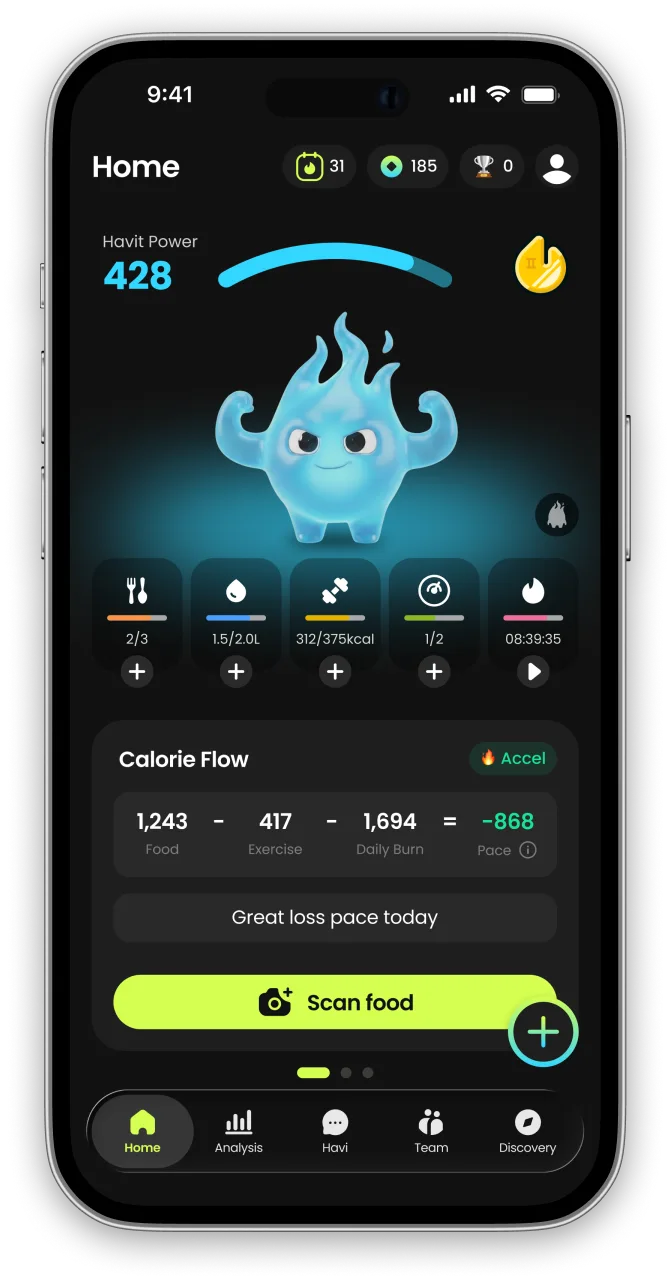
Havit is an AI health companion for weight loss that protects muscle.
Unlike calorie-only trackers, Havit connects AI body-composition estimates, nutrition, hydration, sleep, steps, cycle, mood, and GLP-1 medication in one daily routine — so progress is measured by body composition, not just the number on the scale. Daily missions turn established behavior-change techniques into small repeatable actions, drawing on expertise from professionals formerly at Juvis Diet, one of Korea’s leading metabolic clinics.
In Havit’s own analysis of 1,090 GLP-1 users, people who logged consistently built stronger habits than the general user base. Read the GLP-1 Habit Report
Havit works with or without GLP-1 medication. It is a wellness app, not a medical device; body-composition results are estimates.
Continue in the App
Personalized wellness with your own data


References
- A Behavior Model for Persuasive Design (Fogg, BJ) — Persuasive Technology Conference, 2009
- Self-Determination Theory (Deci & Ryan) — Psychological Inquiry, 2000
- Exercise, physical activity, and self-determination theory (Teixeira et al.) — International Journal of Behavioral Nutrition and Physical Activity, 2012
- Wearable devices and behavior change (Patel et al.) — Annals of Internal Medicine, 2015
- Internet-based weight loss program (Tate et al.) — JAMA, 2003
- Personalized Nutrition by Prediction of Glycemic Responses (Zeevi et al.) — Cell, 2015
- PREDICT 1: Human postprandial responses to food (Berry et al.) — Nature Medicine, 2020
- Protein intake and satiety (Westerterp-Plantenga) — Current Opinion in Clinical Nutrition and Metabolic Care, 2009
- STEP 3 — Semaglutide + Intensive Behavioral Therapy (Wadden et al.) — JAMA, 2021
- Clinical Management of Obesity Guidelines — World Health Organization, 2022
- Standards of Medical Care in Diabetes — American Diabetes Association, 2024
- 126 Archetypes Clustering Methodology — AI Connect Internal Research
- 2,000+ Behavior Library Design Spec — AI Connect Internal Research


