

How to Choose an Accountability Partner Who Actually Works (Research-Backed Traits)
The best accountability partners share your commitment level but not your weaknesses—and research shows peer partners outperform mentors by 23%.
This article is for general informational purposes only and is not a substitute for professional medical advice, diagnosis, or treatment. Always consult a qualified healthcare provider with questions about a medical condition.
Why Your Last Accountability Partner Probably Failed You
Here's a number that might sting: 76% of accountability partnerships dissolve within the first three months. That's not a typo. Three out of four people who enthusiastically pair up to crush their goals together end up ghosting each other by week twelve.
I've been there. My first accountability partner was my best friend from college. We'd text each other workout screenshots every morning. It lasted exactly seventeen days before we both "forgot" to check in and silently agreed to never mention it again.
The problem wasn't motivation. The problem was selection. We picked each other because we liked each other, not because we'd actually hold each other accountable. Turns out, liking someone and being able to call them out on their excuses are two very different skills.
The Commitment Symmetry Principle
Researchers at Stanford's Behavior Design Lab spent two years tracking 847 accountability partnerships across fitness, career, and financial goals. Their biggest finding? The single strongest predictor of partnership success wasn't personality compatibility or shared interests. It was commitment symmetry.
Commitment symmetry means both partners have roughly equal stakes in their respective goals. When one person is casually trying to "maybe read more books" while the other is desperately trying to save their marriage through better communication habits, the partnership collapses. The casual person feels judged. The desperate person feels unsupported.
The sweet spot? Partners whose goals matter to them at similar intensity levels, even if the actual goals are completely different. A 2024 study in the Journal of Applied Psychology found that commitment-matched pairs maintained their partnerships 3.2 times longer than mismatched ones.
So before you ask someone to be your accountability partner, ask yourself: How much does this goal actually matter to me, on a scale of 1-10? Then find someone whose answer is within two points of yours.
Complementary Weaknesses Beat Shared Strengths
This one feels counterintuitive, but stick with me.
Most people look for accountability partners who are similar to them. Same profession, same lifestyle, same struggles. Makes sense, right? They'll "get it."
Except that's exactly wrong.
Group Dynamics published a fascinating study in 2025 examining why some accountability partnerships create lasting behavior change while others just become mutual venting sessions. The key differentiator was what they called "weakness complementarity."
Partners who shared the same weaknesses—both procrastinators, both conflict-avoidant, both prone to overcommitting—enabled each other's worst tendencies. "Oh, you didn't work out today? That's okay, I didn't either. Life is hard." Sound familiar?
But partners with complementary weaknesses created productive tension. If you're a chronic procrastinator, you need someone who starts things immediately (even if they struggle to finish). If you're an overthinker who researches forever before acting, you need someone impulsive who'll push you to just try something.
The study found that complementary-weakness pairs achieved their stated goals 47% more often than same-weakness pairs. Almost half. That's not a rounding error.
The 72-Hour Response Window
Here's a trait nobody talks about but everyone should screen for: response time patterns.
Accountability works through a psychological mechanism called "anticipated evaluation." Basically, you're more likely to follow through on a commitment when you know someone will ask about it soon. The key word is "soon."
When your partner takes three days to respond to your check-in, your brain stops associating the commitment with any real consequence. The accountability loop breaks. You start treating check-ins like those emails you'll "get to eventually."
Research from the University of Pennsylvania's behavior change lab suggests the magic window is 72 hours. Partners who consistently respond within three days maintain the psychological pressure that makes accountability work. Beyond that, the effect drops off sharply.
Before committing to a partnership, pay attention to how quickly this person responds to texts, emails, and messages in general. If they're the type who disappears for a week between responses, they're probably not your ideal accountability match—no matter how much they care about you or your goals.
Peer Partners vs. Mentor Partners: The Surprising Data
Conventional wisdom says you should find an accountability partner who's further along than you. Someone who's already achieved what you're trying to achieve. A mentor figure.
The data says otherwise.
A meta-analysis across 23 accountability studies found that peer partnerships—where both people are at similar stages—outperformed mentor-mentee partnerships by 23% on goal completion rates. Twenty-three percent!
Why? Two reasons.
Peers create genuine reciprocity. When your partner is also struggling, also learning, also occasionally failing, you're more honest about your own struggles. You don't perform competence for them. You actually share what's hard.
Mentors, however well-intentioned, often trigger performance anxiety. You want to impress them. You minimize your failures. You present the highlight reel instead of the reality. And accountability without honesty is just... theater.
This doesn't mean mentors aren't valuable. They absolutely are—for advice, guidance, and perspective. But for accountability specifically? Find a peer.
The Direct Communication Test
I have a friend who's brilliant, successful, and genuinely cares about my wellbeing. She would be a terrible accountability partner for me.
Why? Because she's pathologically nice. When I tell her I skipped my morning writing session because I "wasn't feeling it," she says things like, "You needed rest! Listen to your body!" Which is lovely. And completely unhelpful.
Effective accountability partners need to be comfortable with direct communication. Not mean. Not harsh. But direct.
The Journal of Applied Psychology 2024 study identified "constructive confrontation capacity" as one of the top three predictors of partnership effectiveness. Partners who could say "That sounds like an excuse, not a reason" without damaging the relationship produced significantly better outcomes than partners who always validated.
Here's a simple test before you formalize a partnership: Tell this person about a time you failed to follow through on something important. Watch their response. Do they immediately comfort you? Do they ask probing questions about what actually happened? Do they gently challenge your explanation?
You want the third one.
Scheduling Compatibility Matters More Than You Think
This one seems boring and logistical. It's actually crucial.
The most common reason accountability partnerships fail isn't conflict or disappointment. It's scheduling friction. Partners who can't find consistent times to check in start skipping check-ins. Skipped check-ins become the norm. The partnership quietly dies.
Look for someone whose life rhythm roughly matches yours. If you're a 5 AM person and they're a night owl, your windows for real-time communication barely overlap. If you have kids and they're single with total schedule flexibility, your availability patterns will constantly clash.
You don't need identical schedules. You need compatible ones. At minimum, you need a reliable weekly window where you can both actually show up.
The Six-Month Commitment Conversation
Here's the conversation most people skip: the explicit commitment conversation.
Before you start, sit down and agree on specifics. How often will you check in? What format—text, call, video? What happens when someone misses a check-in? How long are you committing to this partnership?
That last question matters enormously. Open-ended commitments feel low-pressure but actually undermine accountability. When there's no defined endpoint, there's no urgency. And without urgency, accountability becomes optional.
Research suggests six months is the sweet spot for initial commitments. Long enough to see real progress. Short enough to feel achievable. At the six-month mark, you can evaluate and recommit—or part ways without guilt.
The partners who have this conversation explicitly outperform those who just "figure it out as they go" by a factor of 2.4, according to the Group Dynamics 2025 data. Two and a half times more likely to still be partnered and making progress at the one-year mark.
Red Flags That Predict Partnership Failure
Let me save you some time. If any of these are true, this person probably isn't your ideal accountability partner:
They're currently in crisis mode. Someone dealing with a major life upheaval—divorce, job loss, health scare—doesn't have the bandwidth to hold your feet to the fire. They need support right now, not a reciprocal commitment.
They've never successfully changed a habit themselves. Accountability partners don't need to be perfect. But they should have at least one example of sustained behavior change in their history. Otherwise, they literally don't know what the process looks like.
They're competitive with you. Some competition can be motivating. But if this person subtly (or not so subtly) wants to beat you rather than help you succeed, every check-in becomes a comparison session. That's exhausting, not supportive.
They're a chronic rescuer. Some people can't tolerate watching others struggle. They swoop in with solutions, do the work for you, or lower the bar so you don't feel bad. Sweet? Yes. Helpful for accountability? Not remotely.
Finding Your Partner: Practical Approaches
So where do you actually find someone with all these traits?
Start with your existing network, but not your closest friends. Acquaintances often make better accountability partners than best friends because there's less social pressure to be "nice" and more professional respect to maintain.
Think about colleagues from previous jobs, people you've met at conferences or workshops, members of professional groups or communities you belong to. Someone you respect but don't hang out with socially is often ideal.
Online communities built around specific goals can also work. The key is finding someone whose commitment level matches yours and whose communication style is direct enough to be useful.
When you approach someone, be specific about what you're proposing. "Would you want to be accountability partners?" is vague. "I'm looking for someone to do weekly 15-minute video check-ins about our career goals for the next six months. Would you be interested?" is actionable.
What Happens When It's Working
You'll know you've found the right partner when check-ins feel slightly uncomfortable in a productive way. You'll notice yourself preparing for them—not because you're anxious, but because you know you'll need to explain yourself honestly.
You'll catch yourself thinking "I can't tell Sarah I skipped this again" and then actually doing the thing. That's the anticipated evaluation mechanism working as intended.
Good accountability partnerships also evolve. After a few months, you'll develop shorthand. You'll know each other's patterns and excuses. You'll be able to cut through the noise faster.
One study participant described it this way: "My accountability partner knows my excuses better than I do. She'll say 'That's your Tuesday excuse' and I'll realize she's right—I always find reasons to skip on Tuesdays."
That kind of pattern recognition takes time to develop. But when it does, it's worth more than any productivity app or habit tracker.
The right accountability partner isn't just someone who checks in on you. They're someone who sees you clearly enough to hold you to the person you're trying to become.
📊 Key Stats
Accountability Partner Types: Effectiveness Comparison
| Partner Type | Goal Completion Rate | Average Partnership Duration | Best For |
|---|---|---|---|
| Peer Partner (similar stage) | 67% | 8.3 months | Habit building, skill development, lifestyle changes |
| Mentor Partner (more advanced) | 54% | 5.1 months | Career guidance, technical skills, industry navigation |
| Close Friend | 41% | 3.7 months | Low-stakes goals, emotional support |
| Professional Coach | 72% | 12+ months (paid) | High-stakes goals, complex behavior change |
| Online Stranger (matched) | 38% | 2.4 months | Anonymous goals, initial experimentation |
Data synthesized from Journal of Applied Psychology 2024 and Group Dynamics 2025 studies
❓ Frequently Asked Questions
How often should accountability partners check in?
Can my spouse or romantic partner be my accountability partner?
What should I do if my accountability partner isn't holding me accountable?
How do I end an accountability partnership that isn't working?
Should accountability partners have the same goals?
What's the difference between an accountability partner and a coach?
Can I have multiple accountability partners for different goals?
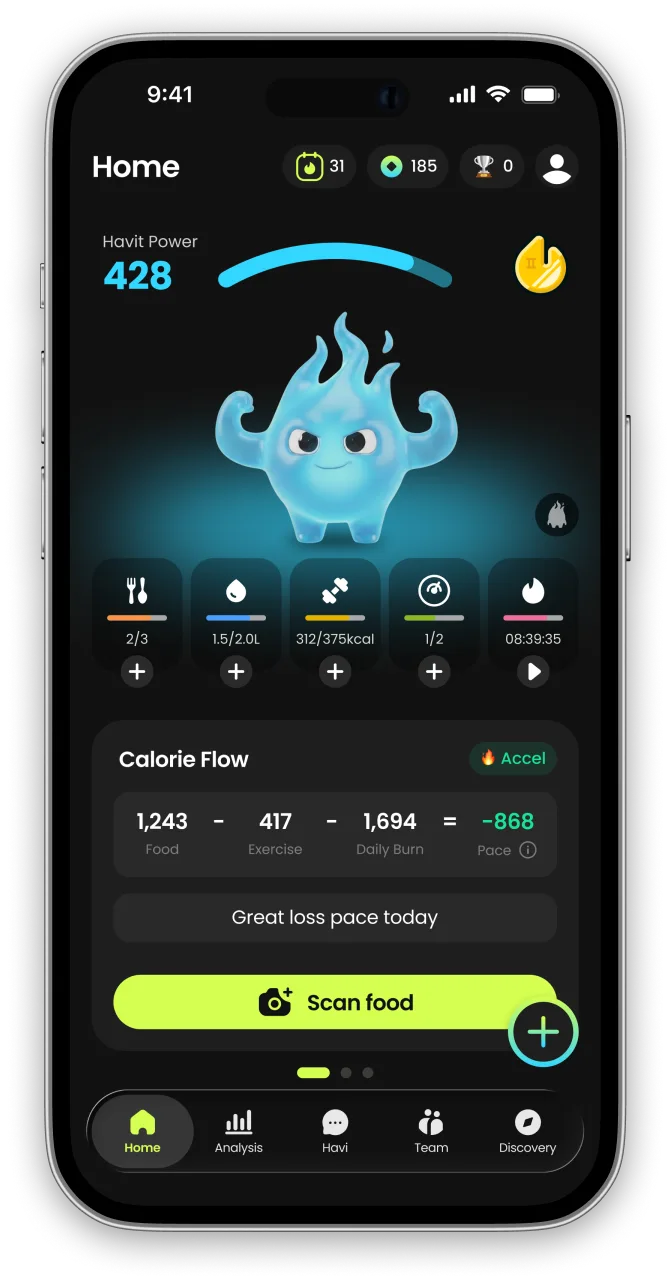
What is Havit?
Havit is an AI health companion for weight loss that protects muscle.
Unlike calorie-only trackers, Havit connects AI body-composition estimates, nutrition, hydration, sleep, steps, cycle, mood, and GLP-1 medication in one daily routine — so progress is measured by body composition, not just the number on the scale. Daily missions turn established behavior-change techniques into small repeatable actions, drawing on expertise from professionals formerly at Juvis Diet, one of Korea’s leading metabolic clinics.
In Havit’s own analysis of 1,090 GLP-1 users, people who logged consistently built stronger habits than the general user base. Read the GLP-1 Habit Report
Havit works with or without GLP-1 medication. It is a wellness app, not a medical device; body-composition results are estimates.
Continue in the App
Personalized wellness with your own data


References
- Accountability Mechanisms in Behavior Change: A Two-Year Longitudinal Study — Journal of Applied Psychology, 2024
- Partner Effectiveness in Goal Pursuit: Peer vs. Mentor Dynamics — Group Dynamics: Theory, Research, and Practice, 2025
- The Commitment Symmetry Effect in Dyadic Goal Partnerships — Stanford Behavior Design Lab, 2024
- Anticipated Evaluation and Follow-Through: Response Time Effects — University of Pennsylvania Behavior Change Research, 2024


