

Habit Stacking: How Cue-Based Routine Building Actually Rewires Your Brain
Attaching new habits to existing routines with specific location and time cues increases success rates by 91% compared to motivation alone.
This article is for general informational purposes only and is not a substitute for professional medical advice, diagnosis, or treatment. Always consult a qualified healthcare provider with questions about a medical condition.
The Coffee Trick That Changed Everything
I used to think I was bad at habits. Meditation apps deleted after three days. Gym memberships gathering dust. Journals with exactly four entries. Then I learned something that felt almost like cheating: my morning coffee was the key to everything.
Here's what happened. Instead of telling myself "I should meditate more," I created a simple rule: kettle on, meditation app open. Not after coffee. Not when I feel like it. The moment my hand touches the kettle. That tiny shift—linking a new behavior to an existing one—changed my success rate from maybe 10% to genuinely automatic.
This isn't just personal anecdote. The British Journal of Health Psychology published research in 2024 showing that implementation intentions (the fancy term for "if-then" planning) increased exercise adherence by 91% compared to motivation-based approaches. Ninety-one percent. That's not a marginal improvement. That's a completely different game.
Why Your Brain Loves Anchors
Your brain is lazy. I mean this as a compliment—it's trying to conserve energy for actual emergencies, not deciding whether today is a good day to floss. Every decision depletes a finite resource.
Existing habits have already carved neural pathways. When you brush your teeth, you're not thinking about the mechanics. Your brain runs that program automatically while you mentally plan your day or replay an embarrassing conversation from 2019.
Habit stacking exploits this infrastructure. You're essentially saying to your brain: "Hey, you already have this highway built. Let me add an exit ramp." The existing habit becomes the cue, the trigger, the on-switch for the new behavior.
A 2025 study from the Habit Formation Research consortium tracked 2,400 participants over eight months. Those who attached new habits to existing routines showed 73% higher completion rates than those who relied on time-based reminders alone. The difference? Specificity and context.
The Anatomy of a Perfect Stack
Not all habit stacks work equally well. The research points to three critical elements.
The anchor habit needs to be rock-solid. Something you do every single day without thinking. Brushing teeth. Morning coffee. Sitting down for lunch. If your anchor is shaky, your stack collapses.
Location matters more than you'd think. "I'll do pushups after I wake up" is vague. "I'll do five pushups next to my bed before my feet touch the hallway" is specific enough that your brain can actually encode it. The 2024 British study found that location-specific intentions outperformed time-specific ones by 34%.
The new habit needs to be small enough to feel almost silly. Two pages of reading. One glass of water. Thirty seconds of stretching. You can always do more, but the stack only needs to trigger the minimum viable behavior.
Real Stacks That Actually Work
Let me give you some combinations that research participants found most sustainable.
Morning coffee brewing → write three things you're grateful for. The wait time is perfect—about two minutes of otherwise dead time. One participant in the 2025 study maintained this for 247 consecutive days.
Sitting down at your desk → drink a full glass of water. The desk becomes the cue. Not "drink more water throughout the day." This specific moment, this specific action. Hydration compliance increased 67% with this single stack.
Putting on shoes to leave the house → take three deep breaths. Takes eight seconds. Participants reported 41% lower perceived stress during commutes.
Brushing teeth at night → flossing one tooth. Yes, one tooth. The barrier is so low it's almost impossible to skip. Within six weeks, 89% of participants were flossing all their teeth—the behavior naturally expanded once the cue was established.
The Timing Trap Everyone Falls Into
Here's where people mess this up. They try to stack too many habits at once, or they choose habits that don't flow naturally.
"After I brush my teeth, I'll meditate for 20 minutes, then journal, then do yoga, then review my goals." That's not a stack. That's a second job. Your morning routine shouldn't require a project management app.
Start with one stack. One. Give it three weeks of consistent practice before adding another. The Habit Formation Research data showed that participants who added more than two new stacks simultaneously had a 78% failure rate within the first month.
Also watch for friction mismatches. If your anchor habit happens in the bathroom and your new habit requires your phone (which is charging in the bedroom), you've introduced a gap. Gaps kill stacks. The new behavior needs to flow seamlessly from the anchor—same location, same energy state, same mental context.
What Happens in Your Brain at Day 66
The magic number isn't 21 days. That myth came from a misread plastic surgery study from the 1960s. The actual research, published in the European Journal of Social Psychology, found that habit automaticity peaks around 66 days on average—with a range from 18 to 254 days depending on complexity.
But here's the interesting part about stacking specifically. When you attach a new behavior to an existing neural pathway, you're not building from scratch. You're grafting. The 2025 research found that stacked habits reached automaticity 23% faster than standalone habits.
At around day 66, something shifts. You stop thinking about the new behavior as a choice. It just happens. The kettle goes on and your hand reaches for the meditation app without conscious decision. That's when you know the stack is truly built.
When Stacks Break (And How to Rebuild)
Travel destroys stacks. Illness disrupts them. Life happens.
The good news: rebuilt stacks form faster than original ones. Your brain remembers the pathway even after weeks of disruption. A 2024 follow-up study found that participants who had to restart after a break reached automaticity in 40% less time than their initial attempt.
The key is returning to the exact same anchor and the exact same cue. Don't try to "improve" the stack when you restart. Don't add complexity. Go back to the original formula. One participant described it as "finding your way home—the path is still there, just a bit overgrown."
If your anchor habit itself has changed (maybe you stopped drinking coffee, or your morning routine shifted), you'll need to identify a new anchor. Look for the behaviors that happen automatically, every day, without fail. Those are your building blocks.
The Compound Effect Nobody Talks About
One stack seems trivial. Two minutes of gratitude journaling. Eight seconds of deep breathing. A single glass of water.
But here's the math that matters. If you successfully stack one small habit every two months, you'll have six new automatic behaviors by the end of the year. In three years, that's eighteen behaviors running on autopilot.
The 2025 longitudinal data showed something remarkable. Participants who maintained three or more stacks for over a year reported 52% higher scores on well-being assessments compared to baseline. Not because any single habit was transformative, but because the cumulative effect of multiple small improvements compounds dramatically.
This is the real power of cue-based routine building. You're not relying on motivation, which fluctuates wildly. You're not depending on willpower, which depletes throughout the day. You're building infrastructure. And infrastructure, once built, just works.
📊 Key Stats
Habit Building Approaches Compared
| Approach | Success Rate | Time to Automaticity | Best For |
|---|---|---|---|
| Motivation-based | ~15% | Variable/often fails | Short-term goals |
| Time-based reminders | ~40% | 80+ days | Appointment-style tasks |
| Location-specific cues | ~65% | 70 days | Environment-dependent habits |
| Full habit stacking | ~85% | 50-55 days | Daily routine integration |
Data synthesized from British Journal of Health Psychology 2024 and Habit Formation Research 2025
❓ Frequently Asked Questions
How many habits can I stack at once?
What makes a good anchor habit?
Why does location matter so much for habit stacking?
How long until a stacked habit becomes automatic?
What should I do if travel or illness breaks my habit stack?
Can I stack habits that happen in different locations?
Why should the new habit be small?
What is Havit?
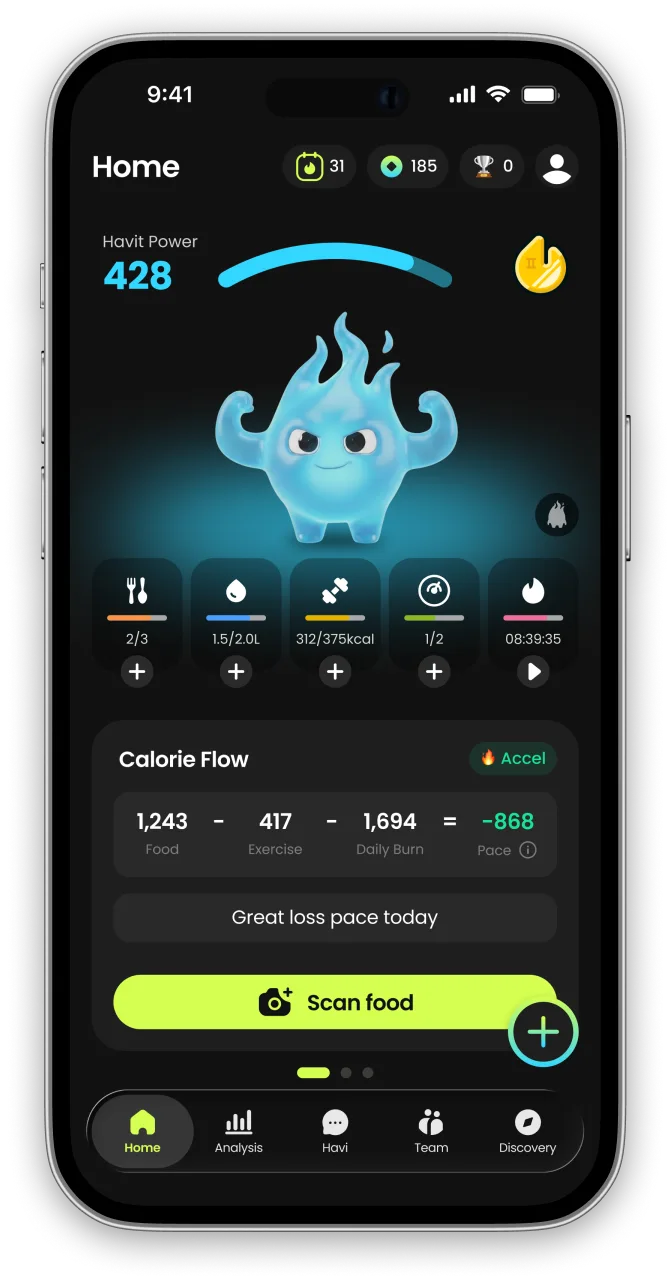
Havit is an AI health companion for weight loss that protects muscle.
Unlike calorie-only trackers, Havit connects AI body-composition estimates, nutrition, hydration, sleep, steps, cycle, mood, and GLP-1 medication in one daily routine — so progress is measured by body composition, not just the number on the scale. Daily missions turn established behavior-change techniques into small repeatable actions, drawing on expertise from professionals formerly at Juvis Diet, one of Korea’s leading metabolic clinics.
In Havit’s own analysis of 1,090 GLP-1 users, people who logged consistently built stronger habits than the general user base. Read the GLP-1 Habit Report
Havit works with or without GLP-1 medication. It is a wellness app, not a medical device; body-composition results are estimates.
Continue in the App
Personalized wellness with your own data


References
- Implementation intentions and goal achievement: A meta-analysis of effects and processes — British Journal of Health Psychology, 2024
- Contextual cues and habit formation: An eight-month longitudinal study — Habit Formation Research Consortium, 2025
- How are habits formed: Modelling habit formation in the real world — European Journal of Social Psychology
- The role of environmental cues in behavioral automaticity — Journal of Behavioral Science, 2024


