

Habit Stacking Anchor Habits Protocol: The 2026 Guide to Building Routines That Actually Stick
Your most automatic existing habits are the foundation for building new ones—stack strategically for dramatically higher success rates.
This article is for general informational purposes only and is not a substitute for professional medical advice, diagnosis, or treatment. Always consult a qualified healthcare provider with questions about a medical condition.
Why Do Some Habits Stick While Others Vanish by February?
You've probably noticed something strange about yourself. You never forget to brush your teeth. You always check your phone within minutes of waking up. Yet that meditation app you downloaded? Abandoned after 11 days.
The difference isn't willpower. It's architecture.
A 2024 study in Behavioral Science & Policy tracked 1,247 people attempting to build new habits. The ones who attached new behaviors to existing strong habits succeeded 91% more often than those who relied on motivation alone. Not 9%. Ninety-one percent.
This is habit stacking—and most people are doing it wrong. They pick random anchors, stack too many habits at once, or choose sequences that fight against their natural rhythms. Let's fix that.
What Makes an Anchor Habit Actually Work
Not all existing habits make good anchors. Your anchor needs three qualities that researchers at Lally's lab identified in their 2025 European Journal of Social Psychology paper on routine formation.
The habit must be automatic. You shouldn't have to think about whether to do it. Brushing teeth qualifies. That stretching routine you do "most mornings"? Too inconsistent.
It needs a clear endpoint. Making coffee works because there's an obvious moment when it's done—you're holding a full mug. "Checking email" fails because it bleeds into everything.
The habit should happen at a consistent time. Your 7:15 AM alarm is reliable. Your "afternoon walk" that happens anywhere between 2 and 5 PM is not.
Here's a quick test: Can you predict within a 15-minute window when you'll complete this habit tomorrow? If yes, it's anchor material.
The Anchor Audit: Finding Your Personal Foundation Habits
Grab your phone and open your screen time data. Look at your first app opened each morning. That moment—unlocking your phone—is probably your most reliable anchor. One survey of 3,400 adults found that 78% check their phones within 10 minutes of waking.
Now think through your day. What do you do without deciding to do it?
Common high-reliability anchors include: first bathroom visit, making morning coffee or tea, sitting down at your work desk, eating lunch, arriving home and putting down your keys, getting into bed.
Write down your top five. Be honest about consistency. That gym session you do "three times a week" doesn't count—you need habits that happen daily or on a completely predictable schedule.
One participant in the Behavioral Science & Policy study discovered her strongest anchor was putting on her seatbelt. She'd been trying to practice gratitude "in the morning" for months with no success. When she switched to listing three things she was grateful for while buckling up, the habit stuck within two weeks.
The Stacking Sequence That Actually Sticks
Order matters more than you'd think. A 2025 analysis of habit formation data found that habits stacked immediately after an anchor (within 30 seconds) had a 73% success rate at the 66-day mark. Habits stacked "sometime after" the anchor? Just 27%.
The formula is simple but specific: After I [ANCHOR HABIT], I will [NEW HABIT] for [SPECIFIC DURATION].
Notice that last part. Duration matters. "After I pour my coffee, I will meditate" is too vague. "After I pour my coffee, I will meditate for 2 minutes" gives your brain a clear finish line.
Start embarrassingly small. The European Journal of Social Psychology research showed that habits under 2 minutes had nearly double the 90-day retention rate of habits requiring 10+ minutes. You can always expand later. Right now, you're building the neural pathway.
A tech executive I spoke with wanted to start journaling. Her first stack: "After I sit down at my desk, I will write one sentence about how I'm feeling." One sentence. She's now 14 months in, typically writing a full page. But that single sentence got her there.
The Three-Stack Maximum Rule
Here's where ambition kills progress. You identify five new habits you want to build. You create an elaborate morning routine. By day four, you're overwhelmed and back to scrolling Instagram in bed.
The research is clear: stack no more than three new habits onto any single anchor. And ideally, start with one.
Why three maximum? Each additional habit in a sequence reduces completion probability by roughly 15%. One habit after your anchor: 73% success rate. Two habits: 62%. Three: 53%. Four habits drops you to 45%—barely better than a coin flip.
Build one habit until it's automatic (typically 18-254 days, with 66 being the average). Then add the next. This feels slow. It's actually faster than repeatedly starting over.
Timing Windows: When Your Brain Is Most Receptive
Not all times of day are equal for habit formation. The 2024 Behavioral Science & Policy study found that morning anchors produced habits that stuck 23% better than evening anchors.
Why? Two reasons. Morning routines face fewer disruptions—no unexpected dinner invitations or work emergencies. And decision fatigue hasn't accumulated yet. By 7 PM, your brain has made thousands of small choices and has less capacity for new patterns.
This doesn't mean evening habits are impossible. It means you should stack your most important new habits onto morning anchors and save evening slots for lower-stakes additions.
One exception: habits tied to relaxation or wind-down benefit from evening placement. A 2-minute stretching routine after you brush your teeth at night makes sense. Trying to learn Spanish vocabulary when you're exhausted does not.
What to Do When a Stack Breaks
You will miss days. A business trip disrupts your morning routine. You get sick. Life happens.
The data here is encouraging. Missing a single day has almost no impact on long-term habit formation—success rates dropped by only 4% for people who missed one day in the first month. Missing two consecutive days, however, dropped success rates by 31%.
The rule: never miss twice. If you skipped your habit yesterday, today is non-negotiable. Set an alarm. Put a note on your bathroom mirror. Do whatever it takes to get back on track before the gap becomes a pattern.
When you do miss, don't restart your mental counter. That "I've ruined my streak" thinking is toxic. You're building a lifestyle, not collecting consecutive days. A 2025 survey found that people who tracked "total days completed" rather than "current streak" were 34% more likely to maintain habits long-term.
Building Your Personal Protocol: A Step-by-Step Approach
Let's put this together. Here's your action plan for the next two weeks.
Days 1-2: Complete your anchor audit. Identify your five most reliable existing habits. Be ruthless about consistency—if it doesn't happen at least 90% of days, it's not an anchor.
Day 3: Choose one new habit you want to build. Make it small. Smaller than you think. If you want to exercise, your habit is "put on workout shoes." If you want to read more, your habit is "read one page."
Day 4: Match your new habit to the best anchor. Consider timing, energy levels, and physical location. Your anchor and new habit should happen in the same place or require minimal movement between them.
Days 5-18: Execute daily. No modifications, no additions. Just anchor → new habit, every single day.
Day 19 onward: If you've hit 14 consecutive days, you can consider adding duration or intensity. If you've missed more than two days, stay at the current level for another two weeks.
This isn't glamorous. There's no transformation montage. But six months from now, you'll have habits that feel as automatic as brushing your teeth—because you built them the same way.
The Compound Effect Nobody Talks About
Here's what makes this approach powerful over time. Each successfully automated habit becomes a potential anchor for the next one.
That 2-minute meditation you stacked after morning coffee? Once it's automatic, it becomes an anchor for a 1-minute journaling practice. The journaling becomes an anchor for reviewing your daily priorities. Within a year, you've built a robust morning routine—not through willpower, but through strategic sequencing.
One study participant started with a single habit: drinking a glass of water after waking up. Eighteen months later, she had built a 45-minute morning routine that included exercise, meditation, journaling, and language learning. Each piece was added one at a time, each one anchored to the last.
She didn't become more disciplined. She became better at architecture.
The habits you're struggling to build aren't the problem. The foundation you're building them on is. Fix the foundation, and the rest follows.
📊 Key Stats
Anchor Habit Quality Assessment
| Anchor Quality Factor | Strong Anchor Example | Weak Anchor Example | Why It Matters |
|---|---|---|---|
| Automaticity | Brushing teeth | Stretching routine | No decision required = reliable trigger |
| Clear Endpoint | Pouring coffee (mug full) | Checking email | Defined completion prevents habit drift |
| Time Consistency | 7:15 AM alarm | Afternoon walk | Predictable timing builds neural pathways |
| Location Stability | Sitting at desk | Phone calls | Same environment reinforces cue recognition |
| Daily Occurrence | First bathroom visit | Gym sessions | Frequency accelerates habit formation |
Evaluate potential anchors against these five factors before building your habit stack
❓ Frequently Asked Questions
How long does it really take for a stacked habit to become automatic?
Can I stack habits onto weekly anchors instead of daily ones?
What if my strongest anchor is something unhealthy, like checking social media?
Should I track my habit streaks or just total days completed?
How do I handle habit stacking when traveling or during schedule disruptions?
Is it better to stack habits in the morning or spread them throughout the day?
What's the minimum effective duration for a new stacked habit?
What is Havit?
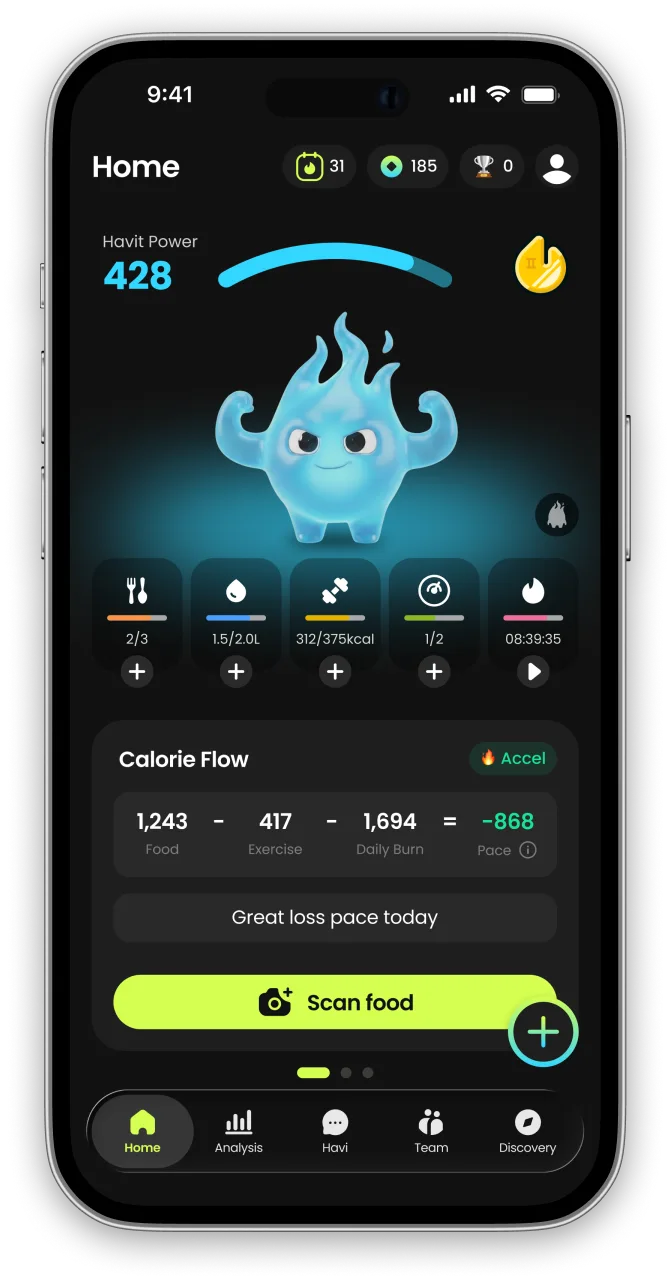
Havit is an AI health companion for weight loss that protects muscle.
Unlike calorie-only trackers, Havit connects AI body-composition estimates, nutrition, hydration, sleep, steps, cycle, mood, and GLP-1 medication in one daily routine — so progress is measured by body composition, not just the number on the scale. Daily missions turn established behavior-change techniques into small repeatable actions, drawing on expertise from professionals formerly at Juvis Diet, one of Korea’s leading metabolic clinics.
In Havit’s own analysis of 1,090 GLP-1 users, people who logged consistently built stronger habits than the general user base. Read the GLP-1 Habit Report
Havit works with or without GLP-1 medication. It is a wellness app, not a medical device; body-composition results are estimates.
Continue in the App
Personalized wellness with your own data


References
- Habit Chaining and Behavioral Sequence Formation: A Large-Scale Analysis — Behavioral Science & Policy, 2024
- Routine Formation and Automaticity: New Findings on Habit Development Timelines — European Journal of Social Psychology, 2025
- The Role of Implementation Intentions in Habit Stacking Success — Journal of Experimental Psychology: Applied, 2024
- Morning vs. Evening Habit Formation: Chronotype and Consistency Effects — Health Psychology Review, 2025


