
Cronometer Alternative for GLP-1 Users: An Honest 2026 Comparison — Havit vs Cronometer

This article is for general informational purposes only and is not a substitute for professional medical advice, diagnosis, or treatment. Always consult a qualified healthcare provider with questions about a medical condition.
Quick answer
Looking for a Cronometer alternative on a GLP-1? What Cronometer does brilliantly, why it doesn't track your dose, and what to look for instead.
Medical disclaimer: This article is for educational purposes only and is not medical advice. Always follow the instructions from your prescribing clinician and pharmacist. Never change your dose based on an app.
If you're on Ozempic, Wegovy, Mounjaro, or Zepbound and you searched for a "Cronometer alternative," there's a good chance you already respect the app — it's arguably the most accurate nutrition tracker on the market — but you've hit its wall: it was never built for the medication side of your journey.
This is an honest, vendor-neutral comparison.
We'll give Cronometer full credit for what it does better than almost anyone, be direct about the gap it leaves for GLP-1 users, and lay out what to look for in an alternative.
Cronometer isn't a bad app — for many people it's the best nutrition app there is. The question is whether nutrition tracking alone is what you need.
01
What Cronometer Does Well
Cronometer earned its reputation among biohackers, dietitians, and data-driven users for a reason.
Unmatched micronutrient depth
Cronometer tracks 80–84+ nutrients per day — vitamins A through K, minerals like iron, zinc, magnesium and selenium, amino acids, and omega-3/omega-6 fatty acids (Cronometer, Calorie Tracker Index).
No mainstream calorie app comes close. If you care about nutritional quality, not just calories, this is the deepest view available.
A verified, high-accuracy database
Unlike apps built on user-submitted entries (which accumulate duplicate and wrong data over years), Cronometer's core database is anchored to the NCCDB and other curated sources (Cronometer Review, 2026).
That means when it tells you a food has 6 grams of protein, you can generally trust it.
For GLP-1 users worried about hitting protein targets on a suppressed appetite, that accuracy is genuinely valuable.
Macros and targets that flex
Cronometer handles standard macro tracking (protein, carbs, fat) with targets you can set in grams or percentages — helpful for a protein-preservation goal.
Its charts and reports are clean and export-friendly.
Lab biomarker import (Gold)
Cronometer's Gold tier lets you import lab results and track biomarkers over time — useful in clinical contexts and for anyone working closely with a dietitian or physician (Cronometer Blog).
02
Where Cronometer Falls Short for GLP-1 Users
Here's the honest core of it: Cronometer is a nutrition app, full stop. It offers general nutrition tracking but does not address GLP-1-specific challenges directly (Cronometer Blog).
For someone whose whole routine revolves around a weekly injection, that's a fundamental mismatch.
- No dose or injection logging
Cronometer has no field for your medication, your dose in milligrams, or your injection date. You can log every micronutrient you eat and still have no record of when you took your shot.
For a once-weekly medication, that's the single most important thing to track — and it's absent.
- No injection-site rotation
Because there's no medication module at all, there's obviously no visual body map to help you rotate injection sites.
Repeatedly injecting the same spot can cause irritation or lumps, so this is a real safety-and-comfort gap for weekly injectors.
- No side-effect correlation
40–70% of GLP-1 users experience GI side effects like nausea and constipation (BioSpace).
Being able to log symptoms against your dose timeline is one of the highest-value habits on a GLP-1 — you learn that nausea peaks two days post-shot and can plan around it.
Cronometer offers no structured way to do this.
- No shot reminders or titration support
There are no countdowns to your next injection, no missed-dose handling, and no awareness that your dose is scheduled to step up.
Cronometer's reminders are built around food and nutrition, not a medication schedule.
- It can feel like a lot of work
Cronometer's depth is its strength and its cost.
Detailed logging of 80+ nutrients is powerful, but on weeks when a GLP-1 has flattened your appetite and energy, a meticulous nutrition tracker can feel like a chore.
Many GLP-1 users need consistency and gentle structure more than they need micronutrient perfection.

03
Comparison Table: Cronometer vs Dedicated GLP-1 Trackers
The honest framing: Cronometer is a best-in-class nutrition app; dedicated GLP-1 trackers are medication-first apps. They're solving different problems.
Features and pricing change frequently — verify in the App Store or Google Play before you commit. Sources: Cronometer, Cronometer Blog, MeAgain.
The bottom line on the gap
The gap isn't that Cronometer is weak — it's that it's playing a different sport. Cronometer wins nutrition depth and accuracy hands-down.
But it tracks zero of the medication signals that define a GLP-1 journey: dose, site, side effects, and schedule. No amount of micronutrient precision fills that hole.
04
Who Should Stay on Cronometer — and Who Should Switch
Stay on Cronometer if:
- Micronutrient depth and database accuracy are your top priorities.
- You (or your dietitian) actively use lab biomarker tracking.
- You're comfortable logging your medication separately, elsewhere.
- You value nutrition precision more than medication features in one place.
Consider an alternative if:
- You want your dose, injection site, and side effects tracked in the same app as your food.
- You need shot reminders and titration awareness.
- You want protein made prominent rather than one nutrient among 84.
- You want coaching or habit support to stay consistent through side-effect weeks.
- Detailed nutrition logging feels like too much on low-energy days.
A reasonable middle path: some users pair Cronometer (for nutrition depth) with a dedicated GLP-1 tracker (for the shot). That works — it just means two apps instead of one.

05
What to Look For in a Cronometer Alternative
If you switch, or add a second app, judge candidates on GLP-1 fundamentals:
- 1
Dose + guided injection-site rotation
the core Cronometer can't do at all.
- 2
Side-effect logging tied to your dose timeline
so you can spot and plan around patterns.
- 3
Protein-first food logging
appetite drops on a GLP-1, and under-eating protein risks muscle loss; you want protein prominent, not buried.
- 4
Reminders and titration support
countdowns and awareness of dose step-ups.
- 5
Progress tracking
weight trends and photos, ideally syncing with Apple Health / Google Fit.
- 6
Privacy
most U.S. wellness apps aren't HIPAA-covered; read the policy, prefer export/delete controls.
- 7
Enough (not maximal) nutrition detail
for many GLP-1 users, protein + calories they'll actually log beats 84 nutrients they won't.
06
A Note on Accuracy and Safety
No app replaces your care team — not Cronometer, not any alternative.
If you use a tracker that shows an "estimated medication-level" curve, treat it as an educational approximation based on published half-lives, never a measurement of the drug in your body.
Use whatever you track to bring better questions to your clinician, and never adjust your dose because of what an app shows.

07
The Bottom Line
Cronometer is the best micronutrient tracker in the category, and if nutrition precision is your goal, it deserves its reputation.
But it tracks none of the medication signals that define a GLP-1 journey — dose, injection site, side effects, or schedule. That's not a flaw; it's simply not what Cronometer is for.
If you want your dose, guided site rotation, side-effect insight, protein-first food logging, and gentle coaching in one place — organized around your shot instead of around a spreadsheet of nutrients — try the HAVIT app. It's built to keep you consistent on your GLP-1 journey, one week at a time.
And if you love Cronometer's depth, there's nothing stopping you from using both.
08
Why HAVIT — Medication + Behavior Change, in One App
GLP-1 medications can meaningfully reduce weight — but the number on the scale is only part of the story.
Roughly 20–40% of the weight lost on GLP-1 therapy can come from lean (muscle) tissue rather than fat (Neeland et al., Diabetes, Obesity and Metabolism, 2024), and results tend to fade once the medication stops unless new habits take their place.
That's why leading guidance treats medication as one part of care, not the whole: the U.S. Preventive Services Task Force recommends that adults with obesity be offered intensive, multicomponent behavioral interventions (USPSTF, Grade B).
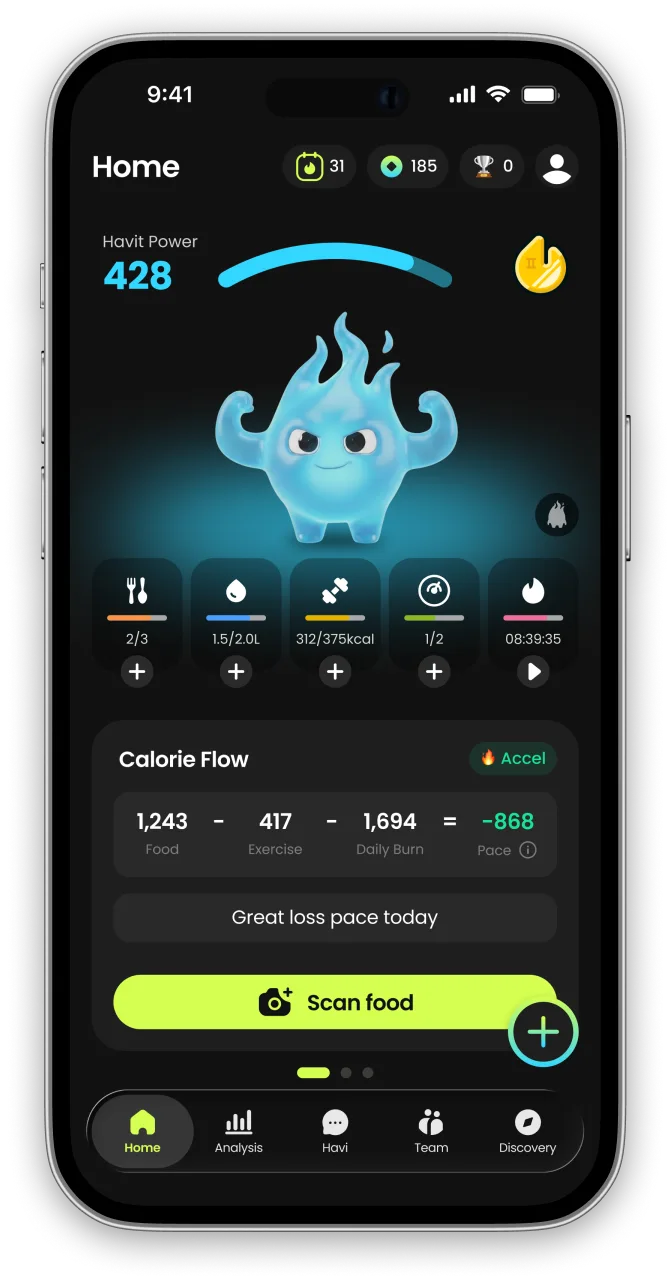
HAVIT is built for exactly this moment — one app that unites medication tracking, body composition, nutrition and protein, daily habit-building, and an AI coach that adapts to you.
Across our own 1,090 GLP-1 users, the most consistent trackers built the strongest habits (see the GLP-1 habit report).
Manage the medicine and the muscle — together. Start with HAVIT →

Comparison Table: Cronometer vs Dedicated GLP-1 Trackers
| Feature | Cronometer | Dedicated GLP-1 trackers (MeAgain, Shotsy) | HAVIT |
|---|---|---|---|
| Dose + injection logging | No | Yes | Yes |
| Injection-site rotation map | No | Yes | Yes |
| Side-effect tracking | No | Yes | Yes |
| Shot reminders / titration | No | Yes | Yes |
| Micronutrient depth | Best in class (84+) | Minimal | Protein-forward |
| Database accuracy | Verified (NCCDB) | Varies | Curated |
| Protein tracking | Yes (precise) | Yes | Yes (front-and-center) |
| Lab biomarker import | Yes (Gold) | Rare | Varies |
| Coaching / habit-building | No | Varies | Yes |
| Price | Free + Gold | Free + paid tiers | Free + optional coach |
Havit is an AI health companion that combines GLP-1 medication tracking, body composition, and daily habit coaching in one app.
Frequently asked questions
Does Cronometer track GLP-1 medications like Ozempic or Wegovy?
What's the best Cronometer alternative for GLP-1 users?
Is Cronometer's nutrition tracking better than dedicated GLP-1 apps?
Can I use Cronometer and a GLP-1 tracker together?
Does Cronometer help with protein on a GLP-1?
Is Cronometer free?
Why doesn't Cronometer just add dose tracking?
Do these apps replace medical advice?
Is Havit better than Cronometer?
What does Havit do that Cronometer doesn't?
Can I switch from Cronometer to Havit?
What is Havit?
Havit is an AI health companion for weight loss that protects muscle.
Unlike calorie-only trackers, Havit connects AI body-composition estimates, nutrition, hydration, sleep, steps, cycle, mood, and GLP-1 medication in one daily routine — so progress is measured by body composition, not just the number on the scale. Daily missions turn established behavior-change techniques into small repeatable actions, drawing on expertise from professionals formerly at Juvis Diet, one of Korea’s leading metabolic clinics.
In Havit’s own analysis of 1,090 GLP-1 users, people who logged consistently built stronger habits than the general user base. Read the GLP-1 Habit Report
Havit works with or without GLP-1 medication. It is a wellness app, not a medical device; body-composition results are estimates.
Continue in the App
Personalized wellness with your own data


References
- Cronometer. *The Most Accurate Nutrition Tracking App & Calorie Counter.* cronometer.com
- Cronometer Blog. *GLP-1 Drugs: How Cronometer Can Help.* cronometer.com
- Calorie Tracker Index. *Cronometer Review (2026): The Micronutrient Standard, Honestly Assessed.* calorietrackerindex.com
- BioSpace. *GLP-1 Side Effects Only One Factor Driving Patient Discontinuation Rates.* biospace.com
- MeAgain. *7 Best GLP-1 Tracker Apps Compared (2026).* meagain.com
- Stanford Medicine. *GLP-1s 101: What the science says about weight loss, side effects, and safe use* (2026). med.stanford.edu


