
Cal AI Alternative for GLP-1 Users: An Honest 2026 Comparison — Havit vs Cal AI

This article is for general informational purposes only and is not a substitute for professional medical advice, diagnosis, or treatment. Always consult a qualified healthcare provider with questions about a medical condition.
Quick answer
Looking for a Cal AI alternative on a GLP-1? What Cal AI's photo calorie counting does, where it falls short, and what to look for instead.
Medical disclaimer: This article is for educational purposes only and is not medical advice. Always follow the instructions from your prescribing clinician and pharmacist. Never change your dose based on an app.
If you're on Ozempic, Wegovy, Mounjaro, or Zepbound and you searched for a "Cal AI alternative," you probably love the idea of photographing your food and skipping manual entry — but you've realized that a photo calorie counter, however slick, doesn't help with the part of your journey that actually matters: the weekly shot.
This is an honest, vendor-neutral comparison. Cal AI genuinely reduced logging friction better than almost anyone, and we'll say so.
We'll also be direct about its accuracy limits, its thin nutrition data, and the fact that it tracks nothing about your medication.
If you need a GLP-1 companion rather than a calorie camera, here's what to look for.
01
What Cal AI Does Well
Cal AI became one of the fastest-growing nutrition apps of the mid-2020s for one clear reason: it made logging almost effortless.
Photo-to-log in seconds
Cal AI's core pitch is a 3–5 second workflow — photograph your plate, and a multimodal AI stack returns the macro breakdown (Vora Blog, Nutrola).
It uses your phone's depth sensor to estimate food volume, which is a clever touch. For people who abandoned manual calorie tracking because it was tedious, this is a genuine breakthrough.
Backed by a huge database (post-acquisition)
MyFitnessPal acquired Cal AI in March 2026, and the app was integrated with MFP's database spanning roughly 20 million foods, 68,500+ brands, and 380+ restaurant chains (TechCrunch).
Cal AI continues as a standalone product with its original team retained — so it's not disappearing, but it now sits inside MyFitnessPal's ecosystem.
Low friction drives consistency
The single biggest reason people quit food tracking is that it's too much work. Cal AI's speed genuinely helps some users log more consistently than they ever did in a manual app.
Consistency is where value comes from, so this matters.
02
Where Cal AI Falls Short for GLP-1 Users
Here's the honest core: Cal AI is a calorie camera, not a GLP-1 tracker. It has no medication features at all, and its nutrition data and accuracy have real limits.
- No dose, injection, or medication tracking
Cal AI has no field for your medication, dose, injection site, or injection date. For a once-weekly GLP-1, the shot is the center of the journey — and Cal AI tracks none of it.
It can tell you the calories in your lunch but nothing about when you last injected.
- No side-effect correlation
40–70% of GLP-1 users experience GI side effects (BioSpace), and logging symptoms against your dose timeline is one of the most useful habits on a GLP-1.
Cal AI offers no structured symptom tracking, so it can't help you spot that your nausea peaks two days after each shot.
- Accuracy is variable
Photo estimation is impressive but imperfect.
Reviews put Cal AI's variance around 10–20% on standard meals, and hands-on tests have found larger misses — one famously identified an apple as tikka masala and underestimated a simple apple by roughly a third (Nutrola, Aumiqx).
That's fine for a rough calorie ballpark; it's shakier when you're trying to hit a precise protein target on a suppressed appetite.
- Micronutrient and protein depth is minimal
Cal AI focuses on calories and headline macros; detailed micronutrient tracking — vitamins, minerals, fiber, amino acids — is minimal or absent (Nutrola).
For GLP-1 users, the risk is that protein — the nutrient you most need to protect muscle — is treated as a number in a macro split rather than a front-and-center goal with reliable data behind it.
- Pricing and trust concerns
Cal AI's pricing runs from about $2.99/week to $29.99/year, with a limited free tier (NutriScan).
Its 2026 was rocky: it was briefly pulled from the App Store over deceptive-billing concerns and disclosed a data breach affecting 3.2M+ users (Aumiqx).
For an app storing health-related data, that history is worth weighing.

03
Comparison Table: Cal AI vs Dedicated GLP-1 Trackers
The honest framing: Cal AI is a fast calorie camera; dedicated GLP-1 trackers are medication-first companions. Different tools for different jobs.
Features, pricing, and accuracy change frequently — verify in the App Store or Google Play before you commit. Sources: Vora Blog, Nutrola, MeAgain.
The bottom line on the gap
Cal AI solved the wrong problem for GLP-1 users — brilliantly. It removed friction from calorie logging, but calorie logging was never the hard part of a GLP-1 journey.
The hard parts are the shot you can't forget, the side effects you need to anticipate, and the protein you must protect. Cal AI addresses none of them.
04
Who Should Stay on Cal AI — and Who Should Switch
Stay on Cal AI if:
- Speed of food logging is your single biggest barrier, and photo capture keeps you consistent.
- You just want a rough calorie ballpark, not precise nutrition data.
- You're comfortable tracking your medication separately, somewhere else.
Consider an alternative if:
- You want your dose, injection site, and side effects tracked in the same app.
- Protein precision matters to you (photo estimates aren't reliable enough for tight targets).
- You want shot reminders and titration awareness.
- The 2026 billing and data-breach history gives you pause about storing health data there.
- You want coaching and habit support, not just a calorie count.

05
What to Look For in a Cal AI Alternative
If you switch, judge candidates on GLP-1 fundamentals rather than logging speed alone:
- 1
Dose + guided injection-site rotation
the core Cal AI doesn't have.
- 2
Side-effect logging tied to your dose timeline
so you can anticipate rough days.
- 3
Reliable protein-first food logging
appetite drops on a GLP-1, and under-eating protein risks muscle loss; you want protein prominent and accurate.
- 4
Reminders and titration support
countdowns to your next shot and awareness of step-ups.
- 5
Progress tracking
weight trends and photos, ideally syncing with Apple Health / Google Fit.
- 6
Privacy
read the policy, check the breach history, prefer export/delete controls.
- 7
Coaching or habit support
the difference between a log and a system that keeps you consistent.
A note on photo logging: it's a great convenience, not a substitute for the medication features above. The ideal is an app that's easy to log and built around your shot.
06
A Note on Accuracy and Safety
No app replaces your care team — including a fast, AI-powered one. Photo-based calorie estimates carry meaningful variance, so don't treat them as exact.
And any "estimated medication-level" curve in a GLP-1 app is an educational approximation from published half-lives, not a measurement.
Use whatever you track to bring better questions to your clinician, and never adjust your dose because of what a screen shows.

07
The Bottom Line
Cal AI is a genuinely impressive calorie camera, and if logging friction is what's stopping you from tracking food, it may help.
But it tracks nothing about the medication that defines a GLP-1 journey — no dose, no injection site, no side effects, no reminders — and its nutrition accuracy and depth are limited.
For a GLP-1 companion, that's the wrong tool.
If you want your dose, guided site rotation, side-effect insight, protein-first food logging, and gentle coaching in one place — built around your shot rather than around a photo of your plate — try the HAVIT app. It's designed to keep you consistent on your GLP-1 journey, one week at a time.
08
Why HAVIT — Medication + Behavior Change, in One App
GLP-1 medications can meaningfully reduce weight — but the number on the scale is only part of the story.
Roughly 20–40% of the weight lost on GLP-1 therapy can come from lean (muscle) tissue rather than fat (Neeland et al., Diabetes, Obesity and Metabolism, 2024), and results tend to fade once the medication stops unless new habits take their place.
That's why leading guidance treats medication as one part of care, not the whole: the U.S. Preventive Services Task Force recommends that adults with obesity be offered intensive, multicomponent behavioral interventions (USPSTF, Grade B).
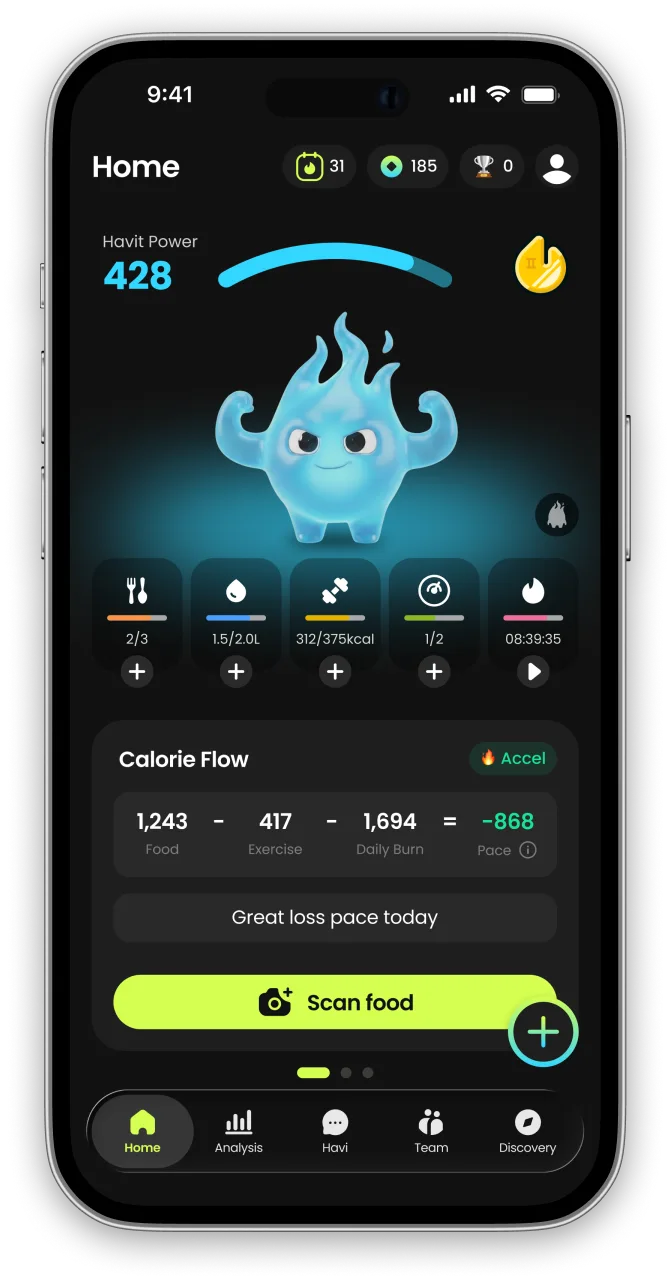
HAVIT is built for exactly this moment — one app that unites medication tracking, body composition, nutrition and protein, daily habit-building, and an AI coach that adapts to you.
Across our own 1,090 GLP-1 users, the most consistent trackers built the strongest habits (see the GLP-1 habit report).
Manage the medicine and the muscle — together. Start with HAVIT →

Comparison Table: Cal AI vs Dedicated GLP-1 Trackers
| Feature | Cal AI | Dedicated GLP-1 trackers (MeAgain, Shotsy) | HAVIT |
|---|---|---|---|
| Dose + injection logging | No | Yes | Yes |
| Injection-site rotation map | No | Yes | Yes |
| Side-effect tracking | No | Yes | Yes |
| Shot reminders / titration | No | Yes | Yes |
| Food logging | Photo-fast (variable accuracy) | Varies | Protein-forward |
| Protein-first framing | Macro split only | Yes | Yes (front-and-center) |
| Micronutrient depth | Minimal | Minimal | Moderate |
| Progress (weight + photos) | Limited | Yes | Yes |
| Coaching / habit-building | No | Varies | Yes |
| Price | ~$2.99/wk–$29.99/yr | Free + paid tiers | Free + optional coach |
Havit is an AI health companion that combines GLP-1 medication tracking, body composition, and daily habit coaching in one app.
Frequently asked questions
Does Cal AI track GLP-1 medications like Ozempic or Wegovy?
What's the best Cal AI alternative for GLP-1 users?
How accurate is Cal AI for calorie counting?
Is Cal AI still around after the MyFitnessPal acquisition?
Can Cal AI help me protect muscle on a GLP-1?
Is Cal AI safe to store my health data in?
Is photo food logging worth it for GLP-1 users?
Do these apps replace medical advice?
Is Havit better than Cal AI?
What does Havit do that Cal AI doesn't?
Can I switch from Cal AI to Havit?
What is Havit?
Havit is an AI health companion for weight loss that protects muscle.
Unlike calorie-only trackers, Havit connects AI body-composition estimates, nutrition, hydration, sleep, steps, cycle, mood, and GLP-1 medication in one daily routine — so progress is measured by body composition, not just the number on the scale. Daily missions turn established behavior-change techniques into small repeatable actions, drawing on expertise from professionals formerly at Juvis Diet, one of Korea’s leading metabolic clinics.
In Havit’s own analysis of 1,090 GLP-1 users, people who logged consistently built stronger habits than the general user base. Read the GLP-1 Habit Report
Havit works with or without GLP-1 medication. It is a wellness app, not a medical device; body-composition results are estimates.
Continue in the App
Personalized wellness with your own data


References
- Vora Blog. *Cal AI Review 2026: Photo Food Logging Accuracy, Pricing & Best Alternatives.* askvora.com
- Nutrola. *Cal AI Review 2026: Honest Pros, Cons, and Accuracy Test.* nutrola.app
- TechCrunch. *MyFitnessPal has acquired Cal AI, the viral calorie app built by teens* (2026). techcrunch.com
- Aumiqx. *Cal AI Review 2026: Is Photo Calorie Counting Accurate?* aumiqx.com
- NutriScan App. *Cal AI Pricing 2026: Monthly vs Yearly and What Premium Unlocks.* nutriscan.app
- BioSpace. *GLP-1 Side Effects Only One Factor Driving Patient Discontinuation Rates.* biospace.com
- MeAgain. *7 Best GLP-1 Tracker Apps Compared (2026).* meagain.com


