

Bryan Johnson's Blueprint Protocol: Which Parts Actually Have Science Behind Them?
About 30% of Blueprint interventions have solid independent research; the rest are expensive self-experiments that may or may not work for anyone else.
This article is for general informational purposes only and is not a substitute for professional medical advice, diagnosis, or treatment. Always consult a qualified healthcare provider with questions about a medical condition.
The $2 Million Guinea Pig Next Door
Bryan Johnson wakes up at 4:30 AM, swallows 111 pills, and has spent over $4 million trying to reverse his biological age. He's 47 but claims his heart functions like a 37-year-old's. His protocol includes everything from extra virgin olive oil (cost: $15/month) to young plasma infusions (cost: $5,000+ per session). The question nobody seems to be asking: which of these actually work for people who aren't tech billionaires with a full-time medical team?
I spent three weeks diving into Johnson's published biomarker data, cross-referencing it with peer-reviewed longevity research. What I found was a messy mix of legitimate science, promising experiments, and some interventions that are basically expensive wishful thinking.
The Stuff That Actually Has Independent Validation
Let's start with what holds up. Johnson's emphasis on extra virgin olive oil isn't just marketing—the PREDIMED trial followed 7,447 participants for nearly five years and found that high olive oil consumption reduced cardiovascular events by 30%. His recommended two tablespoons daily falls right in line with Mediterranean diet research spanning decades.
Sleep consistency is another winner. Johnson goes to bed at 8:30 PM every single night. Sounds extreme, but a 2023 study in Sleep Medicine Reviews analyzing 73 studies found that irregular sleep timing increased all-cause mortality risk by 23%. The specific bedtime doesn't matter as much as the consistency itself.
His vegetable intake—about 2 pounds daily—aligns with research from the Harvard T.H. Chan School of Public Health showing that five daily servings of fruits and vegetables correlated with 13% lower mortality. Johnson just takes it further.
Resistance training three times weekly? The evidence here is overwhelming. A 2022 meta-analysis in the British Journal of Sports Medicine covering 16 studies and 480,000 participants found that muscle-strengthening activities reduced all-cause mortality by 10-17%.
Where the Science Gets Thin
Now for the uncomfortable part. Johnson's young plasma transfusions—receiving blood plasma from donors in their late teens—cost around $5,000 per session. He was doing this monthly until he publicly stopped in 2023, admitting he saw no measurable benefit. The Ambrosia trial that sparked interest in this intervention was criticized for lacking a control group and never published peer-reviewed results.
His gene therapy experiments exist in an even grayer zone. Johnson has received follistatin gene therapy aimed at increasing muscle mass. The treatment cost approximately $25,000, and while animal studies show promise, human trials remain in early phases with sample sizes under 50 participants. We simply don't know the long-term effects.
The electromagnetic pulse therapy for hair growth? A 2020 review in Dermatologic Surgery found "low-quality evidence" for low-level laser therapy in hair loss, with most positive studies funded by device manufacturers.
The Biomarker Problem Nobody Talks About
Johnson publishes his biomarker data religiously. His biological age, measured by various epigenetic clocks, reportedly dropped from 49 to 42 over two years. Sounds impressive until you understand how these clocks work.
Different epigenetic clocks give different results for the same person. A 2024 analysis in Nature Aging examined eight popular biological age calculators and found they agreed with each other only 60% of the time. Johnson's results come primarily from the Horvath clock and DunedinPACE, but using GrimAge or PhenoAge might tell a different story.
There's also the issue of regression to the mean. Someone with unusually high biological age readings at baseline will naturally show improvement on subsequent tests, even without intervention. Without a control group—without a parallel-universe Bryan Johnson who ate pizza and slept whenever—we can't isolate which interventions actually moved the needle.
What $2 Million Gets You (And What $200 Can)
Johnson's annual protocol cost reportedly exceeds $2 million when you include his medical team, testing, and experimental treatments. But here's what's interesting: the interventions with the strongest evidence are also the cheapest.
Olive oil runs about $180 per year for high-quality extra virgin. Consistent sleep is free. Vegetables cost maybe $3,000 annually at his consumption level. Resistance training requires a gym membership or some dumbbells. Add in basic supplements with actual evidence—vitamin D if you're deficient, omega-3s—and you're looking at under $5,000 yearly.
The expensive stuff—plasma exchange, gene therapy, hyperbaric oxygen chambers, stem cell injections—falls into the "might work, probably doesn't, definitely unproven" category. Johnson himself acknowledges he's running experiments, not following established protocols.
The Replication Crisis in Longevity Self-Experimentation
STAT News ran a piece in early 2025 examining longevity influencers and their protocols. The pattern they identified: charismatic figures with resources to try everything simultaneously, making it impossible to determine what actually helps.
Johnson takes 111 supplements daily. If his inflammation markers improve, which supplement caused it? Was it the combination? Would the same combination work for someone with different genetics, gut microbiome, or baseline health? These questions don't have answers because n=1 experiments can't answer them.
The longevity research community has started pushing back. Dr. Matt Kaeberlein, former director of the University of Washington's Healthy Aging and Longevity Research Institute, has noted that many popular longevity interventions lack the randomized controlled trials needed to recommend them broadly. Enthusiasm has outpaced evidence.
What Actually Makes Sense to Adopt
Strip away the spectacle and some Blueprint principles hold up. Eating mostly plants, exercising regularly, sleeping consistently, maintaining social connections, managing stress—these align with research on Blue Zones and large population studies.
The specific numbers matter less than the direction. You don't need exactly 2,256 calories or precisely 8.5 hours of sleep. You need enough vegetables, enough movement, enough rest. The optimization obsession can become its own form of stress, which—ironically—accelerates aging.
Johnson's data obsession has value as a research contribution, even if his conclusions remain personal. He's essentially funding a longitudinal case study on aggressive intervention stacking. Future researchers might find patterns in his data that inform actual clinical trials.
The Uncomfortable Truth About Longevity Optimization
Here's what nobody selling longevity protocols wants to admit: we don't have a proven way to dramatically extend human lifespan. Caloric restriction extends life in mice by 30-40%, but human trials show much more modest effects. Rapamycin looks promising in animal models, but long-term human safety data doesn't exist.
The interventions that definitely work—not smoking, maintaining healthy weight, staying active, sleeping enough—add maybe 10-14 years compared to the worst lifestyle choices. That's meaningful but not the radical life extension that captures headlines.
Johnson's protocol might be pushing boundaries. It might also be an elaborate, expensive placebo effect combined with the basics that work for everyone. We won't know for decades, and by then, the science will have moved on to new interventions anyway.
The most honest thing anyone can say about Blueprint: some of it is solid, some of it is speculative, and the ratio probably isn't what the marketing suggests.
📊 Key Stats
Blueprint Interventions: Evidence Level vs Cost
| Intervention | Evidence Quality | Annual Cost | Independent Validation |
|---|---|---|---|
| Extra virgin olive oil (2 tbsp/day) | Strong (RCTs) | $180 | Yes - PREDIMED, Mediterranean diet studies |
| Sleep consistency (same time daily) | Strong (meta-analyses) | $0 | Yes - multiple population studies |
| Resistance training 3x/week | Strong (meta-analyses) | $500-1,200 | Yes - extensive mortality research |
| High vegetable intake | Strong (cohort studies) | $2,500-3,500 | Yes - Harvard, Blue Zones research |
| 111 daily supplements | Mixed (varies by supplement) | $15,000-25,000 | Partial - some validated, many not |
| Young plasma transfusions | Weak (no peer-reviewed RCTs) | $60,000+ | No - Johnson himself stopped |
| Gene therapy (follistatin) | Experimental (early trials) | $25,000+ | No - human trials under 50 participants |
| Hyperbaric oxygen | Limited (small studies) | $10,000-20,000 | Partial - some wound healing evidence |
Evidence quality based on peer-reviewed research as of early 2025; costs are estimates from published Blueprint data and industry averages
❓ Frequently Asked Questions
Has Bryan Johnson actually reversed his biological age?
Why did Bryan Johnson stop the young blood plasma transfusions?
What Blueprint interventions have the strongest scientific evidence?
How much does it cost to follow the Blueprint protocol?
Can regular people replicate Blueprint results?
What do longevity researchers think about Blueprint?
Is the Blueprint supplement stack necessary for longevity benefits?
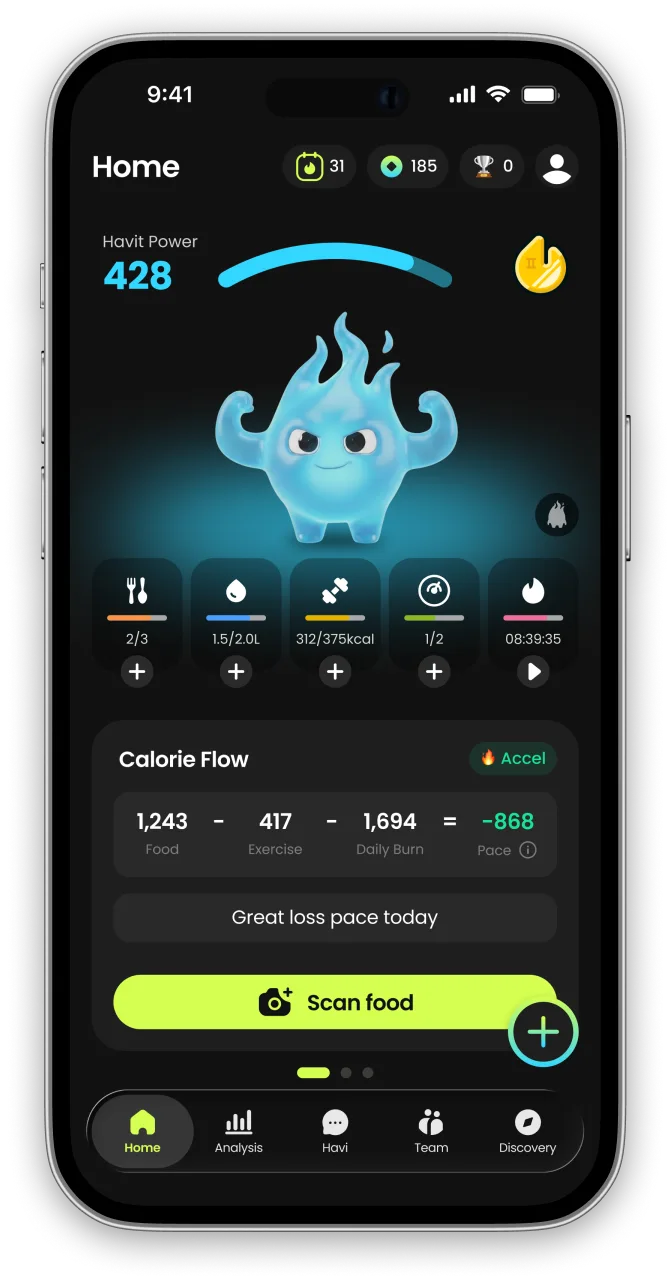
What is Havit?
Havit is an AI health companion for weight loss that protects muscle.
Unlike calorie-only trackers, Havit connects AI body-composition estimates, nutrition, hydration, sleep, steps, cycle, mood, and GLP-1 medication in one daily routine — so progress is measured by body composition, not just the number on the scale. Daily missions turn established behavior-change techniques into small repeatable actions, drawing on expertise from professionals formerly at Juvis Diet, one of Korea’s leading metabolic clinics.
In Havit’s own analysis of 1,090 GLP-1 users, people who logged consistently built stronger habits than the general user base. Read the GLP-1 Habit Report
Havit works with or without GLP-1 medication. It is a wellness app, not a medical device; body-composition results are estimates.

Continue in the App
Personalized wellness with your own data


References
- Blueprint Protocol Published Biomarker Data 2024-2025 — Bryan Johnson Blueprint official documentation and public data releases
- Epigenetic Age Reversal Claims Analysis — Nature Aging, 2024 - Comparison of biological age calculators
- Longevity Influencer Protocol Review — STAT News, January 2025
- PREDIMED Trial Results — New England Journal of Medicine, Primary Prevention of Cardiovascular Disease with a Mediterranean Diet
- Muscle-strengthening activities and mortality — British Journal of Sports Medicine, 2022 systematic review and meta-analysis


