
Best Food Tracker for GLP-1: What Generic Calorie Apps Miss

This article is for general informational purposes only and is not a substitute for professional medical advice, diagnosis, or treatment. Always consult a qualified healthcare provider with questions about a medical condition.
Quick answer
The best food tracker for GLP-1 users is one that puts protein, fiber, and hydration ahead of raw calories, and links what you eat to your symptoms and injection day. Generic calorie counters miss all three.
When you start Ozempic, Wegovy, Zepbound, or Mounjaro, your appetite drops fast. That is the point of the drug — but it quietly changes what "tracking food" even means.
On a GLP-1, eating less is easy. Eating well while eating less is the hard part, and it is exactly the part that ordinary calorie apps were never built to help with.
This guide explains why most food trackers fall short for GLP-1 users, what a purpose-built GLP-1 food tracker should measure, and how to log your meals so the data actually protects your muscle and calms your gut.
If you are looking for the meals themselves, see our companion piece on the 7-day GLP-1 meal plan — this article is about the tracking, not the menu.
01
Why generic calorie trackers fall short on GLP-1
Apps like MyFitnessPal, Cronometer, and the newer AI photo-loggers (Cal AI and similar) are genuinely good tools.
But they were designed around one core assumption: your problem is eating too much, so the app's job is to help you eat less. On a GLP-1, the drug already solved that problem.
Your new problems are different, and here is where the mismatch shows.
- They are calorie-first, not protein-first
Open almost any mainstream tracker and the giant number at the top is calories.
Protein is a secondary stat, often buried, and in some free tiers macros are set as percentages that must add up to 100 rather than as hard gram targets.
That framing is backwards for GLP-1 users. When your total intake collapses to 1,000–1,300 kcal a day, hitting a protein floor in grams matters far more than shaving another 100 calories.
A tracker that celebrates a low calorie total can quietly reward you for under-eating protein — the single biggest driver of muscle loss on these drugs.
- No dose or injection-day correlation
GLP-1 side effects and appetite are not constant. Nausea and fullness often spike in the day or two after your weekly injection and ease later in the week.
Generic trackers have no concept of an "injection day," so they cannot show you the pattern that would let you plan lighter, blander meals right after your shot and push protein on the days you feel best.
(MyFitnessPal and MyNetDiary have recently added GLP-1 symptom logging — a real improvement — but the correlation view is still thin.)
- No symptom-to-food link
Reflux after a fatty dinner, bloating after carbonated drinks, cramping after a big high-fiber jump — these are the daily realities of GLP-1 life.
A pure calorie counter records the food and ignores how you felt. Without connecting the two, you keep repeating the meals that make you miserable because nothing surfaces the pattern.
- Fiber and hydration are afterthoughts
Constipation is one of the most common GLP-1 complaints, driven by slowed gut motility and a reduced desire to drink.
Fiber and water are the two levers that fix it, yet in most trackers fiber is a minor micronutrient and water tracking is an optional widget you have to go hunting for.
- Data-entry friction when you eat almost nothing
Ironically, logging gets harder when you eat less.
Portions are tiny and irregular, you graze instead of eating "meals," and user-submitted food databases are full of mislabeled entries — MyFitnessPal's catalog runs into the tens of millions of foods, but much of it is crowd-sourced and error-prone.
Fighting the app to log three bites of chicken is how people quit tracking in week two.
02
What a GLP-1 food tracker should actually do
Flip every shortcoming above and you get a spec for a proper GLP-1 food tracker.
Protein first, in grams.
A daily protein target front and center, shown as grams remaining, with a nudge when you are behind. Evidence points to roughly 1.0–1.6 g of protein per kg of body weight per day, split into 25–40 g per meal, to preserve lean mass during rapid loss.
Fiber and hydration as headline stats, not buried micros. Target roughly 25–30 g of fiber and at least ~2 liters (64 oz) of fluid a day, adjusted by your clinician.
Injection-day awareness.
Mark your shot day so the app can correlate appetite, symptoms, and intake across the weekly cycle.
Symptom-food correlation.
One-tap logging of nausea, reflux, bloating, or constipation, tied to the meals around it, so patterns surface automatically.
Small-meal and grazing support.
Fast entry for tiny portions and repeat "usual" mini-meals, because that is how GLP-1 eating actually looks.
Muscle-protective framing.
Guidance that pairs protein targets with resistance-training reminders, since protein plus strength training is what drives lean-mass loss toward zero.
03
Comparison: generic trackers vs. a GLP-1 food tracker
The takeaway is not that MyFitnessPal or Cronometer are bad — Cronometer in particular has excellent, lab-verified nutrient data and lets you set gram targets for free.
It is that their center of gravity is the calorie deficit, while a GLP-1 tracker's center of gravity is protein, symptoms, and the weekly dose rhythm.
04
Why the numbers matter: muscle is on the line
This is not a nice-to-have. Body-composition sub-studies of these drugs are sobering.
In the STEP 1 DEXA sub-study of semaglutide 2.4 mg, participants lost about 15.3 kg on average, of which roughly 39% registered as lean mass. Tirzepatide's SURMOUNT-1 sub-study looked somewhat better at around a 75/25 fat-to-lean split.
Across trials, 25–45% of the weight lost can come from lean tissue — unless you intervene.
The intervention is boring and effective: eat enough protein and lift things.
Studies combining GLP-1 therapy with adequate protein and resistance training have pushed muscle loss toward near-zero while preserving strong fat loss.
A tracker that keeps protein in your face every day is, functionally, muscle insurance. A tracker that only celebrates a low calorie number is not.

05
How to log food on GLP-1: a step-by-step guide
Here is a simple daily logging routine that works even on days you barely want to eat.
Step 1 — Set gram targets, not just calories
With your clinician or dietitian, set a daily protein floor in grams (start around 1.0–1.6 g/kg), a fiber goal (~25–30 g), and a fluid goal (~2 L). Enter these as hard targets in your tracker.
Calories can be a ceiling you rarely reach, not the number you optimize.
Step 2 — Log protein first, every meal
Before anything else, log the protein source and its grams.
Aim for 25–40 g per sitting. If a meal has no real protein, treat that as the signal to fix the meal — not just something to record.
Step 3 — Mark your injection day
Tag the day you take your shot. Over two or three weeks you will see how appetite and nausea rise right after the dose and recover later — priceless for planning meals.
Step 4 — Log how you felt, not just what you ate
After meals, tap any symptom: nausea, reflux, bloating, constipation. This is the data generic apps throw away, and it is what lets you retire the meals that hurt.
Step 5 — Track fiber and water in real time
Log fluids as you drink and check fiber at each meal. If you are behind on both by mid-afternoon, that is your early-warning system for constipation.
Step 6 — Review weekly, adjust with your care team
Once a week, look at protein consistency, symptom clusters, and the injection-day pattern. Bring the trends — not a food diary of shame — to your clinician or dietitian.
06
Where HAVIT fits
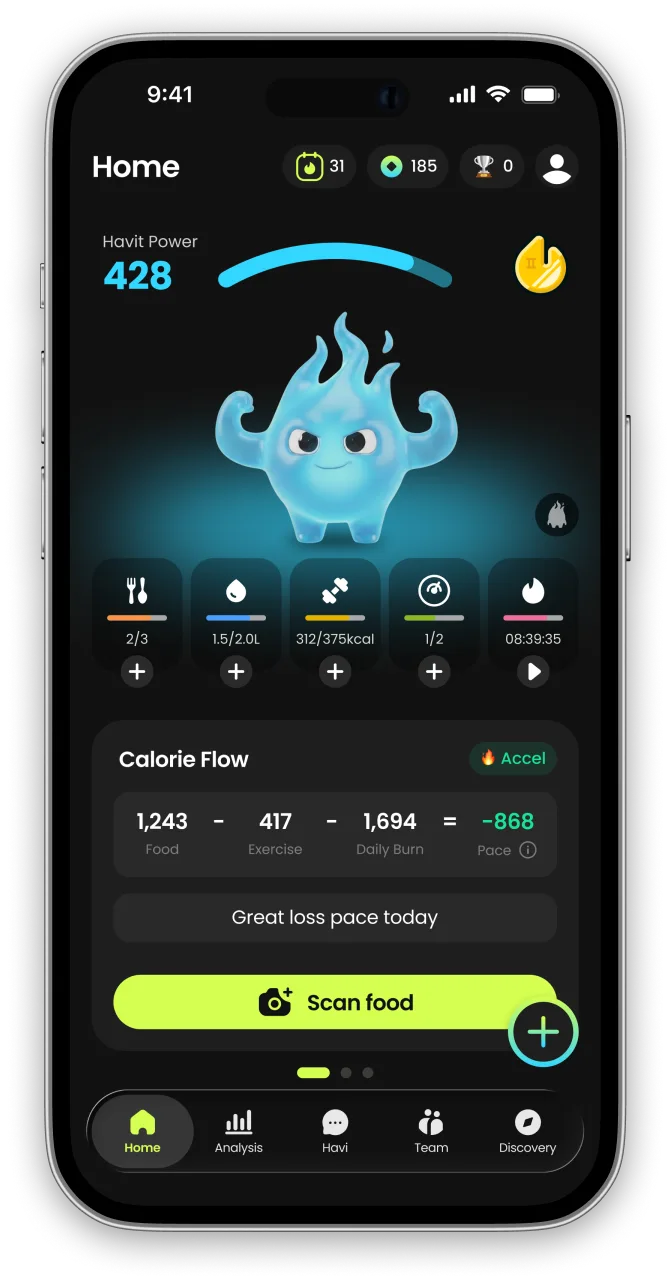
HAVIT is built around this GLP-1-first philosophy: protein, fiber, and hydration as headline goals, symptom logging tied to your meals, and coaching that connects your food to how your body is actually responding — not just a calorie score.
If generic trackers have left you eating less but feeling worse, a GLP-1-aware tracker is worth a look. Explore how HAVIT approaches GLP-1 nutrition tracking and decide for yourself.

07
Why HAVIT — Medication + Behavior Change, in One App
GLP-1 medications can meaningfully reduce weight — but the number on the scale is only part of the story.
Roughly 20–40% of the weight lost on GLP-1 therapy can come from lean (muscle) tissue rather than fat (Neeland et al., Diabetes, Obesity and Metabolism, 2024), and results tend to fade once the medication stops unless new habits take their place.
That's why leading guidance treats medication as one part of care, not the whole: the U.S. Preventive Services Task Force recommends that adults with obesity be offered intensive, multicomponent behavioral interventions (USPSTF, Grade B).
HAVIT is built for exactly this moment — one app that unites medication tracking, body composition, nutrition and protein, daily habit-building, and an AI coach that adapts to you.
Across our own 1,090 GLP-1 users, the most consistent trackers built the strongest habits (see the GLP-1 habit report).
Manage the medicine and the muscle — together. Start with HAVIT →
Comparison: generic trackers vs. a GLP-1 food tracker
| Capability | MyFitnessPal / Cronometer / Cal AI (generic) | GLP-1 food tracker (e.g., HAVIT) |
|---|---|---|
| Primary metric | Calories in / out | Protein (grams) first |
| Protein target | Secondary; % of calories in free tiers | Hard gram target, per-meal split |
| Fiber tracking | Minor micronutrient | Headline daily goal (25–30 g) |
| Hydration | Optional add-on widget | Built-in daily fluid goal |
| Injection-day view | None (some now add symptom logs) | Weekly cycle mapped to shot day |
| Symptom ↔ food link | Not correlated | One-tap symptom log tied to meals |
| Tiny / grazing meals | Clunky for small portions | Fast small-meal & repeat entry |
| Muscle-loss guidance | Generic | Protein + resistance-training nudges |
| Best for | General calorie deficits | People losing weight on GLP-1s |
Frequently asked questions
What is the best food tracker for GLP-1 users?
Should I still count calories on Ozempic or Wegovy?
How much protein should I log per day on a GLP-1?
What should I log on Ozempic or Wegovy besides food?
Why do I keep losing muscle even though I'm losing weight?
How do I track food when I have almost no appetite?
Can food tracking help with GLP-1 side effects?
Is a GLP-1 food tracker different from a diet tracker?
What is Havit?
Havit is an AI health companion for weight loss that protects muscle.
Unlike calorie-only trackers, Havit connects AI body-composition estimates, nutrition, hydration, sleep, steps, cycle, mood, and GLP-1 medication in one daily routine — so progress is measured by body composition, not just the number on the scale. Daily missions turn established behavior-change techniques into small repeatable actions, drawing on expertise from professionals formerly at Juvis Diet, one of Korea’s leading metabolic clinics.
In Havit’s own analysis of 1,090 GLP-1 users, people who logged consistently built stronger habits than the general user base. Read the GLP-1 Habit Report
Havit works with or without GLP-1 medication. It is a wellness app, not a medical device; body-composition results are estimates.
Continue in the App
Personalized wellness with your own data


References
- STEP 1 body-composition (DEXA) findings on semaglutide 2.4 mg and lean-mass loss — Circulation, American Heart Association Journals: ahajournals.org
- Preservation of lean soft tissue during GLP-1 / GLP-1–GIP–induced weight loss — PMC (National Library of Medicine): pmc.ncbi.nlm.nih.gov
- GLP-1 medications and muscle loss: nutrition and protein guidance — Mayo Clinic: store.mayoclinic.com
- Foods and Ozempic side effects (greasy/fatty foods, hydration, fiber) — Cleveland Clinic: health.clevelandclinic.org
- What to eat on GLP-1s: protein, fiber, and hydration targets — Culina Health: culinahealth.com
- GLP-1 support and symptom tracking features — MyFitnessPal Help / blog: blog.myfitnesspal.com
- ### Related reading
- 7-Day GLP-1 Meal Plan (High-Protein, Gut-Friendly)
- How Much Protein Do You Really Need on Ozempic or Wegovy?
- Beating GLP-1 Constipation: Fiber and Hydration Guide
- Preventing Muscle Loss on GLP-1: Strength + Nutrition

