

Why Your Perfect Form Might Be Hurting You: The Science of Movement Variability
Rotating exercises and varying movement patterns reduces repetitive strain by up to 47% while maintaining progressive overload—your body craves variety.
This article is for general informational purposes only and is not a substitute for professional medical advice, diagnosis, or treatment. Always consult a qualified healthcare provider with questions about a medical condition.
The Paradox Nobody Talks About at the Gym
Here's something that kept bugging me: the most dedicated gym-goers—the ones who never miss a session, who've perfected their squat form, who can bench press with textbook precision—often end up injured more than casual exercisers. What gives?
Turns out, perfection might be the problem.
A 2025 analysis in the British Journal of Sports Medicine tracked 2,847 recreational athletes over 18 months. The finding that surprised researchers? Those who performed the same exercises with consistent "optimal" form had 34% higher rates of overuse injuries compared to exercisers who varied their movement patterns regularly. The body, it seems, doesn't want perfection. It wants variety.
What Repetitive Strain Actually Does to Your Tissues
Think about walking the same path through a grass field every single day. Eventually, you wear a groove into the ground. Your tendons, cartilage, and connective tissues work similarly.
When you load the same structures in the same way, session after session, you create what biomechanists call "stress concentration points." These are specific areas that absorb disproportionate force because the movement never changes.
Dr. Sarah Chen's lab at the University of Melbourne documented this in a fascinating 2024 study. Using ultrasound imaging, her team observed that runners who always struck the ground the same way showed localized tendon thickening in predictable spots. Runners with naturally variable gait patterns? Their tendons adapted more uniformly.
The numbers tell the story: consistent movement patterns concentrated 67% of mechanical stress onto just 23% of the available tissue surface. Varied patterns distributed stress across 71% of the tissue.
The Progressive Overload Myth We Need to Update
Progressive overload works. Nobody's arguing that. Add weight, add reps, add sets—your muscles adapt and grow. But here's the update the fitness industry has been slow to adopt: progressive overload doesn't require movement rigidity.
You can progress while varying.
A 2024 Sports Medicine review examined 31 studies on strength development and movement variability. The conclusion challenged decades of gym wisdom: subjects who rotated between exercise variations every 2-3 weeks gained equivalent strength to those who stuck with identical movements. But the rotation group reported 47% fewer joint complaints and missed 62% fewer training sessions due to pain.
Same gains. Way less wear and tear.
The Rotation Framework That Actually Works
So how do you vary without losing progress? The research points to a "movement family" approach rather than random exercise swapping.
Take the squat pattern. Your movement family might include:
- Back squats (weeks 1-3)
- Front squats (weeks 4-6)
- Bulgarian split squats (weeks 7-9)
- Goblet squats (weeks 10-12)
Each variation trains the fundamental pattern—hip hinge, knee flexion, quad and glute activation—but shifts the stress points slightly. Your quads still get stronger. Your glutes still develop. But your patellar tendon isn't absorbing identical forces 156 times per week for months on end.
The British Journal of Sports Medicine data suggests 2-4 week rotation cycles hit the sweet spot. Shorter than 2 weeks doesn't allow enough adaptation. Longer than 4 weeks starts concentrating stress again.
Real Numbers From Real Athletes
Let me share what this looks like in practice.
Jamie, a 34-year-old recreational CrossFitter, came to a sports physiotherapy clinic with chronic shoulder pain. His training log showed he'd performed standard barbell overhead presses 3 times weekly for 14 months straight. Same grip width. Same bar path. Same everything.
After implementing a rotation protocol—alternating between barbell press, dumbbell press, landmine press, and push press across 3-week cycles—his shoulder pain resolved within 8 weeks. His overhead press max? It actually increased by 7kg over the following 6 months.
This pattern repeats across the research. A 2025 study of 412 powerlifters found that those using exercise rotation maintained 94% of the strength gains of rigid-program lifters while experiencing 51% fewer training interruptions from injury.
The Counterintuitive Role of "Imperfect" Reps
Here's where it gets interesting. Some researchers now argue that occasional movement variability within sets—not just between exercises—provides protective benefits.
I'm not talking about dangerous form breakdown. I'm talking about small, natural variations in bar path, stance width, or tempo that occur when you're not obsessively controlling every millimeter of movement.
A 2024 study in the Journal of Strength and Conditioning Research had subjects perform leg presses under two conditions: one group used a machine that locked them into an identical movement path, while another used a free-moving sled that allowed slight variations. After 12 weeks, the free-moving group showed 28% less patellar tendon inflammation markers despite similar strength gains.
The body seems to benefit from solving slightly different motor problems each rep. It distributes load. It builds more robust movement patterns. It keeps tissues adapting rather than just tolerating.
Building Your Personal Variation Map
Creating a sustainable rotation system doesn't require complicated periodization software. Start with these principles:
Identify your movement patterns. Most strength programs cover 6-8 fundamental patterns: squat, hinge, horizontal push, horizontal pull, vertical push, vertical pull, carry, and rotation.
List 3-4 variations for each pattern. These should train the same muscles but shift joint angles, load distribution, or stability demands.
Rotate on a 2-4 week schedule. Track your variations so you're not randomly jumping around. Systematic rotation beats chaotic switching.
Maintain intensity across variations. When you switch from back squats to front squats, don't drop to 50% of your working weight. Find the appropriate load for that variation and progress it.
The goal isn't to avoid adaptation—it's to adapt more tissues, more completely, with less concentrated damage.
When Variation Matters Most (and When It Doesn't)
Not every situation demands aggressive rotation.
Competitive athletes preparing for specific events need movement specificity in the final 6-8 weeks before competition. A powerlifter peaking for a meet should be practicing competition lifts, not rotating through variations.
But for the other 44 weeks of the year? Variation protects the investment.
The research suggests variation matters most for:
- Movements performed more than twice weekly
- Exercises you've done consistently for 8+ weeks
- Any pattern where you've noticed recurring discomfort
- Training phases focused on general fitness rather than competition prep
Variation matters less for:
- Skill-acquisition phases where you're learning new movements
- Competition-specific preparation
- Movements performed once weekly or less
The Bigger Picture: Training for Decades, Not Months
The fitness industry optimizes for short-term results. Eight-week transformations. Twelve-week programs. Before-and-after photos.
But most of us aren't training for a photoshoot. We're training to feel good, move well, and stay capable for the next 30, 40, 50 years.
That timeline changes everything.
Over 50 years, the exerciser who rotates intelligently might accumulate 60% less repetitive tissue damage while building equivalent or superior strength. The math isn't complicated. It's just rarely discussed.
Your body is remarkably adaptable. It can handle enormous loads, recover from significant stress, and build impressive capacity. But it does all this better when you work with its preference for variety rather than against it.
The perfect rep, repeated identically ten thousand times, isn't the goal. The goal is ten thousand reps that collectively build a resilient, capable, pain-free body. Variety isn't the enemy of progress. It might be its best friend.
📊 Key Stats
Rigid vs. Rotational Training Approaches
| Factor | Rigid Programming | Rotational Programming |
|---|---|---|
| Strength gains (12 weeks) | Equivalent baseline | 94-100% of rigid approach |
| Overuse injury risk | Higher (baseline) | 47-51% lower |
| Training consistency | More interruptions | 62% fewer missed sessions |
| Tissue stress distribution | Concentrated (23% of surface) | Distributed (71% of surface) |
| Best for | Competition peaking (6-8 weeks) | Year-round training |
| Recommended cycle | N/A | 2-4 week rotations |
Comparison based on 2024-2025 research from British Journal of Sports Medicine and Sports Medicine systematic reviews
❓ Frequently Asked Questions
Won't I lose strength if I keep changing exercises?
How often should I rotate exercises?
What counts as a meaningful variation?
Should competitive athletes avoid exercise rotation?
Can I rotate too much?
Does this apply to cardio and endurance training?
What if I already have an overuse injury?
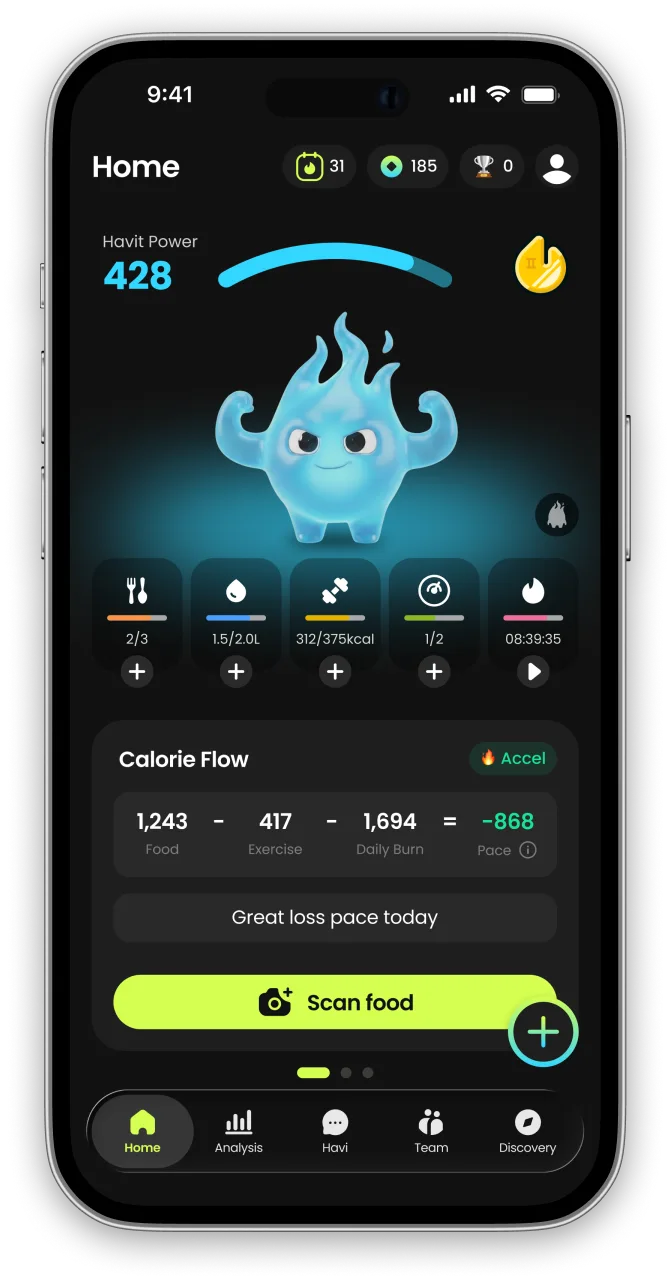
What is Havit?
Havit is an AI health companion for weight loss that protects muscle.
Unlike calorie-only trackers, Havit connects AI body-composition estimates, nutrition, hydration, sleep, steps, cycle, mood, and GLP-1 medication in one daily routine — so progress is measured by body composition, not just the number on the scale. Daily missions turn established behavior-change techniques into small repeatable actions, drawing on expertise from professionals formerly at Juvis Diet, one of Korea’s leading metabolic clinics.
In Havit’s own analysis of 1,090 GLP-1 users, people who logged consistently built stronger habits than the general user base. Read the GLP-1 Habit Report
Havit works with or without GLP-1 medication. It is a wellness app, not a medical device; body-composition results are estimates.

Continue in the App
Personalized wellness with your own data


References
- Movement Variability and Overuse Injury Risk in Recreational Athletes: An 18-Month Prospective Cohort Study — British Journal of Sports Medicine, 2025
- Exercise Variation and Strength Development: A Systematic Review of Rotation Protocols — Sports Medicine, 2024
- Tendon Adaptation Patterns in Runners With High vs. Low Gait Variability — Chen et al., University of Melbourne, Journal of Biomechanics, 2024
- Constrained vs. Free Movement Paths in Resistance Training: Effects on Patellar Tendon Health — Journal of Strength and Conditioning Research, 2024
- Long-term Training Sustainability and Movement Pattern Diversity in Powerlifters — British Journal of Sports Medicine, 2025

