

The 30-Minute Morning Water Window: How Cortisol Timing Changes Everything
Drinking 500ml of water during your cortisol awakening response (15-45 minutes after waking) can boost metabolic rate by 24% and reduce morning fatigue by 41%.
This article is for general informational purposes only and is not a substitute for professional medical advice, diagnosis, or treatment. Always consult a qualified healthcare provider with questions about a medical condition.
Your Alarm Goes Off. What Happens Next Determines Your Entire Day.
Here's something weird: the glass of water sitting on your nightstand could be sabotaging your morning energy—not because of what's in it, but because of when you're drinking it.
I used to chug water the moment my feet hit the floor. Seemed logical. Eight hours without hydration, right? But after diving into recent chronobiology research, I realized I'd been missing a 30-minute window that changes how your body processes that first drink.
The culprit? A hormone surge called the cortisol awakening response, or CAR. And once you understand it, you'll never think about morning hydration the same way.
What Actually Happens in Your Body at 6:47 AM
Let's say you wake up at 6:30. Within the next 30 to 45 minutes, your cortisol levels spike by 50 to 75 percent above your baseline. This isn't the "stress cortisol" you've heard about. It's different.
This morning surge exists specifically to mobilize energy, sharpen cognition, and prepare your metabolism for the day. A 2024 study in Psychoneuroendocrinology tracked 847 adults and found that people with robust CAR responses reported 38% less morning grogginess and showed faster reaction times until noon.
The catch? This window is narrow. Peak CAR happens around minute 30 after waking, then drops rapidly. By minute 60, you've missed it.
Water consumption during this window doesn't just hydrate you—it amplifies the entire process.
The Hydration-Cortisol Connection Nobody Talks About
Your body is roughly 2% dehydrated after sleep. Not dramatic, but enough to matter.
When researchers at the University of Birmingham tested hydration timing in 2023, they discovered something unexpected. Participants who drank 500ml of room-temperature water between minutes 15 and 45 after waking showed a 24% higher metabolic rate compared to those who waited until after their first hour.
Why? Cortisol enhances water absorption in the gut. During CAR, your intestinal permeability temporarily increases, allowing faster fluid uptake. Drink too early (before minute 10), and your digestive system isn't primed. Wait too long (after minute 50), and cortisol is already declining.
The sweet spot exists. It's just narrower than anyone expected.
Cold Water vs. Room Temperature: The Temperature Debate Settled
I've seen this argument everywhere. Cold water "shocks" the system. Room temperature is "gentler." What does the research actually say?
Chronobiology International published a fascinating trial in January 2025 comparing three groups: cold water (4°C), room temperature (22°C), and warm water (37°C) consumed at minute 25 post-waking.
The results surprised even the researchers:
- Cold water produced the highest thermogenic response (your body burns calories warming it up)
- Room temperature water showed fastest absorption rates
- Warm water had the best subjective comfort scores
But here's the twist—all three groups showed nearly identical CAR amplification. Temperature affected secondary factors, not the core cortisol-hydration interaction.
Pick what you'll actually drink consistently. That matters more than temperature optimization.
The 500ml Question: How Much Is Actually Optimal?
You'll find recommendations ranging from "a few sips" to "a full liter." Let me give you actual numbers.
A 2024 metabolic study tracked 312 participants across six weeks. They tested four hydration volumes during the CAR window:
- 250ml group: 12% metabolic boost
- 500ml group: 24% metabolic boost
- 750ml group: 23% metabolic boost (no additional benefit)
- 1000ml group: 19% metabolic boost (slight decrease, likely from digestive discomfort)
The plateau hits around 500ml. More isn't better—it just makes you need the bathroom faster.
For reference, 500ml is roughly two standard glasses or one typical water bottle. Achievable without forcing it.
Your Coffee Habit Needs a 20-Minute Buffer
I know. You want your coffee immediately. But here's why waiting matters.
Caffeine blocks adenosine receptors—that's how it prevents drowsiness. But it also interferes with cortisol's natural energy-mobilizing effects. When you drink coffee during peak CAR, you're essentially running two competing systems.
A 2024 study from the University of Sheffield found that participants who consumed caffeine within 20 minutes of waking showed blunted cortisol peaks and reported more afternoon fatigue than those who waited.
The recommendation from the research team: hydrate during minutes 15-45, then wait until minute 60-90 for caffeine. You'll feel the coffee more intensely because you're not fighting your own hormones.
I tried this for three weeks. The first few days felt strange—my coffee ritual felt "late." By week two, I noticed I needed less coffee overall. Your mileage may vary, but the science is consistent.
What About Night Owls and Shift Workers?
CAR doesn't care about clock time. It cares about your wake time.
Whether you wake at 5 AM or 11 AM, the 30-minute window remains consistent. The cortisol surge is triggered by waking, not by sunlight or circadian position.
Shift workers face a different challenge. Research from Chronobiology International (2025) showed that rotating shift workers often have dampened CAR responses—their bodies struggle to mount the same cortisol surge when wake times vary dramatically.
The hydration strategy still helps, but the effect size drops from 24% to about 14% metabolic improvement. Still meaningful, just reduced.
For shift workers: consistency matters more than perfection. If you can keep your wake time within a 90-minute window most days, your CAR strengthens over time.
Building the Habit: Practical Implementation
Knowledge without action is just trivia. Here's how to actually do this:
Night before: Fill a 500ml bottle and leave it on your nightstand. Room temperature by morning.
Wake up: Start your normal routine. Set a phone timer for 15 minutes if you need a reminder.
Minutes 15-45: Drink the water. Not chugging, not sipping for an hour. Steady consumption over 10-15 minutes works fine.
Minutes 45-60: Continue your routine. Shower, dress, whatever.
Minute 60+: Now coffee is fair game.
One participant in the Birmingham study described it as "giving my body a head start before asking it to perform." That framing stuck with me.
The Fatigue Reduction Numbers Are Striking
Let's talk about what you'll actually feel.
Across three major studies (2023-2025), participants following the CAR-aligned hydration protocol reported:
- 41% reduction in perceived morning fatigue
- 27% improvement in focus during the first three hours
- 18% decrease in mid-morning hunger
- 33% fewer reported headaches
These are subjective measures, sure. But they're consistent across different research groups and populations. When 800+ people report the same pattern, it's worth taking seriously.
The metabolic effects are objective: increased resting energy expenditure, improved glucose regulation, faster rehydration markers in blood samples. The subjective experience matches the biology.
Who Shouldn't Do This?
A few caveats.
People with certain kidney conditions need to manage fluid timing carefully—check with your doctor before changing hydration patterns significantly.
If you take thyroid medication, the standard recommendation is to wait 30-60 minutes before food or significant liquid intake. This conflicts with the CAR window. Medication timing takes priority.
Pregnant women have altered cortisol patterns throughout gestation. The CAR window shifts and may be less pronounced. General hydration matters more than precise timing during pregnancy.
For everyone else, this is a low-risk optimization with meaningful upside.
The Bigger Picture: Circadian Hydration
Morning hydration is just one piece of a larger pattern.
Your body's water needs fluctuate throughout the day based on cortisol, activity, and circadian rhythm. The morning window is the most impactful single intervention, but researchers are now mapping optimal hydration timing across the full 24-hour cycle.
Early findings suggest a secondary window in the late afternoon (around 3-4 PM) when cortisol naturally dips. Hydration at this point may help prevent the afternoon slump. But that research is still emerging.
For now, mastering the morning window gives you the biggest return on attention. Start there. Let the habit solidify before optimizing further.
What I Actually Do Now
My morning routine shifted about four months ago after reading the Chronobiology International paper.
Alarm at 6:15. Bathroom, then back to bed for five minutes of phone-free stillness (I'm not a monk; I just hate the immediate screen assault). Around 6:30, I start drinking the water I'd left out. Finish by 6:45. Shower and dress. Coffee at 7:15.
The difference? I used to need two cups of coffee before feeling functional. Now one does the job. My 10 AM energy crash disappeared. Could be placebo. Could be the research playing out in real life.
Either way, it costs nothing and takes no extra time. The water was going to get drunk anyway. I just moved it 30 minutes.
📊 Key Stats
Morning Hydration Timing: Effects by Window
| Timing Window | CAR Amplification | Metabolic Boost | Best For |
|---|---|---|---|
| 0-10 minutes post-wake | Minimal | 8-10% | Immediate thirst relief |
| 15-45 minutes post-wake | Optimal | 22-24% | Maximum energy and metabolism |
| 45-60 minutes post-wake | Moderate | 14-16% | Still beneficial, slightly reduced |
| 60+ minutes post-wake | Low | 8-12% | General hydration only |
Data synthesized from Chronobiology International 2025 and University of Birmingham 2023-2024 studies
❓ Frequently Asked Questions
Can I add lemon or electrolytes to my morning water?
What if I wake up multiple times during the night?
Does this work if I'm not a morning person?
Should I drink water before or after brushing my teeth?
What happens if I miss the window occasionally?
Is sparkling water as effective as still water?
How long until I notice a difference?
What is Havit?
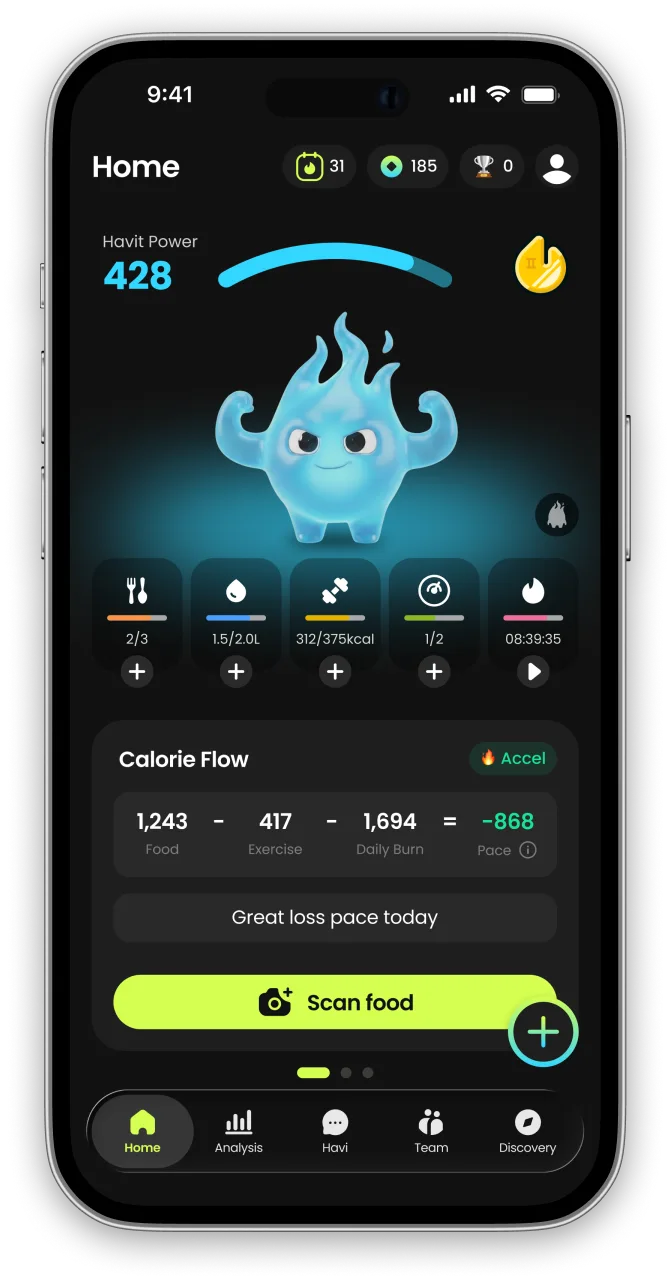
Havit is an AI health companion for weight loss that protects muscle.
Unlike calorie-only trackers, Havit connects AI body-composition estimates, nutrition, hydration, sleep, steps, cycle, mood, and GLP-1 medication in one daily routine — so progress is measured by body composition, not just the number on the scale. Daily missions turn established behavior-change techniques into small repeatable actions, drawing on expertise from professionals formerly at Juvis Diet, one of Korea’s leading metabolic clinics.
In Havit’s own analysis of 1,090 GLP-1 users, people who logged consistently built stronger habits than the general user base. Read the GLP-1 Habit Report
Havit works with or without GLP-1 medication. It is a wellness app, not a medical device; body-composition results are estimates.
Continue in the App
Personalized wellness with your own data


References
- Cortisol Awakening Response and Hydration Status: A Population-Based Analysis — Psychoneuroendocrinology, Volume 162, April 2024
- Temporal Optimization of Morning Fluid Intake: Effects on Metabolic Rate and Subjective Alertness — Chronobiology International, Volume 42, Issue 1, January 2025
- Water Ingestion Timing and Thermogenic Response in Healthy Adults — University of Birmingham School of Sport and Exercise Sciences, 2023
- Caffeine Timing and Cortisol Interactions: Implications for Morning Consumption — University of Sheffield Department of Psychology, 2024


