

The 1-2% Dehydration Threshold: When Your Brain Starts Losing Its Edge
Losing just 1-2% of body weight through dehydration triggers measurable drops in attention, working memory, and mood—often before you feel thirsty.
This article is for general informational purposes only and is not a substitute for professional medical advice, diagnosis, or treatment. Always consult a qualified healthcare provider with questions about a medical condition.
That 3 PM Fog Might Not Be What You Think
You're staring at the same email for the fourth time. The words blur together. Your colleague asks a simple question and you fumble for an answer that should be automatic. Before you blame last night's sleep or this morning's stress, consider this: you might just need water.
A 150-pound person who's lost just 1.5 pounds of water—that's roughly skipping your morning coffee and sweating through a commute—has crossed into territory where their brain measurably underperforms. Not dramatically. Not obviously. But enough that researchers can pick it up in controlled tests. And enough that it accumulates into a foggy, frustrating afternoon.
The Science of the Threshold
For decades, hydration research focused on athletes and extreme conditions. Desert survival. Marathon runners. Military operations. The assumption was that mild dehydration—the kind office workers experience between their morning latte and lunch—didn't really matter.
That assumption was wrong.
A 2024 meta-analysis in the Journal of the American College of Nutrition pooled data from 33 studies involving over 2,000 participants. The findings painted a clear picture: cognitive impairment begins at approximately 1.5% body mass loss, with some individuals showing deficits as early as 1%. By the time you hit 2%, the effects become consistent across nearly all test subjects.
What makes this threshold so insidious is its invisibility. Thirst typically doesn't kick in until 1-2% dehydration has already occurred. Your body's warning system lags behind the damage.
What Actually Happens to Your Brain
Water constitutes about 75% of brain tissue. When fluid levels drop, several things happen simultaneously. Blood volume decreases, which means less oxygen reaches neurons. Electrolyte concentrations shift, affecting signal transmission. The brain actually shrinks slightly—MRI studies show measurable volume reduction at just 2% dehydration.
But you don't need an MRI to notice the effects. They show up in how you think, feel, and perform.
Attention fractures first. In a 2025 study published in Frontiers in Human Neuroscience, participants at 1.5% dehydration showed a 12% increase in reaction time variability on sustained attention tasks. They weren't slower on average—they were inconsistent. Some responses were normal, others delayed. It's the cognitive equivalent of a flickering lightbulb.
Working memory takes the next hit. The same study found that participants could hold fewer items in working memory—about 0.7 fewer items on average. That might sound trivial until you realize working memory is what you use to follow a conversation, hold a phone number in your head while dialing, or keep track of multiple points in a meeting.
Mood deteriorates in parallel. Dehydrated participants reported 23% higher tension and 14% more fatigue compared to their hydrated baseline. Interestingly, women showed more pronounced mood effects at lower dehydration levels than men—a finding that appeared across multiple studies.
The Individual Variation Problem
Here's where it gets complicated. That 1-2% threshold is an average. Some people show cognitive decline at 0.8% body mass loss. Others don't exhibit measurable effects until 2.5%.
Age matters. A 2024 study of adults over 60 found that the threshold shifted lower—closer to 1%—and the cognitive effects were more pronounced. Older adults also have blunted thirst perception, creating a double vulnerability.
Habituation matters too. People who regularly exercise in heat or live in hot climates show some adaptation. Their bodies become more efficient at conserving water, and their cognitive performance degrades less steeply. But this adaptation takes weeks to develop and disappears within days of returning to temperate conditions.
Caffeine complicates the picture. Moderate coffee consumption doesn't dehydrate you—that's a myth—but it does mask some symptoms of dehydration while potentially amplifying others. You might feel alert but still have impaired working memory.
Real-World Scenarios That Cross the Threshold
Let's make this concrete. For a 160-pound person, 1.5% body mass loss equals 2.4 pounds of water—roughly 1.1 liters or about 37 ounces.
How fast can you lose that much?
- A 45-minute moderate workout in a climate-controlled gym: 0.5-1 liter
- Three hours in an air-conditioned office without drinking: 0.3-0.5 liters
- A 90-minute flight: 0.3-0.5 liters (cabin humidity hovers around 10-20%)
- Sleeping 8 hours: 0.3-0.4 liters
Add these up and you can see how a morning flight followed by a few hours of meetings could easily push someone past the threshold—all without any obvious sweating or exertion.
One study tracked office workers and found that 28% were already at 1% dehydration by 10 AM. By 3 PM, that number rose to 41%. The afternoon slump isn't just circadian rhythm. It's accumulated fluid deficit.
The Recovery Timeline
Good news: rehydration works fast. Cognitive performance begins improving within 20-30 minutes of drinking water, with full recovery typically occurring within 45-60 minutes for mild dehydration.
But there's a catch. Gulping large amounts rapidly doesn't speed recovery—it mostly just makes you urinate more. The body can absorb roughly 200-300 ml of water every 15-20 minutes through the small intestine. Drinking 500 ml at once doesn't rehydrate you twice as fast as drinking 250 ml. It just means half of it passes through.
Temperature matters slightly. Cool water (around 16°C or 60°F) empties from the stomach faster than ice-cold or room-temperature water. The difference is modest—maybe 10-15%—but it exists.
Adding a small amount of sodium accelerates absorption. This is why oral rehydration solutions outperform plain water for recovery. You don't need a commercial sports drink; a pinch of salt in water achieves similar effects.
Monitoring Without Obsession
The challenge with hydration is finding the middle ground between ignoring it entirely and becoming neurotically focused on ounces consumed. Neither extreme serves you well.
Urine color remains the simplest practical indicator. Pale yellow suggests adequate hydration. Dark yellow or amber indicates deficit. Clear and colorless might actually mean overhydration, which carries its own risks (hyponatremia, though rare in non-athletes).
Thirst is useful but delayed. By the time you feel thirsty, you're often already at 1-1.5% deficit. Treating thirst as a late warning rather than an early signal makes more sense.
Some people find success with time-based drinking—a glass upon waking, one mid-morning, one with lunch, and so on. This bypasses the need to constantly assess thirst or check urine color.
The 8-glasses-a-day rule is arbitrary but not unreasonable for sedentary adults in temperate climates. Active people, those in hot environments, or those consuming diuretics like alcohol need more.
The Cognitive Cost of Chronic Mild Dehydration
Most dehydration research examines acute effects—what happens when you withhold water for hours or days. But what about people who hover at 1% deficit most of the time? Who rarely feel thirsty because their baseline has shifted?
This is harder to study, but emerging evidence suggests chronic mild dehydration may have cumulative effects. A 2024 longitudinal study followed 1,200 adults over two years, tracking hydration status and cognitive performance. Those who consistently tested at the lower end of hydration showed steeper declines in processing speed over time—about 8% more decline than well-hydrated peers.
Correlation isn't causation. People who drink less water might also have other habits that affect cognition. But the association is strong enough to warrant attention.
Practical Takeaways for Sharper Thinking
The research points toward a few actionable conclusions.
Drink before high-stakes cognitive work. If you have an important presentation, exam, or negotiation, ensure you're well-hydrated beforehand. The 20-30 minute absorption window means drinking right before isn't optimal—aim for 30-45 minutes ahead.
Front-load your intake. Most people drink the majority of their fluids in the evening, when cognitive demands are lower. Shifting consumption earlier captures more benefit.
Watch for compounding factors. Air travel, alcohol the night before, air conditioning, caffeine, and exercise all increase fluid needs. Days with multiple factors require conscious compensation.
Don't rely on thirst alone. Especially if you're over 50, working in climate-controlled environments, or habituated to low fluid intake. Build drinking into your routine rather than waiting for signals.
The brain runs on water. Not exclusively—glucose, oxygen, and sleep matter too. But water is the easiest variable to control, the fastest to correct, and the most commonly overlooked. That afternoon fog might lift with nothing more than a glass of water and twenty minutes of patience.
📊 Key Stats
Cognitive Effects by Dehydration Level
| Dehydration Level | Typical Symptoms | Cognitive Impact | Recovery Time |
|---|---|---|---|
| 0.5-1% | No thirst, normal urine | Minimal or none | N/A |
| 1-1.5% | Mild thirst, slightly darker urine | Attention variability, mild mood changes | 20-30 minutes |
| 1.5-2% | Noticeable thirst, reduced urine output | Working memory decline, fatigue, 12%+ reaction variability | 30-45 minutes |
| 2-3% | Dry mouth, headache possible | Significant attention and memory deficits, irritability | 45-60 minutes |
| 3%+ | Marked thirst, dark urine, fatigue | Severe cognitive impairment, confusion possible | 1-2+ hours |
Effects vary by individual; older adults and women may experience impacts at lower thresholds
❓ Frequently Asked Questions
How much water do I need to drink to avoid cognitive decline?
Does coffee dehydrate you and affect cognitive performance?
Why don't I feel thirsty if I'm already cognitively impaired from dehydration?
Can I drink too much water and harm cognitive function?
Do electrolyte drinks work better than water for cognitive performance?
How quickly does drinking water improve cognitive performance?
Are some people more vulnerable to dehydration's cognitive effects?
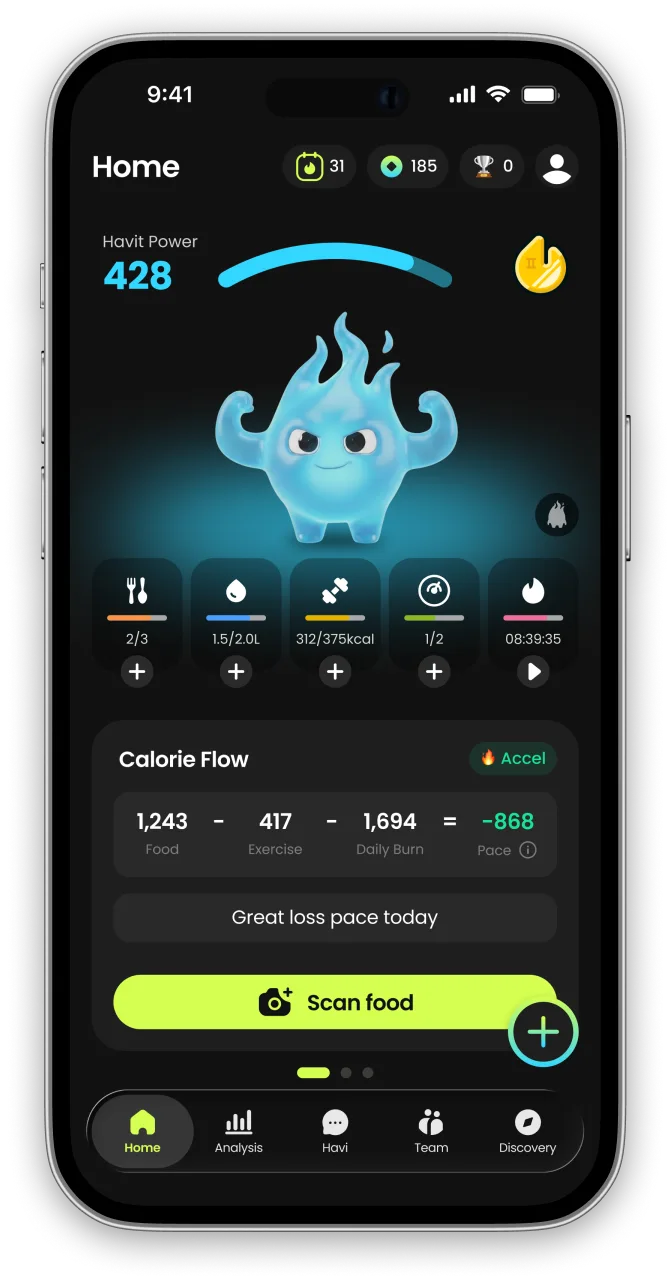
What is Havit?
Havit is an AI health companion for weight loss that protects muscle.
Unlike calorie-only trackers, Havit connects AI body-composition estimates, nutrition, hydration, sleep, steps, cycle, mood, and GLP-1 medication in one daily routine — so progress is measured by body composition, not just the number on the scale. Daily missions turn established behavior-change techniques into small repeatable actions, drawing on expertise from professionals formerly at Juvis Diet, one of Korea’s leading metabolic clinics.
In Havit’s own analysis of 1,090 GLP-1 users, people who logged consistently built stronger habits than the general user base. Read the GLP-1 Habit Report
Havit works with or without GLP-1 medication. It is a wellness app, not a medical device; body-composition results are estimates.

Continue in the App
Personalized wellness with your own data


References
- Mild Dehydration and Cognitive Performance: A Systematic Review and Meta-Analysis — Journal of the American College of Nutrition, 2024
- Hydration Status and Neurocognitive Function: Threshold Effects and Individual Variability — Frontiers in Human Neuroscience, 2025
- Water, Hydration and Health: A Narrative Review — European Journal of Clinical Nutrition, 2024
- Chronic Mild Dehydration and Cognitive Aging: A Two-Year Longitudinal Study — Journal of the American College of Nutrition, 2024

