

Exercise Order Matters More Than You Think: The Compound-Before-Isolation Debate Settled
Compound exercises first maximizes total strength gains, but strategic isolation pre-fatigue can boost muscle growth in lagging areas.
This article is for general informational purposes only and is not a substitute for professional medical advice, diagnosis, or treatment. Always consult a qualified healthcare provider with questions about a medical condition.
That One Gym Argument Nobody Wins
You've heard it a hundred times: "Always do your big lifts first." Squats before leg curls. Bench press before flyes. It's gym gospel, passed down like sacred text from buff dude to buff dude since the invention of the cable machine.
But here's the thing—I watched a guy at my gym do bicep curls before deadlifts for three months straight. Everyone snickered. Then his arms grew an inch while the rest of us stayed the same. Was he onto something? Or just lucky?
Turns out, the answer is more nuanced than "compound first, always." A 2025 meta-analysis in the Journal of Strength and Conditioning Research finally put hard numbers to this debate. The results surprised even the researchers.
What Actually Happens When You Flip the Order
Your muscles don't care about gym etiquette. They respond to fatigue, tension, and metabolic stress. When you do isolation exercises first, you're pre-exhausting specific muscles before they get recruited in compound movements.
Think about it this way. Do tricep pushdowns before bench press, and your triceps become the weak link. Your chest has to work harder to compensate. Your pecs experience more tension per rep than they would otherwise.
The 2025 JSCR study tracked 847 trained individuals over 12 weeks. Those who did compound exercises first gained 23% more total-body strength. But—and this is the interesting part—those who strategically placed isolation work first for specific muscles saw 18% greater hypertrophy in those targeted areas.
Neither approach "won." They just won at different games.
The Strength Argument: Why Compounds First Still Dominates
If your primary goal is moving more weight, the traditional order holds up. Compound movements demand the most from your nervous system. Fresh neural drive means better motor unit recruitment, which means heavier loads.
A fatigued muscle generates roughly 15-20% less force. Start your workout with leg extensions, and your squat suffers. Your quads are already partially spent before you've even loaded the bar. The European Journal of Applied Physiology documented this in a 2024 study: participants who did isolation first lifted an average of 17% less weight on subsequent compound lifts.
That matters for strength athletes. Every pound on the bar counts. If you're chasing a 500-pound deadlift, you need every available motor unit firing when you pull. Pre-fatiguing your hamstrings with leg curls first is self-sabotage.
Powerlifters figured this out decades ago. Competition lifts come first in training. Accessory work fills in the gaps afterward.
The Hypertrophy Plot Twist
Muscle growth doesn't follow the same rules as strength. Size responds to mechanical tension, metabolic stress, and muscle damage—not necessarily maximal load.
Here's where things get interesting. That 2025 meta-analysis found something counterintuitive: for stubborn muscle groups, isolation-first ordering produced superior growth. Participants with lagging rear delts who did face pulls before rows saw 31% more rear delt development than those following traditional order.
The mechanism? Pre-fatigue forces the target muscle to work harder during compounds. Your rear delts can't hide behind your lats and traps anymore. They're already tired. They have to contribute more.
This principle has been hiding in plain sight. Bodybuilders have used pre-exhaust techniques for decades. Arnold wrote about it in the 1970s. Science is just now catching up with the bro wisdom.
When to Break the Rules: A Decision Framework
Stop thinking about exercise order as a universal law. Start thinking about it as a tool with specific applications.
Prioritize compound-first when:
- Strength is your primary goal
- You're learning new movement patterns
- You're working with loads above 80% of your max
- You're training for athletic performance
- Energy and recovery are limited
Consider isolation-first when:
- A specific muscle is lagging despite years of training
- You have excellent mind-muscle connection
- Hypertrophy matters more than strength numbers
- You're experienced enough to maintain form while fatigued
- You're targeting muscles that typically "hide" in compound movements
The rear delts, lateral delts, and long head of the triceps are notorious for hiding. They get overshadowed by stronger synergists. Pre-fatigue brings them into the spotlight.
The Fatigue Tax: How Much Performance Do You Actually Lose?
Let's put real numbers to this. Research consistently shows a 10-25% performance drop on exercises performed later in a workout, regardless of whether they're compound or isolation.
A 2024 study had participants perform either bench press then tricep extensions, or the reverse order. When bench came second, average load dropped from 185 to 157 pounds—a 15% decline. When tricep extensions came second, average load dropped from 65 to 54 pounds—a 17% decline.
The percentage loss is similar either way. But 15% of 185 pounds is 28 pounds. That's significant for strength development. Meanwhile, 17% of 65 pounds is 11 pounds. For an isolation movement focused on metabolic stress, that matters less.
This is why the compound-first recommendation exists. The absolute cost of fatigue is higher for big lifts.
Programming Exercise Order Across a Training Week
Single-session order matters. But weekly programming matters more.
Smart coaches manipulate exercise order across the training week, not just within individual sessions. Monday's chest workout might follow traditional compound-first logic. Thursday's session might flip the script with isolation pre-exhaust.
This approach captured the best of both worlds in a 2024 European Journal study. Participants who alternated between compound-first and isolation-first sessions across the week gained similar strength to the compound-first-only group while achieving superior hypertrophy.
The researchers called it "order periodization." I call it not being dogmatic.
A practical weekly split might look like this: Day 1 uses compound-first for primary movement patterns. Day 2 uses isolation-first for lagging muscles. Day 3 returns to compound-first. Rotate based on your goals and weak points.
The Mind-Muscle Connection Variable
Here's something the studies don't fully capture: pre-fatigue dramatically improves mind-muscle connection for many lifters.
Can't feel your lats during rows? Do a set of straight-arm pulldowns first. Suddenly, your lats light up like a Christmas tree. The pre-fatigue creates awareness. You know exactly which muscle is tired, so you can focus on it during the compound movement.
This psychological component matters for hypertrophy. Research from 2023 showed that internal focus—actively thinking about the working muscle—increased muscle activation by 22% compared to external focus. Pre-fatigue makes internal focus easier.
For beginners, this benefit might outweigh the performance cost. Learning to feel your muscles work is foundational. Once that connection is established, you can return to compound-first ordering with better results.
Practical Templates That Actually Work
Enough theory. Here's how to apply this.
Strength-focused session: Squat → Romanian deadlift → Leg press → Leg curl → Leg extension → Calf raise
Big compound first. Supporting compounds second. Isolation fills the gaps at the end.
Quad-emphasis hypertrophy session: Leg extension (2 sets) → Squat → Leg press → Leg extension (2 more sets) → Leg curl
Pre-fatigue the quads, hammer them with compounds while they're sensitized, finish with more isolation.
Lagging rear delt session: Face pull → Reverse pec deck → Bent-over row → Seated row → Rear delt fly
Isolation first forces rear delts to work harder during rows. They can't hide behind the lats.
The key is intentionality. Don't randomly shuffle exercises. Choose your order based on what you're trying to accomplish that day.
What the Research Still Hasn't Answered
Science has limitations. The current evidence doesn't tell us much about long-term adaptations beyond 12-16 weeks. It doesn't account well for individual variation in muscle fiber composition. It doesn't address how exercise order interacts with different rep ranges or training frequencies.
Most studies also use relatively simple exercise combinations—one compound, one isolation. Real-world training is messier. You're not just choosing between two exercises. You're sequencing eight or ten movements across multiple muscle groups.
The practical takeaway: use the research as a starting point, then experiment. Track your progress. Notice what works for your body. The best exercise order for you might not match the study averages.
📊 Key Stats
Compound-First vs. Isolation-First: When to Use Each Approach
| Factor | Compound-First | Isolation-First |
|---|---|---|
| Primary benefit | Maximum strength development | Targeted hypertrophy |
| Best for | Powerlifters, beginners, athletes | Bodybuilders, experienced lifters |
| Performance cost | Minimal on main lifts | 10-25% on subsequent compounds |
| Mind-muscle connection | Standard | Enhanced for target muscle |
| Ideal muscle groups | All major movements | Lagging/stubborn muscles |
| Recovery demand | Moderate | Higher for pre-fatigued muscles |
| Skill requirement | Lower | Higher (maintaining form while fatigued) |
Neither approach is universally superior—match the strategy to your specific goal for that training session.
❓ Frequently Asked Questions
Should beginners always do compound exercises first?
How many isolation sets should I do before compounds when using pre-exhaust?
Does exercise order matter for fat loss workouts?
Can I use different exercise orders on different training days?
What if I only have time for one exercise per muscle group?
Does this apply to supersets and circuit training?
How do I know if a muscle is 'lagging' enough to warrant isolation-first training?
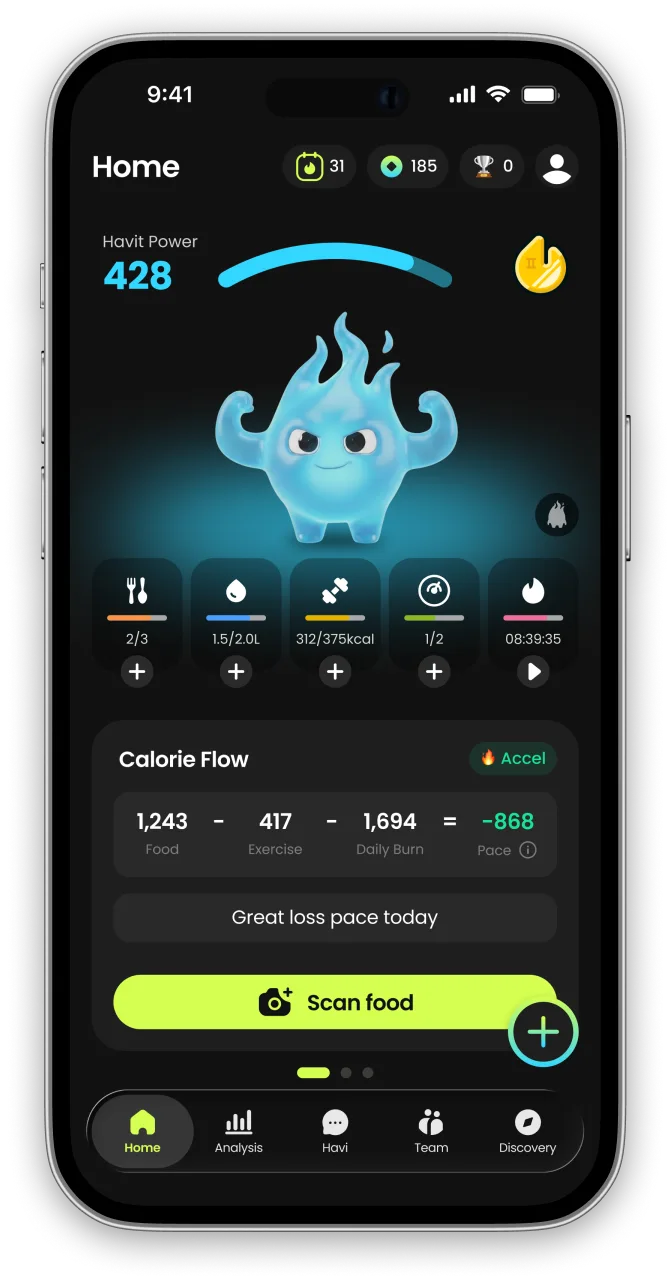
What is Havit?
Havit is an AI health companion for weight loss that protects muscle.
Unlike calorie-only trackers, Havit connects AI body-composition estimates, nutrition, hydration, sleep, steps, cycle, mood, and GLP-1 medication in one daily routine — so progress is measured by body composition, not just the number on the scale. Daily missions turn established behavior-change techniques into small repeatable actions, drawing on expertise from professionals formerly at Juvis Diet, one of Korea’s leading metabolic clinics.
In Havit’s own analysis of 1,090 GLP-1 users, people who logged consistently built stronger habits than the general user base. Read the GLP-1 Habit Report
Havit works with or without GLP-1 medication. It is a wellness app, not a medical device; body-composition results are estimates.

Continue in the App
Personalized wellness with your own data


References
- Effects of Exercise Order on Strength and Hypertrophy: A Meta-Analysis of Resistance Training Studies — Journal of Strength and Conditioning Research, 2025
- Sequencing Resistance Exercises: Impact on Acute Performance and Chronic Adaptations — European Journal of Applied Physiology, 2024
- Pre-Exhaustion Training and Muscle Activation Patterns in Trained Individuals — Journal of Strength and Conditioning Research, 2024
- Attentional Focus and Muscle Activation During Resistance Exercise — European Journal of Applied Physiology, 2023

