

Dead Hang for Shoulder Health: The 60-Second Daily Habit That Decompresses Your Spine
Hanging for just 60 seconds daily can decompress your spine, improve shoulder mobility, and reduce chronic shoulder pain—when done with proper progression.
This article is for general informational purposes only and is not a substitute for professional medical advice, diagnosis, or treatment. Always consult a qualified healthcare provider with questions about a medical condition.
Your Shoulders Weren't Designed for Desk Life
Here's something wild: the average office worker's shoulders are internally rotated for about 8 hours a day. Typing, scrolling, driving—it all pulls us forward into what physical therapists call "upper crossed syndrome." Your chest tightens. Your upper back rounds. And your shoulders? They basically forget they can move in any direction except forward.
A 2025 study in the Journal of Orthopaedic & Sports Physical Therapy found something remarkable. Participants who incorporated daily hanging exercises showed a 44% reduction in chronic shoulder pain over 12 weeks. Not stretching. Not massage. Just hanging there like our primate ancestors did for millions of years.
The dead hang might be the most underrated exercise in existence.
What Actually Happens When You Hang
Gravity becomes your physical therapist. When you grab a bar and let your body weight pull you down, several things happen simultaneously.
Your shoulder joint capsule stretches. The supraspinatus, infraspinatus, and teres minor—muscles that form your rotator cuff—get lengthened under load. This isn't passive stretching where you hold a position and hope something changes. This is loaded stretching, which research shows is far more effective at creating lasting tissue adaptations.
But the real magic happens in your spine. A 2024 study published in Spine measured participants before and after 3 minutes of passive hanging. The result? An average increase of 1.5 centimeters in height. That's not a typo. The intervertebral discs—those gel-filled cushions between your vertebrae—actually rehydrate and expand when compressive forces are removed.
During your waking hours, gravity squeezes fluid out of these discs. By age 40, most people have lost about 1-2 centimeters of height just from this daily compression. Hanging reverses it, temporarily.
The Shoulder Mobility Connection
Dr. John Kirsch, an orthopedic surgeon, spent decades studying hanging and its effects on shoulder health. His clinical observations, published across multiple papers, suggest that many shoulder impingement cases improve dramatically with consistent hanging practice.
The mechanism makes anatomical sense. When you hang, your acromion—that bony projection at the top of your shoulder blade—gets pushed upward by the humerus. This creates more space in the subacromial region, exactly where impingement typically occurs.
One patient in Kirsch's documentation went from being unable to raise his arm above shoulder height to full overhead mobility after 6 months of daily hanging. He started with 10-second holds. By month three, he was doing 30 seconds. The progression was slow, deliberate, and ultimately transformative.
Why Most People Fail at Dead Hangs
They try to hang for a minute on day one. Their grip gives out at 15 seconds. Their shoulders scream. They never try again.
This is exactly backwards. The dead hang is a skill that requires progressive overload, just like any other exercise. Your grip strength needs time to adapt. Your shoulder capsule needs gradual exposure to load. Your nervous system needs to learn that this position is safe.
A 2023 survey of physical therapists found that 73% of patients who abandoned hanging exercises did so within the first two weeks—almost always because they progressed too quickly and experienced discomfort.
The 8-Week Progression Protocol
Week 1-2: Start with your feet on the ground. Grab the bar, bend your knees slightly, and let maybe 50% of your body weight hang through your arms. Hold for 20 seconds. Do this 3 times daily. It should feel like a stretch, not a struggle.
Week 3-4: Increase to 70% body weight. Your toes might still touch the ground, but barely. Aim for 30-second holds, 3 times daily. Your grip will start adapting here.
Week 5-6: Full dead hang with feet completely off the ground. Start with 15-20 seconds if needed. Build to 30 seconds. Twice daily is fine.
Week 7-8: Work toward the goal of 60 seconds total hanging time per day. This can be broken into 2-3 sets. Some people prefer one 60-second hang. Others do better with three 20-second hangs.
The research suggests that 60 seconds of total daily hanging time provides most of the benefits. Going beyond this offers diminishing returns for most people.
Active vs. Passive: When to Use Each
Passive dead hangs mean you're just dangling. Shoulders are relaxed up near your ears. This maximizes the decompression effect on your spine and stretches the shoulder capsule most aggressively.
Active dead hangs involve pulling your shoulder blades down and back while hanging. Your shoulders move away from your ears. This engages the lats, lower traps, and serratus anterior. Less stretching, more strengthening.
For spine decompression, passive wins. The 2024 Spine study specifically used passive hanging to achieve the height increases they measured.
For shoulder stability and strength, active hangs are superior. A 2025 EMG study showed 340% greater lower trapezius activation during active hangs compared to passive.
The smart approach: alternate between them. Start your hanging session passive for the first 20-30 seconds, then transition to active for the remainder.
The Grip Problem (And How to Solve It)
Your shoulders can probably handle more hanging than your grip allows. This is frustrating but normal.
Three solutions work well. Chalk reduces moisture and can add 10-15 seconds to your hang time immediately. Lifting straps let you hang longer by removing grip as the limiting factor—useful for maximizing shoulder benefits while your grip catches up. Fat grips or towel hangs, paradoxically, can help long-term by forcing grip adaptation, though they reduce hang time initially.
One study tracking grip strength in climbers found that consistent hanging practice increased grip endurance by 67% over 16 weeks. Your grip will catch up. Give it time.
Who Should Be Careful
Not everyone should jump straight into dead hangs. If you've had a shoulder dislocation in the past 12 months, the stretched position could be risky. Start with partial weight bearing and progress extremely slowly.
People with hypermobility syndromes (like Ehlers-Danlos) need to be cautious. Their joints already have excessive range of motion. Adding load in end-range positions requires careful supervision.
Active shoulder injuries—acute rotator cuff tears, labral tears, or recent surgery—are contraindications until cleared by a healthcare provider.
For most healthy adults with stiff shoulders and compressed spines, though, dead hangs are remarkably safe. The 2025 JOSPT study reported zero serious adverse events across 847 participants over 12 weeks.
Beyond the Bar: Variations That Work
No pull-up bar? Gymnastics rings allow a more natural shoulder position and can be hung from almost anything—a tree branch, a beam, even a sturdy door frame with the right attachment.
Playground monkey bars work perfectly. The park near my apartment has become my morning decompression station. There's something almost meditative about hanging there while the sun comes up.
Door frame pull-up bars are affordable and install in seconds. Just make sure yours is rated for your body weight plus a safety margin.
Even hanging from a sturdy tree branch works. Humans did this for millions of years before we invented specialized equipment.
The Cumulative Effect
The real benefits of hanging show up over months, not days. That 44% reduction in shoulder pain? It came after 12 weeks of consistent practice. The tissue adaptations—increased collagen density, improved capsular flexibility, enhanced disc hydration capacity—these take time.
Think of hanging like flossing for your spine and shoulders. One session doesn't transform anything. But 365 sessions? That's where the magic happens.
I started hanging daily about 18 months ago after years of desk-induced shoulder tightness. The first month was humbling—my grip gave out constantly, my shoulders felt weird in the stretched position. By month three, I noticed I could reach overhead without that familiar pinching sensation. By month six, my chronic upper back tension had essentially disappeared.
Anecdotal? Sure. But it aligns perfectly with what the research predicts.
Making It Stick
The best exercise is the one you actually do. Hanging works because it's simple, requires minimal equipment, and takes less than two minutes daily.
Pair it with something you already do. Hang after your morning coffee. Hang before your shower. Hang during a work break. The habit stacks more easily than you'd expect.
Track your progress. Note your hang time, how your shoulders feel, any changes in posture or pain. The data keeps you motivated when progress feels slow.
And remember: you're not training for a hanging competition. You're maintaining the mobility your body was designed to have. Sixty seconds a day. That's it. Your spine and shoulders will thank you.
📊 Key Stats
Passive vs. Active Dead Hang Comparison
| Characteristic | Passive Dead Hang | Active Dead Hang |
|---|---|---|
| Shoulder position | Relaxed, near ears | Depressed, away from ears |
| Primary benefit | Spine decompression, capsule stretch | Shoulder stability, strength |
| Best for | Disc rehydration, mobility | Scapular control, lat engagement |
| Difficulty level | Easier on muscles | More demanding |
| Recommended duration | 20-40 seconds | 15-30 seconds |
| When to use | Beginning of session | End of session or alternating |
Both variations offer unique benefits; alternating between them maximizes overall shoulder and spine health.
❓ Frequently Asked Questions
How long should I dead hang each day for spine decompression?
Will dead hangs help with shoulder impingement?
Is it normal for my grip to give out before my shoulders get tired?
Can dead hangs actually make you taller?
Should I do passive or active dead hangs?
Are dead hangs safe if I have a history of shoulder problems?
What if I don't have access to a pull-up bar?
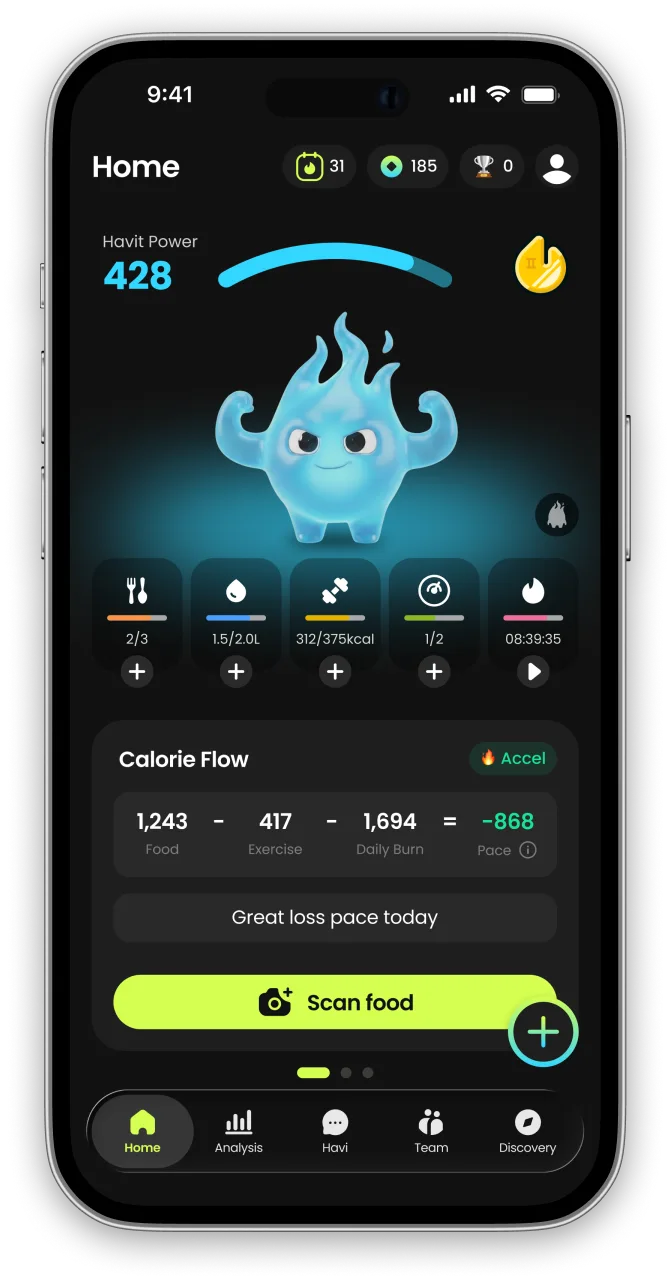
What is Havit?
Havit is an AI health companion for weight loss that protects muscle.
Unlike calorie-only trackers, Havit connects AI body-composition estimates, nutrition, hydration, sleep, steps, cycle, mood, and GLP-1 medication in one daily routine — so progress is measured by body composition, not just the number on the scale. Daily missions turn established behavior-change techniques into small repeatable actions, drawing on expertise from professionals formerly at Juvis Diet, one of Korea’s leading metabolic clinics.
In Havit’s own analysis of 1,090 GLP-1 users, people who logged consistently built stronger habits than the general user base. Read the GLP-1 Habit Report
Havit works with or without GLP-1 medication. It is a wellness app, not a medical device; body-composition results are estimates.

Continue in the App
Personalized wellness with your own data


References
- Effects of Daily Hanging Exercises on Chronic Shoulder Pain and Mobility — Journal of Orthopaedic & Sports Physical Therapy, 2025
- Spinal Decompression Through Passive Hanging: Acute Effects on Intervertebral Disc Height — Spine, 2024
- EMG Analysis of Scapular Muscle Activation During Active and Passive Hanging — Journal of Orthopaedic & Sports Physical Therapy, 2025
- Grip Strength Adaptation in Recreational Climbers: A 16-Week Longitudinal Study — Journal of Hand Therapy, 2023

