

The 10,000 Steps Myth: How a 1960s Pedometer Ad Became Global Health Advice
10,000 steps originated from a 1965 Japanese pedometer campaign; 2024 research shows mortality benefits plateau around 7,000-8,000 steps for most adults.
This article is for general informational purposes only and is not a substitute for professional medical advice, diagnosis, or treatment. Always consult a qualified healthcare provider with questions about a medical condition.
A Number Born from Marketing, Not Medicine
What if the health goal you've been chasing for years was invented by an advertising team?
In 1965, a Japanese company named Yamasa Clock launched a pedometer called "Manpo-kei." The name translates to "10,000 steps meter." That's it. That's the entire origin story of the world's most famous fitness target. No clinical trials. No longitudinal studies. Just a catchy product name that happened to stick around for six decades.
The number 10,000 looked good in Japanese characters. It was round, memorable, and felt ambitious but achievable. Yamasa's marketing team probably never imagined their slogan would end up in WHO guidelines, smartphone default settings, and the anxious minds of millions checking their wrists at 9 PM.
What the Science Actually Says Now
For decades, researchers assumed someone had done the homework. Surely this globally accepted target had solid evidence behind it?
Not quite. The first rigorous examination didn't come until 2019, when Harvard researchers tracked 16,741 older women and found mortality benefits leveled off around 7,500 steps. But the landmark study arrived in 2024.
Published in JAMA Internal Medicine, this massive analysis followed 226,889 participants across multiple countries. The findings were clear but nuanced. Yes, more steps generally meant lower mortality risk. But the relationship wasn't linear, and it definitely didn't hinge on hitting exactly 10,000.
For adults under 60, benefits continued climbing until about 8,000-10,000 steps. For those over 60? The sweet spot sat lower, around 6,000-8,000 steps. Beyond these ranges, the curve flattened. Walking 15,000 steps didn't provide dramatically more protection than walking 8,000.
The Dose-Response Curve Explained
Think of it like vitamin C. Your body needs it. More is better up to a point. But megadosing doesn't make you superhuman—it just makes expensive urine.
The Lancet Public Health published a 2025 meta-analysis examining this dose-response relationship across 17 studies and 250,000+ participants. Their conclusion? Each additional 1,000 steps reduced all-cause mortality risk by roughly 12%, but only until you hit the plateau zone.
Here's what that looks like in practice:
- Going from 2,000 to 4,000 steps: substantial benefit
- Going from 4,000 to 6,000 steps: still significant
- Going from 6,000 to 8,000 steps: meaningful gains
- Going from 8,000 to 12,000 steps: marginal improvements
- Going from 12,000 to 20,000 steps: basically flat
The person walking 4,000 steps who adds 2,000 more gains far more than the person walking 12,000 who adds another 4,000. This matters enormously for how we think about daily movement goals.
Why Your Age Changes Everything
A 35-year-old and a 70-year-old shouldn't chase the same step target. The JAMA study made this explicit.
Younger adults showed continued mortality reduction up to about 8,000-10,000 daily steps. Their bodies could handle and benefit from higher activity volumes. The cardiovascular system, metabolic function, and musculoskeletal health all responded positively to more movement.
Older adults hit their optimal zone earlier. Around 6,000-8,000 steps delivered maximum benefit. This isn't about older people being "less capable"—it's about different physiological responses to exercise stress and recovery demands.
One 68-year-old participant in a related study put it well: "I used to feel guilty every day I didn't hit 10,000. Now I know my 6,500 steps are actually doing the job."
The Intensity Question Nobody Asks
Step counts ignore something crucial: how you're walking.
3,000 brisk steps up a hilly trail stress your cardiovascular system completely differently than 3,000 leisurely steps around a flat mall. The 2024 research acknowledged this limitation but couldn't fully account for it in population-level data.
Smaller studies suggest intensity matters significantly. A 2023 analysis in the British Journal of Sports Medicine found that "cadence peaks"—short bursts of faster walking—correlated with better outcomes independent of total step count. Even just 30 minutes of purposeful, moderate-pace walking showed stronger associations with longevity than double that time spent shuffling.
This doesn't mean casual walking is worthless. It absolutely counts. But if you're optimizing, occasional faster segments probably help more than simply adding more slow steps.
The Sitting Problem Steps Don't Solve
Here's an uncomfortable truth: you can hit 10,000 steps and still face elevated health risks.
If those steps happen in one morning burst followed by 14 hours of sitting, you're not fully protected. Prolonged sedentary time carries independent health risks that step counts alone don't capture.
Research from the American Heart Association in 2024 found that breaking up sitting time—even with brief 2-3 minute movement breaks—reduced cardiovascular risk markers regardless of total daily steps. Someone walking 6,000 steps spread throughout the day might actually fare better than someone cramming 10,000 steps into a single session bookended by desk-bound hours.
The emerging consensus? Total steps matter. But distribution matters too. And intensity adds another layer.
Practical Targets That Actually Make Sense
So what should you actually aim for?
If you're currently sedentary (under 3,000 steps daily), adding 2,000-3,000 steps delivers the biggest bang for your buck. Don't worry about 10,000. Just move more than yesterday.
If you're moderately active (4,000-6,000 steps), pushing toward 7,000-8,000 steps still provides meaningful benefits. This is achievable for most people with a 20-30 minute daily walk.
If you're already hitting 8,000+ steps regularly, congratulations—you're likely capturing most of the mortality benefit available through walking. Additional steps won't hurt, but they probably won't dramatically change your health trajectory either.
The real question isn't "How do I hit 10,000?" It's "What's the minimum effective dose for my situation, and how do I make it sustainable?"
Why the Myth Persists
Round numbers are sticky. "Walk more" lacks punch. "10,000 steps" fits on a billboard.
Fitness trackers defaulted to 10,000 because... well, everyone else used 10,000. The WHO included it in physical activity guidelines partly because it had become so culturally embedded. Challenging it felt like telling people Santa isn't real.
There's also something psychologically satisfying about a clear target. Ambiguity is uncomfortable. "Somewhere between 6,000 and 10,000 depending on your age and other factors" doesn't motivate like a single shining number.
But good health advice shouldn't prioritize catchiness over accuracy. And now that we have large-scale evidence, clinging to a marketing slogan from 1965 seems increasingly silly.
The Bottom Line on Daily Movement
The 10,000 steps goal isn't dangerous. It's just arbitrary. Walking that much certainly won't harm a healthy person, and it's a reasonable target for younger, active adults.
But if you're 65 and feeling defeated because you "only" managed 5,500 steps today? You're probably fine. If you're 40 and wondering whether grinding out those last 2,000 steps at 11 PM really matters? It probably doesn't much.
Move regularly. Walk at a pace that occasionally makes conversation slightly harder. Break up long sitting periods. And stop letting a Japanese pedometer company from six decades ago dictate your daily anxiety levels.
Your body doesn't know about round numbers. It just knows whether you're moving enough to stay healthy. And "enough" is almost certainly less than you've been told.
📊 Key Stats
Step Count Benefits by Daily Range
| Daily Steps | Mortality Benefit | Best For | Notes |
|---|---|---|---|
| Under 4,000 | Baseline/minimal | Currently sedentary individuals | Any increase provides significant gains |
| 4,000-6,000 | Moderate reduction | Older adults, those with mobility limits | Captures majority of longevity benefit for 60+ |
| 6,000-8,000 | Strong reduction | Most adults over 60 | Optimal zone for older populations |
| 8,000-10,000 | Near-maximum benefit | Adults under 60 | Diminishing returns begin here for most |
| 10,000-15,000 | Marginal additional benefit | Highly active individuals | Benefits plateau; not harmful but not dramatically better |
| 15,000+ | Minimal additional benefit | Athletes, active occupations | No significant mortality advantage over 10,000 |
Data synthesized from JAMA Internal Medicine 2024 and Lancet Public Health 2025 meta-analyses
❓ Frequently Asked Questions
Is walking 10,000 steps a day actually necessary for good health?
Where did the 10,000 steps goal originally come from?
How many steps should older adults aim for daily?
Does walking speed matter more than step count?
Can I still be unhealthy if I hit 10,000 steps daily?
What's the minimum number of steps that provides health benefits?
Should fitness trackers change their default goal from 10,000 steps?
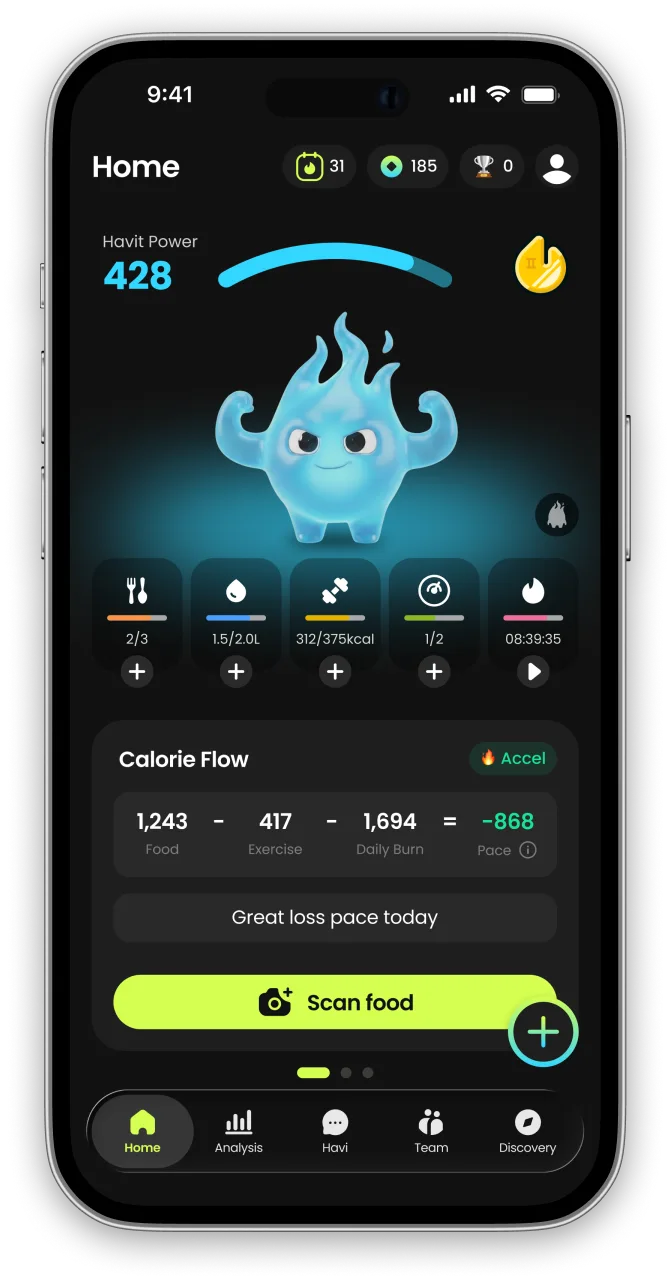
What is Havit?
Havit is an AI health companion for weight loss that protects muscle.
Unlike calorie-only trackers, Havit connects AI body-composition estimates, nutrition, hydration, sleep, steps, cycle, mood, and GLP-1 medication in one daily routine — so progress is measured by body composition, not just the number on the scale. Daily missions turn established behavior-change techniques into small repeatable actions, drawing on expertise from professionals formerly at Juvis Diet, one of Korea’s leading metabolic clinics.
In Havit’s own analysis of 1,090 GLP-1 users, people who logged consistently built stronger habits than the general user base. Read the GLP-1 Habit Report
Havit works with or without GLP-1 medication. It is a wellness app, not a medical device; body-composition results are estimates.

Continue in the App
Personalized wellness with your own data


References
- Association of Daily Step Count and Intensity With Mortality Among US Adults — JAMA Internal Medicine, 2024
- Physical Activity Dose-Response and All-Cause Mortality: Systematic Review and Meta-Analysis — Lancet Public Health, 2025
- Association of Step Volume and Intensity With All-Cause Mortality in Older Women — JAMA Internal Medicine, 2019 (I-Min Lee et al., Harvard)
- Breaking Up Prolonged Sitting and Cardiometabolic Risk Markers — American Heart Association Scientific Sessions, 2024
- The History of the 10,000 Steps Recommendation — International Journal of Behavioral Nutrition and Physical Activity, Historical Review

