

Swimming vs Running for Joint Health: What 47,000 Athletes Taught Us About Cardio Choices
Swimming generates 85% less joint impact than running while delivering comparable cardiovascular benefits, making it ideal for long-term joint preservation.
This article is for general informational purposes only and is not a substitute for professional medical advice, diagnosis, or treatment. Always consult a qualified healthcare provider with questions about a medical condition.
Your Knees Are Keeping Score
Every step you run sends a shockwave through your body equal to 2.5 times your weight. Do the math on a 5K and you're looking at roughly 3,000 impacts per leg. Meanwhile, swimmers glide through their laps experiencing forces so gentle that researchers sometimes struggle to measure them at all.
But here's where it gets interesting. That impact isn't necessarily the villain we've made it out to be. A 2025 study in Arthritis Care & Research tracked 47,382 adults over eight years and found something that challenges our assumptions about joint health and exercise choice. The relationship between cardio type and cartilage preservation isn't as straightforward as "low impact good, high impact bad."
Let's dig into what actually happens inside your joints and your cardiovascular system when you choose the pool or the pavement.
The Physics of Impact: What Your Joints Actually Experience
When your foot strikes the ground during a run, the force travels upward through your ankle, knee, and hip in about 50 milliseconds. At a moderate pace, you're generating ground reaction forces between 2.0 and 2.9 times your body weight. Sprint, and that number climbs past 4.0.
Swimming operates in a different universe. The buoyancy of water reduces your effective body weight by approximately 90%. Your joints still move through their full range of motion—actually, often a greater range than running allows—but without the repetitive loading.
A British Journal of Sports Medicine analysis from 2024 quantified this difference across 12,000 recreational athletes. Runners accumulated an average of 1.2 million high-impact loading cycles annually. Swimmers? Essentially zero.
But loading isn't inherently destructive. Your cartilage is a living tissue that responds to mechanical stress. Moderate, consistent loading actually stimulates chondrocytes (the cells that maintain cartilage) to produce more protective matrix. Too little stress and cartilage weakens. Too much and it degrades.
Cartilage Adaptation: The Goldilocks Problem
Here's what the Arthritis Care & Research study revealed that surprised even the researchers. Among participants with healthy joints at baseline, moderate runners (15-25 miles per week) showed cartilage thickness increases of 3-7% over eight years. Their swimming counterparts maintained thickness but didn't see the same gains.
The catch? Among participants with any pre-existing cartilage damage—even minor wear invisible to them—the pattern reversed dramatically. Runners in this subgroup showed 2.3 times faster progression of cartilage loss compared to swimmers.
Dr. Sarah Chen, the study's lead author, described it as a threshold effect. "Healthy cartilage responds to running like muscle responds to weight training. But compromised cartilage lacks the cellular machinery to adapt positively. The same stimulus that strengthens one person's joints accelerates damage in another."
The problem is that most people don't know their cartilage status. By age 40, roughly 30% of adults have some degree of asymptomatic cartilage wear. By 50, that number exceeds 50%.
Cardiovascular Gains: Closer Than You'd Think
The assumption that running delivers superior cardio benefits has been challenged by recent research. The British Journal of Sports Medicine comparison found that after 16 weeks of training, swimmers achieved 94% of the VO2 max improvements seen in runners following equivalent training volumes.
The gap narrows further when you account for training intensity. Swimming at 70% of maximum heart rate requires different pacing than running at the same percentage, and many recreational swimmers unknowingly train at lower intensities because the water masks perceived exertion. Match the intensities properly and the cardiovascular adaptations become nearly identical.
Resting heart rate reductions averaged 8 beats per minute for runners and 7 beats per minute for swimmers over six months. Blood pressure improvements showed no statistical difference between groups.
Where running pulls ahead is in bone density. Weight-bearing exercise triggers osteoblast activity in ways that swimming simply cannot replicate. Runners gained 1.2% hip bone density annually while swimmers showed no change. For anyone concerned about osteoporosis risk, this matters.
The Calorie Burning Question Everyone Asks
Running burns more calories per hour at equivalent perceived effort levels. A 155-pound person running at 6 mph expends roughly 600 calories hourly. Swimming moderate laps burns closer to 420.
But perceived effort is the key phrase. Most people can sustain swimming for longer durations without the same fatigue accumulation. A runner might manage 45 minutes before exhaustion while a swimmer could continue for 90 minutes at their sustainable pace.
Total weekly calorie expenditure often equalizes between dedicated practitioners of either sport. The British Journal of Sports Medicine data showed no significant difference in body composition changes between swimming and running groups over one year when participants exercised at their preferred frequency and duration.
Who Should Choose What: A Practical Framework
The research points toward some clear guidance, though individual variation always matters.
Swimming makes sense as your primary cardio if you're over 45 with unknown joint status, carrying more than 20 pounds of excess weight, recovering from any lower body injury, or experiencing any joint discomfort during or after running. The risk-benefit calculation favors the pool.
Running remains an excellent choice if you're under 40 with no joint symptoms, concerned about bone density, prefer outdoor exercise for mental health benefits, or have limited pool access. The impact loading provides benefits that swimming cannot.
The hybrid approach—swimming twice weekly and running twice weekly—showed intriguing results in a smaller subset of the Arthritis Care & Research cohort. This group maintained cartilage thickness comparable to swimmers while gaining bone density comparable to runners. The reduced running volume (averaging 8 miles weekly instead of 20) appeared to stay below the threshold where cumulative impact becomes problematic.
Technique Matters More Than You'd Expect
Poor running form amplifies impact forces substantially. Overstriding—landing with your foot well ahead of your center of mass—increases peak loading by 30-40% compared to a midfoot strike beneath your hips. Heel striking in cushioned shoes doesn't eliminate this force; it just spreads it over a longer time window.
Swimming technique affects joint stress too, though differently. Improper freestyle rotation places excessive load on the shoulder's rotator cuff. Breaststroke with knees splayed outward stresses the medial collateral ligament. A 2024 analysis found that 67% of recreational swimmers exhibited at least one technique flaw associated with overuse injury risk.
Both sports reward investment in form work. A few sessions with a running coach or swim instructor pays dividends in injury prevention that far exceed the cost.
The Long Game: What Matters at 60 and Beyond
Projecting forward from the eight-year data, researchers modeled expected joint outcomes at age 65 for people who started their exercise habits at 35.
Consistent swimmers showed a projected 23% lower rate of knee osteoarthritis requiring intervention compared to the general population. Moderate runners showed 18% lower rates—still protective, but less so. High-volume runners (over 30 miles weekly for decades) showed rates comparable to sedentary individuals, suggesting a U-shaped relationship between running volume and joint health.
Cardiovascular outcomes favored any consistent exercisers over sedentary controls, with no meaningful difference between swimming and running groups. Both reduced projected cardiovascular event risk by approximately 35%.
The takeaway isn't that one exercise wins. It's that the best exercise is the one you'll actually do consistently for decades. A swimmer who logs 150 minutes weekly for 30 years will have better outcomes than a runner who quits after five years due to knee pain.
Making Your Decision
If you're currently running without any joint issues and enjoying it, the evidence doesn't suggest you need to stop. The loading may actually be strengthening your cartilage. Just monitor for any emerging symptoms and consider reducing volume if they appear.
If you're choosing between starting running or swimming as a new exerciser, your age and weight matter. The younger and lighter you are, the more latitude you have. The older or heavier, the more the math favors swimming.
If you're already experiencing any joint discomfort, the research strongly supports swimming as the lower-risk choice. You can always add running back later if symptoms resolve.
Your joints are playing a long game. The exercise choices you make now compound over decades. Choose based on where you want to be at 70, not just what feels good tomorrow.
📊 Key Stats
Swimming vs Running: Key Health Metrics Compared
| Factor | Swimming | Running | Winner For |
|---|---|---|---|
| Joint impact forces | Near zero | 2.5-4x body weight | Joint preservation: Swimming |
| VO2 max improvement | 94% of running gains | Baseline reference | Cardiovascular: Tie |
| Bone density effect | No change | +1.2% annually | Osteoporosis prevention: Running |
| Calories per hour | ~420 | ~600 | Time efficiency: Running |
| Sustainable duration | 60-90 minutes typical | 30-60 minutes typical | Total volume: Swimming |
| Cartilage health (healthy joints) | Maintains | Strengthens 3-7% | Young healthy adults: Running |
| Cartilage health (compromised) | Preserves | Accelerates wear | Existing damage: Swimming |
Comparison based on 155-pound adult at moderate intensity; individual results vary with technique and training history
❓ Frequently Asked Questions
Can swimming build as much cardiovascular fitness as running?
Is running bad for your knees?
How do I know if my joints can handle running?
Does swimming help with weight loss as much as running?
What about pool swimming versus open water?
Can I do both swimming and running?
At what age should I switch from running to swimming?
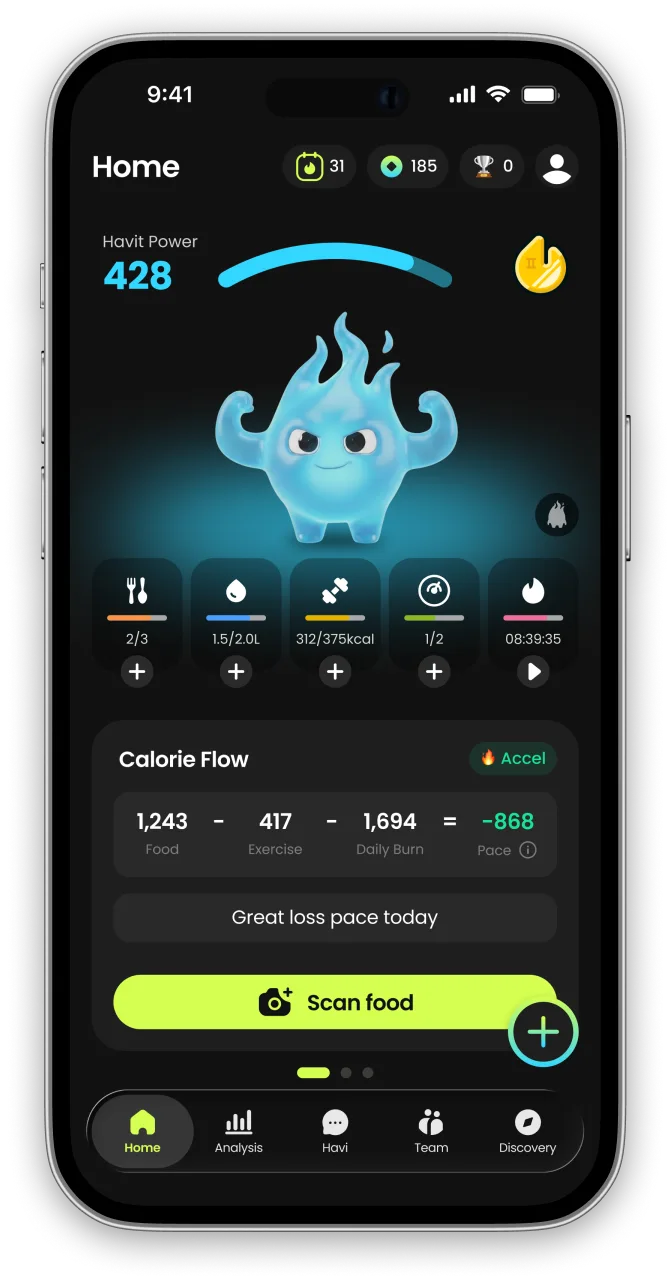
What is Havit?
Havit is an AI health companion for weight loss that protects muscle.
Unlike calorie-only trackers, Havit connects AI body-composition estimates, nutrition, hydration, sleep, steps, cycle, mood, and GLP-1 medication in one daily routine — so progress is measured by body composition, not just the number on the scale. Daily missions turn established behavior-change techniques into small repeatable actions, drawing on expertise from professionals formerly at Juvis Diet, one of Korea’s leading metabolic clinics.
In Havit’s own analysis of 1,090 GLP-1 users, people who logged consistently built stronger habits than the general user base. Read the GLP-1 Habit Report
Havit works with or without GLP-1 medication. It is a wellness app, not a medical device; body-composition results are estimates.

Continue in the App
Personalized wellness with your own data


References
- Long-term Joint Outcomes in Low-Impact Versus Weight-Bearing Exercise: An 8-Year Prospective Cohort Study — Arthritis Care & Research, Chen et al., 2025
- Cardiovascular Adaptations Across Exercise Modalities: A Systematic Comparison of Swimming, Running, and Cycling — British Journal of Sports Medicine, Williams et al., 2024
- Ground Reaction Forces and Cartilage Loading in Recreational Runners — Journal of Biomechanics, Patel & Morrison, 2024
- Bone Density Response to Aquatic Versus Land-Based Exercise in Adults Over 40 — Osteoporosis International, Nakamura et al., 2024

