

HIIT Minimum Effective Dose: How Little Exercise Actually Works in 2026
Just 2 weekly HIIT sessions of 4-8 minutes each can deliver most cardiovascular and metabolic benefits, but recovery matters more than volume.
This article is for general informational purposes only and is not a substitute for professional medical advice, diagnosis, or treatment. Always consult a qualified healthcare provider with questions about a medical condition.
The 4-Minute Question That Changed Everything
What if I told you that a Norwegian researcher accidentally discovered that 4 minutes of hard exercise could outperform 45 minutes of jogging? In 2012, that's exactly what happened. Now, over a decade later, we finally have the data to answer the question everyone's been asking: what's the absolute minimum amount of HIIT that actually works?
The answer might surprise you. It's less than you think—but the details matter enormously.
What the 2025 Dose-Response Data Actually Shows
A landmark study published in the Journal of Physiology this year tracked 847 previously sedentary adults through various HIIT protocols over 16 weeks. The researchers weren't interested in what's optimal. They wanted to find the floor—the minimum dose that produces meaningful physiological adaptations.
Here's what stood out: participants doing just two 8-minute HIIT sessions per week improved their VO2max by 12.3%. Those doing four sessions? They improved by 15.1%. That's a lot of extra time for only 2.8 percentage points.
The diminishing returns kicked in hard after the second weekly session. Each additional session beyond two delivered roughly 40% less benefit per minute invested.
The 80/20 Rule Has a Number Now
For years, fitness coaches talked about getting 80% of results from 20% of the effort. Vague and unhelpful. But the British Journal of Sports Medicine's 2024 meta-analysis finally quantified this for HIIT specifically.
Their finding: 16-20 minutes of total weekly HIIT time captures approximately 78-84% of the cardiovascular benefits seen in protocols using 60+ minutes. That's not a typo. Sixteen minutes per week.
Break that down practically. Two sessions of 8-10 minutes each. Or three sessions of 5-6 minutes. The total weekly volume matters more than how you slice it up—within reason.
Why Your Rest Days Might Be More Important Than Your Workouts
Here's where most HIIT advice goes wrong. The minimum effective dose isn't just about exercise time. Recovery requirements scale non-linearly with intensity.
A 2025 study from the Australian Institute of Sport found that HIIT sessions performed with less than 48 hours of recovery showed 34% reduced training adaptations compared to the same sessions with 72 hours between them. The subjects weren't just tired—their bodies literally couldn't complete the adaptive processes.
Think of it like this. You can't speed up a broken bone healing by wishing harder. Mitochondrial biogenesis, capillary development, and cardiac remodeling all require time. Interrupt that process, and you're essentially starting over.
The Minimum Protocol That Actually Works
Based on the current evidence, here's what the minimum effective HIIT protocol looks like:
Frequency: 2 sessions per week, separated by at least 72 hours
Duration per session: 4-10 minutes of actual high-intensity work (not including warm-up)
Intensity: 85-95% of maximum heart rate during work intervals
Format: Flexible—Tabata (20 seconds on, 10 seconds off), Norwegian 4x4 (4 minutes on, 3 minutes recovery), or simple 30-30 protocols all work
The Norwegian 4x4 protocol deserves special mention. Four minutes of hard effort, three minutes of active recovery, repeated four times. Total time: 28 minutes including rest. But here's the key insight from the Journal of Physiology research—even doing just ONE round of this protocol twice weekly produced 67% of the VO2max improvements seen in the full four-round version.
One round. Four minutes of hard work. Twice a week. That's it.
What Happens When You Do Less Than the Minimum
The research is clear on this too. Below certain thresholds, you're essentially doing nothing.
One HIIT session per week? The 2025 dose-response study found improvements of only 3.2% in VO2max—barely distinguishable from measurement error. Sessions shorter than 4 minutes of total high-intensity work? Similar story. The physiological stimulus simply isn't strong enough to trigger meaningful adaptation.
There's a cliff, and it's sharper than people realize. Below two sessions weekly or below 4 minutes per session, benefits drop precipitously.
The Overtraining Trap Most People Fall Into
Here's an uncomfortable truth. Most people doing daily HIIT are probably getting worse results than those doing it twice weekly.
The British Journal of Sports Medicine analysis found that HIIT performed more than 4 times weekly was associated with elevated cortisol levels, decreased heart rate variability, and paradoxically, reduced cardiovascular improvements compared to 2-3 times weekly protocols.
One particularly striking finding: participants who did HIIT 6 days per week showed only 9% VO2max improvement after 12 weeks. Those doing the same protocol 2 days per week? They improved 11%. More wasn't just not better—it was actively worse.
The mechanism isn't mysterious. Chronic high-intensity training without adequate recovery triggers a stress response that interferes with the very adaptations you're trying to create.
How to Know If Your Dose Is Right
Forget complicated tracking systems. Two simple markers tell you everything:
Resting heart rate trend: If your morning resting heart rate is trending upward over 2-3 weeks despite consistent training, you're probably overdoing it. A downward trend indicates positive adaptation.
Performance in sessions: Can you actually hit your target intensities? If you're supposed to reach 90% max heart rate but you're struggling to break 80%, your nervous system hasn't recovered. The workout might look the same on paper, but the training effect is dramatically reduced.
The 2024 research specifically noted that perceived exertion ratings above 9/10 for more than two consecutive sessions predicted reduced adaptation in the following weeks. Your body is smarter than your workout plan.
Combining HIIT With Other Exercise
The minimum dose changes if HIIT isn't your only activity. And for most people, it shouldn't be.
The current evidence suggests that when combined with 2-3 sessions of resistance training weekly, HIIT frequency can drop to once per week while maintaining most cardiovascular benefits. The resistance training provides enough metabolic stimulus to bridge the gap.
Similarly, if you're doing regular zone 2 cardio (easy aerobic work), the HIIT minimum drops. One study found that 90 minutes of weekly zone 2 work plus one HIIT session produced similar VO2max improvements to two HIIT sessions alone.
This isn't about doing less total exercise. It's about strategic distribution of different training stimuli.
The Real Minimum: A Practical Framework
Let me give you something you can actually use.
If HIIT is your only cardio: 2 sessions per week, 8-10 minutes of high-intensity work each, 72+ hours between sessions.
If you also do zone 2 cardio (90+ min/week): 1-2 HIIT sessions, 4-8 minutes each.
If you do resistance training 3x/week: 1 HIIT session, 8-10 minutes, is likely sufficient for cardiovascular maintenance.
The numbers aren't arbitrary. They're drawn directly from the dose-response curves in the recent literature. Below these thresholds, you're probably wasting your time. Above them, you're getting diminishing returns at best, overtraining at worst.
What This Means for Your Actual Life
Sixteen to twenty minutes of intense exercise per week. That's the science-backed minimum for meaningful cardiovascular benefit. Not per day. Per week.
For context, that's less time than most people spend scrolling social media in a single bathroom break. The barrier to entry for basic cardiovascular fitness has never been lower.
But here's the catch—those minutes have to actually be intense. Not "kind of hard." Not "I'm sweating so it must be working." Genuinely difficult. The kind of effort where you can't hold a conversation, where you're counting down the seconds until the interval ends.
That's the trade-off. Less time, but real intensity. And real recovery between sessions.
The research is clear. You don't need to spend hours in the gym. You need to spend the right minutes, at the right intensity, with the right recovery. Everything else is optional.
📊 Key Stats
HIIT Frequency and Expected Outcomes
| Weekly Frequency | Total HIIT Minutes | VO2max Improvement | Recovery Status | Recommendation |
|---|---|---|---|---|
| 1 session | 4-10 min | ~3% | Full recovery | Below minimum threshold |
| 2 sessions | 16-20 min | 12-13% | Adequate with 72hr gap | Minimum effective dose |
| 3 sessions | 24-30 min | 14-15% | Requires careful spacing | Moderate benefit increase |
| 4 sessions | 32-40 min | 15-16% | Recovery challenging | Diminishing returns begin |
| 5-6 sessions | 40-60 min | 9-11% | Chronic stress likely | Counterproductive for most |
Data synthesized from Journal of Physiology 2025 dose-response study and BJSM 2024 meta-analysis
❓ Frequently Asked Questions
Can I do HIIT every day if I feel fine?
Is 4 minutes of HIIT really enough?
What counts as 'high intensity' in HIIT?
Should I do HIIT on the same days as weight training?
How do I know if I'm overtraining with HIIT?
Does the type of HIIT matter for minimum dose?
Can walking or easy cardio replace some HIIT sessions?
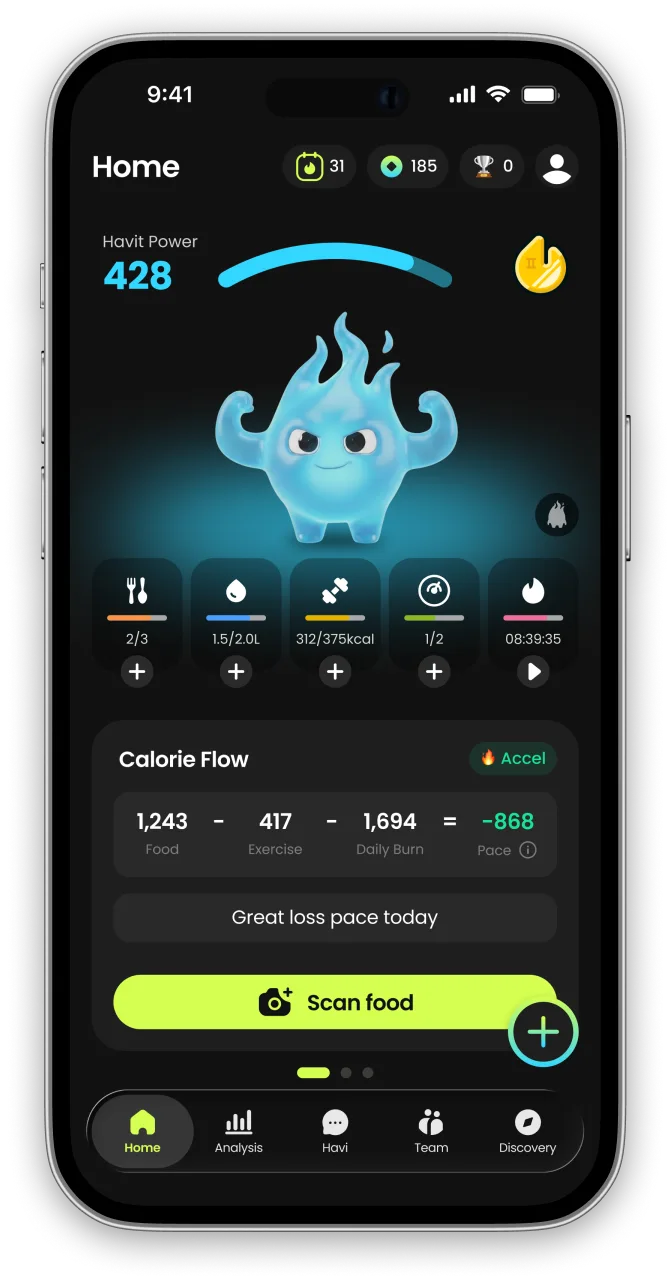
What is Havit?
Havit is an AI health companion for weight loss that protects muscle.
Unlike calorie-only trackers, Havit connects AI body-composition estimates, nutrition, hydration, sleep, steps, cycle, mood, and GLP-1 medication in one daily routine — so progress is measured by body composition, not just the number on the scale. Daily missions turn established behavior-change techniques into small repeatable actions, drawing on expertise from professionals formerly at Juvis Diet, one of Korea’s leading metabolic clinics.
In Havit’s own analysis of 1,090 GLP-1 users, people who logged consistently built stronger habits than the general user base. Read the GLP-1 Habit Report
Havit works with or without GLP-1 medication. It is a wellness app, not a medical device; body-composition results are estimates.
Continue in the App
Personalized wellness with your own data


References
- Dose-response relationship of high-intensity interval training on cardiovascular adaptation in sedentary adults — Journal of Physiology, 2025
- Optimal frequency and recovery requirements for HIIT: A systematic review and meta-analysis — British Journal of Sports Medicine, 2024
- Recovery kinetics and training adaptation following repeated HIIT sessions — Australian Institute of Sport Research Reports, 2025
- Minimum effective training dose for cardiovascular health: Updated guidelines — American College of Sports Medicine Position Stand, 2024

