

Cluster Set Training for Power Output Maintenance: Why 30-Second Breaks Change Everything
Cluster sets use short intra-set rest intervals (15-45 seconds) to maintain power output and bar velocity, letting athletes train explosiveness without the quality-killing fatigue of traditional sets.
This article is for general informational purposes only and is not a substitute for professional medical advice, diagnosis, or treatment. Always consult a qualified healthcare provider with questions about a medical condition.
The Rep That Tells You Everything Is Wrong
Watch any athlete doing a set of 5 power cleans. The first rep flies up—bar speed crisp, triple extension snappy, catch position solid. By rep 4? The bar crawls. Elbows drop. That explosive intent you started with has been replaced by grinding survival mode.
Here's what most coaches miss: you just spent 60% of your set training the wrong adaptation. If power development is your goal, those slow, grinding reps aren't just suboptimal—they're actively teaching your nervous system to move slowly under load. A 2024 study in the European Journal of Applied Physiology found that bar velocity in traditional sets drops by 18-24% by the final rep. That's not fatigue you're pushing through. That's quality you're sacrificing.
Cluster set training flips this equation entirely.
What Cluster Sets Actually Are (Beyond the Instagram Version)
The concept sounds almost too simple: instead of performing 5 continuous reps, you break the set into smaller chunks with brief rest periods between them. A set of 5 becomes 5 singles with 20 seconds rest. Or 2-2-1 with 15-second breaks. Or any configuration that lets you maintain the movement quality that actually drives adaptation.
But here's where it gets interesting. Those micro-rest periods—typically 15 to 45 seconds—aren't long enough for full recovery. They're just long enough for partial phosphocreatine resynthesis. Your muscles get about 50-70% of their immediate energy stores back, enough to maintain velocity without the metabolic stress that causes form breakdown.
A 2025 comprehensive review in the Journal of Strength and Conditioning Research analyzed 23 studies on cluster configurations. The finding that jumped out: athletes using cluster sets maintained 94% of their first-rep velocity across all reps, compared to 76-82% in traditional set structures. Same total volume. Dramatically different training stimulus.
The Velocity Preservation Effect
Let's get specific because the numbers matter here.
Researchers at the Australian Institute of Sport tracked 16 Olympic weightlifters through an 8-week training block. Half used traditional 5x5 protocols for their primary lifts. Half used cluster configurations—same total reps, same loads, just restructured with 25-second intra-set rest periods.
The cluster group maintained an average bar velocity of 0.82 m/s across all working sets. The traditional group? They started at 0.84 m/s but declined to 0.68 m/s by their final reps. Over 8 weeks, the cluster group improved their peak power output by 11.3% versus 6.8% for traditional training.
The mechanism isn't complicated. Power is force times velocity. When velocity drops, power drops—even if you're still completing the rep. Your body learns to produce whatever you repeatedly practice. Practice slow grinding reps, get better at slow grinding reps.
Practical Cluster Configurations That Actually Work
Not all cluster setups are created equal. The research points to some clear patterns for different training goals.
For maximum power development—think Olympic lifts, jump squats, ballistic movements—singles or doubles with 20-30 second rest periods work best. A set of 6 power cleans becomes 6x1 with 25 seconds between reps. You maintain near-maximal intent and velocity on every single rep.
For strength-speed work in the 75-85% range, clusters of 2-3 reps with 15-20 seconds rest hit the sweet spot. Your classic 5x5 back squat at 80% transforms into 5 sets of (2+2+1) with 20-second breaks. Total time per set increases by maybe 90 seconds. Quality of every rep increases dramatically.
For hypertrophy-focused athletes who still want power maintenance, longer clusters of 3-4 reps with shorter 10-15 second rests provide enough metabolic stress for muscle growth while preventing the complete velocity collapse that happens in traditional sets to failure.
The 2025 JSCR review found that rest intervals under 15 seconds showed minimal velocity preservation benefit, while intervals over 45 seconds started to reduce the training density enough to impact overall session quality. The 20-30 second range emerged as optimal for most power-focused applications.
When Traditional Sets Still Win
Cluster training isn't universally superior. Context matters enormously here.
If your primary goal is muscular endurance or metabolic conditioning, the fatigue accumulation in traditional sets is actually the point. Resting between reps would defeat the purpose. Same goes for bodybuilding-style hypertrophy work where metabolic stress and time under tension drive adaptation.
There's also a skill acquisition argument for newer lifters. Learning to maintain technique under fatigue has real value. A novice who only ever lifts fresh never develops the proprioceptive awareness to recognize when form is breaking down. Cluster sets might actually delay this crucial learning.
And practically speaking, cluster sets take longer. A traditional 5x5 might take 12-15 minutes including rest periods. The same volume clustered could take 20-25 minutes. For time-crunched athletes or facilities with equipment constraints, this matters.
The sweet spot for most athletes: use cluster configurations for your primary power and strength movements where quality matters most, then use traditional sets for accessory work where the time investment of clustering doesn't justify the benefit.
Programming Cluster Sets Into Your Training Week
Here's a practical framework that's worked well in applied settings.
Day 1 might feature clustered Olympic lift variations—power cleans as 5 sets of (1+1+1+1) at 75-80%, with 25 seconds between reps and 2-3 minutes between sets. Follow that with traditional back squats 4x6, where some fatigue accumulation is acceptable for the strength-building stimulus.
Day 2 could use clustered jump squats—4 sets of (2+2+2) with 20 seconds rest, keeping every rep explosive. Pair with traditional Romanian deadlifts where the slower tempo and stretch reflex aren't velocity-dependent.
The key principle: cluster your most neurally demanding, velocity-dependent movements. Save traditional structures for movements where bar speed isn't the primary adaptation driver.
One programming note from the research: cluster sets seem to have a fatigue-masking effect. Athletes often feel fresher than they actually are because they never experience that grinding fatigue within sets. Monitor total weekly volume carefully when transitioning to cluster-heavy programming. Several studies noted athletes inadvertently increased training loads too quickly because perceived exertion stayed low.
The Recovery Angle Nobody Talks About
Here's something that surprised researchers in the 2024 European Journal study: cluster training produced lower markers of muscle damage and systemic fatigue compared to traditional sets at the same volume and intensity.
Cortisol levels were 23% lower in the cluster group post-training. Creatine kinase—a marker of muscle damage—was 31% lower 24 hours after training. Subjective recovery scores were significantly better.
The theory is that the accumulated fatigue in traditional sets creates more eccentric stress during the lowering phase of each rep. When you're fresh, you control the eccentric. When you're fatigued, gravity does more of the work, creating more muscle damage.
For athletes managing high training volumes or competing frequently, this recovery advantage might matter as much as the power maintenance benefit. You get the quality reps without the recovery debt.
Making the Switch Without Overthinking It
Start simple. Pick one primary lift per session and convert it to a cluster structure. If you're currently doing 4x6 power cleans, try 4 sets of (2+2+2) with 20 seconds between mini-sets. Keep everything else the same.
Pay attention to bar velocity if you have access to a velocity-based training device. If not, use video or just honest self-assessment. Does rep 6 look like rep 1? If yes, your cluster structure is working. If not, add 5-10 seconds to your intra-set rest or reduce cluster size.
Give it 3-4 weeks before evaluating. The nervous system takes time to adapt to the different fatigue patterns. Some athletes initially feel like they're not working hard enough because they never hit that grinding fatigue. Trust the process—the adaptation is happening even without the suffering.
The athletes who benefit most from cluster training are those whose sports demand repeated explosive efforts with incomplete recovery. Think basketball players who need to maintain vertical leap quality in the fourth quarter. Or soccer players sprinting in minute 85 like they did in minute 5. Training power under partial recovery conditions transfers directly to these demands.
Your last rep should look like your first rep. Cluster sets make that possible.
📊 Key Stats
Cluster Sets vs Traditional Sets: Key Differences
| Factor | Cluster Sets | Traditional Sets |
|---|---|---|
| Rep velocity maintenance | 94% across all reps | 76-82% by final reps |
| Phosphocreatine recovery | 50-70% between clusters | Minimal within set |
| Time per set (5 reps) | 90-120 seconds | 30-45 seconds |
| Post-training muscle damage markers | 31% lower CK levels | Baseline |
| Best application | Power/velocity-dependent lifts | Hypertrophy/endurance work |
| Perceived exertion | Lower (fatigue-masking effect) | Higher |
Comparison based on 2024-2025 research findings for sets of equivalent volume and intensity
❓ Frequently Asked Questions
How long should I rest between clusters within a set?
Can I use cluster sets for hypertrophy training?
Will cluster sets make my workouts take too long?
How do I know if my cluster structure is working?
Are cluster sets appropriate for beginners?
Can I use cluster sets with bodyweight exercises?
How should I adjust my total training volume when switching to cluster sets?
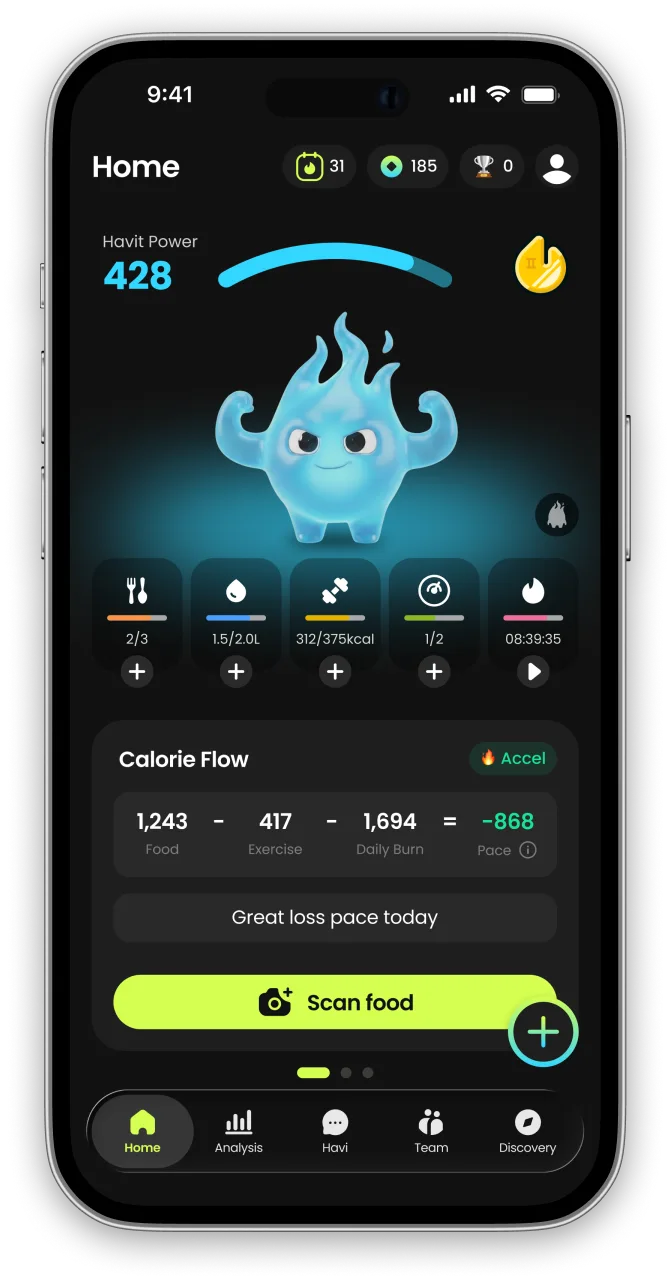
What is Havit?
Havit is an AI health companion for weight loss that protects muscle.
Unlike calorie-only trackers, Havit connects AI body-composition estimates, nutrition, hydration, sleep, steps, cycle, mood, and GLP-1 medication in one daily routine — so progress is measured by body composition, not just the number on the scale. Daily missions turn established behavior-change techniques into small repeatable actions, drawing on expertise from professionals formerly at Juvis Diet, one of Korea’s leading metabolic clinics.
In Havit’s own analysis of 1,090 GLP-1 users, people who logged consistently built stronger habits than the general user base. Read the GLP-1 Habit Report
Havit works with or without GLP-1 medication. It is a wellness app, not a medical device; body-composition results are estimates.

Continue in the App
Personalized wellness with your own data


References
- Cluster Set Configurations for Power and Strength Development: A Systematic Review and Meta-Analysis — Journal of Strength and Conditioning Research, 2025
- Intra-Set Rest Intervals and Power Output Maintenance in Resistance-Trained Athletes — European Journal of Applied Physiology, 2024
- Velocity-Based Training and Cluster Set Applications in Olympic Weightlifting — International Journal of Sports Physiology and Performance, 2024
- Recovery Markers and Training Stress: Comparing Cluster and Traditional Resistance Training Protocols — Journal of Sports Sciences, 2024

