

Returning to the Gym After a Long Break: Your Week-by-Week Progression Guide for 2026
Start at 50% of your previous weights, add 10-15% weekly, and you'll be back to full strength in 6-8 weeks without the crippling soreness.
This article is for general informational purposes only and is not a substitute for professional medical advice, diagnosis, or treatment. Always consult a qualified healthcare provider with questions about a medical condition.
That First Workout Back Hits Different (And Not in a Good Way)
You haven't touched a barbell in four months. Maybe it was a work project that swallowed your life, a nagging injury, or just... life happening. Now you're back in the gym, feeling motivated, and you load up the bench press with what you used to lift.
Big mistake.
Three days later, you're walking down stairs like a baby giraffe, arms stuck at weird angles, wondering if you've permanently damaged something. Sound familiar? You're not alone. A 2024 study in the Journal of Strength and Conditioning Research found that 67% of gym-goers returning after breaks of 8+ weeks experience moderate to severe delayed onset muscle soreness (DOMS) that sidelines them for another week.
The cruel irony? Your brain remembers what you could lift. Your muscles have moved on.
What Actually Happens to Your Body During a Training Break
Here's the uncomfortable truth about detraining. After just two weeks away, your muscle glycogen storage drops by roughly 20%. By week four, you've lost measurable strength—typically 10-15% in compound lifts. Hit the three-month mark, and research shows muscle fiber cross-sectional area decreases by up to 25%.
But here's what most people miss: the loss isn't uniform.
Your nervous system—the electrical wiring that recruits muscle fibers—declines faster than the muscles themselves. This creates a dangerous gap. You might look at your arms and think "those still look decent," but the neural pathways that coordinate heavy lifts have gotten rusty. It's like having a sports car with a driver who hasn't been behind the wheel in months.
The good news? Muscle memory is real. Those satellite cells surrounding your muscle fibers retain their nuclei even during extended breaks. A 2025 Sports Medicine review confirmed that previously trained individuals can regain lost muscle 40-60% faster than building it originally took. Your body wants to get back. You just need to give it the right roadmap.
The 50% Rule: Your Starting Point
Forget what you used to lift. For your first week back, cut every weight in half.
Yes, half.
I know it feels embarrassing. You'll see someone quarter-squatting more than you're using. Ignore them. That 50% starting point isn't about ego—it's about letting your connective tissue catch up. Tendons and ligaments adapt 3-4 times slower than muscle tissue. They need the reduced load to rebuild collagen cross-links that weakened during your break.
Here's what Week 1 looks like in practice:
- Previous bench press: 185 lbs → Week 1: 90-95 lbs
- Previous squat: 225 lbs → Week 1: 110-115 lbs
- Previous deadlift: 275 lbs → Week 1: 135-140 lbs
Keep reps moderate—3 sets of 8-10 for most exercises. The goal isn't fatigue. It's reintroduction. You should finish workouts feeling like you could do more. That restraint is the point.
Week-by-Week Load Progression: The Exact Numbers
This is where most "just ease back into it" advice fails you. Vague guidance doesn't work. Your body responds to specific, progressive overload. Here's the framework backed by current return-to-training research:
Week 1: 50% of previous working weights, 3 sessions
Week 2: 60% of previous weights, 3 sessions
Week 3: 70% of previous weights, 3-4 sessions
Week 4: 75-80% of previous weights, 4 sessions
Week 5: 85% of previous weights, 4 sessions
Week 6: 90% of previous weights, 4 sessions
Weeks 7-8: Test new working maxes, full programming resumes
Notice the progression isn't linear. Weeks 1-3 jump 10% each week because your neural adaptations recover quickly—that's the "it's like riding a bike" effect. Weeks 4-6 slow to 5% increments as you approach previous strength levels and the gains become more about actual tissue adaptation.
One critical note: these percentages assume a 2-4 month break. Been out 6+ months? Add two weeks at the beginning, starting at 40%.
Managing DOMS Without Derailing Progress
Some soreness is inevitable. The question is whether it's productive discomfort or a warning sign.
Productive DOMS peaks 24-72 hours post-workout and feels like a dull, diffuse ache throughout the muscle belly. It shouldn't prevent normal movement. You can still sit down, reach overhead, walk normally—it's just uncomfortable.
Warning-sign soreness is sharp, localized to one spot, or accompanied by swelling. It persists beyond 72 hours or worsens with movement. This isn't adaptation. This is damage.
To minimize the productive kind while maximizing recovery:
Active recovery works. A 2024 meta-analysis found that 20-30 minutes of low-intensity movement on rest days reduced perceived DOMS by 31% compared to complete rest. Light cycling, swimming, or even walking counts.
Protein timing matters more during reintroduction. Aim for 0.4g per kg of bodyweight within 2 hours post-workout. For a 180-lb person, that's roughly 33g—about a chicken breast or a solid protein shake.
Sleep is non-negotiable. Growth hormone release peaks during deep sleep, and tissue repair accelerates dramatically. The research is clear: under 6 hours of sleep can extend DOMS duration by 40%.
The Exercises That Need Extra Caution
Not all movements carry equal risk when returning. Eccentric-heavy exercises—where the muscle lengthens under load—cause significantly more microtrauma than concentric movements.
The highest-risk exercises for return DOMS and injury:
- Romanian deadlifts — The stretched hamstring position under load is DOMS central
- Walking lunges — Eccentric quad and glute stress with balance demands
- Incline dumbbell curls — Biceps in stretched position, notorious for severe soreness
- Nordic hamstring curls — Extreme eccentric load, skip entirely for weeks 1-3
Safer alternatives for early weeks:
- Leg press instead of heavy squats (more controlled, less stabilizer demand)
- Machine rows instead of barbell rows (removes lower back fatigue)
- Cable exercises for arms (constant tension without extreme stretch)
By week 4, you can reintroduce the higher-risk movements—just apply the percentage guidelines more conservatively.
Programming Structure: Less Is More (At First)
The temptation to jump back into your old 5-day split is strong. Resist it.
Start with 3 full-body sessions per week, spaced at least 48 hours apart. This frequency provides enough stimulus for readaptation while allowing recovery between sessions. A Monday-Wednesday-Friday schedule works well.
Each session should include:
- 1 compound lower body movement (squat or deadlift variation)
- 1 compound upper push (bench or overhead press variation)
- 1 compound upper pull (row or pulldown variation)
- 2-3 accessory movements targeting weak points
Total working sets per session: 12-16 for weeks 1-2, building to 18-22 by week 4.
By week 5, you can transition to a 4-day upper/lower split if that matches your previous programming. The key is earning the right to train more frequently through consistent recovery from less.
Red Flags That Mean Slow Down
Progress isn't always linear, and some signals mean you're pushing too fast:
Joint pain that persists between sessions. Muscle soreness should fade. Aching knees, shoulders, or elbows that carry over to your next workout indicate connective tissue isn't keeping up.
Sleep quality declining. Overtraining often shows up as difficulty falling asleep or staying asleep, even when you're exhausted. Your nervous system is overstimulated.
Strength going backward. If week 4 weights feel harder than week 3, you've accumulated more fatigue than you're recovering from. Drop back 10% and add an extra rest day.
Persistent fatigue outside the gym. Feeling wiped out at work, losing motivation for other activities, or getting sick more frequently all suggest systemic recovery debt.
When you hit these signals, the fix is simple but requires humility: reduce volume by 30%, add a rest day, and hold steady for a week before progressing again.
The Mental Game of Returning
Let's talk about the part nobody writes about.
Watching someone warm up with your old working weight stings. Seeing your reflection and noticing changes you don't like is demoralizing. The voice in your head saying "you used to be stronger" doesn't help.
Here's a reframe that might: you're not rebuilding from zero. You're reactivating a system that already knows the way. Every rep is faster progress than someone starting fresh would experience. The 2025 Sports Medicine research confirms this—your muscle memory advantage is substantial and real.
Set process goals instead of outcome goals for the first month. "I will complete three sessions this week" beats "I will bench 185 again." The outcomes will follow the process. They always do.
And take progress photos or measurements now, at the beginning. You'll want evidence of where you started when you're back to full strength in two months, wondering why you ever worried.
📊 Key Stats
Week-by-Week Return to Gym Progression Plan
| Week | Load (% of Previous Max) | Sessions/Week | Total Working Sets | Focus |
|---|---|---|---|---|
| 1 | 50% | 3 | 12-14 | Neural reactivation, movement patterns |
| 2 | 60% | 3 | 14-16 | Building work capacity |
| 3 | 70% | 3-4 | 16-18 | Progressive overload begins |
| 4 | 75-80% | 4 | 18-20 | Strength rebuilding |
| 5 | 85% | 4 | 20-22 | Approaching previous levels |
| 6 | 90% | 4 | 20-22 | Near full capacity |
| 7-8 | Test new maxes | 4-5 | Full program | Resume normal training |
Progression assumes 2-4 month training break. Add 2 weeks at 40% for breaks exceeding 6 months.
❓ Frequently Asked Questions
How long does it take to regain strength after a long gym break?
Should I do cardio when returning to the gym after a break?
Why am I so sore after my first workout back?
Can I do my old workout routine when returning to the gym?
How do I know if I'm progressing too fast?
Is muscle memory real or just a myth?
What supplements help when returning to the gym?
What is Havit?
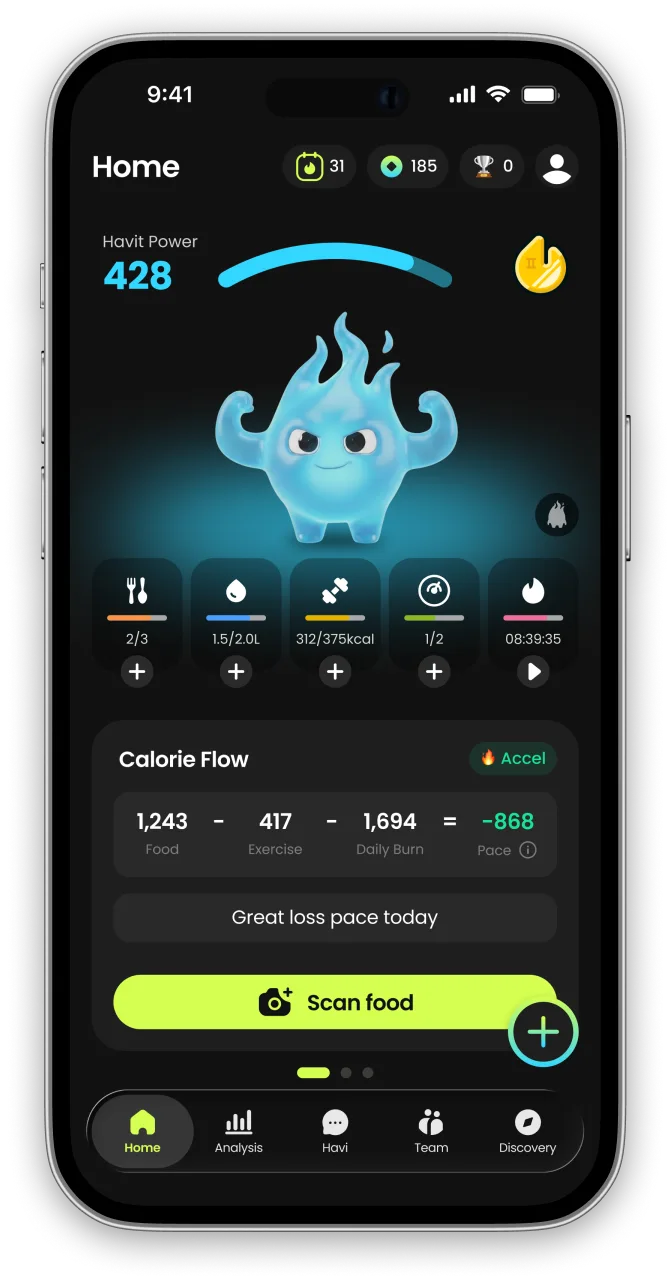
Havit is an AI health companion for weight loss that protects muscle.
Unlike calorie-only trackers, Havit connects AI body-composition estimates, nutrition, hydration, sleep, steps, cycle, mood, and GLP-1 medication in one daily routine — so progress is measured by body composition, not just the number on the scale. Daily missions turn established behavior-change techniques into small repeatable actions, drawing on expertise from professionals formerly at Juvis Diet, one of Korea’s leading metabolic clinics.
In Havit’s own analysis of 1,090 GLP-1 users, people who logged consistently built stronger habits than the general user base. Read the GLP-1 Habit Report
Havit works with or without GLP-1 medication. It is a wellness app, not a medical device; body-composition results are estimates.

Continue in the App
Personalized wellness with your own data


References
- Detraining and Retraining: Physiological Responses and Performance Recovery Timelines — Journal of Strength and Conditioning Research, 2024
- Return to Training After Extended Breaks: Evidence-Based Guidelines for Load Progression — Sports Medicine, 2025
- Muscle Memory and Myonuclear Permanence: Implications for Resistance Training — Frontiers in Physiology, 2024
- Delayed Onset Muscle Soreness: Treatment Strategies and Prevention — British Journal of Sports Medicine, 2024


