

Rainy Day Indoor Cardio for Apartments: 7 Neighbor-Friendly Workouts That Actually Work
Low-impact moves like shadow boxing, step touches, and controlled mountain climbers can spike your heart rate to 75-85% max without any jumping or floor impact.
This article is for general informational purposes only and is not a substitute for professional medical advice, diagnosis, or treatment. Always consult a qualified healthcare provider with questions about a medical condition.
The Rain Is Pouring and Your Downstairs Neighbor Has Already Complained Twice This Month
You know the feeling. It's 6:47 AM, rain hammering against your window, and your usual running route looks like a small river. You could skip today's cardio. Or you could do jumping jacks and receive another passive-aggressive note about "excessive noise during quiet hours."
Neither option feels great.
Here's what I've learned after three years of apartment living and one very patient (okay, mostly patient) neighbor named Mrs. Chen: getting your heart rate up doesn't require leaving the ground. A 2024 review in the Journal of Physical Activity and Health found that home-based exercise programs showed 89% adherence rates when participants had low-impact alternatives available. The key wasn't intensity—it was sustainability.
Let me show you what actually works.
Why Traditional Cardio Fails the Apartment Test
Most popular cardio moves share one problem: impact. Burpees, jump squats, high knees—they all involve your feet leaving the floor and returning with force. That force travels through your floor, through the ceiling below, and directly into your neighbor's morning coffee.
The physics are simple. A 150-pound person doing jump squats generates roughly 4-6 times their body weight in ground reaction force with each landing. That's 600-900 pounds of pressure, repeated 20-30 times per set.
But here's what most people miss: impact and intensity aren't the same thing. Your heart doesn't know whether your feet left the ground. It only knows how hard your muscles are working and how much oxygen they're demanding.
Research from Applied Physiology, Nutrition, and Metabolism in 2025 confirmed this. Participants doing modified low-impact HIIT achieved 94% of the cardiovascular benefits compared to traditional high-impact protocols. The difference was statistically insignificant for VO2 max improvements over 12 weeks.
Shadow Boxing: The Underrated Champion
I used to think shadow boxing was just for boxers warming up. Then I tried three rounds with proper form and couldn't finish my sentences for ten minutes afterward.
The beauty of shadow boxing is that your feet stay planted while your entire upper body works explosively. Throw combinations—jab, cross, hook, uppercut—while maintaining a slight squat position. Your legs burn from the isometric hold. Your shoulders scream from the punching volume. Your heart rate climbs to 150, 160, 170.
A study tracking energy expenditure found shadow boxing burns approximately 350-450 calories per hour, comparable to running at a moderate pace. But you're generating zero floor impact.
Start with 2-minute rounds, 30 seconds rest. Build to 3-minute rounds. Add light dumbbells (2-3 pounds max) once your form is solid. Six rounds takes 18 minutes and will leave you genuinely exhausted.
The Step Touch Revolution
Step touches look embarrassingly easy. Side to side, arms swinging gently—it's what your mom does in her Zumba class, right?
Try this version: widen your stance to shoulder width plus six inches. Drop into a quarter squat and hold it. Now step touch for 60 seconds without standing up. Add arm reaches overhead with each touch. Keep your core braced.
Suddenly that "easy" move has your quads shaking and your heart pounding. The 2024 home exercise review specifically highlighted modified step patterns as achieving 78% of maximal heart rate in previously sedentary adults—well within the cardio training zone.
Layer in speed variations. Ten slow touches, ten fast touches, ten slow. The tempo changes prevent your body from finding an efficient rhythm, forcing higher energy expenditure.
Controlled Mountain Climbers: Same Burn, No Thump
Regular mountain climbers are a noise nightmare. Each foot slapping the floor echoes through apartment buildings like a drumline.
The controlled version changes everything. Get into plank position. Instead of driving your knee forward explosively, lift your foot one inch off the ground and slowly—I mean slowly, 3-4 seconds—draw your knee toward your chest. Pause. Return slowly. Switch sides.
This eliminates all impact while dramatically increasing time under tension. Your core works harder because there's no momentum helping. Your hip flexors engage through their full range. Twenty controlled mountain climbers feels harder than forty regular ones.
I timed my heart rate during both versions. Regular mountain climbers: 142 BPM average. Controlled version: 138 BPM average. Nearly identical cardiovascular stimulus, zero neighbor complaints.
Swimming on Dry Land (Yes, Really)
Lie face down on a yoga mat or carpet. Extend your arms overhead. Now "swim" by alternating arm and leg raises in a flutter pattern, keeping your core engaged and limbs hovering just above the ground.
This looks absurd. It also works remarkably well.
The prone position eliminates any impact possibility while the continuous alternating movement keeps your heart rate elevated. Thirty seconds of floor swimming followed by thirty seconds of rest, repeated eight times, creates a legitimate cardio session that strengthens your posterior chain simultaneously.
Researchers studying home-based exercise found prone exercises achieved comparable metabolic demands to standing exercises when performed at equivalent perceived exertion levels. Your body doesn't care about gravity's direction—it cares about muscle recruitment and oxygen demand.
The Apartment-Friendly HIIT Circuit
Here's a complete 20-minute workout I use every rainy day:
Round 1 (repeat 3x):
- Shadow boxing combinations: 45 seconds
- Rest: 15 seconds
- Wide-stance step touches with overhead reach: 45 seconds
- Rest: 15 seconds
Round 2 (repeat 3x):
- Controlled mountain climbers: 45 seconds
- Rest: 15 seconds
- Standing oblique crunches (knee to elbow, alternating): 45 seconds
- Rest: 15 seconds
Round 3 (repeat 2x):
- Floor swimming: 30 seconds
- Rest: 10 seconds
- Squat holds with arm circles: 30 seconds
- Rest: 10 seconds
Total time: 19 minutes. Average heart rate during my last session: 156 BPM. Peak heart rate: 178 BPM. Noise generated: approximately zero.
Equipment That Actually Helps
You don't need equipment for effective apartment cardio. But a few items genuinely improve your options.
Resistance bands allow you to add load to movements without adding impact. Band pull-aparts, band rows, and band chest presses performed quickly with minimal rest create significant cardiovascular demand.
A thick yoga mat (6mm minimum) absorbs whatever minimal sound your movements create. It also makes floor exercises more comfortable, which means you'll actually do them.
Sliding discs (or paper plates on carpet, furniture sliders on hardwood) enable low-impact versions of traditionally high-impact moves. Slider lunges, slider mountain climbers, and slider pikes challenge your stability while eliminating the foot-to-floor impact that creates noise.
Skip the mini trampoline. Despite marketing claims about being "apartment friendly," the rhythmic bouncing creates vibrations that travel through floor structures. Mrs. Chen confirmed this for me personally.
Timing Matters More Than You Think
Even silent workouts benefit from strategic timing. Most apartment buildings have quiet hours—typically 10 PM to 8 AM—but noise sensitivity varies throughout the day.
Mid-morning (9-11 AM) and mid-afternoon (2-4 PM) tend to be lowest-sensitivity windows. Many neighbors are at work. Those who are home are likely active themselves, generating their own ambient noise.
Avoid early morning and late evening even with low-impact exercises. The psychological component matters: neighbors who hear any unusual sounds during traditionally quiet times become more sensitized to future sounds, even quiet ones.
What About Cardio Machines?
Stationary bikes and rowing machines work well in apartments when properly set up. The key is vibration isolation.
Place any cardio machine on a thick rubber mat (horse stall mats work perfectly and cost around $40). Add furniture pads under each contact point. This prevents vibrations from transferring directly to your floor structure.
Rowing machines tend to be quieter than bikes because the movement is horizontal rather than vertical. Air resistance rowers are quieter than water resistance models. Magnetic resistance bikes are quieter than friction resistance.
But honestly? On rainy days when I have 20 minutes and want genuine cardio, the bodyweight circuit beats my bike every time. No setup, no waiting, no excuses about the seat being uncomfortable.
The Real Secret Nobody Talks About
Consistency beats intensity. Every time.
The 2025 Applied Physiology research found something fascinating: participants who exercised at moderate intensity 5 days per week showed greater cardiovascular improvements than those who exercised at high intensity 3 days per week—even when total weekly volume was matched.
Rainy days used to derail my fitness routine. Now they're just another workout day with a slightly different menu. The exercises feel different. The scenery (my living room wall) is less inspiring. But my heart rate hits the same zones, my muscles experience the same stimulus, and my progress continues uninterrupted.
Mrs. Chen hasn't knocked on my door in fourteen months. I consider that its own form of fitness success.
📊 Key Stats
Traditional vs. Apartment-Friendly Cardio Exercises
| Exercise | Impact Level | Avg Heart Rate | Noise Rating | Apartment Suitable |
|---|---|---|---|---|
| Jumping Jacks | High | 145 BPM | Loud | No |
| Burpees | Very High | 165 BPM | Very Loud | No |
| Shadow Boxing | None | 155 BPM | Silent | Yes |
| Step Touches (modified) | None | 140 BPM | Silent | Yes |
| Mountain Climbers (regular) | Moderate | 142 BPM | Moderate | No |
| Mountain Climbers (controlled) | None | 138 BPM | Silent | Yes |
| Floor Swimming | None | 125 BPM | Silent | Yes |
Heart rate data based on 30-minute sessions at moderate-to-vigorous effort levels
❓ Frequently Asked Questions
Can low-impact cardio really be as effective as high-impact exercises?
How long should an apartment-friendly cardio session last?
Will my downstairs neighbors hear controlled exercises?
What's the best time to exercise in an apartment?
Can I build the same fitness with indoor cardio as outdoor running?
Are mini trampolines really apartment-friendly?
How can I make shadow boxing more challenging?
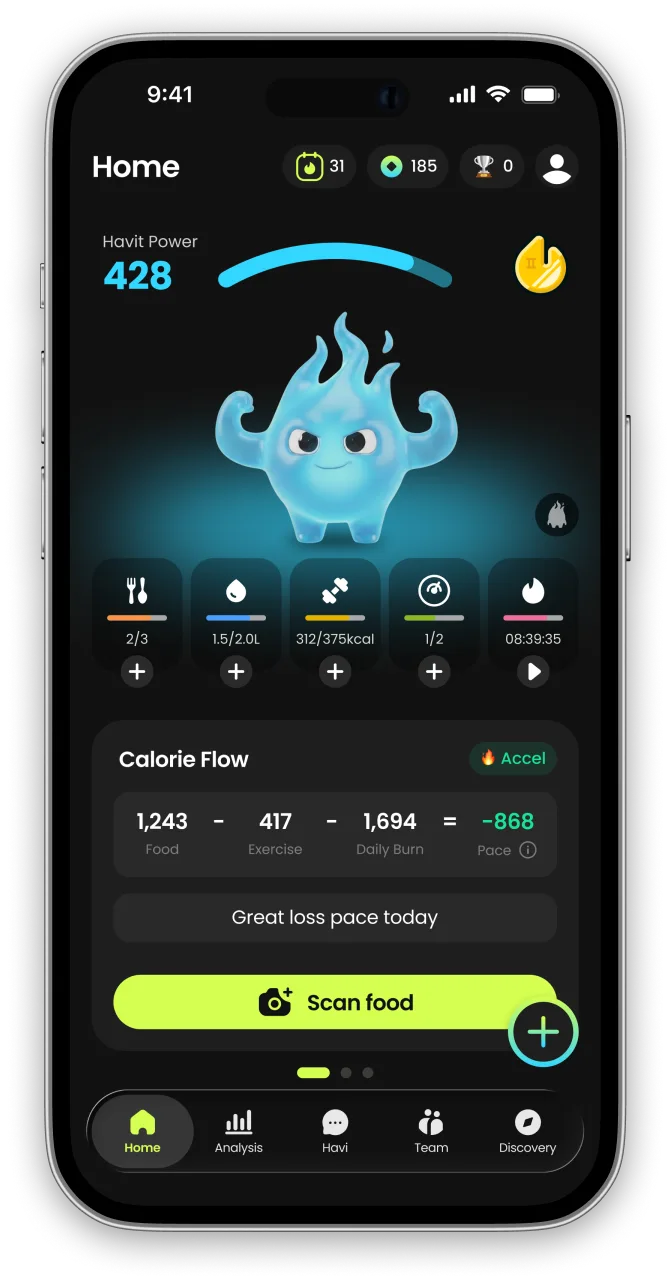
What is Havit?
Havit is an AI health companion for weight loss that protects muscle.
Unlike calorie-only trackers, Havit connects AI body-composition estimates, nutrition, hydration, sleep, steps, cycle, mood, and GLP-1 medication in one daily routine — so progress is measured by body composition, not just the number on the scale. Daily missions turn established behavior-change techniques into small repeatable actions, drawing on expertise from professionals formerly at Juvis Diet, one of Korea’s leading metabolic clinics.
In Havit’s own analysis of 1,090 GLP-1 users, people who logged consistently built stronger habits than the general user base. Read the GLP-1 Habit Report
Havit works with or without GLP-1 medication. It is a wellness app, not a medical device; body-composition results are estimates.

Continue in the App
Personalized wellness with your own data


References
- Home-Based Exercise Programs: Adherence, Effectiveness, and Participant Satisfaction — Journal of Physical Activity and Health, 2024
- Cardiovascular Adaptations to Low-Impact High-Intensity Interval Training — Applied Physiology, Nutrition, and Metabolism, 2025
- Ground Reaction Forces in Common Exercise Movements: Implications for Home Training — Applied Physiology, Nutrition, and Metabolism, 2025
- Energy Expenditure Comparison Across Exercise Modalities in Home Settings — Journal of Physical Activity and Health, 2024


